No. Early intervention is not a requirement for every autistic toddler, but it is worth pursuing for most, because the toddler years are when children learn fastest and families gain the most from early support. The part the short answer leaves out: "necessary" depends on your child's needs, and no single program or hour count fits every child.
- Early intervention is not mandatory for every autistic toddler, but it is worth exploring for most families in 2026.
- The right support depends on your child’s communication, sensory, motor and social needs, not on a fixed program.
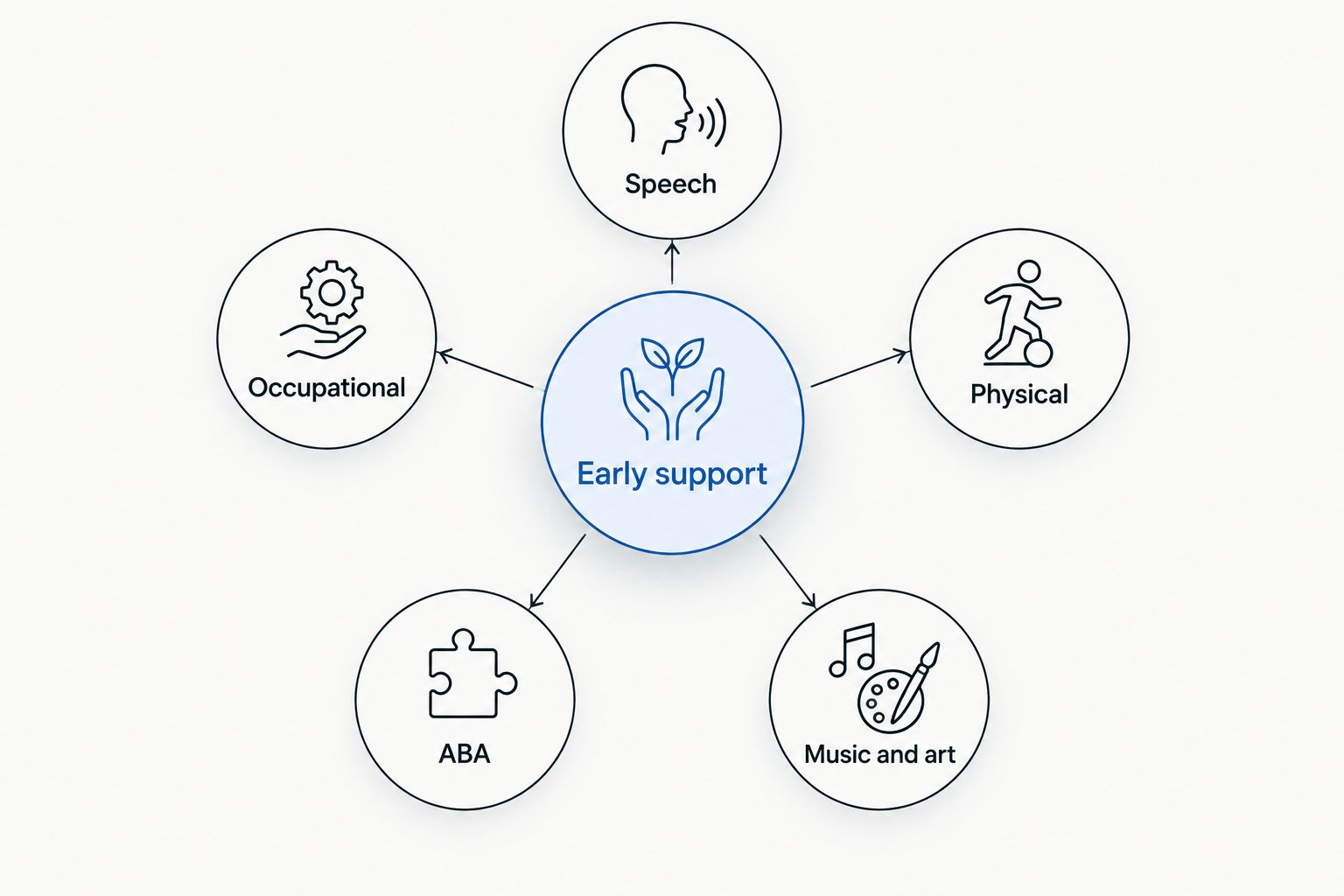
- Early intervention can mean speech, occupational, physical, ABA, music or play-based support, alone or combined.
- Autism Learn & Play offers therapy services and online classes for children ages 2 to 18 in Brooklyn.
Why this matters
Parents of newly identified toddlers hear two messages at once: act now, and don't panic. Both are partly true. Toddlerhood is a period of fast learning, so support started early gives your child more time to build skills at a comfortable pace. That is a reason to look into options, not a reason to feel behind.
Autism is a different way of experiencing the world, not a defect to fix. Good early support builds on your child's strengths and helps them communicate, move and play in ways that work for them. No program can promise a particular outcome, and you should be wary of any that does.
Is early intervention necessary for every autistic toddler?
It is not necessary in the sense of a rule every family must follow. It is recommended for most because the benefit of starting early is high and the downside of exploring is low. Here is how the decision usually breaks down.
| Situation | What it usually means | Best for |
|---|---|---|
| Limited or no spoken words | Speech and communication support is a strong place to start | Toddlers who are still finding ways to express needs |
| Sensory sensitivities that disrupt daily routines | Occupational therapy can help with everyday tasks and regulation | Toddlers who struggle with meals, dressing or noise |
| Delayed motor skills | Physical or occupational therapy can build movement confidence | Toddlers who tire quickly or avoid climbing and play |
| Strong skills across areas, with mild differences | Play-based groups and parent coaching may be enough for now | Families who want to watch and reassess |
The honest pros and cons:
- Pros: more time to build communication, earlier answers for your family, access to services and a community of parents who understand.
- Cons: it can be time-consuming, costs and insurance coverage vary, and a packed schedule can leave a toddler too little time for free play.
A good rule: start with the area that affects your child's daily life the most, and add from there.
What counts as early intervention?
Early intervention is not one thing. It is a set of supports, and your child may need only one or two.
Speech and communication support
This covers spoken language, gestures, picture systems and AAC devices. If your toddler is not speaking yet, read about whether nonverbal autistic children can learn to speak with therapy. Communication matters even when speech does not come first.
Occupational and physical therapy
Occupational therapy focuses on daily skills and sensory needs. Physical therapy focuses on movement and strength. Both can be playful and short.
ABA and behavioral approaches
ABA is one option among several, and families have strong and varied views on it. If you are weighing it, compare how many hours of ABA therapy a child needs each week with what your child can comfortably handle.
Music, art and play-based learning
Music and art give toddlers low-pressure ways to connect, take turns and express themselves. These are often the activities children look forward to most.
Why the right amount of support varies
No two toddlers need the same plan. These factors shape what makes sense:
- Your child's current communication style and how they let you know what they need.
- Sensory sensitivities and how much they affect meals, sleep and outings.
- Motor skills and comfort with movement.
- How your child plays and connects with other children.
- Your family's schedule, energy and budget.
- Insurance and coverage, which differ by service. See whether insurance covers ABA therapy in New York.
Is it too late if my child is older than three?
No. Children learn skills at every age, and support at ages 4, 8 or 14 is still valuable. Earlier is often easier, but later is never pointless. Families with older children can look at age-specific resources, such as the guide to tutoring for autistic high schoolers.
Can I skip formal therapy and use play at home?
Some families do, especially when a toddler's needs are modest. Play at home is valuable on its own: songs, sensory play, simple games and shared routines all build connection. You can also combine home activities with a professional's guidance. Ideas for sensory-friendly play are in the list of best sensory toys for autistic toddlers.
How do I know if my toddler needs more support?
Watch for daily friction. If meals, transitions, communication or sleep are consistently hard, ask a professional for an evaluation. If your child is happy, engaged and gaining skills, you can keep observing and check in again. Trust what you see at home, since you know your child best.
What does a first step look like?
A practical sequence for most families:
- Write down what is hardest and what your child loves.
- Ask your pediatrician or local early intervention program about an evaluation.
- Pick one area to start with rather than everything at once.
- Join a parent community so you are not doing this alone. Brooklyn families can start with the best family support groups for autism in Brooklyn.
- Reassess every few months and adjust.
If you want a sense of what a smooth path looks like, the early intervention to ABA therapy workflow walks through the handoff step by step.
Where Autism Learn & Play fits
Autism Learn & Play is a Brooklyn-based nonprofit offering therapy services, community programs and online classes for children ages 2 to 18 on the autism spectrum. The online classes below are held over Zoom, and the class descriptions say that once you select your preferred days, the team gets in touch to finalize and book a slot. Reach out through the website contact form or at info@autismlearnplay.org to ask what fits your child.


FAQ
Is early intervention necessary for every autistic toddler?
No, it is not required for every toddler, but it is worth exploring for most. The right mix depends on your child’s communication, sensory and motor needs.
What age should early intervention start?
As soon as you have concerns or an identification. Toddlerhood is a period of fast learning, though support at any later age still helps.
Does early intervention mean ABA therapy?
No. It can include speech, occupational, physical, music, art and play-based support. ABA is one option among several.
Can my toddler do early intervention and still have time to play?
Yes, and they should. Free play builds skills too, so keep schedules light enough that your child has plenty of unstructured time.
Will early intervention guarantee my child speaks?
No program can guarantee an outcome. Support can build communication in many forms, including gestures, pictures and AAC devices, not only speech.
What if my toddler is not diagnosed yet?
You can still ask about an evaluation and begin supports for specific needs, such as speech or sensory differences, while you wait.
How do I choose between therapy types?
Start with the area that affects daily life most. Add other supports gradually and reassess every few months.
One last thing
The question "is it necessary?" often hides a better one: what does my child enjoy, and how can support build on it? A toddler who loves music can learn turn-taking through songs. A toddler who loves movement can build communication through games. Start from joy, and the rest tends to follow.
Related guides
- Occupational therapy for autistic toddlers: complete guide
- Physical therapy for autistic toddlers: complete guide