Yes, some nonverbal autistic children learn to speak with therapy, but speech development varies, and no therapy can guarantee spoken language. Speech-language therapy can support communication while pictures, gestures, signing, or a speech-generating device give your child ways to express themselves now. The goal is reliable communication, not speech at the expense of being understood.
- Can nonverbal autistic children learn to speak? Yes, some do; speech-language therapy cannot guarantee speech.
- ASHA supports AAC alongside speech development; children do not need to earn access to communication tools.
- Measure communication progress through choices, refusals, shared interests, and requests—not spoken words alone.
- For Brooklyn outings, plan communication access and breaks before expecting participation.
Why this matters
Your child needs a way to say that something hurts, share an interest, refuse an activity, and connect with other people. Those needs matter today, whether speech develops soon, later, or remains limited.
Autism Learn & Play provides autism therapy services, community programs, and online classes for children ages 2–18 in Brooklyn. This 2026 guide explains what communication support can involve and how to carry it into everyday family activities.
Can nonverbal autistic children learn to speak with therapy?
Yes, some children who do not currently use speech develop spoken words with support. Others continue to communicate primarily without speech. An individual assessment helps identify useful goals; it does not provide a certain prediction of future speech.
The American Speech-Language-Hearing Association's Autism Practice Portal describes individualized communication assessment and intervention. Its Augmentative and Alternative Communication Practice Portal explains that AAC can supplement speech or provide another means of communication, and that there are no prerequisites for considering AAC.
For your 2026 planning, these ASHA resources offer a sound starting point: support communication now rather than postponing it until speech appears. They do not establish a timetable or promise an outcome for your child.
| Support approach | Best for | What it offers | Limitation to discuss |
|---|---|---|---|
| Speech-language therapy | Assessing and supporting speech, language, and everyday communication | Individualized goals based on your child's communication profile | Therapy does not guarantee spoken language |
| AAC alongside speech-language therapy | Giving children communication access beyond speech | Pictures, signs, writing, or speech-generating tools matched to the child | Tools need accessible setup and support from communication partners |
| Communication practice during play and outings | Using communication in daily life | Opportunities to choose, refuse, comment, and connect | Practice does not replace assessment or individualized therapy |
These approaches are not competing routes. A speech-language pathologist, often called an SLP, can help combine them around your child's needs and interests.
What does “nonverbal” tell you about a child?
“Nonverbal” usually describes someone who does not use spoken language, but families and professionals use the term differently. Some prefer “nonspeaking,” particularly because not speaking does not mean having nothing to say.
Describe what your child actually does. Pointing, bringing you an object, typing, using pictures, making sounds, and speaking occasional words all give the therapist more useful information than a label alone.
Avoid assuming either that your child understands everything or that they understand little. Ask the SLP how to assess understanding without making spoken answers the only way to respond.
What should a communication assessment include?
A useful assessment looks beyond whether your child can repeat a word. It considers how your child understands messages, expresses needs, interacts with others, and accesses communication tools.
Bring examples from home and school, including moments when communication works well. Your child's familiar routines can reveal abilities that are harder to show in an unfamiliar appointment.
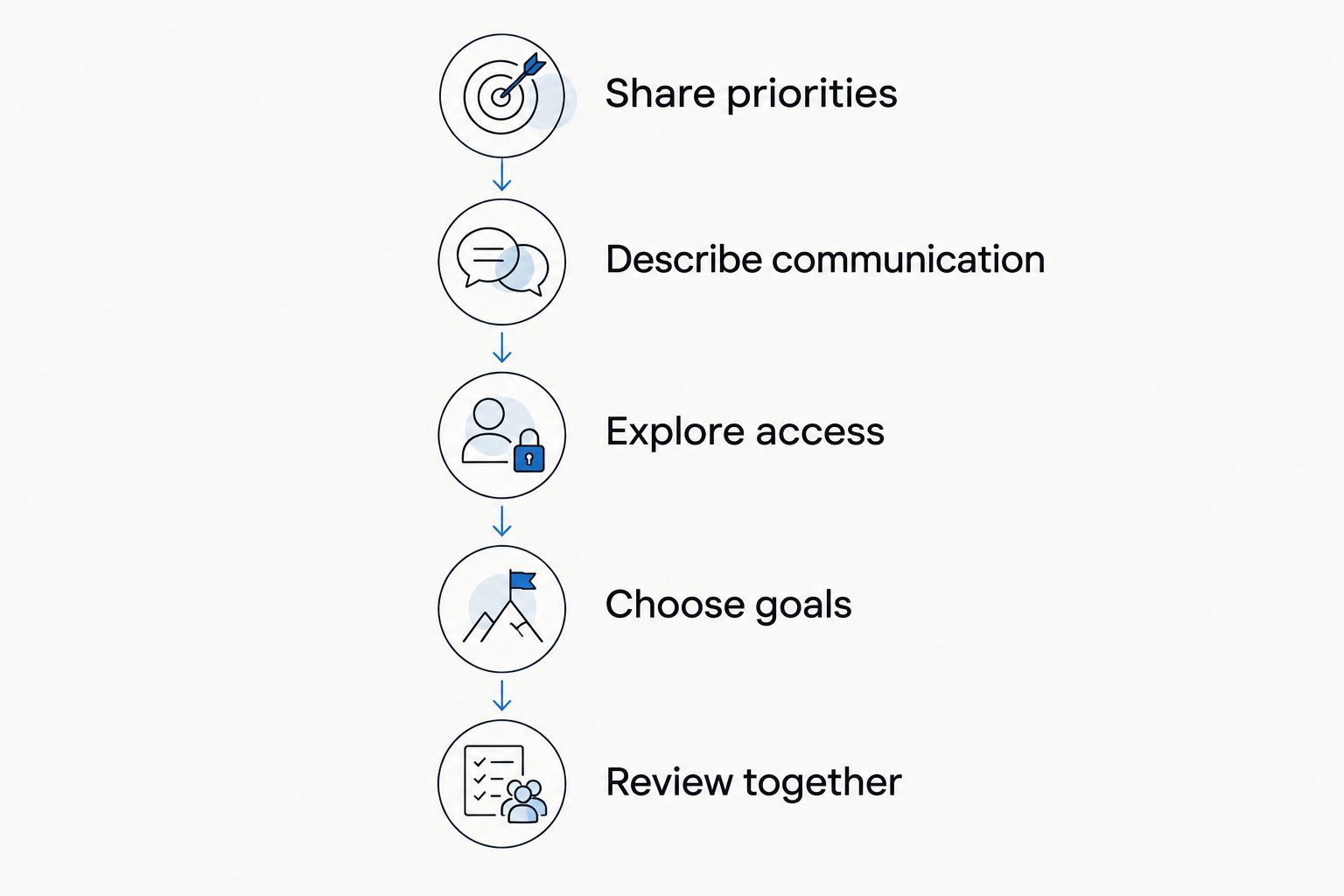
- Share priorities. Explain what your child needs to communicate during meals, play, school, and outings. Include refusal and asking for help, not just requesting objects.
- Describe communication. Tell the SLP about sounds, words, gestures, pictures, signs, or devices your child already uses. Include the languages used at home.
- Explore access. Ask how hearing, vision, movement, sensory preferences, and the physical demands of a tool affect participation. The SLP can recommend other assessments when needed.
- Choose goals. Agree on meaningful communication goals and how the team will recognize progress. Ask what adults should do differently, too.
- Review together. Compare experiences across settings and adjust support. A skill demonstrated in a quiet session still needs support in a busy community space.
The sequence is a planning aid, not a test your child must pass. You can bring questions or request clarification at any point.
Why speech development and therapy plans vary
There is no single speech-development timeline for autistic children. For a practical 2026 plan, discuss these differences rather than choosing a program by a promised result:
- Your child's age and priorities. A young child's play routines and a teenager's community activities call for different materials and goals.
- How your child communicates now. Occasional words, gestures, pictures, and device use each provide a starting point for individualized support.
- The setting. Home, online sessions, school, and community activities place different demands on communication. Ask how support will transfer between them.
- The activity and your child's interests. A preferred game and an unfamiliar group task offer different reasons to communicate. Build practice around meaningful participation.
- The goal being measured. Clearer speech, independent requests, and sharing an opinion are different goals. Make sure the plan identifies which change matters and how it will be observed.
A goal such as communicating discomfort gives the team something concrete to support. “Become verbal” is too broad to explain what happens in the next session.
Will AAC stop my child from learning to speak?
AAC does not need to wait for speech therapy to fail. ASHA's AAC guidance explains that using AAC does not prevent speech development; children can receive support for speech and other communication methods together.
AAC means augmentative and alternative communication. It includes options such as gestures, picture boards, and speech-generating devices—not only tablets.
The right approach depends on access and communication needs. A picture board needs to be within reach; a device needs to be usable; adults need to notice and respond to messages rather than treating the tool as a quiz.
Ask your SLP to demonstrate communication during ordinary activities. The guide to connecting speech therapy to AAC device use at home offers a related planning topic to discuss with your child's team.
Does my child need to speak before joining a group?
No, spoken language should not be treated as the only route to participation. Ask a group organizer how children can choose, take turns, request breaks, and join activities without speaking.
A group description alone cannot tell you whether the setting fits. Confirm communication support, sensory conditions, caregiver involvement, and the option to observe before committing to participation.
Is it too late for a teenager to get communication support?
No, teenagers still deserve assessment and communication support, whether or not spoken language develops. Goals can include privacy, friendships, self-advocacy, school participation, and communicating with unfamiliar people.
Use age-respectful materials. A teenager interested in music or games should not have to use preschool activities simply because speech is limited.
How can you support communication without pressuring speech?
Start with something your child already enjoys. Join the activity, notice what your child communicates, and respond without requiring a spoken answer first.
During drawing, you might name a color while pointing to its picture or symbol. During a game, you can model “my turn,” “help,” or “finished” using the communication system your SLP recommends.
Try these practical habits:
- Offer real choices. Present options you can honor, and accept an accessible response rather than insisting on a word.
- Leave room to respond. Pause after a comment or invitation. Avoid filling every quiet moment with another question.
- Model without demanding imitation. Show how a word, gesture, or symbol works without making your child copy it before the activity continues.
- Respond to refusal. Treat “no,” turning away, or using a stop symbol as meaningful communication. Help your child communicate boundaries clearly.
- Keep communication accessible. Bring the child's usual tools to play, meals, and outings rather than saving them for therapy.
Do not withhold basic needs, comfort, or communication tools to obtain speech. If practice repeatedly creates distress, stop and discuss a different approach with the therapist.
What can Brooklyn families plan for different ages?
For children ages 2–5, consider familiar play, simple choices, and caregiver-supported participation. Before an outing, ask where your child can take a break and whether watching from the edge is welcome.
For children ages 6–12, shared interests can guide activity selection. Ask how children communicate during games or projects and whether the group supports picture-based or device-based participation.
For teenagers ages 13–18, include the young person's preferences in the decision. Ask about age-appropriate activities, opportunities to connect with peers, and support for communicating boundaries.
These are planning categories, not developmental rules. In 2026, choose activities by your child's interests, access needs, and comfort—not age alone or pressure to participate like everyone else.
For any age, preview what you can: the journey, arrival, main activity, break options, and departure. An outing can include observing, joining briefly, or leaving when your child needs to stop.
Where can Autism Learn & Play fit into your plan?
Autism Learn & Play is a fit for Brooklyn families seeking autism therapy services, community programs, and online classes for children ages 2–18. Its stated services include speech therapy, occupational therapy, ABA, music and art therapy, and tutoring.
A community activity or online class is not automatically speech-language therapy. Ask how a proposed activity matches your child's communication needs, who provides support, and what participation involves; do not assume a class includes individualized clinical treatment.
To discuss Autism Learn & Play autism therapy services or community options, use the website contact form or email info@autismlearnplay.org. Describe your child's interests, current communication methods, and support needs, then ask about the specific program you are considering.
FAQ
Can nonverbal autistic children learn to speak with therapy?
Yes, some nonverbal autistic children develop spoken language with therapy, but no therapy guarantees speech. Support should also give children reliable ways to communicate without speaking.
Does using an AAC device delay speech?
AAC does not prevent speech development, according to ASHA’s AAC guidance. An SLP can support speech and AAC together while matching the communication system to your child’s needs.
How long does speech therapy take to work for a nonverbal child?
There is no single timeline for spoken language to develop. Ask the SLP to identify meaningful communication goals and explain how progress will be reviewed, including progress without new spoken words.
Can my child understand language without speaking?
A child can understand language without being able to speak, but understanding varies by child. An assessment should examine understanding without relying only on spoken responses.
Should I make my child say a word before giving them something?
Do not withhold basic needs or comfort to obtain a spoken word. Model useful communication and respond to accessible messages, including gestures, pictures, or AAC.
Can a nonspeaking teenager benefit from speech-language therapy?
A nonspeaking teenager can receive support for meaningful communication goals even when speech remains limited. Priorities can include self-advocacy, friendships, privacy, and participation in school or community activities.
Can my child attend a community activity without speaking?
A child does not need spoken language to have meaningful participation in an activity. Ask the organizer about AAC access, breaks, caregiver support, and ways to join without spoken responses.
One last thing
Before adding another speech goal to your child's 2026 plan, ask: Can my child tell someone to stop? A usable way to refuse, request space, or ask for help deserves the same attention as naming a favorite toy.
Bring that question to the next therapy conversation and the next outing. Communication support should help your child have a voice in what happens—not simply produce more words.
Related guides
- Speech therapy for autistic teenagers
- Family support groups for autism in Brooklyn
- Autism-friendly museums and attractions in NYC