Yes—insurance covers ABA therapy in New York, but the rules depend on whether your child has a New York–regulated insurance policy, a self-funded employer plan, or Medicaid. In 2026, a covered benefit still requires checking medical necessity, provider participation, authorization rules, and your family's share of the bill before treatment starts.
- Does insurance cover ABA therapy in New York? Yes, but your child’s plan determines the coverage rules.
- New York–regulated insurance, self-funded employer plans, and Medicaid follow different requirements for ABA therapy.
- Confirm authorization and provider participation before scheduling; a covered benefit is not a payment guarantee.
- Autism Learn & Play provides autism therapy and community programs for children ages 2–18; confirm insurance arrangements directly.
Does insurance cover ABA therapy in New York?
Yes. The first step is identifying who regulates your child's plan—not simply which insurance company's name appears on the card. New York's autism insurance requirements apply to covered policies regulated by the state. Self-funded employer plans generally fall outside state insurance benefit mandates, while Medicaid follows separate coverage rules.
Use this comparison to identify the right starting point for your 2026 coverage check. The relevant public references are the New York State Department of Financial Services' autism coverage guidance, the U.S. Department of Labor's guidance on employer health plans, and New York State Department of Health Medicaid ABA guidance.
| Coverage route | Best starting point | What supports access | What still needs checking |
|---|---|---|---|
| New York–regulated insurance | Ask member services whether New York insurance law governs the policy | State autism coverage requirements include ABA | Medical necessity, network participation, authorization, and cost-sharing |
| Self-funded employer plan | Ask the employer's benefits administrator for the plan document | The plan document explains the ABA benefit and review process | State autism insurance mandates generally do not govern these plans |
| Medicaid | Identify fee-for-service or the child's managed care plan | Federal EPSDT protections apply to eligible members under age 21 | Current New York ABA criteria, provider enrollment, and authorization procedures |
The insurer's logo alone does not answer the question. An insurance company can administer a self-funded employer plan without insuring the benefits itself.
Why this matters
Your child deserves support that fits their communication, comfort, interests, and everyday needs. Insurance approval is an administrative decision, not a judgment about your child or a guarantee that a particular approach is the right fit.
For Brooklyn families considering local services, Autism Learn & Play provides autism therapy, community programs, and online classes. Keep the service decision and the insurance decision separate: first understand your child's needs, then verify how the proposed care would be covered.
A provider offering ABA does not establish that the provider participates in your specific plan. Likewise, an insurer listing ABA as a benefit does not establish that every proposed session will be approved.
New York–regulated insurance: check the autism benefit
New York's insurance law includes coverage requirements for autism screening, diagnosis, and treatment, including ABA, in policies subject to those requirements. The Department of Financial Services' autism insurance guidance explains the state-regulated coverage framework.
Ask member services to identify the autism or behavioral health benefit in your 2026 policy documents. Request the relevant section in writing rather than relying only on a general statement that therapy is covered.
Then ask whether the insurer requires a clinical assessment, a treatment plan, or prior authorization. Have the provider confirm which documents they submit and which records you need to supply.
State-mandated coverage is the starting point, not approval for a specific treatment schedule. The plan can review whether proposed care meets its medical-necessity requirements. Ask for the criteria used to make that decision.
If your policy was issued outside New York, ask which state's insurance law governs it. Living in Brooklyn does not, by itself, establish that New York's insurance mandate applies.
Self-funded employer plans: read the plan document
A self-funded employer plan pays benefits from employer or plan funds rather than buying a traditional insurance policy for those benefits. Federal law generally exempts these plans from state insurance benefit mandates.
That does not mean ABA is excluded. It means you need the plan's own benefit terms to establish coverage.
Ask your benefits administrator for the Summary Plan Description and any separate ABA or behavioral health coverage policy. Confirm who administers the benefit; it can be a different organization from the one handling other medical care.
For a 2026 employer-plan review, ask these questions:
- Does the plan cover ABA for an autism diagnosis?
- Which medical-necessity criteria apply?
- Who handles assessments and treatment authorizations?
- Which providers participate in this exact plan?
- Where are the claim and appeal instructions?
The U.S. Department of Labor's Employee Benefits Security Administration provides guidance on employer health plans and claims rights. For a coverage dispute, use the appeal instructions in your plan documents rather than assuming the state insurance process applies.
Medicaid: confirm the child's eligibility and delivery system
Medicaid has a different legal framework from commercial insurance. Federal Early and Periodic Screening, Diagnostic, and Treatment protections—usually called EPSDT—apply to eligible Medicaid members under age 21 and cover medically necessary services within federal Medicaid benefit categories.
New York Medicaid has ABA coverage guidance, including provider and clinical requirements. That is not automatic approval for every requested service, setting, or schedule.
Ask whether your child receives benefits through Medicaid fee-for-service or a Medicaid managed care plan. Then contact the correct administrator about the current ABA process and participating providers.
For children approaching their 21st birthday, ask about transition planning before that birthday. The under-21 EPSDT framework should not be assumed to continue unchanged into adult coverage.
New York State Department of Health's Medicaid ABA policy guidance and provider manual are the relevant state references. Use the current requirements for your child's coverage arrangement, not another family's approval experience.
How do I verify ABA coverage before the first appointment?
Get benefit verification and treatment authorization treated as separate tasks. A benefits check identifies what the plan covers; authorization addresses a proposed assessment or treatment request.
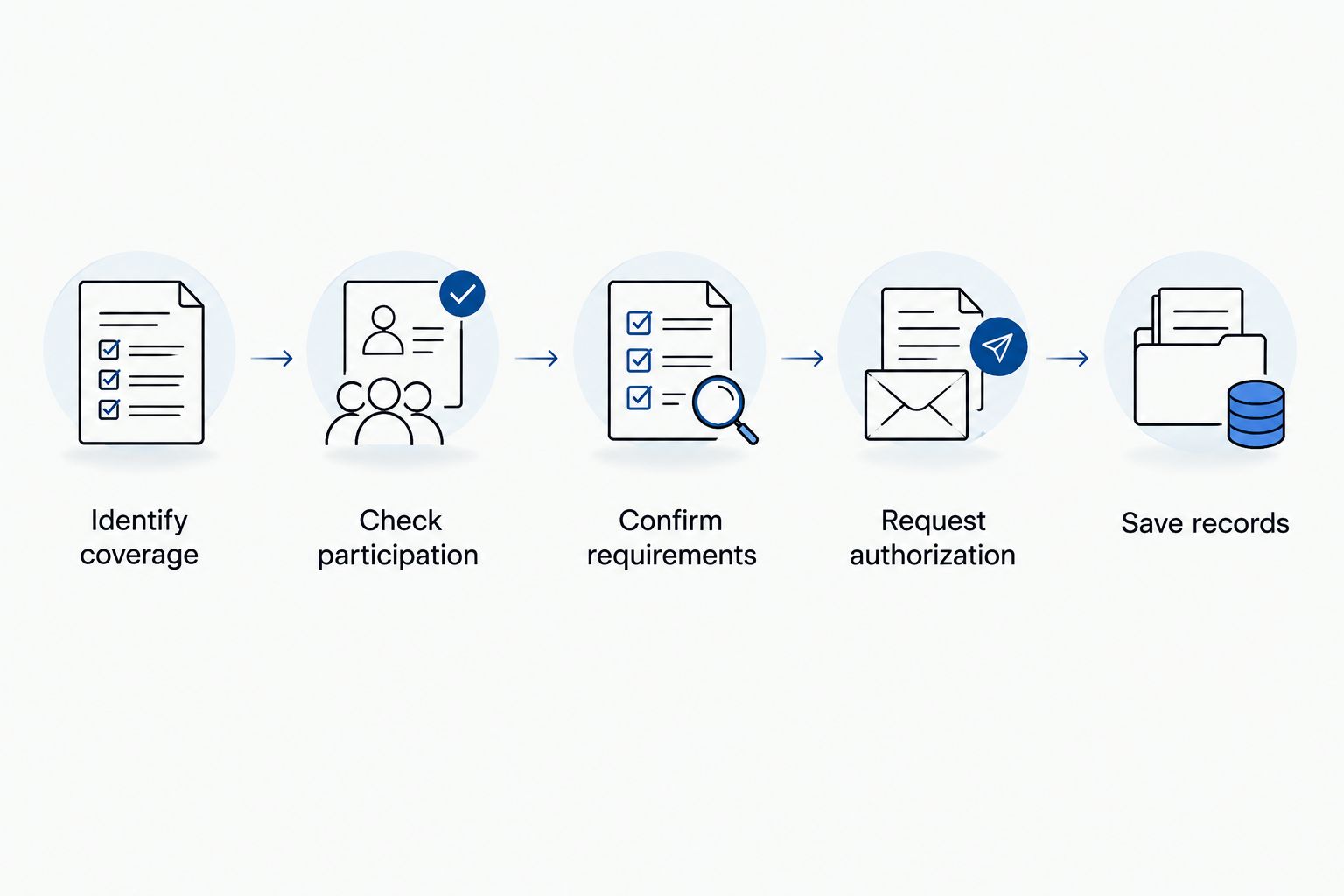
- Identify coverage. Write down the plan's full name, member details, and whether it is state-regulated, self-funded, or Medicaid. Ask the benefits administrator if you are unsure.
- Check participation. Give the insurer the provider's billing details. Confirm the individual clinician, organization, and proposed location rather than relying on an insurer logo on a website.
- Confirm requirements. Ask what diagnosis documentation, referral, assessment, or treatment plan is required. Check whether assessment and ongoing treatment have separate approval steps.
- Request authorization. Establish who submits the request and how you will receive the decision. Ask what services, dates, and settings an approval covers.
- Save records. Keep the written benefit explanation, authorization notice, call reference details, and provider correspondence together. Recheck when coverage or treatment changes.
Ask the provider to explain what happens if authorization is pending or a claim is denied. Do not assume the insurer will approve sessions retroactively.
Why ABA coverage varies
The same therapy can produce different coverage decisions because the benefit terms and proposed care differ. These are the main factors to clarify:
- Plan regulation: State-regulated insurance, self-funded employer coverage, and Medicaid follow different legal frameworks.
- Medical necessity: The insurer reviews clinical documentation against its criteria. Ask which criteria apply to your child's request.
- Provider participation: Participation must match the specific plan and billing arrangement, not just the insurance company's name.
- Authorization scope: An approval can specify services, dates, settings, or other conditions. Match the proposed care to the actual notice.
- Benefit structure: Deductibles, copayments, coinsurance, and out-of-network terms affect what your family owes, even when ABA is covered.
Ask for written answers about your child's plan, not assurances about what insurance usually covers. Keep that record available when comparing an explanation of benefits with a provider's bill.
Does an autism diagnosis automatically approve ABA?
An autism diagnosis does not automatically approve ABA. A plan can require additional documentation showing why the proposed services are medically necessary and how the treatment plan addresses the child's needs.
Ask the clinician to explain the proposed goals in everyday language. You should understand what your child would work on, how their preferences are included, and how the team would respond to distress or requests for a break.
Does an IEP replace insurance authorization?
An IEP does not replace insurance authorization. School services and health insurance use different eligibility and decision-making processes, even when they address related needs.
With appropriate permission, families can share useful information across teams. This guide to connecting your child's IEP to ABA therapy goals explains the coordination question; the insurer still makes its own coverage decision.
What should I do if insurance denies ABA?
Ask for the written denial and its specific reason before deciding your next step. A denial for missing records calls for a different response from a denial based on medical necessity or a benefit exclusion.
Compare the notice with the policy language and authorization request. Ask the provider whether the clinical submission addresses the insurer's stated concern.
Follow the appeal instructions and deadlines in the notice. Ask whether an expedited review is available when a delay could seriously affect your child's health, and whether external review applies to the dispute.
For New York–regulated coverage, the Department of Financial Services explains complaint and external appeal routes. Self-funded employer plans and Medicaid have different procedures; use the process identified for your child's coverage.
Choose support that fits your child
Insurance coverage is only part of the decision. Ask what a visit involves, how caregivers participate, and how the provider supports communication, sensory needs, and the child's ability to express preferences.
For a child aged 2 years, ask how play, familiar routines, and caregiver involvement shape sessions. For a young person aged 18 years, include their own priorities and choices directly in the conversation. Age alone does not determine communication needs or interests.
Autism Learn & Play is a local option for Brooklyn families seeking autism therapy and community programs for children ages 2–18. Confirm the service fit and insurance arrangements directly; do not treat that description as confirmation of network participation or payment.
When contacting the organization, you can use info@autismlearnplay.org to ask about services and the appropriate next steps. Avoid sending your child's medical records or insurance identification details until you have confirmed how to share them securely.
FAQ
Does insurance cover ABA therapy in New York in 2026?
Yes, insurance covers ABA therapy in New York, but the applicable requirements depend on the plan. Confirm whether coverage is New York–regulated insurance, a self-funded employer plan, or Medicaid, then check authorization and provider participation.
How do I know whether my employer’s plan is self-funded?
Ask your employer’s benefits administrator whether the plan is self-funded or fully insured. The insurance company name on your card does not establish the funding arrangement.
Does Medicaid cover ABA therapy for children in New York?
New York Medicaid covers ABA subject to its clinical and provider requirements. Confirm the process with your child’s managed care plan or fee-for-service administrator before treatment begins.
Can I use an out-of-network ABA provider?
Out-of-network ABA coverage depends on your plan’s terms. Ask about out-of-network benefits and whether any exception process applies before scheduling care.
Does an ABA assessment mean treatment is already approved?
An ABA assessment does not establish that ongoing treatment is approved. Ask whether assessment and treatment require separate authorizations and obtain the relevant decisions in writing.
Does Autism Learn & Play accept my insurance for ABA?
Confirm insurance arrangements directly with Autism Learn & Play and your insurer. Providing ABA services does not establish participation in your specific plan or approval for your child’s treatment.
Will insurance cover the same ABA schedule every year?
An existing approval does not establish coverage for every future treatment period. For your 2026 care plan, check authorization dates, renewal requirements, and any changes to benefits or provider participation.
One last thing
An insurance card, a provider directory listing, and an authorization notice answer different questions. Keep all three parts of the coverage check together: which plan you have, whether the provider participates, and what treatment has been approved.
Then return to the question that matters at home: does the proposed support respect your child and address needs your family actually wants help with? Insurance approval should support that conversation, not replace it.
Related guides
- ABA therapy for nonverbal toddlers
- Connecting a CSE evaluation to autism therapy services
- Family support groups for autism in Brooklyn