Best overall starting point: large stacking cups. Best for quiet exploration: a soft fabric book. Best for tactile play: a large textured ball. This 2026 guide to sensory toys for autistic toddlers helps you choose by your child's interests, comfort, and age—not by promises on a package.
- Large stacking cups are a practical starting point for sensory toys for autistic toddlers who enjoy filling, nesting, and knocking down.
- Soft fabric books suit quiet sensory play; large textured balls suit children who enjoy touch and rolling games.
- Choose toddler-rated toys without accessible small parts, and supervise play according to the manufacturer’s instructions.
- Autism Learn & Play encourages families to choose activities around each child’s needs, with opportunities for connection.
Why this matters
A toy that delights one autistic toddler can feel uncomfortable to another. Sound, texture, movement, and predictability all affect the experience. The best sensory toy is one your child chooses to explore safely—not one that demands a particular response.
For Brooklyn families, a familiar toy can also give a shared activity a starting point: rolling a ball together, looking through a fabric book, or building beside another child. Friendship does not require taking turns on command. Watching, playing alongside someone, and joining briefly are valid ways to participate.
Autism Learn & Play provides therapy services, community programs, and online classes for children ages 2–18. Autism Learn & Play is a community-program option for Brooklyn families seeking activities tailored to autistic children's needs. The recommendations below are general toy categories, not claims about equipment used in its programs.
What makes the best sensory toys for autistic toddlers?
Use these criteria for your 2026 shortlist before choosing a toy:
- Age-appropriate safety: Check the manufacturer's age rating, warnings, construction, and instructions. An older child's sensory toy is not automatically suitable for a toddler.
- Sensory fit: Match the toy to textures, sounds, and movements your child already enjoys. A sensory label does not make every sensation welcome.
- Child control: Favor toys your child can start, stop, put down, or explore without an adult directing every move.
- Flexible play: Look for different ways to participate, such as watching, touching, filling, rolling, or playing alongside someone.
- Practical care: Check cleaning instructions and inspect toys for damage. Shared toys need a workable cleaning routine.
For children under 3 years, accessible small parts are a central safety concern. The U.S. Consumer Product Safety Commission's small-parts requirements cover toys intended for this age group; check current CPSC guidance when choosing toys in 2026. Supervision does not make an unsuitable small-parts toy appropriate.
Sensory toys at a glance
These rankings separate use cases rather than declaring one toy right for every autistic toddler. Choose the row that matches what your child enjoys now.
| Toy category | Best for | Standout feature | Key limitation |
|---|---|---|---|
| Large stacking cups | Flexible everyday exploration | Nesting, filling, stacking, and knocking down | Hard pieces can make unwanted noise |
| Soft fabric book | Quiet, shared exploration | Pages and fabric surfaces to investigate | Some versions include crinkles or attachments |
| Large textured ball | Tactile rolling games | Touch and movement in a simple activity | Texture or bouncing can be unwelcome |
| Chunky inset puzzle | Predictable matching | A visible place for each piece | Loose pieces need age and safety checks |
| Factory-sealed sensory bottle | Watching without touching messy materials | Enclosed moving contents | Damaged seals or caps create hazards |
| Washable finger paint | Child-led messy exploration | Color and texture with direct control | Skin contact and cleanup do not suit everyone |
| Simple toddler drum | Self-directed sound play | A direct connection between action and sound | Noise can overwhelm the child or others |
1. Large stacking cups: best for flexible everyday exploration
Large stacking cups offer several ways to play without requiring a finished result. Your toddler can nest them, place them upside down, fill them with suitable objects, or knock down a tower. You can build beside your child rather than making imitation the goal.
Stacking cups pros:
- Different actions work with the same set.
- Play does not depend on speech or answering questions.
- A parent or sibling can join without changing the activity.
Stacking cups cons:
- Hard plastic can sound loud when dropped.
- Smaller cups or damaged pieces require careful safety checks.
Best for: Toddlers who enjoy containers, repetition, and making things happen.
For your 2026 starting choice, select a toddler-rated set with pieces your child can handle comfortably. Try placing a cup beside your child's cup and let them decide whether to interact. Buy: Choose large stacking cups when your child enjoys filling, nesting, or knocking down.
2. Soft fabric book: best for quiet, shared exploration
A fabric book gives your toddler something to hold, turn, and explore alongside you. Reading every word is optional. You can name a picture, notice what your child touches, or simply share the space while they investigate a page.
Fabric book pros:
- Offers a quiet alternative to electronic toys.
- Allows looking, touching, and page-turning as separate activities.
- Gives adults a natural opening to follow the child's attention.
Fabric book cons:
- Crinkle panels can still be unpleasantly loud.
- Ribbons, fasteners, and attached pieces need inspection.
Best for: Toddlers who enjoy soft surfaces and low-pressure time together.
Choose the actual texture, not the category name. A smooth cloth page and a scratchy patch feel different, and your child does not need to tolerate both. Check the cleaning instructions before taking a fabric book to a shared outing. Buy: Choose a fabric book when your child prefers soft, quiet exploration.
3. Large textured ball: best for tactile rolling games
A large textured ball combines touch with an easy invitation to play together. Roll it across the floor and leave space for your child to watch, touch, return it, or move away. Catching is not required.
Textured ball pros:
- Makes shared play possible without spoken instructions.
- Offers a surface your child can explore at their own pace.
- Works for rolling beside someone as well as toward them.
Textured ball cons:
- Raised textures can feel uncomfortable.
- Bouncing and chasing require suitable space.
Best for: Toddlers who seek texture and enjoy watching or making objects move.
Check that the ball is toddler-rated and inspect it for splitting or loose material. Start with rolling rather than introducing every possible movement. Buy: Choose a large textured ball when your child welcomes its surface and enjoys rolling play.
4. Chunky inset puzzle: best for predictable matching
A chunky inset puzzle has a shaped space for each piece. That visible relationship can appeal to a toddler who enjoys matching or putting objects in particular places. Lifting pieces out is also play; completing the puzzle is not the only useful experience.
Chunky puzzle pros:
- Gives each piece a clear destination.
- Supports independent exploration and side-by-side play.
- Lets you offer help without adding sound or flashing lights.
Chunky puzzle cons:
- Loose pieces, knobs, or damaged parts need inspection.
- Repeated correction can turn play into a demand.
Best for: Toddlers who enjoy predictable arrangements and matching shapes.
Select a puzzle rated for your child's age, with pieces and attachments that meet the manufacturer's safety instructions. If your child prefers lining pieces up, you can respect that choice rather than resetting the board repeatedly. Buy: Choose a chunky inset puzzle when matching itself interests your child.
5. Factory-sealed sensory bottle: best for visual observation
A sensory bottle contains materials that move inside a sealed container. Some children enjoy watching that movement without touching the contents. Others have no interest, and that is a useful answer too.
Sensory bottle pros:
- Offers visual exploration without direct contact with the filling.
- Can be watched without completing a task.
- Gives a shared point of attention when a child is interested.
Sensory bottle cons:
- Caps, leaks, cracks, and loose contents create safety concerns.
- Visual movement is not calming for every child.
Best for: Toddlers who enjoy watching enclosed materials move.
Use a commercially made, toddler-rated product according to its instructions. A homemade bottle is not automatically safe because its lid has glue on it. Avoid loose water beads in toddler play; swallowing them can cause serious injury. Hold: Choose a sensory bottle only after checking its age rating, construction, and condition.
6. Washable finger paint: best for child-led messy exploration
Finger paint offers direct exploration of color and texture. Your child can use their hands if they choose, or you can offer an age-appropriate painting tool. Keep the activity optional rather than treating touching paint as a milestone they must reach.
Finger paint pros:
- Allows marks, smears, and mixing without a correct result.
- Gives children control over where they touch and move.
- Works for parallel activity on separate sheets of paper.
Finger paint cons:
- Wet texture or smell can be unwelcome.
- Washable does not mean edible or suitable for every child.
Best for: Toddlers who actively enjoy messy materials.
Choose paint labeled for your child's age and follow its safety instructions. If your toddler frequently mouths play materials, discuss suitable alternatives with their care professional rather than relying on a non-toxic label. Buy: Choose finger paint for a child who welcomes the texture; skip it when contact causes distress.
7. Simple toddler drum: best for self-directed sound play
A simple drum lets a child make a sound through their own action. Unlike a toy that starts a long song after a button press, the activity can stop when the child stops tapping. The sound still needs to suit your child and everyone sharing the space.
Toddler drum pros:
- Connects an action with an immediate sound.
- Allows quiet tapping, pauses, and short exchanges.
- Gives interested children a way to share a rhythm without words.
Toddler drum cons:
- Percussion can be uncomfortable for sound-sensitive children.
- Separate beaters and detachable parts need safety checks.
Best for: Toddlers who actively seek sound they can control.
Start gently, and stop if your child covers their ears, withdraws, or shows discomfort. Do not use louder tapping to encourage participation. Buy: Choose a toddler-rated drum for a child who enjoys making sound; skip it when sound is unwelcome.
How these sensory toys were ranked
The order prioritizes flexible play, child control, and clear use cases. Large stacking cups take the default position because they offer several simple activities; the other categories serve more specific preferences.
This is a category-based buying guide, not a product-testing report. Your child's response outranks the list order. In 2026, the same rule applies to a new toy as to a familiar one: interest is an invitation, not an obligation.
Make the first play session easy
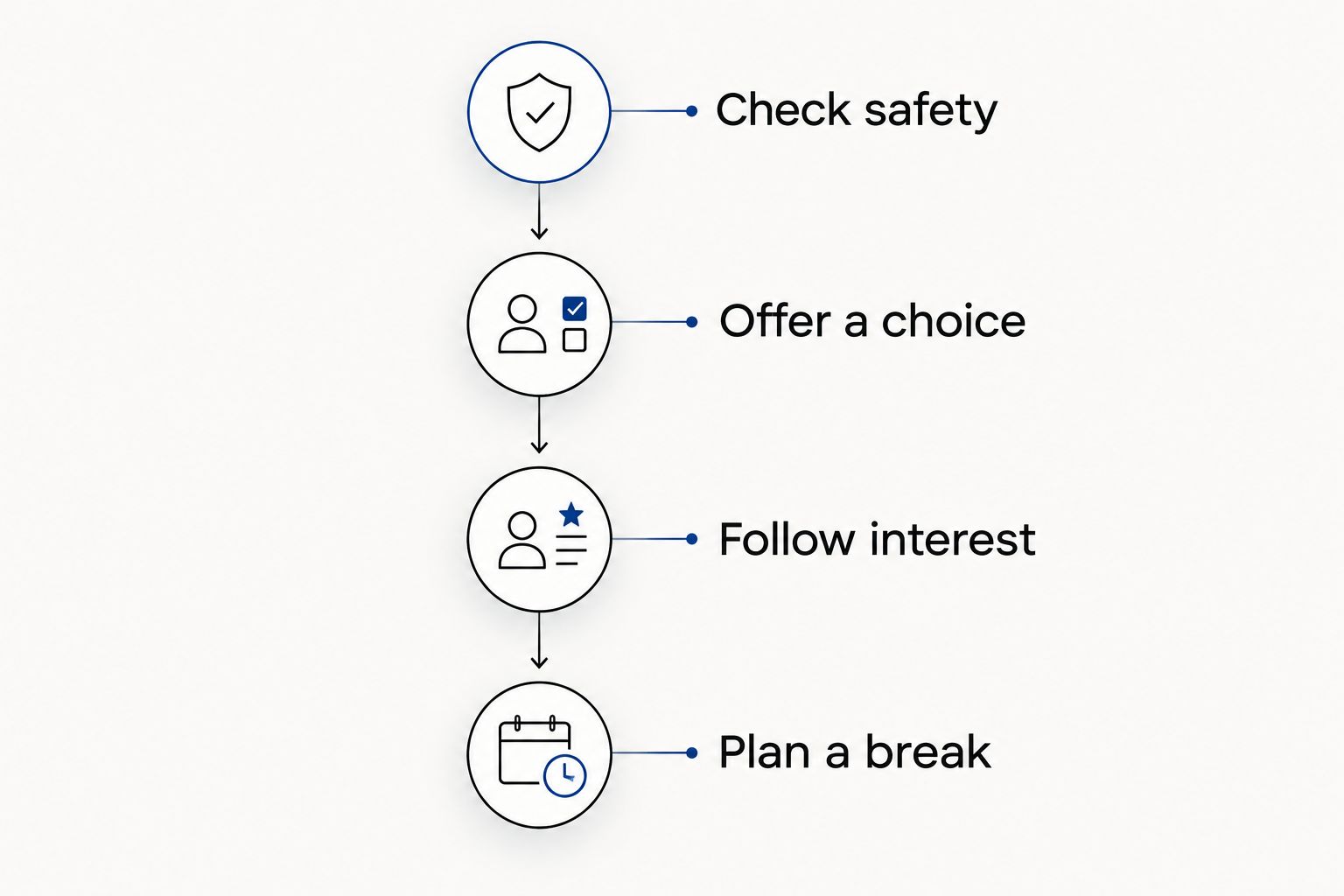
Use this sequence at home before taking a new toy to a Brooklyn outing or shared activity:
- Check safety: Read the age rating and instructions, and inspect the toy.
- Offer a choice: Present 2 toy choices rather than a crowded collection.
- Follow interest: Let your child look, touch, watch, or decline.
- Plan a break: Keep an easy way to stop or move away.
Introduce 1 new toy at a time so you can notice the child's response without adding several unfamiliar sensations. Do not set a required playing time.
For a community visit, ask the organizer about the setting, what children are expected to do, and whether your child can bring a familiar item. Those answers help you prepare without assuming that a program follows a particular format.
Autism Learn & Play serves children ages 2–18, but toddler toys are not a template for every age. Older children need activities that respect their interests and age, even when sensory preferences overlap.
Which sensory toy should you choose?
Start with large stacking cups if you are undecided, then choose by your child's response. A soft fabric book is the quieter alternative; a large textured ball suits a child who welcomes tactile rolling play. A puzzle, sensory bottle, paint activity, or drum belongs on your shortlist only when its particular experience is appealing and safe.
For your 2026 choice, buy less and observe more. A familiar toy your child enjoys has a clearer purpose than a collection selected because every package says sensory.
FAQ
What are the best sensory toys for autistic toddlers?
Large stacking cups are a practical starting point because they allow nesting, filling, stacking, and knocking down. Soft fabric books suit quiet exploration, while large textured balls suit children who enjoy tactile rolling play.
Does every autistic toddler need sensory toys?
No, every autistic toddler does not need a special collection of sensory toys. Choose safe play materials around your child’s interests rather than treating a sensory label as a requirement.
Are sensory toys safe for a 2-year-old?
Safety depends on the individual toy’s age rating, construction, condition, and instructions. For a 2-year-old, avoid accessible small parts and check attachments, battery compartments, and damage before play.
Are water beads suitable for toddler sensory play?
Water beads are not a suitable choice for toddler sensory play because swallowing them can cause serious injury. Choose a different material, and do not assume that supervision removes the risk.
What sensory toy works for a toddler who dislikes noise?
A soft fabric book without sound features is a useful quiet option. Check for crinkle panels, since a fabric toy can still make an unwelcome sound.
Can sensory toys help my child play with other children?
Sensory toys can provide a shared activity, but they do not guarantee friendship or participation. Rolling a ball or building beside another child offers an invitation without requiring speech or taking turns on command.
Should I make my child try a texture they avoid?
Do not force your child to touch a toy texture they find uncomfortable. Offer another activity and discuss persistent sensory concerns with a qualified professional who understands your child’s needs.
How can Brooklyn families ask about community activities?
Contact Autism Learn & Play through its website contact form or info@autismlearnplay.org to ask about community programs. Describe your child’s age, interests, communication preferences, and sensory needs without assuming a particular activity or schedule.
One last thing
Keep a note of how your child uses the toy—not just whether they use it as pictured. A toddler who repeatedly turns a cup over or watches a ball roll is showing you an interest you can join. You do not need to turn that interest into a lesson for the play to matter.
Related guides
- Art activities for autistic children
- Occupational therapy activities at home
- Communication activities for nonverbal autistic children
- Music activities and therapy techniques