
Best overall: cooperative storytelling. Best for meeting new peers: interest bingo. Best simple-materials option: a choose-next scenario game. These social skills games for autistic teens give your family practical starting points for 2026, with choices for shared interests, different communication styles, and community outings—not pressure to perform or fit in.
- Cooperative storytelling is the best starting point for social skills games for autistic teens who enjoy shared creative play.
- Interest bingo offers a clear opening for meeting peers; collaborative puzzles offer a less conversation-heavy alternative.
- Autism Learn & Play serves Brooklyn families seeking therapy services, community programs, and online classes for autistic children.
- Choose games around your teen’s interests, communication preferences, and sensory needs; allow passing, breaks, and stopping.
Why this matters
A social game should give your teen a reason to connect, not another situation where someone grades their behavior. The useful question is whether your teen wants to participate and has a comfortable way to do so. Talking, typing, pointing, and using a communication device all belong at the table.
Autism Learn & Play is a Brooklyn nonprofit for families seeking community programs and therapy services for autistic children ages 2–18. You can explore Autism Learn & Play while considering what support fits your family. The games below are adaptable activity ideas, not descriptions of the nonprofit’s programs or promises of therapeutic outcomes.
What makes the best social skills games for autistic teens?
For your 2026 shortlist, prioritize these criteria before choosing a game:
- Teen ownership: Your teen helps choose the theme and can decline. Use interests they actually enjoy, rather than younger-child materials repackaged for adolescents.
- Flexible communication: The activity accepts speech, writing, gestures, pictures, or a communication device without treating one method as the goal.
- Clear expectations: Explain what happens on a turn, how someone passes, and how the game ends before starting.
- Sensory choice: Ask about sound, lighting, seating, materials, and movement. A game described as quiet still needs your teen’s approval.
- Shared purpose: Give participants something to create, solve, or decide together instead of asking them to demonstrate social behavior on command.
- Respectful boundaries: Avoid scoring eye contact, requiring personal disclosures, or insisting that every participant speak. Agreement is not the same as connection.
The best choice is the game your teen wants to return to. Keep that standard ahead of winning, finishing, or speaking more.
Social skills games at a glance
These are game formats you can adapt, not named commercial products. Read the limitations alongside the recommendations.
| Game | Best for | Standout feature | Key limitation |
|---|---|---|---|
| Cooperative storytelling | Shared creative play | Participants contribute to one story | Open-ended invention can feel demanding |
| Interest bingo | Meeting new peers | Shared interests provide conversation starters | Repeated questions can feel like an interview |
| Collaborative puzzle | Less conversation-heavy participation | Players work toward a visible shared result | One player can take over |
| Choose-next scenarios | Expressing boundaries and preferences | Multiple responses remain valid | Hypothetical situations can feel abstract |
| Outing planning challenge | Preparing for a community activity | Players make choices about a real outing | Planning is not the same as experiencing the venue |
| Music exchange | Discussing personal preferences | Participants choose what to share | Sound and disagreement need careful handling |
1. Cooperative storytelling: best for shared creative play
Cooperative storytelling asks players to build one story together. Start with a setting your teen chooses, then let each person add a sentence, drawing, typed message, or selected picture. An imaginary adventure works just as well as an everyday scene.
For a first attempt, invite 2 players to choose 3 prompts: a character, a place, and a problem. These are setup suggestions, not required group sizes or a tested formula. Let your teen change the prompts or contribute out of order.
Cooperative storytelling pros:
- A shared story gives contributions a clear purpose.
- Drawing and typing can replace spoken narration.
- Themes can reflect a teen’s actual interests.
Cooperative storytelling cons:
- Inventing an answer on demand can feel difficult.
- Unexpected plot changes can cause disagreement.
Offer a choice between adding something new and selecting from prepared options. If players disagree, keep both versions rather than making an adult’s version the correct one. Avoid judging whether a contribution is realistic, funny, or socially appropriate unless it crosses an agreed boundary.
Best for: Teens who enjoy imagination, characters, or making things together.
Verdict: Buy into cooperative storytelling as the default starting point when your teen chooses creative play.
2. Interest bingo: best for meeting new peers
Interest bingo replaces personal trivia with optional prompts about hobbies, activities, and preferences. Players look for someone who shares an interest, then mark that square. Finishing the board is optional; a single comfortable exchange is enough to participate.
Ask your teen to help write the prompts. Examples include enjoying drawing, liking a particular kind of game, or preferring outdoor activities. Leave out addresses, diagnoses, family circumstances, and other information a participant should not need to disclose.
Interest bingo pros:
- Prompts give participants a clear conversation opening.
- Shared interests provide a reason to continue talking.
- Players can answer by pointing or writing.
Interest bingo cons:
- Moving between people can feel overwhelming.
- Repeated questions can become mechanical or intrusive.
At a group gathering, offer a seated version and let participants approach one another by invitation. A parent or facilitator can model asking permission without speaking for the teen. Do not require signatures or proof that someone had a conversation.
Best for: Teens who want an introduction structure when meeting unfamiliar peers.
Verdict: Buy into interest bingo for introductions; skip it when your teen does not want to approach new people.
3. Collaborative puzzle: best for less conversation-heavy participation
A collaborative puzzle gives players a visible task to share. Use an age-respectful picture puzzle, a matching challenge, or a paper puzzle that your teen selects. Participants can sort, point, offer pieces, or work alongside one another without constant conversation.
Agree on how to request help and where to place pieces someone wants to offer. Do not withhold needed pieces to force a spoken request. The shared task should remain enjoyable, rather than becoming a communication test.
Collaborative puzzle pros:
- The shared result makes the activity’s purpose clear.
- Participation does not depend on frequent speaking.
- Players can contribute through different roles.
Collaborative puzzle cons:
- Difficulty or fiddly pieces can make the task frustrating.
- A faster player can dominate the activity.
Let players choose roles such as sorting or assembling, and allow those roles to change. If your teen prefers working beside someone rather than sharing every step, respect that preference. Shared presence is a valid way to spend time together.
Best for: Teens who prefer a concrete shared activity with less conversational demand.
Verdict: Buy into collaborative puzzles when your teen enjoys the task itself; skip puzzles chosen only to make them interact.
4. Choose-next scenarios: best for expressing boundaries
A choose-next scenario game presents a situation and asks players what they would want to do next. Use teen-relevant examples, such as a friend changing a plan or someone asking to borrow an item. Offer possible responses, plus an open choice to write another response or pass.
This simple-materials option needs only a way to present the scenario and record choices. Keep the focus on expressing preferences, not identifying the answer an adult wants.
Choose-next scenarios pros:
- Players can explore ways to say yes, no, or not now.
- Written choices reduce the need to invent an immediate answer.
- The same situation can have different acceptable responses.
Choose-next scenarios cons:
- Imagined situations can be harder to interpret than real ones.
- Adult-led examples can become disguised behavior lessons.
Ask what information the player would need before deciding. Someone choosing to leave, ask for clarification, or decline an invitation does not need to defend that boundary. Other players can share different preferences without correcting the first answer.
Best for: Teens interested in discussing choices, consent, and self-advocacy.
Verdict: Buy into choose-next scenarios for boundary discussions; skip any version built around obedience or a single correct response.
5. Outing planning challenge: best for community preparation
The outing planning challenge turns preparation into a shared decision-making game. Invite participants to propose an activity, identify questions, and agree on a plan that respects everyone’s preferences. For Brooklyn families, the setting can be a local outing your teen already wants to consider.
Create 3 planning cards: activity, support, and exit. Each player can suggest an option or identify something they want checked. These cards organize the conversation; they do not establish a required preparation routine.
Outing planning challenge pros:
- Choices connect to an activity participants care about.
- Teens can name support needs before leaving home.
- Planning creates space for negotiating different preferences.
Outing planning challenge cons:
- Venue conditions still need direct verification.
- A detailed plan can become frustrating if circumstances change.
Ask the organizer about noise, breaks, communication access, caregiver participation, and the expected age range. Do not assume that a general children’s activity suits a teenager. Include the option to leave without treating departure as failure.
Best for: Teens who want a say in preparing for group activities and community outings.
Verdict: Buy into outing planning for a real, teen-chosen activity; hold off on treating it as a substitute for checking the setting.
6. Music exchange: best for discussing personal preferences
A music exchange invites participants to share a song, describe a sound they enjoy, or choose a music-related discussion prompt. Listening is optional. A teen can talk about music without playing any audio for the group.
Before starting, agree on volume and whether anyone wants a no-audio version. Participants should control what they share, including the choice not to reveal a personal favorite.
Music exchange pros:
- Participants choose material that matters to them.
- The format supports comparing preferences without requiring agreement.
- Written descriptions offer an alternative to listening.
Music exchange cons:
- Unexpected sounds can make participation uncomfortable.
- Criticism of a favorite song can feel personal.
Model respectful differences: explain your own preference rather than judging another person’s taste. Do not turn the exchange into guessing what an artist or listener must feel. Participants can describe a beat, instrument, memory, or lyric they choose to discuss.
This is a recreational activity, not a claim about music therapy.
Best for: Teens who want to connect through music and share preferences on their own terms.
Verdict: Buy into music exchange when participants welcome the format; skip audio playback when anyone needs a quieter option.
How these games were ranked
The 2026 ranking prioritizes teen choice, flexible communication, clear expectations, sensory options, and a shared purpose. Cooperative storytelling leads because the format allows different kinds of contribution around a jointly created activity. Its open-ended nature is also the reason some teens should choose a different starting point.
These recommendations compare activity formats, not measured treatment results. There is no claim that the first-ranked game produces better outcomes than the others. Match the use-case label to your teen rather than treating the list as a ladder everyone needs to climb.
Set up a comfortable first session
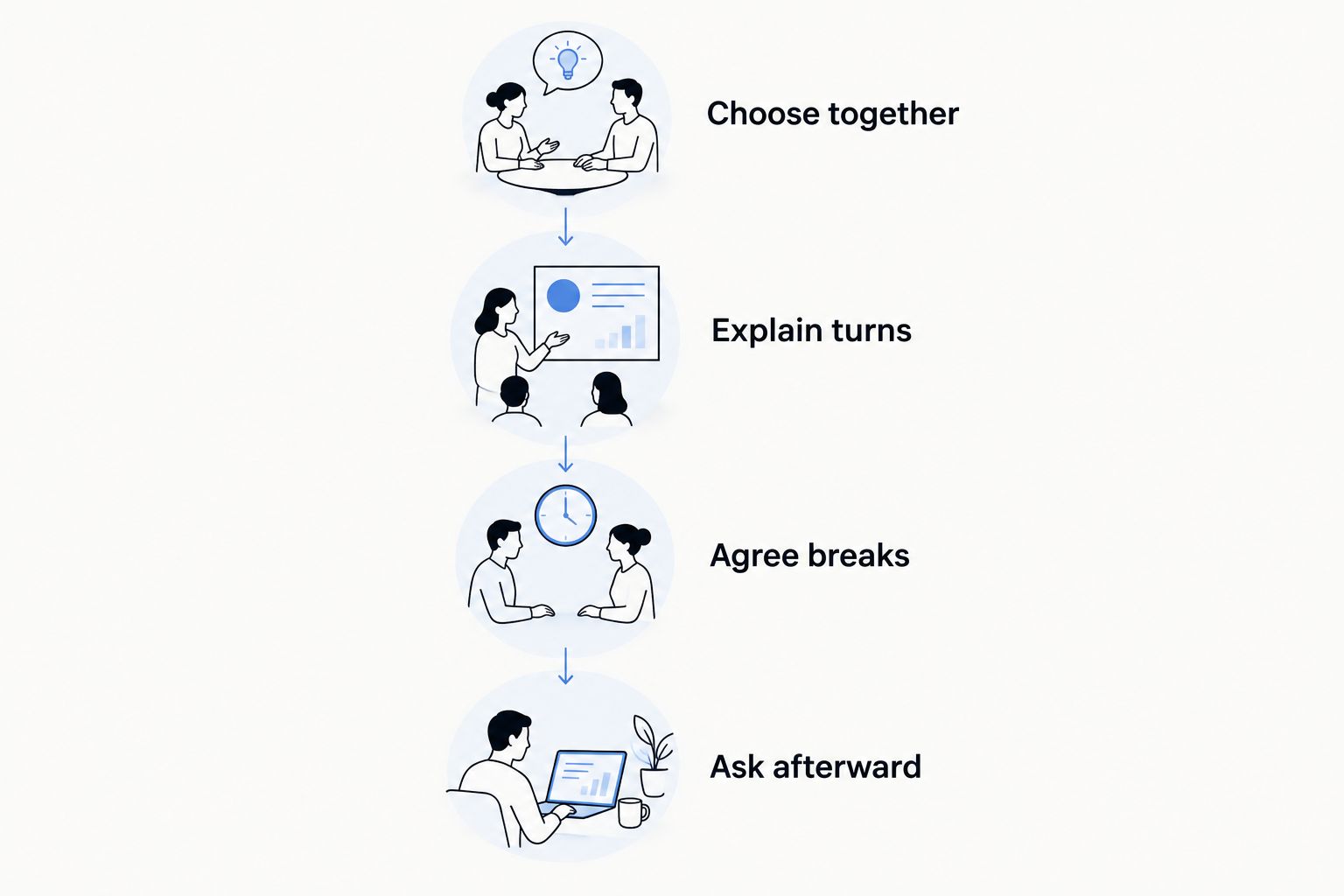
Use this sequence for whichever game your teen chooses:
- Choose together: Show the activity and ask whether your teen wants to try it. Offer an alternative without making refusal a problem.
- Explain turns: Demonstrate a turn and show how someone can contribute without speaking. State that passing is allowed.
- Agree breaks: Identify a place or way to pause. Let participants stop without earning a break through performance.
- Ask afterward: Ask what they liked, disliked, or would change. Accept a brief answer, a written response, or no discussion.
For your first 2026 session, keep the plan easy to change. A teen choosing to observe before joining is giving you useful information about their preferred pace.
If you are exploring community support, ask Autism Learn & Play about the ages served, participation expectations, and adaptations relevant to your teen. Explain what your teen enjoys as well as what makes a group setting uncomfortable. Those details give the conversation a practical starting point.
Ask about support for your teen
Share your teen’s interests, communication preferences, and questions about community programs.
Which social skills game should you choose?
Choose cooperative storytelling as your 2026 default only if your teen enjoys creating stories. Choose collaborative puzzles for a visible shared task, interest bingo for introductions, choose-next scenarios for boundaries, outing planning for community preparation, or music exchange for discussing preferences.
For younger teens, check that prompts feel age-respectful rather than childish. For older teens, offer genuine control over themes, invitations, and participation. Age alone does not tell you which format will feel comfortable.
Start with the best-fit game rather than the highest-ranked one. If your teen dislikes it, change the activity—not the standard for what counts as acceptable participation.
FAQ
What are the best social skills games for autistic teens?
Cooperative storytelling is a practical starting point for teens who enjoy shared creative play. Interest bingo, collaborative puzzles, choose-next scenarios, outing planning, and music exchange suit different interests and participation preferences.
Can a nonspeaking autistic teen join these games?
Yes, these game formats can include typing, pointing, gestures, pictures, and communication devices. Keep the teen’s preferred communication method accessible and do not make speaking a condition of participation.
Should I make my teenager join a social skills game?
No, offer an invitation and respect the answer. Watching, passing, taking a break, and choosing another activity should remain available options.
Are cooperative games better than competitive games?
Choose the format your teen prefers rather than assuming cooperative games are always better. Cooperative formats remove the need to defeat another player, but disagreements about shared decisions still need respectful handling.
How do I choose a game for a teen who dislikes noise?
Start by asking your teen about sound preferences and choose a format that does not require audio. A written storytelling game, paper scenario game, or selected puzzle offers a starting point, but the room and other participants also matter.
What should I ask before a Brooklyn group activity?
Ask about the age range, activity structure, noise, break options, communication access, and caregiver participation. Describe your teen’s preferences and verify the setting directly rather than relying on a sensory-friendly label alone.
Does Autism Learn & Play offer these exact teen games?
This guide does not identify these games as Autism Learn & Play program activities. The nonprofit provides therapy services, community programs, and online classes for autistic children ages 2–18; email info@autismlearnplay.org with questions about support for your teen.
One last thing
For your next activity in 2026, ask your teen to choose the stop signal before choosing the game. It can be a word, gesture, written message, or another accessible signal they prefer.
A successful game does not require your teen to stay until the end. Respecting a request to stop keeps the activity aligned with its purpose: spending time together with choice, dignity, and room to celebrate uniqueness.
Related guides
- Art therapy activities for autistic kids
- Gross motor activities for kids with autism
- Speech therapy activities for nonverbal autism
- Music therapy techniques for autism