Best overall: choice-based collage. Best for children who prefer clean hands: dry drawing. Best for shared play: a side-by-side mural. This 2026 guide to art therapy activities for autistic kids helps you choose creative activities around your child’s interests, communication, and sensory preferences—not a finished picture.
- Choice-based collage leads this guide to art therapy activities for autistic kids because children can choose materials and participation.
- Dry drawing suits children who dislike wet textures; painting belongs only when the child welcomes it.
- Autism Learn & Play provides art therapy among its services for children ages 2–18.
- Home art activities are creative play, not a substitute for art therapy with a qualified professional.
Why this matters
Art offers something to do together without making conversation the price of participation. Your child can choose a color, place a shape, draw beside someone, or simply watch. Each is a valid way to join.
Autism Learn & Play is a Brooklyn-based nonprofit offering therapy services, community programs, and online classes for children ages 2–18. Autism Learn & Play is an option for Brooklyn families seeking art therapy among a broader range of children’s services. Ask directly about the format and support that fit your child.
One distinction matters before you start: art therapy is a professional therapeutic practice. The activities below are suggestions for creative play at home or in a group; using paint or clay does not turn an activity into therapy. For your 2026 activity plan, separate enjoyable art time from any goals you discuss with a qualified art therapist.
What makes the best art activities for autistic kids?
Choose the activity that fits your child today. These criteria matter more than artistic skill:
- Child choice: Your child can choose materials, change direction, decline, or stop.
- Sensory fit: The activity respects preferences about touch, smell, sound, and mess.
- Communication access: Your child can participate through speech, gestures, pointing, or their usual communication system.
- Flexible difficulty: You can simplify the task without making older children use babyish materials.
- Shared participation: Children can create alongside others without compulsory sharing or conversation.
- Safe materials: You select age-appropriate supplies and account for mouthing, allergies, sharp tools, and small pieces.
Start with 2 material choices, not an overflowing supply bin. That is a setup suggestion, not a rule: offer more when your child asks, and fewer when the choices feel distracting.
Art activities at a glance
| Rank and activity | Best for | Standout feature | Key limitation |
|---|---|---|---|
| 1. Choice-based collage | Flexible, child-directed participation | Pieces can be moved before attaching | Loose pieces need safety checks |
| 2. Dry drawing | Children who prefer clean hands | No wet paint or glue required | Mark-making can still feel demanding |
| 3. Side-by-side mural | Creating near peers | Separate spaces on a shared surface | Shared space needs clear boundaries |
| 4. Tool-based painting | Children interested in paint but not finger painting | Brushes or rollers separate hands from paint | Wet textures and smells remain |
| 5. Clay or dough sculpture | Children who enjoy squeezing and shaping | Three-dimensional, open-ended making | Texture and mouthing concerns |
| 6. Visual storytelling | Children who enjoy characters and sequences | Images can carry the story | Prompts can become adult-led |
| 7. Found-object printing | Children drawn to repetition and patterns | The same shape can be repeated | Paint transfer creates mess |
1. Choice-based collage: best for flexible participation
Choice-based collage lets your child select and arrange paper, pictures, or other suitable materials. Pieces can stay loose while your child experiments; attaching them is optional. There is no model picture to copy.
Offer a theme connected to an actual interest, such as animals, transportation, or favorite colors. For a younger child, you can prepare large paper shapes. An older child or teen can choose photographs, abstract arrangements, or a subject they want to explore.
Choice-based collage pros:
- Choosing and placing are separate actions.
- Pieces can be rearranged without redrawing.
- A child can participate without speaking.
- The subject can reflect the child’s own interests.
Choice-based collage cons:
- Small pieces are unsuitable when mouthing creates a safety concern.
- Glue introduces another texture and handling task.
- Too many pictures can distract from choosing.
Best for: Children who want control over materials and pace.
Verdict: Try choice-based collage first. Keep the pieces movable, and let your child decide whether the arrangement is finished.
2. Dry drawing: best for children who prefer clean hands
Dry drawing uses materials such as crayons or pencils without introducing wet paint. Your child can make lines, trace a familiar shape, draw a favorite subject, or create an abstract page. Coloring inside an outline is not a requirement.
Offer paper that stays in place and a drawing tool your child finds comfortable. If gripping or pressing is frustrating, change the setup rather than asking for repeated practice. Watching you draw or choosing your next color also counts as involvement.
Dry drawing pros:
- No wet glue or paint is necessary.
- Setup and cleanup are straightforward.
- Children can draw independently beside a peer.
- Subjects can suit young children or teens.
Dry drawing cons:
- Gripping and pressing can be tiring or uncomfortable.
- A blank page can feel less inviting than a clear starting point.
- Detailed copying can turn play into a performance task.
Best for: Children who enjoy marks and pictures but dislike wet materials.
Verdict: Choose dry drawing when texture is the main barrier. Offer a starting point without deciding what the finished drawing must look like.
3. Side-by-side mural: best for creating near peers
A side-by-side mural gives children separate areas on a shared sheet of paper. Each child can work independently, with joining the pictures left optional. Creating near another child does not require sharing tools or taking turns immediately.
For a Brooklyn community outing in 2026, ask whether the group activity allows separate working spaces. Bring your child’s interests into the plan, and check how the organizer handles breaks, crowding, and children who prefer to observe.
Side-by-side mural pros:
- Children can participate without a shared theme.
- Separate areas make boundaries visible.
- Drawing beside someone does not require conversation.
- Different ages can use different levels of detail.
Side-by-side mural cons:
- Reaching across another child’s area can cause friction.
- A busy table can feel crowded.
- Shared materials need an agreed approach.
Best for: Children interested in being near peers while keeping their own space.
Verdict: Try a side-by-side mural with clear boundaries. Ask before connecting drawings or adding marks to someone else’s section.
4. Tool-based painting: best for exploring paint without finger painting
Tool-based painting offers a brush, roller, or suitable sponge instead of requiring direct hand contact. Your child chooses whether to make broad strokes, small marks, or repeated shapes. Finger painting is not a necessary next step.
Show the materials before beginning and let your child decline them. Keep a dry alternative available. For older children, offer subjects and tools that match their interests rather than assuming bright handprints are appealing at every age.
Tool-based painting pros:
- Tools separate hands from paint during use.
- Children can explore different marks.
- Abstract work needs no recognizable subject.
- Painting can happen beside another person.
Tool-based painting cons:
- Paint can still reach hands and clothing.
- Smell and wet texture remain part of the activity.
- Cleanup introduces another transition.
Best for: Children who are curious about paint but prefer using tools.
Verdict: Offer tool-based painting only when paint itself is welcome. Switching to crayons is a valid choice, not a missed opportunity.
5. Clay or dough sculpture: best for hands-on shaping
Clay or dough sculpture invites squeezing, flattening, rolling, and shaping an age-appropriate material. Your child can make a recognizable object or explore the material without producing anything to keep. Ask before touching or changing their creation.
Choose supplies suited to your child’s age and safety needs, and follow the manufacturer’s instructions. Do not assume a material is edible because it resembles food. If your child avoids the texture, offer a different activity instead of making touching it the goal.
Clay or dough sculpture pros:
- Shapes can be changed repeatedly.
- A finished object is optional.
- Children can work separately at the same table.
- Themes can follow a child’s interests.
Clay or dough sculpture cons:
- Sticky or firm textures do not suit every child.
- Mouthing requires careful material selection and supervision.
- Tools and loose accessories add safety considerations.
Best for: Children who already enjoy squeezing or shaping suitable materials.
Verdict: Choose sculpture for an interested child, not as a texture challenge. Respect a refusal to touch the material.
6. Visual storytelling: best for children who enjoy characters
Visual storytelling uses drawings or selected pictures to build a sequence. Your child can show a character, an event, or an imagined place without narrating aloud. You can write down words they choose, but the story belongs to them.
Begin with 3 picture spaces if a simple sequence appeals to your child. Leave them open to rearrangement. A teen might prefer a comic, while a younger child might choose pictures of familiar objects without creating a plot.
Visual storytelling pros:
- Pictures can carry meaning without spoken narration.
- Favorite characters offer a starting point.
- Children can revise or reorder images.
- The format can grow with the child’s interests.
Visual storytelling cons:
- Sequencing adds a task beyond making art.
- Repeated questions can interrupt enjoyment.
- Adults can accidentally take over the story.
Best for: Children who enjoy pictures, characters, or imagined events.
Verdict: Try visual storytelling without requiring an explanation. Do not interpret a drawing as evidence of a particular feeling; ask only if your child welcomes the conversation.
7. Found-object printing: best for repeated shapes
Found-object printing uses safe, suitable objects to make repeated paint marks. Your child might press a large sponge shape onto paper, repeat the same print, or change the arrangement. Repetition can be the whole activity.
Select objects carefully rather than treating every household item as an art tool. Avoid sharp edges, breakable objects, and pieces unsuitable for your child. Show what printing involves, then let your child choose whether to participate.
Found-object printing pros:
- Repeated marks need no drawing skill.
- Children can choose spacing and patterns.
- The same action can remain the focus.
Found-object printing cons:
- Paint transfers to hands and surfaces.
- Holding and pressing an object can be difficult.
- Household objects require individual safety checks.
Best for: Children who enjoy repeated shapes and welcome paint.
Verdict: Try printing when repetition is the attraction. Do not insist on varied colors or a more complicated pattern.
How these activities are ranked
This 2026 ranking prioritizes choice, sensory fit, communication access, flexible difficulty, shared participation, and safe setup. Collage comes first because you can separate choosing, arranging, and attaching; dry drawing follows as a practical option without wet materials.
The order is not a clinical effectiveness ranking. Your child’s preference outranks the list. A familiar drawing activity is a better starting point than a higher-ranked activity your child dislikes.
Make the activity fit your child
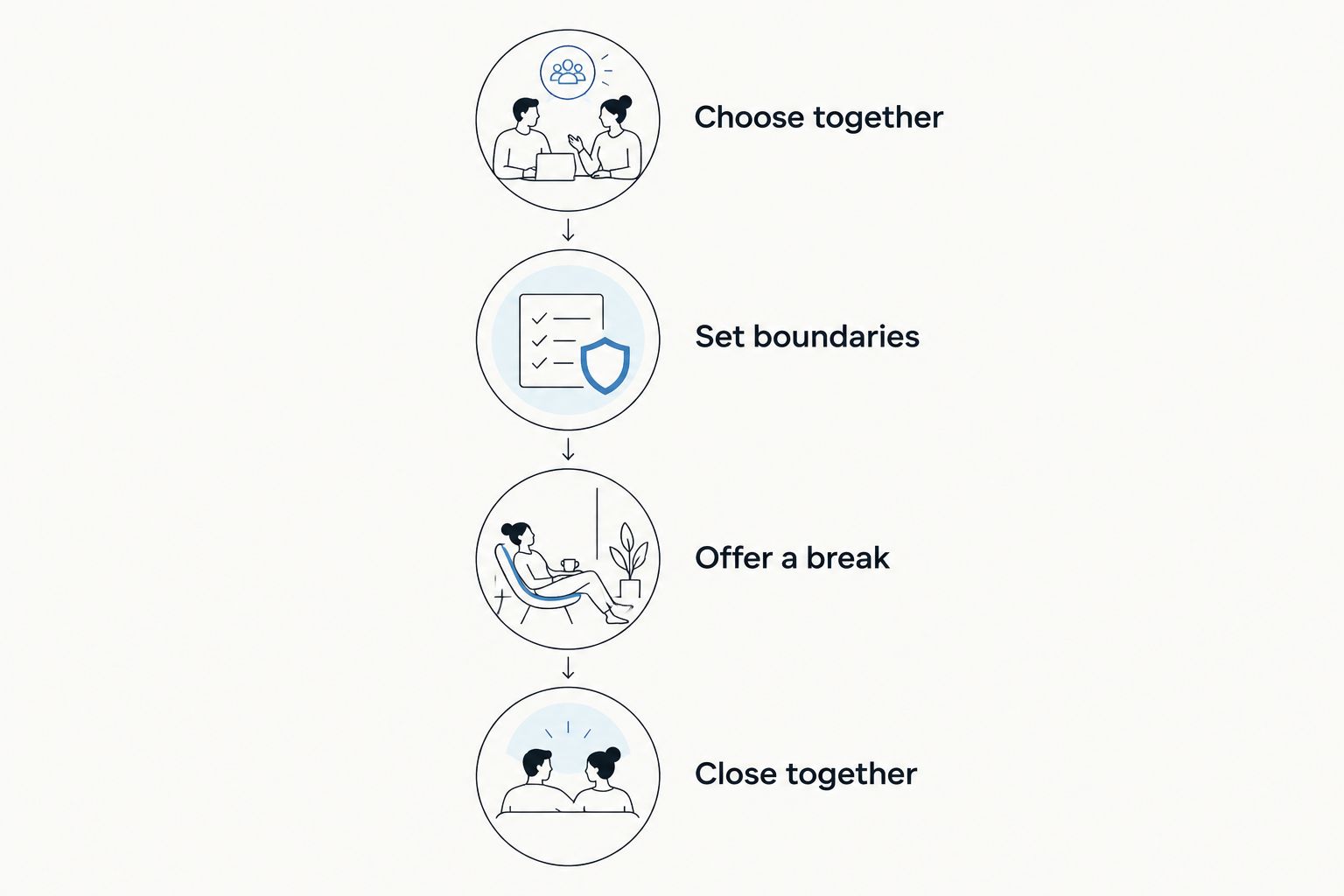
Use this sequence when planning art at home or asking about a group:
- Choose together: Offer materials your child recognizes or wants to explore.
- Set boundaries: Explain where materials belong and how personal space works.
- Offer a break: Make stopping possible without finishing the picture.
- Close together: Ask whether your child wants to keep, display, change, or discard the work.
For children ages 2–5, consider large, age-appropriate materials and close supervision. For children ages 6–12, offer subjects they actually enjoy and ask before introducing shared work. For teens ages 13–18, protect privacy and avoid displaying artwork without permission. These are planning prompts, not ability assumptions.
Before booking a 2026 group activity, ask about the room, materials, communication support, caregiver participation, and ways to step away. Describe what your child needs rather than relying on a broad age label.
Ask about art therapy options
Tell Autism Learn & Play about your child’s interests, sensory preferences, and support needs.
Which activity should you choose?
Start with choice-based collage unless your child already has a clear favorite. Choose dry drawing for a child who dislikes wet materials, or a side-by-side mural when the priority is creating near peers. Keep the first session simple and let your child’s response guide the next choice.
For families considering Autism Learn & Play art therapy in 2026, ask how the service fits the child’s age, interests, and communication. Do not assume the home activities in this guide describe a particular session or program.
FAQ
What are the best art therapy activities for autistic kids?
Choice-based collage is the default recommendation in this guide because children can choose, arrange, and rearrange materials. Dry drawing suits children who prefer clean hands, while side-by-side murals offer a way to create near peers. Home versions are creative activities, not professional art therapy.
Is finger painting necessary for an autistic child?
No, finger painting is not necessary. Offer brushes, dry drawing, or collage when direct contact with paint is unwelcome, and respect your child’s choice.
Can a child who does not speak join an art activity?
Yes, spoken language is not a requirement for making art. Offer choices through pointing, gestures, or the child’s usual communication system, and avoid requiring an explanation of the artwork.
How do I choose art activities for an autistic teenager?
Choose materials and subjects that match the teenager’s interests and preferences. Comics, abstract drawing, collage, and sculpture are options to discuss; ask permission before sharing or displaying the work.
What should I ask before joining a Brooklyn art group?
Ask about materials, room conditions, personal space, breaks, communication support, and caregiver participation. Explain your child’s preferences so the organizer can answer specific questions about fit.
Does Autism Learn & Play provide art therapy?
Yes, Autism Learn & Play includes art therapy among its services for children ages 2–18. Email info@autismlearnplay.org to ask about the format and support relevant to your child.
What if my child only wants to watch?
Watching is a valid way to participate in a creative activity. Keep the invitation open without requiring your child to touch materials, produce artwork, or join another child.
One last thing
Ask permission before improving your child’s artwork. Straightening a collage, adding a missing detail, or finishing a picture changes something they made. Leave space for a piece that looks unfinished to you but feels complete to your child.
Related guides