Best overall starting point: child-led musical play. Best for shared participation: rhythm turn-taking. Best for home practice: familiar-song choices. This 2026 guide compares music therapy techniques for autism so you can choose a starting point around your child’s interests, communication, and comfort—not a requirement to perform.
- Start with child-led musical play when choosing music therapy techniques for autism; follow your child’s interests without requiring speech.
- Choose rhythm turn-taking for shared participation, or familiar-song choices for expressing preferences.
- Autismlearnplay offers music therapy for children ages 2–18; ask how sessions fit your child’s needs.
- Music activities at home are not a substitute for individualized music therapy.
Why this matters
Music offers different ways to participate: listening, moving, playing, choosing, or sharing silence. Your child does not need to sing, speak, make eye contact, or copy someone else to take part. The useful question is whether the activity gives your child a comfortable way to participate.
For Brooklyn families exploring support in 2026, Autismlearnplay provides therapy services, community programs, and online classes for autistic children ages 2–18, including music therapy. Ask about the music therapy approach, the person delivering it, and how your child’s preferences shape sessions.
Music therapy involves a trained music therapist using music within a therapeutic relationship and working toward individualized goals. Singing together at home can be enjoyable, but it is not automatically therapy. This guide helps you discuss approaches with a provider and choose respectful activities between sessions.
What makes the best music therapy techniques for autism
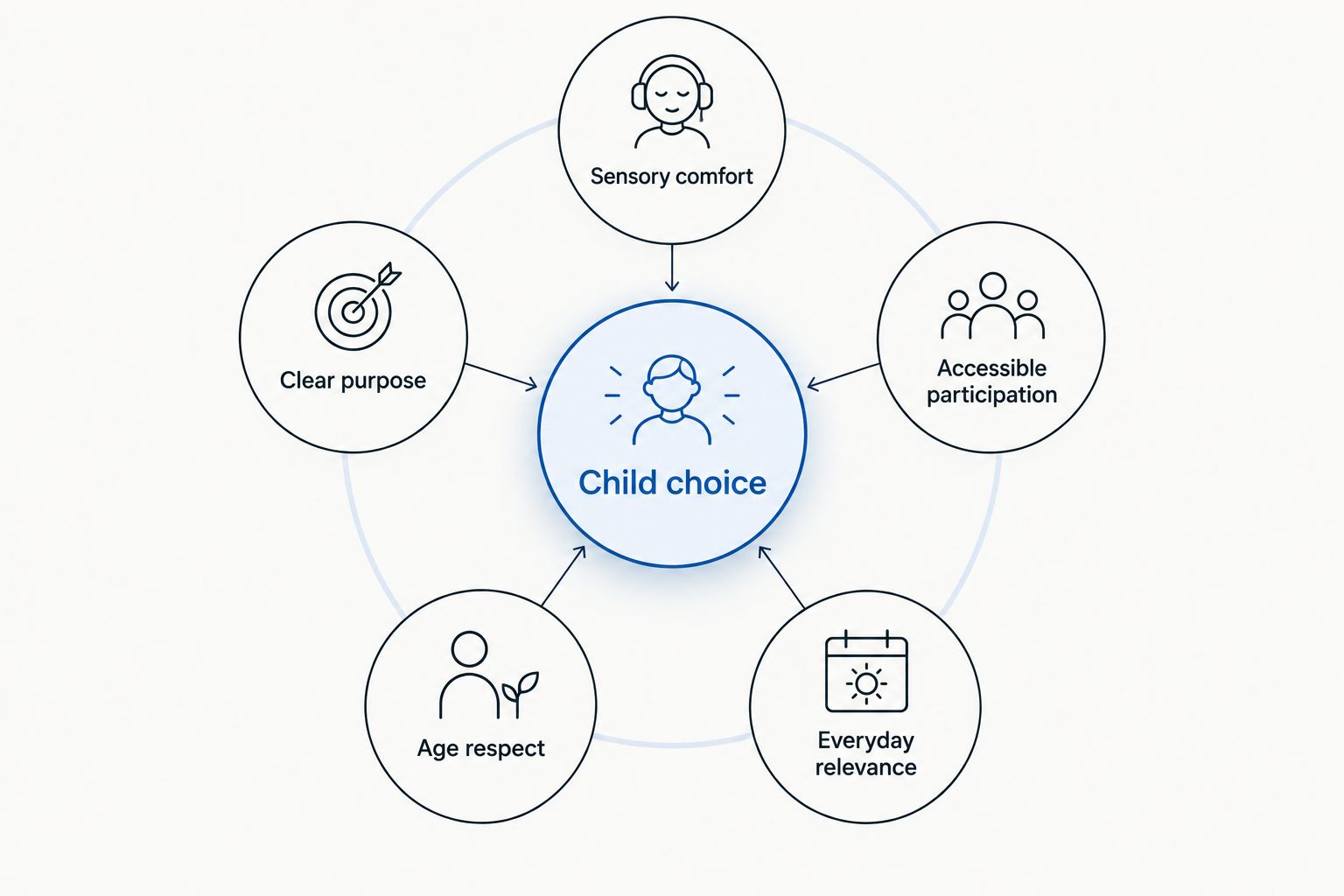
Use these criteria before choosing an approach. An activity that looks engaging from the outside is not necessarily comfortable for the child taking part.
- Child choice: Your child can choose, decline, stop, or change the activity.
- Sensory comfort: Sound, pace, instruments, and space fit your child’s preferences.
- Clear purpose: The therapist explains what the activity supports without promising an outcome.
- Accessible participation: Speech, gestures, movement, and communication devices are accepted.
- Age respect: Materials match your child’s interests without treating older children like preschoolers.
- Everyday relevance: The activity connects with something meaningful, such as making choices or enjoying time together.
A suitable approach balances these criteria rather than prioritizing obedience or a polished performance. Ask what happens when your child wants quiet, declines an instrument, or participates differently from the group.
Music therapy techniques at a glance
These rankings are practical starting points, not a claim that one technique works best for every autistic child. Each approach has a different purpose; your child’s response determines whether it belongs in a session.
| Technique | Best for | Standout feature | Key limitation |
|---|---|---|---|
| Child-led musical play | Exploring interests | The adult follows the child’s musical choices | Open-ended play still needs thoughtful pacing |
| Rhythm turn-taking | Shared participation | A repeated beat creates a clear exchange | Waiting or copying can become pressure |
| Familiar-song choices | Expressing preferences | Known music offers recognizable choices | Familiar music is not always welcome |
| Musical routine cues | Making transitions understandable | A consistent sound marks a familiar activity | An unwanted cue adds sensory demand |
| Movement with music | Participating through the body | Movement replaces a need to sit or sing | Space and sound require careful planning |
| Songwriting and sound stories | Self-expression | Children choose words, sounds, or themes | Adult interpretation can override the child |
| Collaborative group music | Community participation | Children share an activity without needing conversation | Groups introduce noise and social demands |
1. Child-led musical play: best for exploring interests
Child-led musical play starts with what your child chooses: a sound, instrument, song, movement, or pause. A therapist follows that interest and offers musical responses without taking over. Your child can participate through listening alone.
Ask how the therapist recognizes interest and refusal. For younger children, exploration might involve sounds and movement; older children deserve equally genuine choices, including music they enjoy rather than materials selected only for their age label.
Child-led musical play pros:
- Gives your child a role in choosing the activity.
- Allows participation without spoken words.
- Leaves room to adjust pace and sound.
Child-led musical play cons:
- Open-ended sessions can feel unclear without an explained purpose.
- An adult can accidentally turn following into repeated prompting.
Best for: Children who need space to explore before joining a structured activity.
Verdict: Try child-led musical play first when you do not yet know which musical activities your child enjoys.
2. Rhythm turn-taking: best for shared participation
Rhythm turn-taking creates an exchange through sound. One person plays a rhythm, then leaves space for another person to respond. A response can be different from the original beat; accurate imitation is not the only way to join.
Keep participation voluntary. A therapist can simplify the exchange, offer a quieter instrument, or follow your child’s rhythm instead of asking your child to copy. Silence should not automatically trigger another instruction.
Rhythm turn-taking pros:
- Makes the exchange audible rather than dependent on conversation.
- Works with simple sounds or movements.
- Allows different responses within a shared activity.
Rhythm turn-taking cons:
- Loud percussion can be uncomfortable.
- Repeated requests to wait or copy can make the exchange demanding.
Best for: Children interested in sharing sounds with another person.
Verdict: Try rhythm turn-taking when your child enjoys an exchange; skip imitation demands that remove the enjoyment.
3. Familiar-song choices: best for expressing preferences
Familiar-song choices give your child a recognizable decision: which song, whether to repeat it, or whether to stop. Offer choices through whatever communication method your child uses, including pointing, gestures, speech, or a communication device.
Do not hold the song back until your child says a word. For families exploring communication support, these speech therapy activities for nonverbal autism provide a related topic to discuss with your child’s team.
Familiar-song choices pros:
- Uses music your child already recognizes.
- Creates a practical opportunity to express preferences.
- Can become a shared home activity without special equipment.
Familiar-song choices cons:
- Repetition can become unwelcome even with a favorite song.
- Adults can mistake familiarity for consent to continue.
Best for: Children who enjoy known music and want a clear way to choose what happens next.
Verdict: Try familiar-song choices for home practice, while accepting stop and no as complete answers.
4. Musical routine cues: best for making transitions understandable
A musical routine cue connects a consistent sound or song with a familiar activity. For example, a family might choose a short tune before putting instruments away. The purpose is to make the next step recognizable, not to make your child comply.
Explain the transition in an accessible way alongside the music. A cue cannot replace information about what is changing, and a song your child dislikes is not a helpful signal simply because adults use it consistently.
Musical routine cues pros:
- Offers a repeatable signal for a familiar activity.
- Can accompany pictures, gestures, or spoken explanations.
- Lets your child help choose the cue.
Musical routine cues cons:
- An unwanted sound adds another demand during a transition.
- A cue loses meaning when adults use it inconsistently.
Best for: Children who welcome a musical signal alongside other transition supports.
Verdict: Try musical routine cues only when your child accepts the sound; skip them when quiet works better.
5. Movement with music: best for participating through the body
Movement with music lets your child participate by swaying, walking, dancing, stretching, or moving in their own way. Sitting still is not the entry requirement. A therapist can adjust the activity around comfort, access, and the session’s purpose.
For a home activity, clear space and let your child choose whether to move or watch. Avoid correcting movement to match an adult’s idea of how dancing should look.
Movement with music pros:
- Offers an alternative to singing or playing instruments.
- Accepts different movement styles.
- Can follow your child’s preferred music and pace.
Movement with music cons:
- Busy spaces and loud music can make participation uncomfortable.
- Some movements require adaptations for access or safety.
Best for: Children who enjoy movement more than seated musical activities.
Verdict: Try movement with music when movement is welcome; skip choreography as a requirement.
6. Songwriting and sound stories: best for self-expression
Songwriting and sound stories let your child choose a theme, sound, lyric, or sequence. Participation does not require writing sentences. A child might select sounds for a story, while a teenager might prefer working with lyrics or discussing a favorite musical style.
Ask before assigning meaning to a musical choice. A repeated sound does not give an adult permission to label your child’s feelings, and personal lyrics do not need to become a performance for others.
Songwriting and sound stories pros:
- Gives children ownership of content.
- Accepts words, sounds, and communication-device selections.
- Can reflect interests beyond traditional children’s songs.
Songwriting and sound stories cons:
- Too many choices can make the activity difficult to enter.
- Adult interpretation can overshadow what your child actually communicates.
Best for: Children who want to create something around their interests or experiences.
Verdict: Try songwriting and sound stories when your child wants creative control; skip requests to share personal content publicly.
7. Collaborative group music: best for community participation
Collaborative group music gives children a shared activity through listening, instrument play, song choices, or sound-making. Joining does not need to mean singing together. Watching from the edge can be a valid way to begin.
For Brooklyn parents comparing groups in 2026, ask about the room, sound levels, breaks, adult support, and ways to participate without speaking. These are questions to confirm with any provider, not assumed features of a particular program.
Collaborative group music pros:
- Offers a shared interest around which children can connect.
- Allows different contributions to the same activity.
- Gives families a community activity to explore.
Collaborative group music cons:
- Other participants make sound less predictable.
- A group can create pressure to join before a child is ready.
Best for: Children interested in being alongside peers during a supported musical activity.
Verdict: Try collaborative group music when the setting fits your child; wait if the group requires participation your child does not want.
How these approaches are ranked
This 2026 ranking starts with choice and sensory comfort, then separates techniques by purpose: exploring, exchanging, choosing, transitioning, moving, creating, and joining a group. It is a parent-facing decision guide, not a ranking of clinical effectiveness. A trained music therapist should connect an approach to your child’s individual goals.
Match the activity to your child’s age and interests
Age helps you choose respectful materials, but it does not determine how your child communicates or participates. Use these age bands as planning prompts, not developmental rules.
- Ages 2–5: Offer concrete choices and room for exploration. Accept watching, moving away, and returning without turning each action into a task.
- Ages 6–11: Invite your child to choose sounds, themes, or a role in the activity. Avoid assuming that familiar classroom songs are personal favorites.
- Ages 12–18: Respect musical taste, privacy, and independence. Ask before sharing recordings or introducing your child’s work to a group.
When arranging a first visit in 2026, describe what your child enjoys and what makes an outing difficult. Ask whether you can learn about the setting beforehand and how staff respond when a child needs to pause or leave.
Which music therapy technique should you choose?
Choose child-led musical play as the default starting point, then add structure only when it serves your child. Pick familiar-song choices for expressing preferences, rhythm turn-taking for shared exchanges, or collaborative group music when community participation is the goal.
Autismlearnplay’s music therapy offering is one service Brooklyn families with children ages 2–18 can ask about. Discuss your child’s interests, communication, sensory preferences, and goals before choosing an approach; do not assume every technique in this guide is part of its programs.
Ask about your child’s music therapy options
Share your child’s age, interests, and sensory preferences with Autismlearnplay.
FAQ
What’s the best music therapy technique for autism?
Child-led musical play is a useful starting point because it centers the child’s interests and choices. No single technique is best for every autistic child; a trained music therapist should match the approach to individual goals and comfort.
Can a nonspeaking child participate in music therapy?
A nonspeaking child can participate in music therapy without being required to sing or speak. Participation can include listening, movement, instrument play, gestures, or communication-device choices.
Is playing music at home the same as music therapy?
Playing music at home is not automatically music therapy. Music therapy involves a trained music therapist, a therapeutic relationship, and individualized goals; home activities can remain enjoyable shared experiences.
What if my child dislikes loud music?
Do not require your child to tolerate loud music to participate. Ask the therapist about quieter options, control over sound, pauses, and whether a different activity better fits your child.
Are music groups suitable for autistic teenagers?
A music group can be suitable for an autistic teenager when its activities, environment, and participation expectations fit that teenager. Ask about age grouping, musical interests, privacy, and options to observe or take a break.
Does Autismlearnplay offer music therapy for children?
Autismlearnplay offers music therapy among its services for autistic children ages 2–18. Contact info@autismlearnplay.org to ask about the current approach and how it fits your child; do not assume the techniques listed here are all offered.
How do I choose a music therapy provider in 2026?
Choose a music therapy provider who explains their training, individualized goals, and approach to child choice. Ask how they support communication, adjust sound, and respond when your child declines an activity.
One last thing
For your 2026 plan, pay attention to what happens when the music stops. If your child asks for more, chooses something different, or wants quiet, each response gives you useful direction. Stopping is a valid choice, not a failed session.
Related guides
- Art therapy activities for autistic kids
- Occupational therapy activities for autism at home
- Sports for kids with autism