Best overall: a caregiver-led, interest-based book club. Best online starting point: Story Time from Autism Learn & Play. Best for independent teens: a teen-led graphic novel circle. This 2026 guide compares book clubs for kids with autism by participation style, sensory needs, and opportunities for connection—not by how much children speak or read aloud.
- The best book clubs for kids with autism welcome different reading levels and communication styles.
- Autism Learn & Play offers Story Time, a 30-minute Zoom class—not a confirmed peer book club.
- Choose a reading buddy for quieter connection or a teen-led circle for greater independence.
- Ask about age fit, sensory supports, and participation choices before joining any reading group.
Why this matters
A book club should give your child something enjoyable to share, not another setting where they must perform. Listening, pointing to an illustration, typing a reaction, and talking about a favorite character all deserve room.
For Brooklyn families exploring Autism Learn & Play, distinguish a reading class from a friendship-focused club. Both have a place, but a class description alone does not establish peer discussion, group size, or an approach to sensory support.
The options below include suggested club formats and verified online classes. A format is an idea to organize or ask about, not a claim that a local program currently runs it.
What makes the best book clubs for kids with autism?
Use these criteria to choose a reading group in 2026:
- Child-led interests: Choose stories your child wants to explore, including nonfiction, comics, or familiar favorites.
- Communication choice: Ask whether children can contribute through speech, AAC, gestures, drawing, or typing.
- Sensory fit: Ask about sound, seating, lighting, movement, and a way to take a break.
- Age respect: Match themes and social expectations to your child's age without assuming reading level determines maturity.
- Predictable structure: Request a clear explanation of what happens before, during, and after the reading.
- Connection first: Look for invitations to share interests rather than compulsory answers, eye contact, or public reading.
Reading options at a glance
| Option | Best for | Standout feature | Key limitation |
|---|---|---|---|
| Caregiver-led interest club | A flexible first club | You shape the reading and participation choices | Requires organizing and another willing family |
| Story Time | Trying an online story activity | Listed as a 30-minute Zoom class | Peer discussion and group structure need confirmation |
| Reading-buddy club | A child who prefers one peer | Shared reading without a larger audience | Depends on a compatible, willing partner |
| Library-hosted book discussion | Exploring a community setting | A format to ask your local library about | Local arrangements and supports require checking |
| Teen-led graphic novel circle | Older readers seeking ownership | Teens choose themes and discussion methods | Requires shared interests and age-appropriate selections |
| Reading Class | Reading-focused online participation | Listed as a 30-minute Zoom class | Instruction is not the same as a friendship-focused club |
1. Caregiver-led interest club: best for a flexible first club
A caregiver-led club starts with your child's interest and another willing family. You choose the book, explain the plan, and agree on ways children can participate without requiring conversation on demand.
For a child who loves trains, that might mean looking through a train book and choosing favorite pictures. For an older reader, it might mean discussing characters from a fantasy series.
Caregiver-led interest club pros:
- You can choose familiar surroundings.
- Children can help select the book.
- You can build movement and breaks into the plan.
Caregiver-led interest club cons:
- You handle invitations, planning, and boundaries.
- Different interests need negotiation rather than adult-imposed agreement.
Best for: Families who want to shape a first reading gathering around their child's preferences.
Verdict: Buy into this format first if you have a willing family partner; keep expectations flexible.
2. Story Time: best for trying an online story activity
Story Time is a listed Autism Learn & Play online class conducted through Zoom, with a stated length of 30 minutes. Its description says the organization contacts families to finalize the booking after preferred course days are selected.
Treat Story Time as an online reading-related starting point, not a verified book club. Before choosing it, ask whether children interact with peers, how books are selected, and what participation looks like.
Story Time pros:
- The online format removes the trip to a meeting venue.
- The listed session length helps you plan your day.
- You can ask specific questions about the class before committing.
Story Time cons:
- A screen-based activity does not suit every child.
- The description does not establish group size or peer discussion.
Best for: Families seeking an online story activity rather than assuming a neighborhood club is the right first step.
Verdict: Hold until the class structure matches your child's communication and sensory needs.
3. Reading-buddy club: best for quieter peer connection
A reading-buddy club pairs your child with one willing peer around a shared book or topic. The children might listen together, compare illustrations, or exchange drawings about a character.
Choose the partner for mutual interest, not because one child is expected to teach or manage the other. Explain that either child can decline an activity or ask for space.
Reading-buddy club pros:
- There is no larger discussion circle to manage.
- Children can revisit the same favorite book.
- You can offer different ways to respond.
Reading-buddy club cons:
- The pairing needs to feel comfortable for both children.
- A mismatch in interests can make the activity feel adult-directed.
Best for: A child who wants company but prefers a single peer to a group.
Verdict: Buy into a buddy format when both children want the shared activity; skip forced pairings.
4. Library-hosted book discussion: best for exploring community spaces
For a community-based option in Brooklyn, ask your local library whether it hosts children's book discussions that fit your child's age and interests. Request details about the actual session rather than relying on a broad label such as “inclusive.”
Ask what happens if a child listens without speaking, needs to move, or leaves early. A specific answer gives you more to work with than a general promise that everyone is welcome.
Library-hosted book discussion pros:
- It gives your family a community setting to investigate.
- A suitable discussion can center a shared reading interest.
- You can ask about the room and routine before attending.
Library-hosted book discussion cons:
- Each location's arrangements need separate confirmation.
- A discussion-based format can place demands on waiting and listening.
Best for: Families who want a neighborhood outing and can confirm the session's fit beforehand.
Verdict: Hold until the host explains participation expectations and practical supports.
5. Teen-led graphic novel circle: best for older readers seeking ownership
A teen-led graphic novel circle lets participants choose titles, themes, and ways to respond. This is a proposed format, not a named local program.
Keep it age-respectful. Graphic novels are a reading choice, not a sign that a teenager should receive younger children's activities or simplified social expectations.
Teen-led graphic novel circle pros:
- Teens can influence the reading choices.
- Artwork provides another topic alongside written dialogue.
- Responses can include drawing, typing, or discussion.
Teen-led graphic novel circle cons:
- Artwork, themes, and language need individual consideration.
- Adults must balance support with teens' privacy and independence.
Best for: Older children and teens who enjoy illustrated stories and want a say in the group.
Verdict: Buy into teen ownership; skip a format that adults control without participant input.
6. Reading Class: best for a reading-focused online option
Reading Class is another listed online offering, described as a 30-minute Zoom class. It belongs on this comparison because reading instruction and book clubs serve different purposes—not because instruction must come before friendship.
Ask what skills the class addresses and whether its approach matches your child's goals. A child does not need to reach a particular reading level to deserve a welcoming social reading activity.
Reading Class pros:
- The online format avoids travel.
- The description provides a session length.
- It gives families a reading-focused option to discuss.
Reading Class cons:
- The description does not establish instructional methods.
- A reading class does not automatically provide peer connection.
Best for: Families whose immediate goal is reading-focused participation rather than a book discussion circle.
Verdict: Hold until the teaching approach and goals are clear.
These listed classes offer different starting points. Confirm their structure directly rather than choosing from the title alone.


Choose books and participation together
For your 2026 reading plans, start with what your child already seeks out. Ask whether they want a familiar story, a favorite subject, an illustrated adventure, or something another child enjoys.
When finding books for reluctant readers, separate interest from performance: offer a choice of subject and format without making independent reading the entry requirement. Listening together and discussing an illustration can belong in your club's plan.
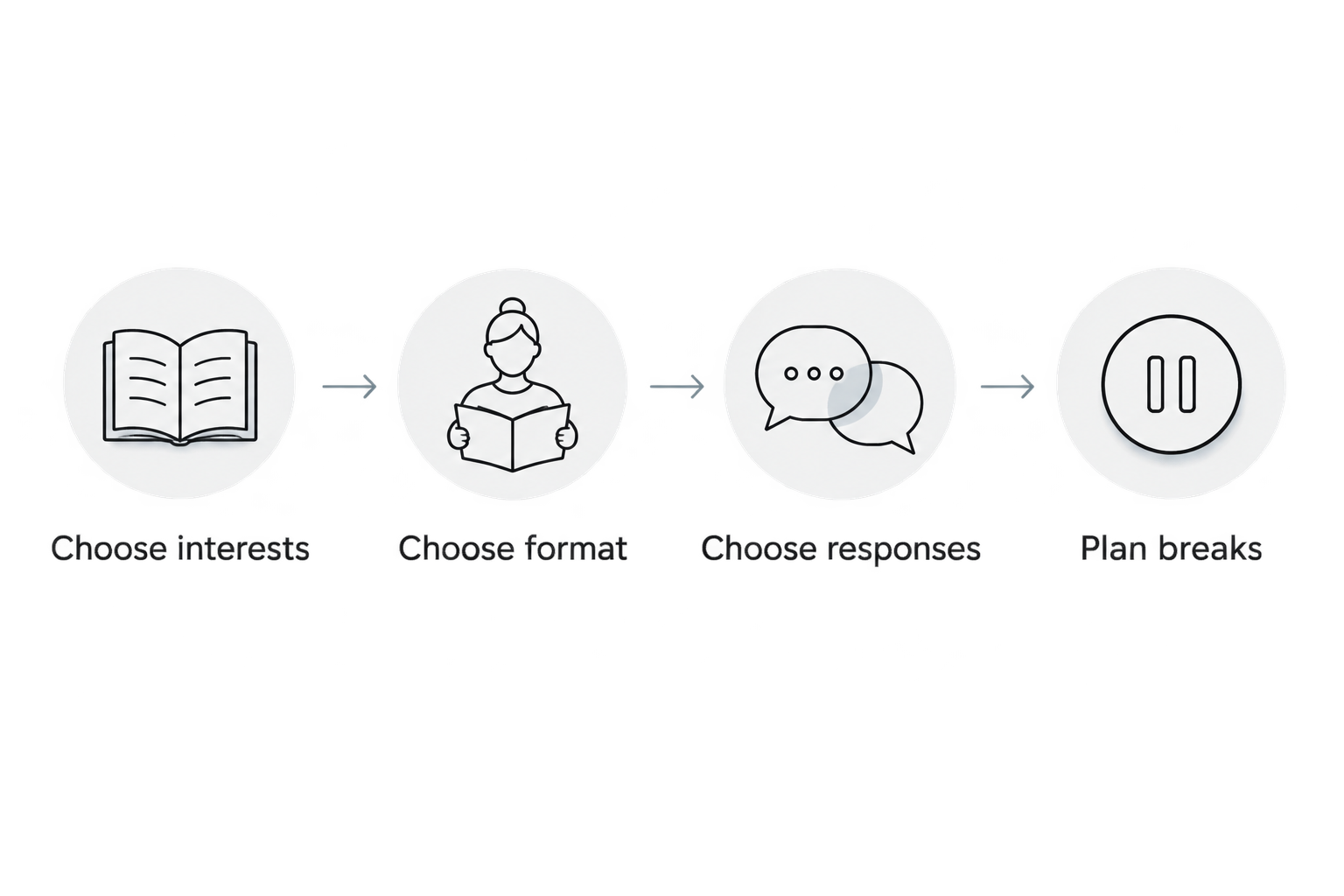
Use these steps before inviting another family:
- Choose interests: Let each child suggest a topic or book.
- Choose format: Offer print, shared reading, or listening according to preference.
- Choose responses: Agree that talking, pointing, drawing, typing, and passing are valid choices.
- Plan breaks: Explain how children can pause or leave the activity.
A comfortable setup still needs consent. If your child does not want a group, offer shared reading without turning it into a preparation assignment for future socializing.
Match the gathering to your child's age
Autism Learn & Play serves children ages 2–18, but that range does not mean every class suits every age. Ask about the intended participants for any specific offering.
For your own gathering, use these age bands as planning prompts—not developmental requirements:
- Ages 2–5: Consider familiar picture books, caregiver participation, and freedom to move away from the reading.
- Ages 6–12: Offer shared interests, clear choices, and ways to respond without reading aloud.
- Ages 13–18: Ask teens about themes, privacy, communication preferences, and how much adult involvement they want.
In 2026, choose age-respectful materials even when a child needs substantial reading support. Reading ability does not tell you everything about interests, understanding, or the friendships a child wants.
Questions to ask before the first meeting
Before arranging a Brooklyn outing or online session in 2026, ask the host:
- What will children do during the session?
- Is speaking or reading aloud required?
- Can my child use AAC, headphones, or a movement break?
- Who will attend, and how are ages grouped?
- Can a caregiver stay, and how can a child leave quietly?
For questions about the nonprofit's classes or community programs, use the contact form or email info@autismlearnplay.org. Describe what your child enjoys and what makes participation comfortable; ask for concrete details rather than a promise of outcomes.
How these options were ranked
This 2026 guide ranks formats by flexibility, child choice, and fit for distinct family goals. It distinguishes verified class descriptions from proposed club formats and does not treat a reading lesson as evidence of a peer book club.
Autism Learn & Play is a reading-class option for families seeking online participation, not a confirmed provider of peer book clubs. For an undecided family seeking friendship through books, the default recommendation is a caregiver-led, interest-based gathering with another willing family.
FAQ
What’s the best book club for a child with autism?
A caregiver-led, interest-based club is the default starting recommendation when you have another willing family. Choose a different format if your child prefers online participation, one reading buddy, or a teen-led discussion.
Does Autism Learn & Play offer a book club?
The listed offerings include Story Time and Reading Class, both described as 30-minute Zoom classes. Those descriptions do not establish a peer book club; ask directly about discussion, participants, and structure.
Can my nonspeaking child join a book club?
Choose a book club that welcomes your child’s communication methods without requiring speech. Ask specifically about AAC, pointing, drawing, typing, listening, and the option to pass.
Does my child need to read independently to participate?
Independent reading does not need to be an entry requirement for a club you organize. For an existing group, ask whether shared reading, listening, or illustrated books fit its activities.
Is an online reading class better than an in-person book club?
Neither format is automatically better; they can serve different goals. Compare the actual participation expectations, sensory setting, and opportunities for peer interaction.
How do I find a suitable book discussion in Brooklyn?
Ask your local library and community organizations about age-appropriate reading discussions. Confirm the room, routine, communication choices, and break arrangements before planning the outing.
What if my child only wants to listen?
Choose a host who accepts listening as participation. Do not assume a quiet child needs prompting to speak; offer a way to contribute and respect a decision to pass.
One last thing
Ask your child what would make them want to return—not how many questions they answered. A favorite page, a comfortable seat, or another child's shared interest is something specific you can carry into the next gathering.
Related guides
- Children's books about autism for parents
- Social skills games for autistic teens
- Can siblings join autism community programs together?