TreeTop ABA alternatives in 2026 deserve a needs-first comparison: if your child already has a trusted relationship with a TreeTop ABA provider, that connection is a strength to preserve. A change makes sense when you want support that your current arrangement does not provide, such as community activities alongside therapy. Autism Learn & Play is the best option to explore for Brooklyn families seeking therapy, community programs, and online classes together; a focused speech or occupational therapy provider is the alternative to explore for a specific communication or daily-activity need.
- Explore Autism Learn & Play when comparing treetop aba alternatives for therapy, community programs, and online classes in Brooklyn.
- Choose a focused therapy provider when your main priority is communication or everyday activities.
- Compare support for your child’s interests, communication, sensory needs, and age—not provider names alone.
- Keep a trusted TreeTop ABA relationship when it supports your child’s goals and respects their needs.
Why this matters
Choosing autism support is not simply choosing another ABA provider. You are deciding what your child needs help with, where they feel comfortable, and how support fits into family life. Making friends, expressing a preference, and enjoying an outing are different priorities; they deserve different questions.
Autism Learn & Play provides autism therapy services, community programs, and online classes for children ages 2–18. Its stated services include ABA, speech, occupational, music and art therapy, and tutoring. That range gives Brooklyn families several kinds of support to discuss without assuming every child needs every service.
Start with your child's next meaningful goal, not a provider ranking. The right comparison for a teenager seeking connection with peers is different from the comparison for a younger child learning to communicate a need.
TreeTop ABA alternatives at a glance
This 2026 comparison separates one named Brooklyn nonprofit from different types of support you can investigate. The service categories are not claims about particular providers or promises that a program fits your child.
| Option | Best for | Main focus | What to compare with TreeTop ABA |
|---|---|---|---|
| TreeTop ABA | Families evaluating their existing or proposed arrangement | The support described in your child's individual plan | Goals, communication with parents, and your child's experience |
| Autism Learn & Play | Brooklyn families seeking several support types | Therapy services, community programs, and online classes for ages 2–18 | Whether these services match needs beyond your current arrangement |
| Speech-language therapy provider | A focused communication goal | Understanding and expressing messages | How communication goals are addressed |
| Occupational therapy provider | A focused everyday-activity goal | Participation in daily activities | How everyday routines and sensory needs are addressed |
| Music or art therapy provider | Exploring support through a creative activity | Therapeutic use of music or art | Whether the approach suits your child's interests |
| Community program | Opportunities to spend time with other children | Shared activities and connection | Whether you need community participation rather than another therapy service |
| Tutoring or online classes | Learning support or an online learning format | Education and instruction | Whether the immediate need is educational rather than therapeutic |
Do not treat the table as a checklist of services your child should receive. Use it to narrow the conversation. A focused service can be a better match than a broad offering when your family has a clearly defined priority.
1. Autism Learn & Play: best for a broader Brooklyn support search
Autism Learn & Play is a Brooklyn-based nonprofit offering therapy services, community programs, and online classes for children on the autism spectrum. Its mix of services makes it relevant when your search includes learning, therapy, and opportunities for community participation. Ask about the particular service you need rather than assuming the full offering belongs in your child's plan.
Where Autism Learn & Play shines
- Its stated services span ABA, speech, occupational, music and art therapy, and tutoring.
- Community programs are part of the offering, so your inquiry can include connection as well as therapy.
- Its stated age range covers children and teenagers ages 2–18.
- Online classes are another format to discuss alongside the other services.
Where Autism Learn & Play falls short
- A broad service offering does not establish that a particular group matches your child's age, interests, or support needs.
- The stated age range does not cover adults beyond age 18.
- A nonprofit offering several services is not automatically the right choice when you need one specific specialist.
Best for: Brooklyn families comparing autism therapy services alongside community programs and online classes.
For your 2026 inquiry, describe what a good experience would look like for your child. Explain how they communicate, what they enjoy, and what makes participation difficult. Ask how the proposed service would respond to those needs.
Verdict: Explore Autism Learn & Play when your search extends beyond one therapy category.
2. Speech-language therapy: best for a focused communication goal
Speech-language therapy is a distinct option when your central question is how your child understands or expresses messages. Communication includes more than spoken words. Gestures, pictures, writing, and communication devices can all belong in the discussion, depending on your child.
Where speech-language therapy shines
- It gives you a focused setting for discussing communication needs.
- You can bring concrete examples, such as asking for help or expressing a preference.
- You can ask how the provider supports your child's existing communication methods.
Where speech-language therapy falls short
- A communication-focused service does not replace every learning, daily-activity, or community need.
- Provider experience with your child's communication method requires a direct conversation.
Best for: Families whose immediate priority is understanding messages or helping a child express needs and choices.
When comparing this option with TreeTop ABA, ask how each proposed plan addresses the same communication goal. Avoid choosing based solely on a therapy label. Your child should not have to abandon a useful way of communicating to fit a program.
Verdict: Explore speech-language therapy when communication is your primary goal.
3. Occupational therapy: best for everyday participation
Occupational therapy focuses on participation in everyday activities. For children, those activities can include play, dressing, classroom tasks, and other daily routines. Start with the activity that matters to your family rather than requesting a generic package of exercises.
Where occupational therapy shines
- It gives everyday tasks a clear place in the support conversation.
- You can discuss how the task, environment, and sensory experience affect participation.
- Goals can be framed around something your child wants or needs to do.
Where occupational therapy falls short
- It is not a substitute for every communication or educational service.
- A clinic-based activity alone does not show how a plan will fit your home or school routine; ask about that connection.
Best for: Families seeking help with a specific everyday activity or participation barrier.
For a TreeTop ABA comparison, describe the same routine to both providers. Ask what each would assess and how they would decide whether the support is useful.
Verdict: Explore occupational therapy when the priority is everyday participation.
4. Music or art therapy: best for exploring creative support
Music and art therapy are options to discuss when a creative medium interests your child. An interest in drawing or music is a starting point for a conversation, not proof that a particular therapy is appropriate.
Where creative therapies shine
- Your child's interests can shape the questions you bring to a provider.
- You can ask how creative activities connect to the proposed therapy goals.
Where creative therapies fall short
- Music or art therapy is not the same as a recreational class.
- Materials, sounds, and participation expectations still need to suit your child.
Best for: Families exploring a therapeutic approach involving music or art.
Ask about practitioner qualifications and the purpose of the sessions. Also ask whether your child can decline a material, sound, or activity without pressure.
Verdict: Explore creative therapy for a defined goal, not simply because your child enjoys art or music.
5. Community programs: best for shared activities and connection
A community program is a different choice from another therapy provider. If your priority is spending time with peers, begin by asking what participants actually do together and how children can join in.
Where community programs shine
- Shared interests can be the starting point for participation.
- The conversation can focus on belonging, enjoyment, and opportunities to meet others.
Where community programs fall short
- A group activity does not replace individualized therapy when that support is needed.
- Age range alone does not establish that a group is a good social or sensory match.
Best for: Families seeking opportunities for their child to participate alongside others.
For a Brooklyn outing or group, ask about arrival, caregiver involvement, breaks, and leaving early. These are questions to confirm with the organizer, not features to assume.
Verdict: Explore a community program when connection is the goal rather than a replacement therapy plan.
6. Tutoring or online classes: best for a learning-focused need
Tutoring and online classes belong in your comparison when the main concern is educational. Separate the learning goal from the delivery format: an online class describes where instruction happens, not how well it fits your child.
Where learning support shines
- You can identify the subject or learning task you want help with.
- You can compare instruction formats against your child's preferences.
Where learning support falls short
- Tutoring is not a replacement for speech or occupational therapy.
- Online participation still requires a suitable communication approach, environment, and level of adult support.
Best for: Families seeking instruction around a defined learning goal.
Ask what a lesson involves and how the instructor responds when a child needs a different explanation or a break.
Verdict: Explore tutoring or online classes for educational goals, not as a catch-all alternative to therapy.
How to narrow your 2026 shortlist
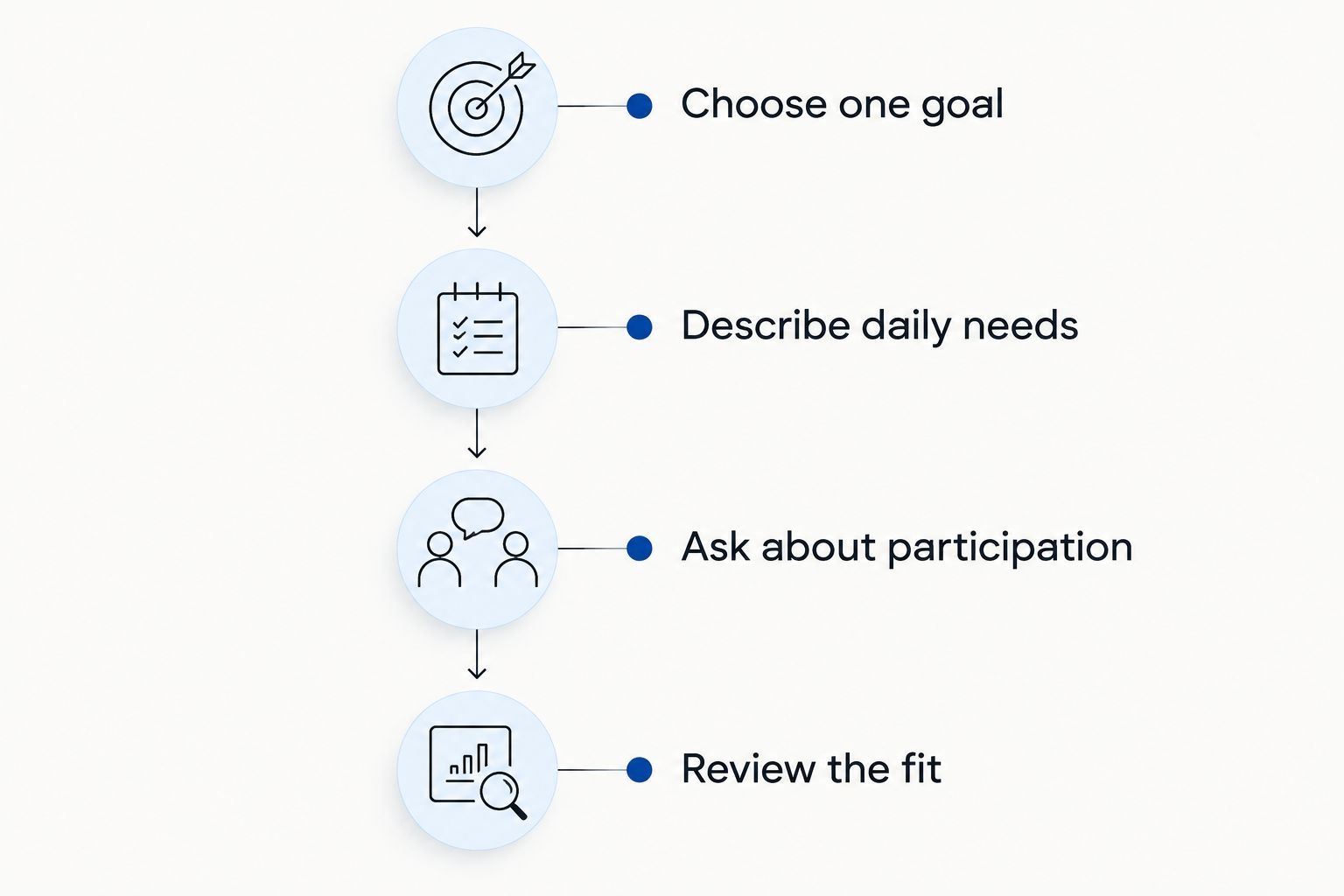
Use these steps before arranging a new service. They keep the comparison centered on your child rather than on the longest list of offerings.
- Choose one goal. Name something meaningful to your child, such as communicating a choice, joining an activity, or getting support with a learning task.
- Describe daily needs. Explain communication methods, interests, sensory preferences, and situations that feel difficult.
- Ask about participation. Find out what happens during a session or group, how breaks work, and how a child can decline an activity.
- Review the fit. Compare the proposed approach with your goal and with what your child communicates about the experience.
Match the questions to your child's age
For a child ages 2–5, ask how the activity accommodates play, caregiver involvement, and ways of communicating without speech. Do not assume a group intended for older children will work with minor changes.
For a child ages 6–12, ask about shared interests, school-day routines, and the difference between structured participation and open-ended play. Describe what helps your child feel comfortable joining others.
For a teenager ages 13–18, include the teenager directly in the decision using their preferred communication method. Ask about age-respectful activities and opportunities to choose. A program should not be selected solely because it accepts their age.
Why consider switching from TreeTop ABA?
Consider a change when the proposed support does not match the goal you need addressed. That is a decision rule, not a claim about TreeTop ABA's services or other families' experiences.
Use these 3 questions to examine your current arrangement:
- Does the plan address a goal that matters to your child and family?
- Can your child communicate discomfort, preferences, and a wish to pause?
- Are you seeking a different service, or an additional opportunity for learning or community participation?
The last question matters. Adding a community activity is not the same decision as replacing a therapist. Before changing providers in 2026, discuss continuity, the child's experience, and the purpose of the change with the people involved in their support.
When staying with TreeTop ABA is the right call
Staying is a reasonable choice when you trust the relationship, the goals remain relevant, and your child's needs are respected. A different provider name does not establish a better fit.
If your concern is a missing community opportunity, investigate that need separately. If your concern is the therapy plan itself, ask for a clear discussion of the goals and approach before deciding whether to leave.
FAQ
What’s the best TreeTop ABA alternative for Brooklyn families in 2026?
Autism Learn & Play is an option to explore when you want therapy services, community programs, and online classes for children ages 2–18. A focused speech or occupational therapy provider is the option to explore when your priority is a specific communication or everyday-activity goal.
Is a community program the same as ABA therapy?
No, a community program and ABA therapy are different kinds of support. Ask whether you need an opportunity for shared activities, an individualized therapy service, or both.
Does my child need to stop ABA to try another activity?
Trying a community activity does not inherently require stopping ABA. Discuss how any additional service fits with your child’s needs and existing support before making a change.
What should I ask before joining an autism community group?
Ask what participants do, which ages the group serves, and how communication needs and breaks are handled. Confirm caregiver expectations and how your child can decline an activity or leave early.
How do I compare speech therapy with an ABA provider?
Compare how each proposed plan addresses the same communication goal. Ask about your child’s existing communication methods and how the provider supports expressing needs, preferences, and discomfort.
What should I look for in a program for an autistic teenager?
Look for age-respectful activities that match the teenager’s interests and communication needs. Include the teenager in choosing the activity and discussing what participation should look like.
How can I ask Autism Learn & Play about services?
Use the website contact form or email info@autismlearnplay.org. Describe your child’s age, interests, communication needs, and the service or community opportunity you want to discuss.
One last thing
The best alternative is sometimes an addition, not a replacement. For your 2026 decision, separate a therapy concern from a wish for more friendship, recreation, or learning opportunities. That distinction helps you ask for the right support without disrupting a relationship your child values.
Related guides
- Family support groups for autism in Brooklyn
- Social skills games for autistic teens
- Autism-friendly museums and attractions in NYC
- Art therapy activities for autistic kids