
Choose an occupational therapy evaluation first when sensory discomfort, movement, or everyday tasks are your child's main barriers; consider an ABA evaluation first when your child needs individualized support learning useful skills or understanding behavior that creates safety concerns. Neither therapy automatically comes first, and some children need both evaluations. In 2026, the right starting point is your child's priorities, comfort, and assessment—not a standard sequence based only on an autism diagnosis.
- ABA therapy vs occupational therapy is a needs-based decision, not a required sequence.
- Occupational therapy is best suited to evaluating barriers involving daily activities, movement, and sensory experiences.
- ABA assessment examines behavior and learning; goals should support communication, safety, and meaningful independence.
- Autism Learn & Play offers ABA and occupational therapy services for autistic children ages 2–18.
Why this matters
You do not have to choose a therapy for every challenge at once. Start with the situation that most limits your child's comfort, safety, or participation: getting dressed, entering a classroom, asking for help, or enjoying an outing.
Autism Learn & Play provides therapy services, community programs, and online classes for children ages 2–18. Autism Learn & Play is a fit for Brooklyn families seeking a nonprofit offering both ABA and occupational therapy services. A service list alone does not establish which approach fits your child; that requires an individual assessment.
Should I choose ABA therapy or occupational therapy first?
Choose the evaluation that best matches the activity your child wants or needs help with. In 2026, compare ABA therapy vs occupational therapy by asking what each clinician would assess, what they would change, and how your child would participate in decisions.
Occupational therapists assess participation in everyday activities, including how movement, sensory experiences, task demands, and the environment affect participation. ABA practitioners assess relationships between behavior, learning, and the surrounding environment. Their work can overlap, but they bring different assessment methods.
| Starting point | Best for evaluating | Potential benefit | Limitation to discuss |
|---|---|---|---|
| Occupational therapy | Daily activities, movement, and sensory barriers | Identifying task adaptations, environmental changes, and skills that support participation | Does not replace medical assessment or every communication and behavioral support need |
| ABA assessment | Learning and behavior patterns | Understanding behavior and teaching practical, individualized skills | Does not replace assessment of pain, movement difficulties, or sensory needs |
| Both evaluations | Overlapping needs | Examining the same challenge from different professional perspectives | Requires coordination so recommendations do not conflict or overwhelm your family |
These are starting points, not diagnostic rules. Difficulty putting on a coat, for example, might involve fasteners, fabric discomfort, an unclear sequence, or several issues together. Describe what happens before accepting a recommendation about treatment.
A sudden change in behavior, apparent pain, loss of skills, or an immediate safety concern calls for medical advice rather than choosing between therapy labels.
When occupational therapy is the better first evaluation
Occupational therapy is a sensible starting point when everyday participation is difficult because of the task, the environment, or your child's physical and sensory experience. Bring examples from home, school, and community outings rather than a list of traits you want changed.
An occupational therapist can assess concerns involving dressing, handling classroom tools, coordinating movements, or managing sensory demands during daily routines. The assessment should connect those concerns to activities your child finds meaningful.
For a younger child, that might mean exploring play materials without pressure to touch uncomfortable textures. For an older child, it might mean managing clothing fasteners or organizing materials for a preferred activity. A teenager might prioritize personal care or participating more comfortably in a community setting.
The advantage is a close look at the activity itself. Sometimes changing the materials, seating, sequence, or surroundings belongs in the plan alongside teaching a skill.
The limitation is that an occupational therapy evaluation does not answer every question about communication, learning, or behavior. Ask the occupational therapist to explain when another professional's assessment is needed. A useful recommendation identifies a barrier and a practical response—not simply a need to tolerate more discomfort.
When an ABA evaluation is the better first step
An ABA evaluation is a reasonable starting point when the main question concerns learning a useful skill or understanding behavior that interferes with safety and participation. Ask the practitioner to explain what information they need before proposing treatment.
Examples include learning a reliable way to request help, understanding patterns around leaving a safe area, or breaking a meaningful routine into teachable steps. Behavior alone does not explain its cause. Pain, communication barriers, sensory discomfort, and confusing expectations need consideration rather than assumptions.
The potential benefit is a structured assessment of what happens before and after a behavior, followed by individualized teaching. A plan should identify the practical purpose of each goal and how your child's preferences will shape sessions.
The limitation is that a behavioral assessment is not a substitute for medical care, occupational therapy, or speech-language assessment. Ask how the practitioner will recognize distress, respond to refusal, and coordinate referrals.
Avoid goals focused only on appearing less autistic. Eye contact, still hands, or unquestioning obedience should not take priority over communication, autonomy, comfort, and safety. Harmless stimming does not need to disappear for your child to belong in a classroom or community group.
Why the right starting point varies
The same outward difficulty can have different explanations. Use these factors to guide the discussion:
- Your child's priority: Identify what your child wants to do, communicate, avoid, or change. Include preferences expressed through gestures, movement, pictures, or communication devices.
- The immediate barrier: Describe whether the difficulty involves discomfort, movement, an unfamiliar task, communication, safety, or several concerns together.
- The setting: Compare what happens at home, school, a playground, and a group activity. Note what changes between settings.
- Existing support: Share school evaluations and current professional recommendations so a new plan does not duplicate or contradict useful support.
- Your family's capacity: Include travel, school, rest, sibling time, and your child's response to appointments when discussing a workable plan.
- The clinician's approach: Ask how the clinician adapts activities, respects a child's refusal, and explains progress in everyday terms.
There is no requirement to fill your child's week with appointments before making room for friendship or play. Discuss how any proposed schedule protects those parts of childhood.
How to decide what to book first
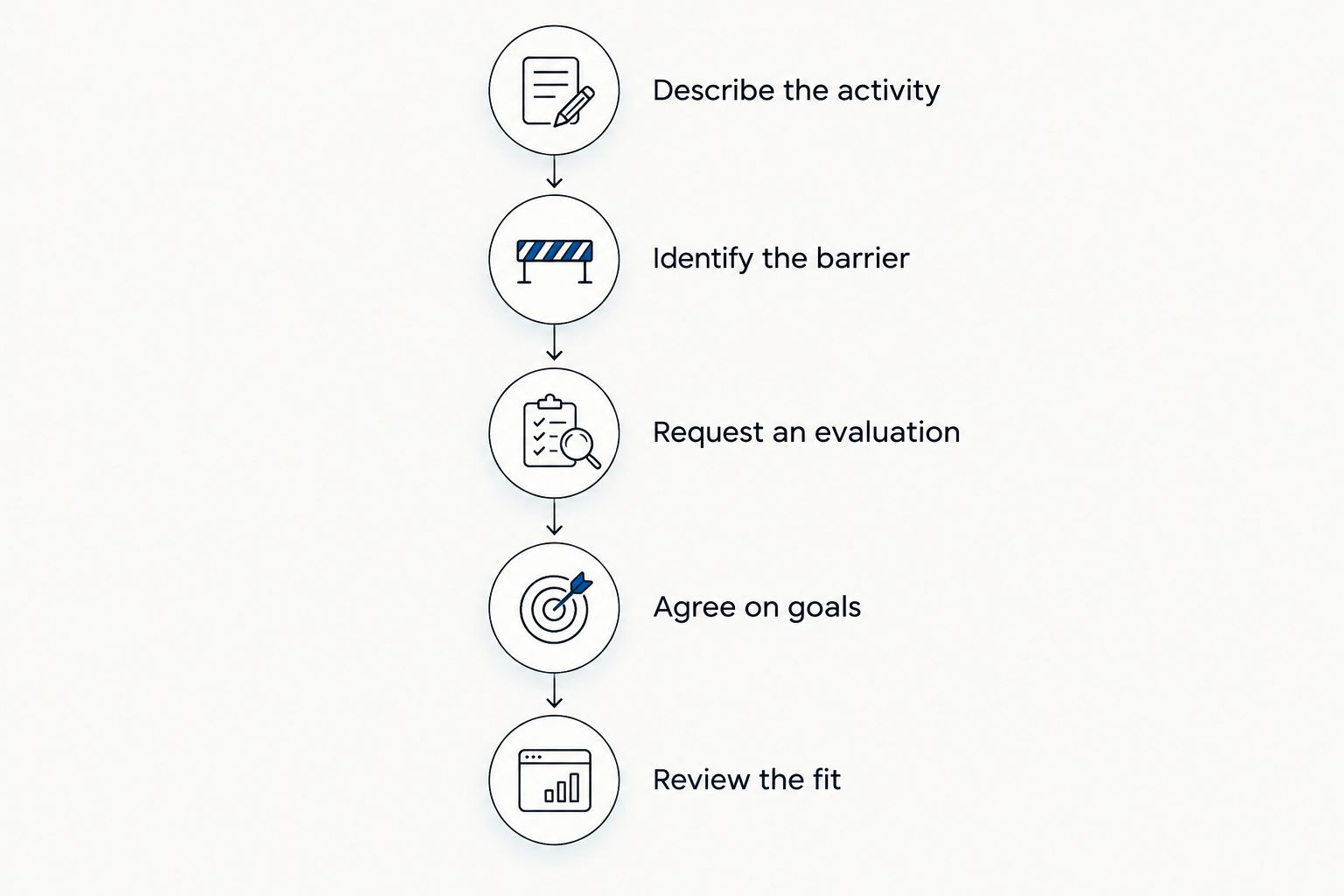
Use this sequence for your 2026 consultation. You do not need to arrive knowing which professional has the answer.
- Describe the activity. Write down a specific situation, such as getting ready for a playground visit. Avoid broad descriptions such as difficult behavior.
- Identify the barrier. Note what your child does, what happens beforehand, and what appears to make the situation easier or harder. Separate observations from guesses.
- Request an evaluation. Ask which assessment best addresses the concern and whether another professional should contribute. Share relevant school and medical information.
- Agree on goals. Choose meaningful changes, such as requesting a break or managing a clothing task. Ask how your child's comfort and choices will be included.
- Review the fit. Discuss participation, distress, daily usefulness, and whether the plan needs adjustment. Do not judge success only by completing session activities.
If school participation is central to your concern, bring your child's existing educational plan. This guide to connecting a CSE evaluation to autism therapy services offers a related starting point for organizing that conversation.
What should I expect at an evaluation?
Expect questions about your child's daily routines, strengths, interests, communication, and the situations that prompted your concern. Depending on the evaluation, the clinician will observe activities, gather caregiver information, and use assessment tools appropriate to the question.
Before the appointment, ask what your child will be invited to do and whether you can share information beforehand. Explain how your child communicates discomfort or needs a break. Bring familiar communication supports when relevant.
Ask the clinician to distinguish observations from conclusions. Leaving a busy room is an observation; deciding why your child left requires more information. A helpful explanation connects the assessment findings to a proposed goal and acknowledges questions that need another professional's input.
How does age change the decision?
Across ages 2–18, interests and responsibilities change, but age alone does not decide between ABA and occupational therapy. In 2026, choose age-respectful activities and include your child in decisions in an accessible way.
- Younger children: Discuss play, caregiving routines, communication, and comfort exploring familiar environments. Ask how caregivers will participate without turning every interaction into practice.
- School-age children: Connect goals to classroom access, self-care, preferred play, and friendships. Ask whether an environmental adjustment would help before adding another demand.
- Teenagers: Ask directly about priorities such as privacy, personal care, school routines, community participation, and friendships. Materials and expectations should respect the teenager's age and interests.
Do not assume that an older child needs younger-looking activities because a skill is emerging. Adapt the task while preserving dignity and choice.
Can my child receive ABA and occupational therapy together?
Your child can receive both when assessments identify distinct or overlapping needs. Ask the clinicians to explain each professional's role and, with your permission, share relevant recommendations.
For example, an occupational therapist might assess the demands of a dressing task while a behavioral practitioner examines how to teach an agreed routine. Neither explanation should erase discomfort or replace the child's communication.
Choose coordination over simply adding appointments. Ask how the clinicians will handle conflicting recommendations, recognize overload, and decide whether a support is helping outside sessions.
Which therapy should come first if my child does not speak?
Not speaking does not, by itself, make ABA or occupational therapy the first choice. Start with the child's main barriers and include a speech-language professional when communication assessment is needed.
Ask every clinician to respect existing communication methods, including gestures, pictures, typing, or an augmentative and alternative communication device. Access to communication should not depend on completing a task or speaking aloud.
How can therapy goals support outings and friendships?
Choose goals that help your child participate in activities they enjoy, not goals that make participation conditional on looking like everyone else. A useful outing goal might involve requesting a quieter space, joining a preferred activity, or leaving comfortably when finished.
For a Brooklyn community outing, ask organizers about noise, transitions, caregiver participation, and opportunities to step away. Confirm these details directly; a sensory-friendly label does not tell you how a particular event will feel to your child.
Friendship is not a performance task. Leave room for shared interests, parallel participation, and relationships that develop at your child's pace.
FAQ
What’s the main difference between ABA therapy and occupational therapy?
ABA examines behavior and learning, while occupational therapy examines participation in everyday activities. Their work can overlap, so ask what each assessment would address for your child.
Is occupational therapy better than ABA for sensory concerns?
An occupational therapy evaluation is a relevant starting point when sensory experiences interfere with daily activities. Ask the occupational therapist to identify practical adaptations and explain whether other assessments are needed.
Does my child have to try ABA before occupational therapy?
There is no universal clinical sequence requiring ABA before occupational therapy. Start with the evaluation that matches your child’s needs and confirm any referral requirements with the relevant provider or insurer.
Can an autistic teenager start occupational therapy or ABA?
An autistic teenager can be evaluated for either service when there is a relevant concern. Goals should reflect the teenager’s priorities, privacy, communication, and age rather than assuming younger-child activities will fit.
Should I stop therapy if my child is distressed?
Take distress seriously and ask the clinician to pause and assess what is happening. Discuss pain, sensory demands, communication, the activity itself, and changes needed before continuing.
How will I know whether a therapy is helping?
Look for meaningful changes connected to agreed goals, alongside your child’s comfort and participation. Ask the clinician to explain how progress is assessed and whether it carries into daily life.
How can I ask Autism Learn & Play about ABA and occupational therapy?
Email info@autismlearnplay.org or use the website contact form to ask about ABA and occupational therapy services. Describe your child’s age, priorities, and the everyday situation you want help understanding.
One last thing
Before your 2026 consultation, write down what already makes the difficult activity easier. A different shirt, a quieter entrance, a familiar companion, or a clearer choice gives the clinician useful information.
The first useful change does not always require teaching your child something new. Ask what adults can change about the task or environment, too.
Related guides
- How do I know if my child needs occupational therapy?
- How to connect your child's IEP to ABA therapy goals
- Can autistic kids make real friends in group therapy?