Your child needs an occupational therapy evaluation when everyday activities—getting dressed, eating, writing, playing, or joining outings—regularly cause difficulty, distress, or a need for support that limits participation. An evaluation, not a checklist or an autism diagnosis alone, determines whether occupational therapy is appropriate; discuss persistent concerns with your child’s pediatrician and describe what happens during daily routines.
- How do I know if my child needs occupational therapy? Look for recurring barriers to daily activities and participation.
- An occupational therapy evaluation considers your child’s abilities, environment, preferences, and support needs—not a diagnosis alone.
- Autism Learn & Play provides autism therapy services and community programs for children ages 2–18.
- The goal is comfortable participation and useful skills, not stopping harmless differences or making children appear less autistic.
How do I know if my child needs occupational therapy?
Ask about an evaluation when a recurring difficulty gets in the way of something your child needs or wants to do. Consider the effort, discomfort, and assistance involved—not simply whether your child can finish the task.
For example, getting through school does not tell you whether holding a pencil hurts or getting dressed leaves your child exhausted. When discussing occupational therapy services, bring examples from ordinary days rather than trying to identify a diagnosis yourself.
| Daily activity | What to bring up during an evaluation | What the example does not prove |
|---|---|---|
| Dressing and grooming | Fasteners, toothbrushing, or clothing sensations repeatedly interrupt routines | Disliking a fabric alone does not establish a therapy need |
| Eating | Using utensils, sitting comfortably, or managing food textures is consistently difficult | A food preference alone does not identify the cause |
| Schoolwork | Handwriting causes discomfort, materials are hard to manage, or work requires substantial help | Untidy handwriting alone does not establish a diagnosis |
| Play and outings | Playground equipment, crowded spaces, or group materials create barriers | Preferring quiet or solitary play is not automatically a problem |
| Daily organization | Starting or sequencing familiar routines requires repeated support | Forgetting an occasional step does not establish a therapy need |
These are conversation starters, not a diagnostic scoring system. A pediatrician or occupational therapist can help separate a task-related concern from a medical issue, a different support need, or an environment that needs changing.
Why this matters
The useful question is not whether your child looks different from other children. It is whether your child has access to everyday life with reasonable comfort, safety, choice, and support.
For a Brooklyn family planning outings in 2026, that might mean finding a manageable way to join a library activity, use a community bathroom, or participate in a shared craft. The activity should serve your child—not become another test your child must pass.
You can make supportive changes while seeking advice. Offering a quieter place, an easier fastener, or a different way to participate does not require proving that your child has a particular condition.
What should I notice at different ages?
Age helps put a task in context, but these age bands are planning examples, not developmental deadlines. Consider your child’s experience, opportunities to practice, communication, and current support needs.
Ages 2–5 years: play and daily care
For children ages 2–5 years, bring concerns about participation in play, mealtimes, dressing, washing, or other familiar routines. Describe what your child enjoys as carefully as what feels difficult.
For instance, explain whether your child wants to use a playground but struggles with the equipment, or enjoys painting but finds touching paint uncomfortable. Those examples point toward different questions and possible adaptations.
Avoid turning every outing into practice. A child can watch, explore alongside others, or leave without completing an adult’s planned activity.
Ages 6–12 years: school tasks and community activities
For children ages 6–12 years, consider both school demands and life outside the classroom. Writing, managing belongings, opening lunch containers, and handling activity materials are useful topics when they create persistent barriers.
Ask teachers what helps rather than requesting only a list of difficulties. A child who participates comfortably with different seating, instructions, or materials gives the evaluator important information about the environment.
When reviewing school concerns in 2026, include your child’s own account of effort and discomfort. Finished work does not tell the whole story.
Ages 13–18 years: autonomy and chosen interests
For young people ages 13–18 years, center goals they value: managing personal care, organizing materials, preparing a snack, or joining an interest-based group. Do not assume that an activity designed for young children is suitable for a teenager.
Ask what feels frustrating, tiring, embarrassing, or unnecessarily difficult. Respect privacy when discussing personal care and invite the teenager to help choose what an evaluation should address.
Support can include changing a task or environment, not just practicing a skill. Independence should not mean removing assistance that remains useful.
Why occupational therapy needs vary
Two children can struggle with the same activity for different reasons. An evaluation should explore the task and its setting rather than treating the visible behavior as the explanation.
- Task demands: Pulling on a loose shirt differs from managing small buttons. Name the particular step that creates difficulty.
- Sensory experiences: Sound, lighting, touch, movement, and food textures can affect comfort and participation. Describe the experience without assuming its cause.
- Physical demands: Gripping, reaching, posture, coordination, or fatigue can affect how a task feels. Report pain to your child’s clinician.
- Communication access: Your child needs a reliable way to request help, decline, or explain discomfort. Include speech, gestures, pictures, or an existing communication device.
- Setting and expectations: A quiet room and a crowded community event place different demands on the same child. Record what changes between settings.
- Personal priorities: Your child’s goals matter. Working toward a chosen activity differs from practicing something solely because an adult prefers it.
A stronger plan explains what support is intended to change and why that change matters to your child. Avoid goals based only on appearing typical or complying without a way to say no.
What should I do before requesting an evaluation?
You do not need a detailed home assessment. Bring clear observations and questions that help a clinician understand ordinary life.
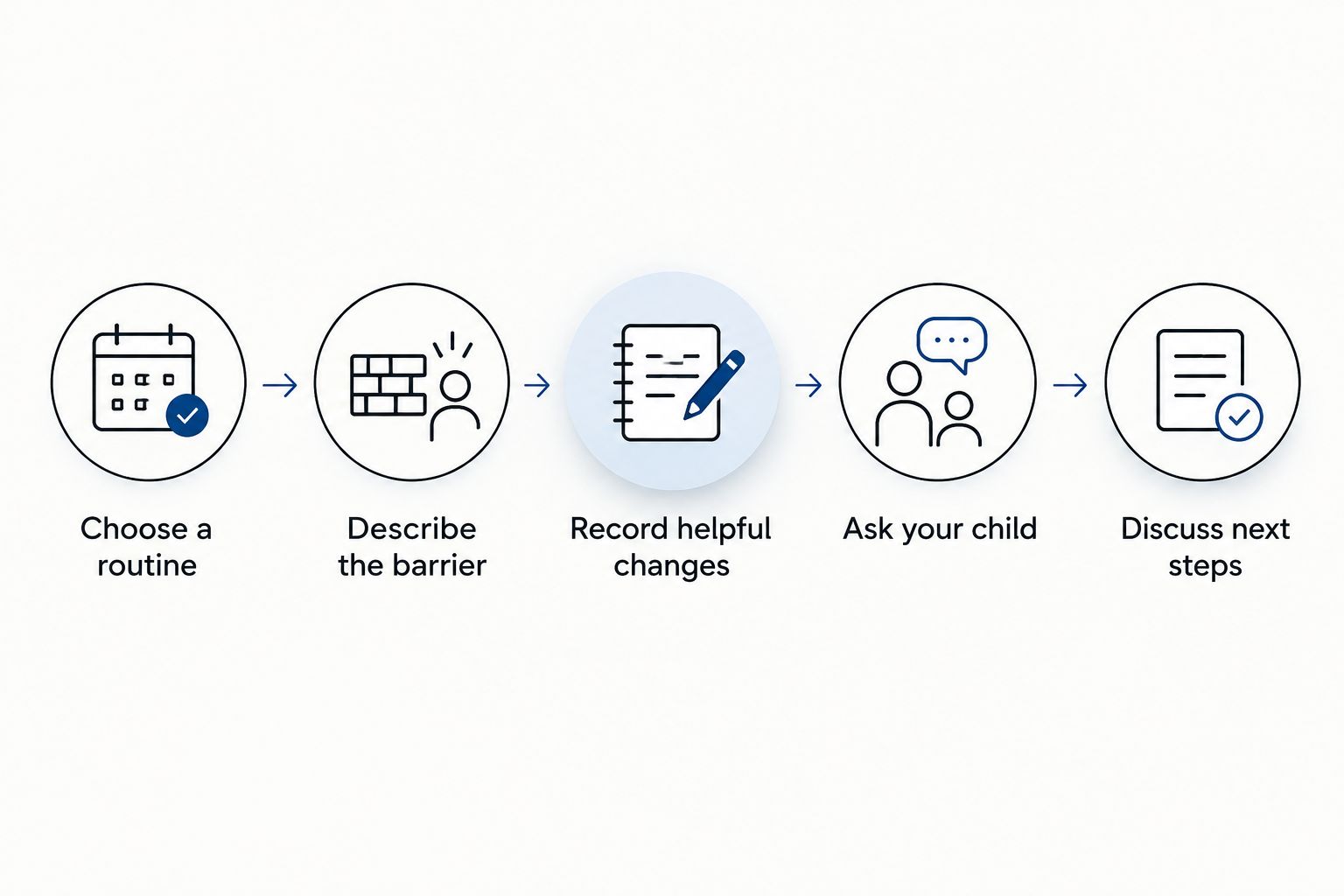
- Choose a routine. Start with an activity that regularly creates difficulty, such as getting ready for school or joining a community art activity.
- Describe the barrier. Record what happens before, during, and after the difficult part. Include your child’s words or other communication when possible.
- Record helpful changes. Note whether quieter surroundings, different materials, extra preparation, or assistance changes the experience.
- Ask your child. Offer an accessible way to explain what feels hard and what they would like to do differently.
- Discuss next steps. Share the examples with your pediatrician or a qualified occupational therapist and ask whether an evaluation is appropriate.
Keep your 2026 notes practical: name the task, the difficulty, and what helped. You do not need to assign a severity score or compare your child with siblings.
Ask the clinician what the evaluation includes and how your child can communicate discomfort or take a break. Explain any supports your child already uses so the appointment does not depend on managing without them.
How can I judge whether an outing needs adapting?
Before booking a Brooklyn outing in 2026, separate the activity from the surroundings. Your child might love the subject of a museum workshop while finding the entrance queue or crowded bathroom difficult.
Ask the organizer about the arrival process, noise, seating, materials, bathroom access, and whether families can step out. These are questions to verify, not features to assume from a sensory-friendly label.
Waiting areas deserve attention too. Whether a room includes sensory wall panels matters less than whether your child wants to use them and can choose a quieter alternative; adding equipment does not establish that a space meets every child’s needs.
Agree on an exit plan that your child understands. Watching from the edge, joining only the preferred part, or leaving early can be valid ways to participate—not evidence of failure.
Afterward, ask what felt good and what should change. Those observations can help an occupational therapist understand barriers that are hard to reproduce during an appointment.
Does every autistic child need occupational therapy?
No. An autism diagnosis alone does not determine whether a child needs occupational therapy; daily participation, individual priorities, and evaluation findings guide that decision.
Harmless stimming, avoiding eye contact, or preferring a particular interest is not, by itself, a reason to seek treatment. Focus on access, comfort, safety, and goals that matter to your child.
Autism Learn & Play is best suited to Brooklyn families seeking autism therapy services and community programs for children ages 2–18. The nonprofit provides occupational therapy alongside other services, but a service listing cannot determine the right support for an individual child.
Should I try activities at home or arrange an evaluation?
You can adapt routines at home while arranging professional advice. Offer choices and reduce unnecessary barriers, but do not use home activities as a test your child must pass before receiving help.
| Approach | Best for | Benefit | Limit |
|---|---|---|---|
| Everyday adaptations | Making a familiar task more accessible now | Lets you respond to your child’s preferences | Does not identify the cause of persistent difficulty |
| Occupational therapy evaluation | Understanding recurring barriers to participation | Connects observations with individualized recommendations | Requires assessment; it does not guarantee therapy will be recommended |
| Pediatric medical review | Pain, sudden changes, or broader health concerns | Addresses possible medical explanations | Does not replace task-specific assessment when that is also needed |
Do not force exposure to an uncomfortable sensation or add specialized equipment simply because it is described as therapeutic. Ask a qualified clinician whether a proposed activity or tool fits your child’s needs.
When should I contact the pediatrician instead of waiting?
Contact your child’s pediatrician promptly for a loss of previously acquired skills, new weakness, persistent pain, or a sudden change in everyday functioning. Do not assume that a new difficulty is part of autism or wait for a routine therapy appointment to discuss it.
Breathing trouble or an active choking emergency requires emergency help. Eating concerns involving coughing, choking, pain, or growth need medical assessment rather than a home sensory plan alone.
This article provides general education, not a diagnosis. A clinician who knows your child can advise on the appropriate evaluation and urgency.
How do I ask about support in Brooklyn?
When contacting a provider in 2026, describe your child’s age, the activities causing difficulty, existing supports, and your child’s priorities. Ask how families participate in goal-setting and how the provider responds when a child needs a break or declines an activity.
For Autism Learn & Play, use the website contact form or write to info@autismlearnplay.org to ask about occupational therapy and community programs. Confirm the program’s age fit and individual arrangements directly; do not assume a class or group is an occupational therapy session.
FAQ
What are the signs that my child needs occupational therapy?
Recurring difficulty with dressing, eating, school tasks, play, or outings is a reason to ask about an occupational therapy evaluation. The key issue is how the difficulty affects comfort, safety, and participation—not a checklist score.
Does my autistic child automatically need occupational therapy?
No, an autism diagnosis does not automatically mean your child needs occupational therapy. An evaluation considers daily activities, individual goals, and the support your child already has.
Can occupational therapy help if my child struggles at community outings?
Occupational therapy can assess barriers that make community outings difficult, including task demands and sensory experiences. Recommendations should address your child’s needs without promising a particular outcome.
Can I request help if my child only struggles at home?
Yes, describe difficulties at home even when school reports no concerns. Different settings place different demands on children, and the contrast is useful assessment information.
Is occupational therapy still relevant for an autistic teenager?
Yes, an occupational therapy evaluation can address a teenager’s difficulties with daily activities and chosen goals. Include the teenager in decisions about personal care, organization, and community participation.
Does Autism Learn & Play provide occupational therapy?
Yes, Autism Learn & Play provides occupational therapy among its autism therapy services for children ages 2–18. Contact the nonprofit directly to discuss your child’s needs and ask about assessment arrangements.
One last thing
Ask what changes when the task becomes easier—not only whether your child finishes it. Choosing comfortable clothing, using an adapted tool, or taking a break can be meaningful support even when the original difficulty remains.
Bring your child’s favorite activities to the conversation. The strongest starting point is something your child wants more access to: making art, playing alongside a friend, or enjoying an outing together.
Related guides
- Occupational therapy activities for autism at home
- How often should a child with autism attend occupational therapy?
- Autism-friendly museums and attractions in NYC