
Instead of manually translating school updates into therapy requests, connect IEP to ABA therapy goals with a shared planning sheet that links each school goal to a useful everyday skill. Keep the school and therapy plans separate, but give both teams a clear picture of your child's priorities, communication, and support needs.
- To connect IEP to ABA therapy goals, match meaningful skills across settings rather than copying targets.
- Autism Learn & Play serves Brooklyn families through autism therapy, community programs, and online classes.
- Keep IEP decisions with the school team and treatment decisions with the treating provider.
- Include your child’s communication, preferences, sensory needs, and right to decline in shared planning.
Why this matters
An individualized education program, or IEP, addresses your child's educational needs. An applied behavior analysis, or ABA, treatment plan has its own assessment, goals, and review process. Related skills can appear in both documents without identical wording or teaching methods.
Connect the purpose of the goals, not just their wording. Asking for help during class and asking for help during a community activity share a practical purpose, even when the surroundings and available supports differ.
Autism Learn & Play is a Brooklyn nonprofit providing autism therapy, community programs, and online classes for children ages 2–18. Families preparing for school discussions can also consult these IEP advocacy resources for autism parents.
For your 2026 planning, start with what your child wants or needs to do more comfortably: join a game, communicate a break, ask a question, or participate in an outing. A goal should make daily life more accessible, not simply make a child appear less autistic.
Before you start
- Gather the current documents. Have the IEP, relevant progress reports, the ABA treatment plan, and any communication or sensory supports your child uses. Mark the dates so an older goal does not become the starting point by mistake.
- Identify the people and permissions. Include the school case manager, treating provider, and relevant specialists. Ask each organization what consent it requires before sharing records or discussing your child; share only the information needed.
- Check the hidden mismatch. Teams sometimes use the same word, such as independent, to mean different things. Establish whether a visual cue, communication device, spoken reminder, or adult model counts as support before comparing progress.
You do not need special software. A 1-page worksheet is enough to begin; it should summarize agreed priorities, not replace either formal plan.
Shared goal map
Identify the meaningful skill
- Choose a starting goal. Select a current IEP goal that connects to a daily need your family recognizes. Begin with a manageable priority rather than translating the entire IEP at once.
- Ask what the goal makes possible. Replace broad descriptions such as better behavior with a specific purpose: communicating discomfort, understanding an activity, requesting assistance, or joining peers voluntarily.
- Invite your child's perspective. Use speech, AAC, pictures, gestures, observation, or another familiar communication method. Ask what feels difficult and what your child would like help doing.
- Record the current starting point. Describe what happens now, where it happens, and what support helps. Keep observation separate from interpretation: leaving a noisy table does not, by itself, explain why your child left.
Expected result: You can explain the selected goal in everyday language and name the benefit to your child. If the purpose is unclear, ask the team to clarify it before adding practice.
Build the planning sheet
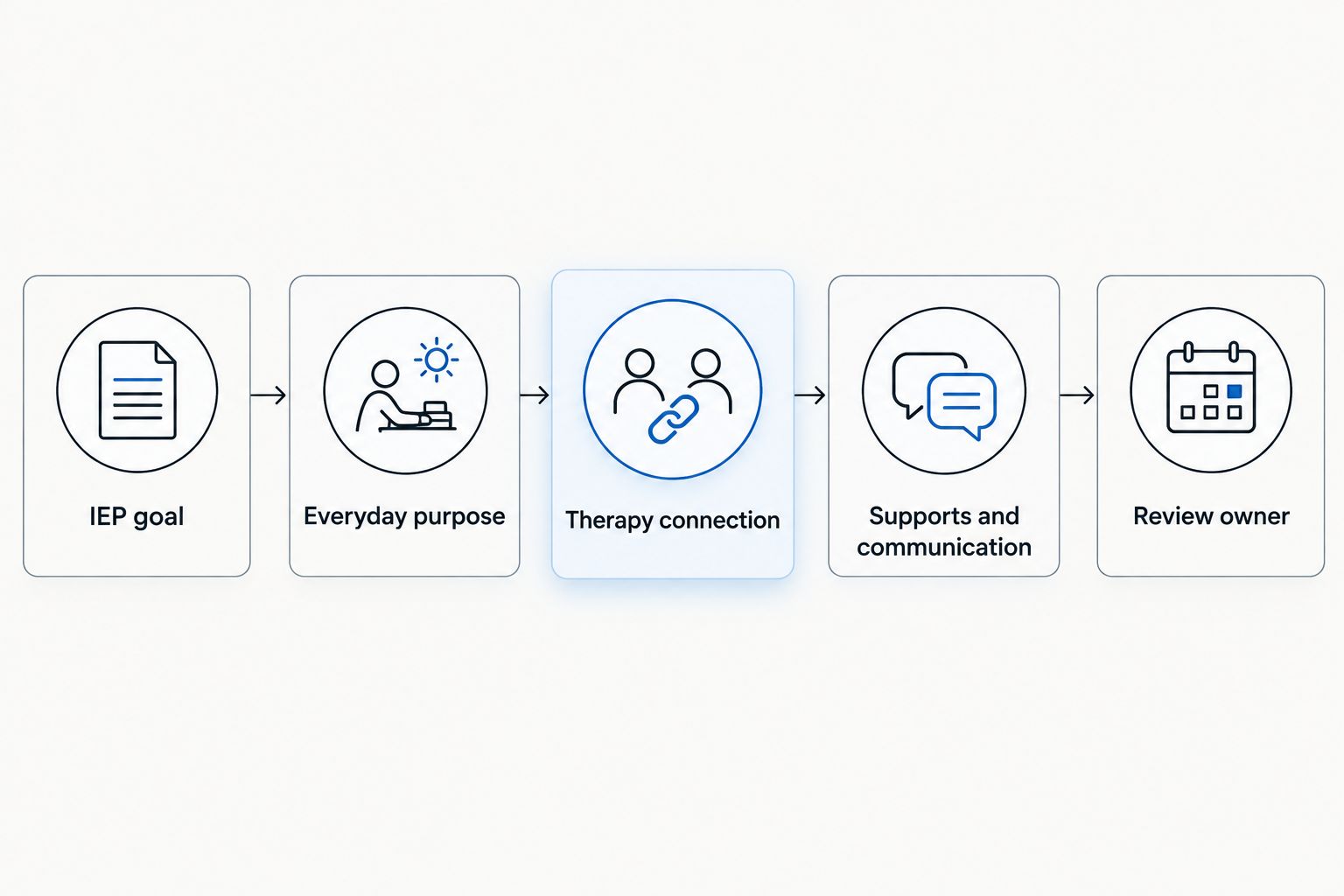
Create a document called Shared goal map — 2026. The bold labels below are suggested worksheet headings, not buttons in a school or therapy platform.
- IEP goal: Copy the relevant wording accurately, including the conditions and measurement method.
- Everyday purpose: Describe the useful skill beneath the goal, such as getting help without waiting for distress.
- Therapy connection: Ask the treating provider whether the skill belongs in the treatment plan and how it would be assessed. A school goal does not automatically become a clinical target.
- Supports and communication: Record the tools, accommodations, preferred communication methods, and choices that should remain accessible.
- Review owner: Identify who will collect each observation, who will summarize it, and when the teams will discuss it.
Use 3 columns for observations: Setting, Support offered, and Child's response. These headings help distinguish a change in skill from a change in the environment.
Expected result: The worksheet connects the plans without quietly rewriting either one. Each team can see its responsibilities and identify questions that need a formal discussion.
Cross-setting practice plan
Choose the connection method
There are two useful ways to connect school and therapy work. Choose according to the child's need, not a preference for matching paperwork.
| Approach | Best for | Benefit | Limitation |
|---|---|---|---|
| Shared skill, different setting | A skill that matters at school and elsewhere | Preserves a clear purpose across daily routines | Progress cannot be compared directly when conditions differ |
| Related supporting skill | A school task that depends on a separate communication or participation skill | Lets each team address its own part | Requires a clear explanation of how the skills connect |
For example, requesting help during a classroom task can connect to requesting help during a familiar game. That is a shared skill in different settings. Learning to communicate confusion might instead support participation in a school activity without copying its academic target.
- Select the approach with both teams. Ask whether you are practicing the same skill or building a related supporting skill. Write that distinction on the sheet.
- Choose a familiar routine. Start with something your child already encounters, such as drawing, choosing a snack, or getting ready to leave. Avoid turning every family activity into a lesson.
- Agree on accessible supports. Keep AAC, visual information, movement breaks, and other needed accommodations accessible. Ask specialists to coordinate when communication or motor access is involved.
- Define when to pause. Agree how adults will respond to refusal, fatigue, discomfort, or distress. A request to stop is communication, not a reason to intensify demands.
Expected result: Every adult knows what skill is being supported, what help stays in place, and when practice ends. The plan fits the child rather than requiring the child to tolerate an unsuitable setup.
Adapt the routine to age and interests
For younger children, choose play and familiar caregiving routines. A child ages 2–5 might communicate a choice during play; the activity should not depend on reading or spoken answers.
For school-age children, consider shared interests, classroom access, or manageable group activities. For teens, ask about privacy, friendships, personal preferences, and independence on their terms. Use age-respectful materials rather than assuming an activity for a preschooler suits a teenager.
An outing can provide a meaningful context, but it is not a test. Before a Brooklyn community activity, ask about noise, waiting, transitions, and a place to pause. Confirm details with the organizer rather than assuming a program provides particular accommodations.
Team review routine
Compare observations without combining unlike scores
- Record the context. Note the activity, communication options, support offered, and your child's response. Include what made participation easier, not just whether an adult marked the task complete.
- Separate supported and unsupported performance. A response following an adult model is different from a response initiated by the child. Both provide useful information when described honestly.
- Review across 2 settings. Compare school with another relevant setting, such as home or a community activity. Look for differences in demands, noise, familiarity, and access to support before drawing conclusions.
- Assign the next action. Decide who will clarify a definition, change an activity, or bring a question to the appropriate team. Record the decision date, including 2026 where applicable.
Expected result: The review ends with a specific action and a named owner, not a combined percentage that hides different conditions.
For school-side context, share the ABA therapy guide for classroom teachers. A shared resource supports discussion; it does not replace your child's individualized plan.
Autism Learn & Play provides autism therapy and community programs for Brooklyn families with children ages 2–18. When asking about services, explain the everyday priority you want to discuss and ask how family and school input are considered. Confirm the provider's actual coordination process directly.
Reconnect the plans whenever a goal changes
Use the same workflow when an IEP is revised or the treating provider changes a therapy goal. Update the connection rather than continuing to practice a target because it appears on an older worksheet.
For a 2026 review, mark each entry Current, Needs discussion, or Retired. These are suggested document labels, not official school categories.
- Current: Both teams confirm the connection remains useful.
- Needs discussion: The purpose, supports, measurement, or child's priorities have changed.
- Retired: The connection no longer applies; keep the history without treating it as an active task.
Bring proposed school changes to the IEP team and treatment changes to the treating provider. Editing your family worksheet does not amend either formal plan.
Troubleshooting
School reports progress, but home feels different
Compare the conditions before concluding that a skill has disappeared. Ask whether school offers visual cues, a familiar routine, different materials, or more preparation. Recreate helpful access supports where appropriate; do not remove them to make the comparison look cleaner.
Both plans use the same goal, but scores disagree
Check the definitions of an opportunity, a successful response, and adult assistance. Keep the records separate until those definitions are understood. Matching goal titles do not make the measurements interchangeable.
Practice causes distress or repeated refusal
Pause the activity and discuss what happened with the relevant provider. Check communication access, sensory demands, fatigue, discomfort, and whether the goal matters to your child. Seek appropriate medical advice when pain or a health concern is suspected.
The school and therapy provider disagree
Ask each team to state the purpose, evidence, and proposed support in plain language. Document the unresolved question and who will address it. Do not ask your child to follow conflicting instructions while adults sort out the plan.
Customize your workflow
Keep coordination small enough to use. A brief, useful record beats a detailed form nobody maintains. Families should not have to document every interaction to participate in planning.
Add speech or occupational therapy input when a goal involves communication access, movement, or sensory needs. For community participation, include practical questions about entering the space, choosing an activity, meeting peers, and leaving comfortably.
Autism Learn & Play offers therapy services, community programs, and online classes. To discuss your family's priorities, use the website contact form or email info@autismlearnplay.org; ask directly about the services and coordination relevant to your child.
FAQ
How do I connect IEP to ABA therapy goals without copying them?
Identify the useful skill beneath an IEP goal, then ask the treating provider whether that skill connects to the therapy plan. Keep each plan’s purpose, measurement, and decision-making process separate.
Does every IEP goal need a matching ABA goal?
No, every IEP goal does not need a matching ABA goal. Connect only the priorities that fit the child’s needs and the treating provider’s assessment; academic targets and clinical goals serve different purposes.
Can my child’s ABA provider change the IEP?
An outside ABA provider cannot independently change your child’s IEP. The provider can share relevant information with appropriate permission, while IEP decisions belong in the school’s IEP process.
What if my child uses AAC instead of speech?
Include your child’s AAC method in shared planning and keep it accessible during relevant activities. Coordinate with the speech-language professional so a communication goal does not become a requirement to speak.
What should I do if a shared goal upsets my child?
Pause the activity and bring the concern to the relevant team. Review the goal’s purpose, the environment, communication access, and signs of discomfort rather than treating distress as something to push through.
Can a community outing connect to an IEP goal?
A community outing can provide a meaningful setting for a related everyday skill, such as requesting help or choosing an activity. Agree on supports beforehand and keep participation voluntary rather than treating the outing as a test.
What should I bring to a 2026 school and therapy planning meeting?
Bring the current IEP, relevant therapy goals, recent observations, and your child’s communication and support information. Include your child’s preferences and identify the specific question you want the teams to resolve.
One last thing
A completed task can hide an access problem. Before celebrating a higher score, ask whether your child could request help, take a break, or say no throughout the activity. Participation matters more when your child has a genuine choice.
Related guides
- Social skills games for autistic teens
- Family support groups for autism in Brooklyn
- Autism-friendly museums and attractions in NYC