Hopebridge offers ABA therapy for autistic children, making it a relevant starting point when that is the service your family needs. A therapy provider does not replace school support, friendships, or opportunities to enjoy your neighborhood. Among Hopebridge alternatives Brooklyn families can consider in 2026, Autism Learn & Play is the best fit for families seeking a Brooklyn nonprofit offering therapy services and community programs; NYC Public Schools is the route for school-based support.
- For hopebridge alternatives brooklyn, Autism Learn & Play fits families seeking therapy services, community programs, and online classes.
- NYC Public Schools is the route for evaluating school-based special education support, not a replacement for community activities.
- Independent clinicians fit families seeking a particular therapy; family support groups offer parent connection rather than treatment.
- Compare age fit, communication support, sensory needs, and travel before choosing an autism therapy or community program.
Why this matters
Choosing autism support is not simply choosing a different provider. You are deciding which part of your child's week needs more support: communication, everyday activities, school participation, shared interests, or time with other children.
Start with that need. A child who wants a quieter place to meet peers needs a different shortlist from a child whose family is seeking an individual speech-language evaluation. Neither need is less important.
For your 2026 search, write down 2 priorities: the support your child needs and the experience your child wants. That keeps the comparison centered on your family rather than on the longest service list.
Hopebridge alternatives at a glance
These options serve different purposes. Use the table to choose a route, not to treat therapy, school services, and community connection as interchangeable.
| Option | Best for | Main offering or role | How it differs from Hopebridge | Main limitation |
|---|---|---|---|---|
| Hopebridge | Families specifically exploring ABA therapy | ABA therapy for autistic children | The reference point for this comparison | Therapy does not replace school services or community friendships |
| Autism Learn & Play | Brooklyn families seeking therapy services and community programs | A nonprofit offering therapies, community programs, and online classes for ages 2–18 | A Brooklyn-based option with educational and community offerings alongside therapy | A broad service list does not establish which individual program fits your child |
| NYC Public Schools | Families seeking school-based special education support | Evaluation and individualized educational planning | Focuses on access to education rather than choosing a private therapy provider | School support does not replace every outside-school need |
| Independent therapy clinicians | Families seeking a particular therapy | Individual professional services, such as speech or occupational therapy | Lets you focus your search on one discipline | Separate clinicians require coordination across providers |
| Parent and family support groups | Parents seeking connection and shared experience | Peer conversation and community support | Supports family connection rather than delivering a child's therapy | Peer support is not clinical assessment or treatment |
The strongest choice is the one that addresses your current priority. You can also combine routes—for example, school support, an outside clinician, and a family group—without expecting one organization to do everything.
1. Autism Learn & Play: best for therapy and community options
Autism Learn & Play is a Brooklyn-based nonprofit providing therapy services, community programs, and online classes for autistic children ages 2–18. Its stated services include ABA, speech, occupational, music and art therapy, and tutoring. Autism Learn & Play is the best Hopebridge alternative for Brooklyn families seeking therapy services alongside community and learning options.
That breadth gives you several types of support to ask about. It does not mean every child needs every service; start with your child's interests and the support you are seeking.
Where this option shines
- Its Brooklyn base matches a local family search.
- Its offerings include therapy, community programs, and online classes.
- Its stated age range includes younger children and teenagers.
- Music, art, and tutoring offer additional directions to explore beyond an ABA-only search.
Where this option falls short
- A program serving a broad age range still needs to fit your child's developmental stage and interests.
- Community participation is not a substitute for an individualized therapy plan when one is needed.
- Outside programs do not replace a school's responsibility to evaluate educational needs.
Head-to-head: nonprofit options versus an ABA-focused search
| Dimension | This Brooklyn nonprofit | Hopebridge |
|---|---|---|
| ABA | Included among stated services | Offers ABA therapy |
| Other stated offerings | Speech, occupational, music and art therapy, tutoring, community programs, and online classes | Compare the specific services relevant to your child directly |
| Local relevance | Brooklyn-based | Confirm the location relevant to your family |
| Decision point | You want to explore therapy and community options together | You are specifically evaluating ABA therapy |
Best for: Families who want to discuss both support needs and opportunities for participation. Verdict: Hold a place on your shortlist; confirm the individual program fit before enrolling.
2. NYC Public Schools: best for school-based support
NYC Public Schools is the appropriate route when your question concerns special education evaluation, an individualized education program, or support during the school day. Under the Individuals with Disabilities Education Act, eligible children receive special education and related services through an individualized educational plan.
This is a different decision from selecting an outside provider. Your starting question is what your child needs to access education, not which organization has the widest therapy menu.
Where NYC Public Schools shines
- School planning connects support to educational participation.
- An IEP documents the individualized services and supports the school must provide.
- Parents participate in the special education planning process.
Where NYC Public Schools falls short
- Educational support does not address every family goal outside school.
- An IEP is not a schedule of neighborhood outings or parent friendships.
- School services and outside therapies require communication when both are involved.
| Dimension | NYC Public Schools | Hopebridge |
|---|---|---|
| Main purpose | Educational access and school-based support | Autism therapy, including ABA |
| Planning route | Special education evaluation and IEP process | Provider assessment and service planning |
| Family decision | What support is needed at school? | What therapy support are you seeking? |
Best for: Families concerned about learning, communication, or participation during the school day. Verdict: Hold outside-provider decisions until you have also addressed the school-based question.
3. Independent clinicians: best for a specific therapy need
An independent speech-language pathologist or occupational therapist gives you a focused route when you already know which discipline you want to explore. Compare the clinician's qualifications, experience with your child's needs, and approach to working with families.
For your 2026 shortlist, ask how the clinician includes your child's preferred communication and interests. A professional title alone does not tell you what a session will feel like.
Where independent clinicians shine
- You can focus your search on a particular therapy discipline.
- You can ask directly about the clinician's approach and relevant experience.
- You can discuss a specific everyday concern rather than a broad program package.
Where independent clinicians fall short
- Separate appointments create coordination work for parents.
- Individual therapy is not automatically a peer-group experience.
- Choosing one discipline does not answer every school or community question.
Best for: Families seeking a focused professional assessment or therapy relationship. Verdict: Hold on your shortlist when the discipline matches your priority.
4. Family support groups: best for parent connection
Parent and family support groups are an alternative when your unmet need is connection rather than another therapy appointment. Shared conversation offers a place to discuss practical questions and hear other families' experiences without making your child the subject of another assessment.
Where family support groups shine
- They create opportunities to meet other parents.
- They offer space for everyday questions about family life.
- They can sit alongside school services and therapy rather than competing with them.
Where family support groups fall short
- Another parent's experience is not individualized clinical advice.
- A parent group is not automatically a children's activity group.
- A group's tone and expectations still need to feel welcoming to your family.
Best for: Parents seeking shared experience and community. Verdict: Hold as a complementary option, not a replacement for needed professional support.
Why families consider alternatives to Hopebridge
A change in priorities is a reason to compare options; it is not evidence that a provider has failed. The useful question is whether your current arrangement addresses the part of family life you want to support.
Consider a different or additional route when:
- Your goal is school participation. Start with the school evaluation and planning process.
- Your goal is a particular therapy. Compare clinicians in that discipline rather than assuming ABA addresses the question.
- Your goal is friendship. Ask about actual peer interaction, shared interests, and participation choices.
- Your goal is parent connection. Look for a family support group rather than another child-focused appointment.
- Your goal is a manageable week. Compare the actual journey and schedule with your family's routines.
These are reasons to investigate fit, not claims about Hopebridge's staffing, service quality, or operations. Keep that distinction clear when reading alternatives pages in 2026.
What to ask before a group activity or outing
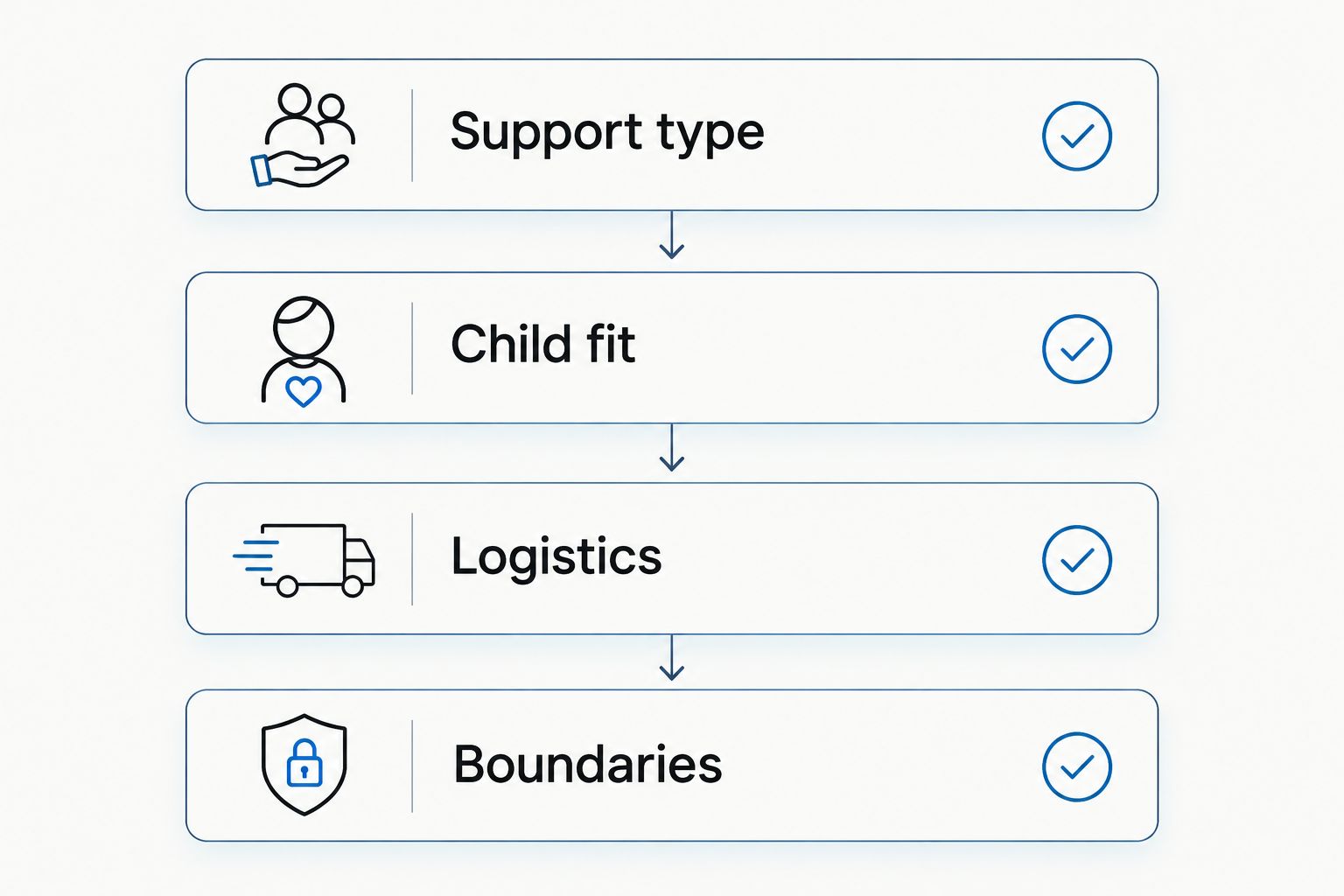
A service list tells you what an organization offers. These 4 checks tell you what to ask about the experience your child would have.
- Support type: Is this therapy, a class, a recreational activity, or a parent group? Ask who leads it and what its purpose is.
- Child fit: Ask about the intended ages, interests, communication methods, and participation expectations.
- Logistics: Discuss the journey, arrival process, caregiver involvement, and what happens if your child needs to leave.
- Boundaries: Ask how staff respond when a child declines an activity, needs a break, or communicates discomfort.
Request a plain-language description of a typical session. You want to understand what happens on arrival, how activities begin, and what choices children have—not just hear that a program is welcoming.
Match the activity to your child's age and interests
Use these age bands as planning prompts, not rules about ability. Children of the same age have different communication preferences, sensory needs, and interests.
Ages 2–5: ask about arrival and transitions
For younger children, ask how adults introduce an unfamiliar space and activity. Discuss caregiver participation, familiar objects, and a way to communicate a pause or an exit.
Do not assume an activity labeled for young children suits every child. Ask what participation looks like without requiring spoken answers or joining immediately.
Ages 6–12: start with a shared interest
Choose an interest your child already enjoys, such as art, building, movement, or music. Then ask how the activity makes room for different ways of participating.
An outing need not become a performance test. Discuss options for watching first, working alongside others, or stepping away from a busy area.
Ages 13–18: include your teenager in the decision
Ask your teenager what kind of company and activity they want. Respect preferences about age peers, privacy, communication, and whether a parent stays nearby.
The guide to social skills games for autistic teens offers another starting point for thinking about shared activities. Use ideas as invitations, not obligations.
When staying with Hopebridge is the right call
Staying with Hopebridge is a reasonable choice when its services match your child's current needs and you are satisfied with the working relationship. An alternatives search does not require a switch.
Before changing support in 2026, ask whether the unmet need belongs to the existing therapy plan or to a different part of life. A family seeking friends, outings, or parent connection can investigate those opportunities separately rather than expecting therapy to provide all of them.
Avoid changing several supports at once without a clear reason. Discuss any planned therapy transition with the professionals involved and give your child an understandable explanation of what will change.
FAQ
What’s the best Hopebridge alternative for Brooklyn families?
Autism Learn & Play is the best fit for Brooklyn families seeking a nonprofit offering therapy services, community programs, and online classes for autistic children ages 2–18. NYC Public Schools is the appropriate route when the priority is school-based special education support.
Is a community program the same as ABA therapy?
A community program is not the same as ABA therapy. Ask whether an activity is therapy, education, recreation, or peer support so you can choose it for the right purpose.
Should I change providers if my child needs friends?
A need for friendship does not automatically require changing therapy providers. Explore interest-based peer activities separately and ask how children can participate, communicate, and take breaks.
Can school services replace all outside therapy?
School services do not automatically replace all outside therapy. Educational services address school-related needs; discuss other concerns with your child’s qualified professionals.
What should I ask before joining an autism group in Brooklyn?
Ask about the group’s purpose, intended ages, communication support, caregiver role, and response to a child needing a break. Request a description of a typical session before deciding.
How do I choose a program for an autistic teenager?
Include your teenager in choosing the activity and setting. Ask about age peers, shared interests, privacy, and participation choices instead of selecting a program solely because it serves autistic children.
How can I ask Autism Learn & Play about programs?
Contact the organization through its website contact form or email info@autismlearnplay.org. Describe your child’s age, interests, preferred communication, and the support you are seeking, then ask about the relevant program.
One last thing
Choose the experience before choosing the label. A program name does not tell you whether your child can watch first, decline an activity, communicate comfortably, or leave when needed.
For your next 2026 inquiry, ask 3 questions: What happens when we arrive? How can my child participate? What happens if my child wants to stop? Those answers give you a practical basis for your decision.
Related guides
- Family support groups for autism in Brooklyn
- Art therapy activities for autistic kids
- Autism-friendly museums and attractions in NYC