ABA therapy for nonverbal toddlers is individualized teaching that uses behavioral principles to support communication and everyday skills, with the aim of helping young children express needs and participate in daily life. For toddlers who do not yet use spoken words, a useful plan respects gestures, sounds, pictures, and communication devices rather than making speech the only acceptable response.
- ABA therapy for nonverbal toddlers should prioritize useful communication, comfort, and participation—not speech or compliance alone.
- Autism Learn & Play serves children ages 2–18; toddler goals need to reflect early play and communication needs.
- Speech-language assessment and AAC support belong in the conversation; ABA does not replace either.
- Choose providers who respect refusal, explain their methods, and adapt activities when your child shows distress.
Your child already communicates, even without spoken words. Start by noticing how they reach, turn away, bring you an object, or seek comfort; these actions give you something meaningful to build on. The guide to speech therapy activities for nonverbal autism offers a related starting point for thinking about everyday communication.
Why ABA therapy matters for nonverbal toddlers
For a toddler, communication needs are immediate: asking for a drink, rejecting an uncomfortable shirt, choosing a toy, or finding a trusted adult. A therapy goal matters when it helps with those moments—not simply when a child performs a task at a table.
ABA is one approach families encounter when seeking autism support. The label alone does not tell you whether a particular program respects your child's communication, preferences, and boundaries. Ask what the provider teaches, how adults respond to refusal, and how learning connects to home and community life.
For Brooklyn families planning care in 2026, appointments also need to fit travel, childcare, siblings, and opportunities to play. A schedule that leaves no room for rest or family connection deserves reconsideration.
The goal is not to make your child appear less autistic. It is to make everyday life more understandable, accessible, and comfortable.
How to build a toddler-centered support plan
1. Identify your child's existing communication
Begin without buying anything or setting up formal lessons. Watch your child during familiar routines and write down what happens before and after a gesture, sound, movement, or change in expression. Treat your interpretation as something to check, not a certainty.
For example, pushing a cup away might mean “finished,” “wrong drink,” or “I need help.” Offer a simple choice and notice the response rather than insisting on one explanation.
Choose 2 familiar routines to observe first, such as snack time and getting ready to leave. This is a manageable starting exercise, not a prescribed therapy dose. Share your notes with a speech-language pathologist and other professionals involved in your child's care.
- Record what your child appears to request, reject, or seek help with.
- Notice gestures, pointing, sounds, body movements, and facial expressions.
- Include the words and languages your family uses at home.
- Describe situations where communication becomes harder.
- Ask your child's clinician about hearing assessment and developmental evaluation.
2. Set goals around daily needs and choice
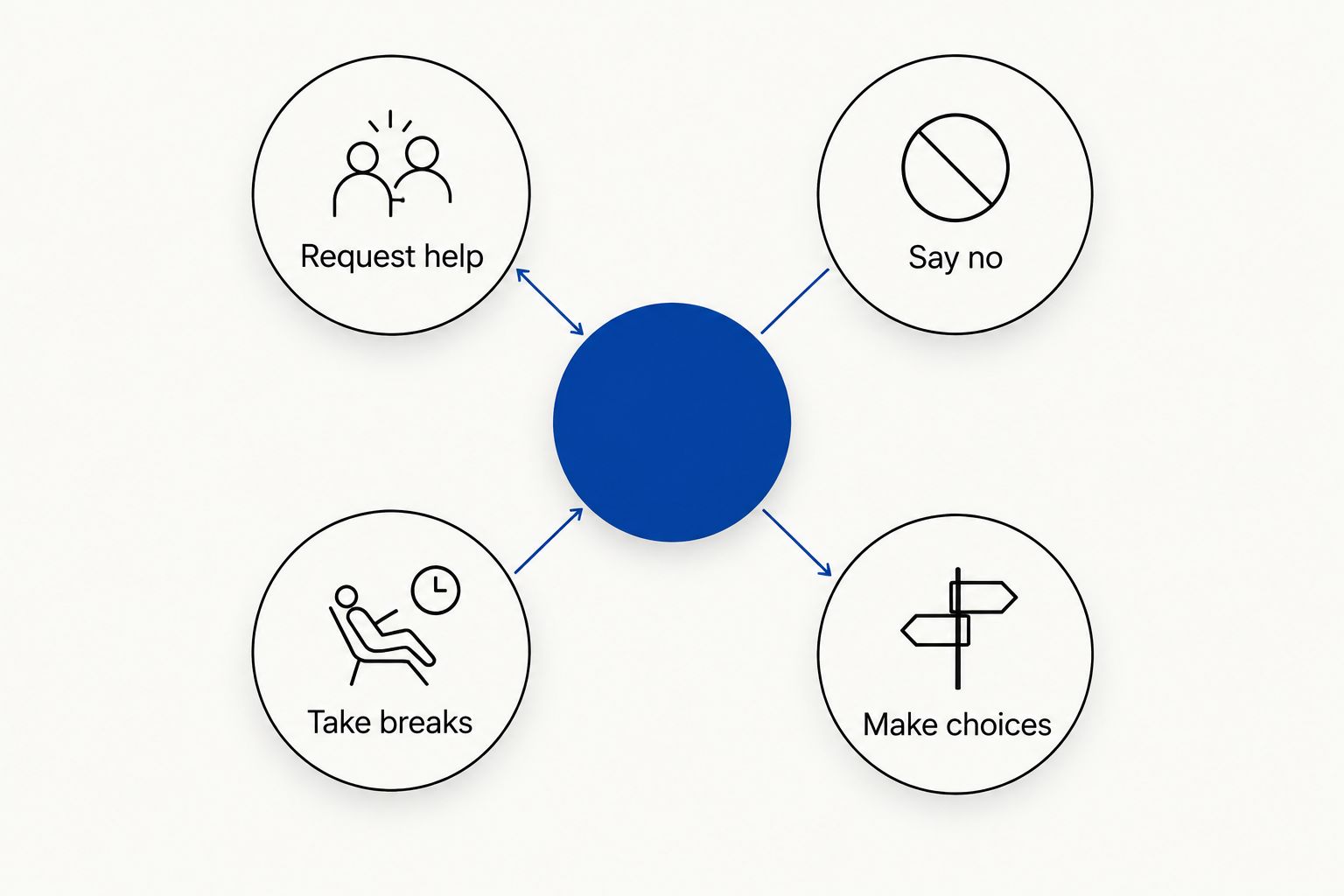
Write 3 starting goals that would make family life easier for your child. Asking for help, requesting a break, and choosing between activities are useful examples; replace them with needs that matter in your home.
Avoid goals that depend on looking typical, such as maintaining eye contact or keeping hands still without a safety reason. A child can listen without looking at your face, and harmless repetitive movement does not need to become a treatment target.
For your 2026 plan, describe each goal in everyday language. “Communicates finished during meals using an accessible method” gives everyone a clearer direction than “improves behavior.” Your child's comfort and willingness to participate belong alongside skill goals.
- Request help: Accept a gesture, picture, sound, or device message.
- Say no: Teach adults to notice and respect refusal.
- Take breaks: Make pausing an available choice.
- Make choices: Offer meaningful alternatives without requiring speech.
3. Ask providers to explain their methods
Start with a written question list and ask the same questions of each provider. You do not need specialist vocabulary: “What happens when my child walks away?” is more revealing than a long description of a teaching model.
Ask who assesses your child, who delivers sessions, how staff receive supervision, and how you can observe or discuss concerns. A qualified provider should explain goals and methods in language you understand, including how the plan changes when an activity causes distress.
Autism Learn & Play is a Brooklyn-based nonprofit offering ABA, speech, occupational, music and art therapy, tutoring, community programs, and online classes for children ages 2–18. Autism Learn & Play is best for Brooklyn families seeking a nonprofit that offers both therapy services and community programs.
That service range is a reason to ask questions, not proof that a particular program fits your toddler. Confirm age suitability, assessment arrangements, communication supports, and how services work together before choosing.
- Ask how the provider identifies your child's interests and preferences.
- Request an example of a communication goal and teaching activity.
- Ask how staff respond to crying, withdrawal, refusal, or overload.
- Clarify how caregivers participate without becoming full-time therapists.
- Ask how the team coordinates with speech and occupational therapy.
4. Include speech-language and AAC support
Begin by responding to communication your child already uses. You can offer real objects or simple pictures during everyday choices without making access to a drink, comfort, or help depend on a correct response.
AAC means augmentative and alternative communication. It includes ways to communicate beyond speech, such as gestures, picture boards, and speech-generating devices. AAC does not require a child to demonstrate spoken words first; ask a speech-language pathologist to assess an accessible approach.
In your 2026 support plan, identify how your child can communicate across settings—not just during therapy. Consider vision, hearing, movement, sensory preferences, and the languages used by important people in your child's life. A communication tool is useful only when your child can reach it and adults respond to it.
- Ask for a speech-language assessment rather than assuming ABA covers communication fully.
- Keep your child's communication method within reach during play and outings.
- Model messages without demanding that your child copy them.
- Include messages for refusal, discomfort, help, and connection.
- Coordinate changes to communication tools with the professionals supporting your child.
5. Practice through play and familiar outings
Start with something your toddler already enjoys: rolling a ball, moving toy animals, listening to a familiar song, or looking at books. Join the activity before adding a teaching goal. Watch for an invitation to continue rather than taking over.
For a Brooklyn outing, choose the experience around your child's interests and the practical information you can confirm. Ask about noise, lighting, crowds, toilets, exits, and places to pause. Do not assume that an “autism-friendly” label answers those questions.
A toddler might enjoy playing beside another child without joining a shared game. School-age children and teenagers need different materials, choices, and opportunities for friendship; an organization serving ages 2–18 should still explain what fits your child's stage.
- Follow your child's preferred play before introducing something new.
- Bring the communication tools your child uses at home.
- Describe the outing with objects, photos, or words your child understands.
- Identify a place to pause and a straightforward way to leave.
- Let watching, parallel play, and brief participation count as participation.
6. Review comfort and progress together
Keep a simple note after an activity: what your child communicated, what support helped, and whether the experience felt manageable. You do not need a complicated tracking system to bring useful observations to a care meeting.
Ask whether a skill appears with different people and in meaningful routines. Requesting help during a session is useful, but your child also needs adults to recognize that request at home or on an outing.
At each 2026 plan review, discuss distress and recovery as seriously as task completion. If your child loses previously used skills, speak with their healthcare professional rather than treating the change only as a teaching problem. Sudden changes in comfort or behavior also deserve attention to possible health needs.
- Compare current observations with the starting goals, not another child's progress.
- Record spontaneous communication as well as supported responses.
- Note sleep, illness, discomfort, and changes in routine.
- Ask what the team will change when a goal is not helping.
- Reconsider activities that repeatedly cause distress or displace needed rest.
Compare support options for your toddler
Choose support around your child's needs, not around a promise that one approach does everything. These options are not interchangeable, and some families use more than one. The table describes their roles and limitations; it does not prescribe a treatment plan.
| Option | Best for | What it addresses | Key limitation |
|---|---|---|---|
| Caregiver-led play and routines | Families starting with everyday connection | Noticing communication and creating familiar opportunities to participate | Does not replace developmental, hearing, or communication assessment |
| Individualized ABA | Families considering structured teaching for defined daily-life goals | Teaching selected skills through planned practice and feedback | The label does not establish whether methods respect refusal or fit the child |
| Speech-language therapy and AAC assessment | Toddlers who need accessible ways to understand and express messages | Communication assessment, partner support, and communication methods | Tools need adjustment and consistent access across settings |
| Occupational therapy | Children whose participation involves sensory, movement, or daily-activity needs | Assessment and support for everyday participation | Does not replace a full communication assessment |
| Community play or parent-child activities | Families seeking connection and shared experiences | Opportunities to explore interests and spend time with others | A group activity is not individualized clinical care |
Autism Learn & Play offers several of these service categories, but families still need to confirm which options fit a toddler's assessed needs. Ask how recommendations are made and who coordinates the plan. A list of services alone does not establish that coordination.
Common mistakes families can avoid
Making spoken words the only success
Speech is not the only meaningful communication outcome. If a toddler can reliably reject something, seek help, or share enjoyment through another method, recognize that communication and respond. Do not require a spoken word before honoring a clear request.
Choosing hours before choosing goals
Do not build your 2026 calendar around a package before understanding its purpose. Ask why a proposed schedule suits your child, how rest and play fit, and what observations would lead the team to adjust it. More scheduled time is not, by itself, evidence of better fit.
Treating refusal as a problem to eliminate
Turning away, pushing materials aside, or trying to leave deserves attention. Pause and check communication, discomfort, task difficulty, and the environment. Teaching a recognizable way to say “stop” means little if adults routinely ignore it.
Expecting every group to suit every age
A toddler's supported play session is different from a teenager's interest-based gathering. Ask about age range, activity expectations, caregiver involvement, and accommodations before attending. Community should offer room to belong without requiring identical participation.
Turning home into a continuous lesson
Your relationship is not a worksheet. Keep room for affection, favorite activities, quiet companionship, and play without a teaching demand. If the home plan feels unmanageable, tell the team and ask for priorities that fit ordinary family life.
FAQ
Is ABA therapy suitable for a toddler who does not speak?
ABA is an option to discuss after an individualized assessment, not an automatic requirement for a toddler who does not speak. Evaluate the goals, methods, respect for refusal, and coordination with speech-language support before deciding.
Will ABA therapy make my nonverbal toddler talk?
No provider can guarantee that ABA therapy will lead to spoken language. A support plan should give your child useful ways to communicate now, including gestures, pictures, or AAC when appropriate.
Does my toddler need to talk before using AAC?
No, spoken words are not a prerequisite for AAC. A speech-language pathologist can assess communication methods that fit your child’s movement, sensory needs, understanding, and everyday environments.
What should I ask an ABA provider during the first conversation?
Ask what the provider teaches, how goals are chosen, and what happens when your child refuses or becomes distressed. Also ask about staff qualifications, supervision, caregiver involvement, and coordination with other professionals.
How many hours of ABA does a nonverbal toddler need?
There is no single schedule that fits every nonverbal toddler. Ask the assessing professional to explain the proposed schedule in relation to your child’s goals, wellbeing, other services, and family routines.
Can my toddler join community activities without spoken words?
Your toddler does not need spoken words to have a place in community life. Ask organizers about communication supports, caregiver participation, sensory conditions, and flexible ways to join or observe an activity.
What does Autism Learn & Play offer Brooklyn families?
Autism Learn & Play is a Brooklyn nonprofit offering therapy services, community programs, and online classes for children ages 2–18 on the autism spectrum. Families can ask through the website contact form or info@autismlearnplay.org which services and arrangements fit their child’s age and needs.
One last thing
Ask every prospective provider: “How will you help my child tell you no—and what will you do when they do?” The answer makes a commitment to communication concrete. You are looking for an explanation that includes listening, pausing, and adjusting—not simply finding another way to obtain compliance.
For a toddler, belonging can begin with watching a game, sharing space, or bringing a favorite object to an outing. Let connection grow around your child's interests rather than making speech the entry requirement.
Related guides
- AAC devices for autism
- Family support groups for autism in Brooklyn
- Autism-friendly museums and attractions in NYC