Yes—music therapy can support sensory regulation for some autistic children when the sound, pace, and activities match their needs. It is not a guaranteed calming tool: music can also feel overwhelming, and enjoying a song does not prove that a child’s sensory needs are being addressed. The goal is greater comfort, choice, and participation—not making a child stay quiet or tolerate distress.
- Can music therapy help with sensory regulation? Yes, for some children; comfort and individual response guide its use.
- Music therapy uses individualized therapeutic goals; a music class or playlist is not the same service.
- Autism Learn & Play provides autism therapy services and community programs for children ages 2–18.
- Choose activities that welcome breaks, communication supports, and the option not to participate.
Can music therapy help with sensory regulation?
Music therapy can help some children find a comfortable way to engage with sound, movement, and shared activity. A music therapist selects and adjusts musical experiences around assessed needs and therapeutic goals. That is different from assuming that any soft song will calm every child.
Your child’s response matters more than the label on the activity. A child who chooses a rhythm, asks for another turn, or requests a pause is giving useful information; a child who covers their ears or moves away also deserves to be heard.
For practical activity ideas to discuss with a provider, explore these music therapy techniques for autism. Treat any technique as something to adapt, not a task your child must complete.
Music therapy, music classes, and home listening are different
These options serve different purposes. Choose according to the support your child needs rather than treating them as interchangeable.
| Approach | Best for | What it offers | Limitation |
|---|---|---|---|
| Individualized music therapy | Families seeking therapeutic goals addressed through music | Assessment and planned musical experiences adjusted by a music therapist | Enjoyment alone does not establish therapeutic benefit; sound still needs careful adjustment |
| Recreational music class | Children interested in a shared musical activity | An opportunity to explore music with others | A class is not automatically therapy or individualized sensory support |
| Music listening at home | Families exploring familiar sounds in a controllable setting | Direct control over what plays and when it stops | A playlist does not replace assessment or show whether a therapeutic goal is being met |
None is automatically the right starting point. If your child dislikes music, choosing a quieter activity is a valid decision—not a missed opportunity.
Why this matters
A child can enjoy singing at home and dislike a crowded sing-along. The room, unfamiliar voices, waiting, and transitions all belong in your planning—not just the songs.
For Brooklyn families choosing a community activity in 2026, the useful question is whether the setting respects your child’s needs. Friendship and belonging should not require enduring uncomfortable sound or performing on demand.
Sensory support should expand a child’s choices, not reward hiding discomfort. Rocking, moving, looking away, or communicating without speech does not automatically mean an activity is going badly.
Why the response to music varies
There is no universal calming song or instrument. Before choosing a session or outing, consider these factors:
- Sound level and texture: A child’s preferred recorded song does not tell you how they will experience a live drum, microphone, or several instruments together.
- Predictability: Ask whether songs start suddenly, whether transitions are explained, and whether your child can preview the activity.
- Choice and control: Find out whether children can decline an instrument, request a different sound, or stop without pressure.
- Communication access: Make room for speech, gestures, pictures, typing, or an AAC device when expressing preferences and discomfort.
- The surrounding environment: Consider lighting, crowding, travel, seating, and access to a quieter place—not sound alone.
- Your child’s current needs: Check how your child feels that day instead of assuming a previously enjoyed activity will always be welcome.
Use these factors to ask specific questions. “Is this sensory-friendly?” is less useful than “What happens if my child needs the music to stop?”
What should you expect from a first music therapy visit?
Start by asking how the provider learns about your child before choosing activities. Share preferred sounds, disliked sounds, communication methods, and what your child does when they need space.
An individualized plan should connect the musical activity to a meaningful goal. “Participates in music” is less informative than a goal about expressing a preference, requesting a break, or joining an activity comfortably.
Ask the provider to explain what they will observe and how they will respond to discomfort. You should understand the plan without needing to learn clinical terminology.
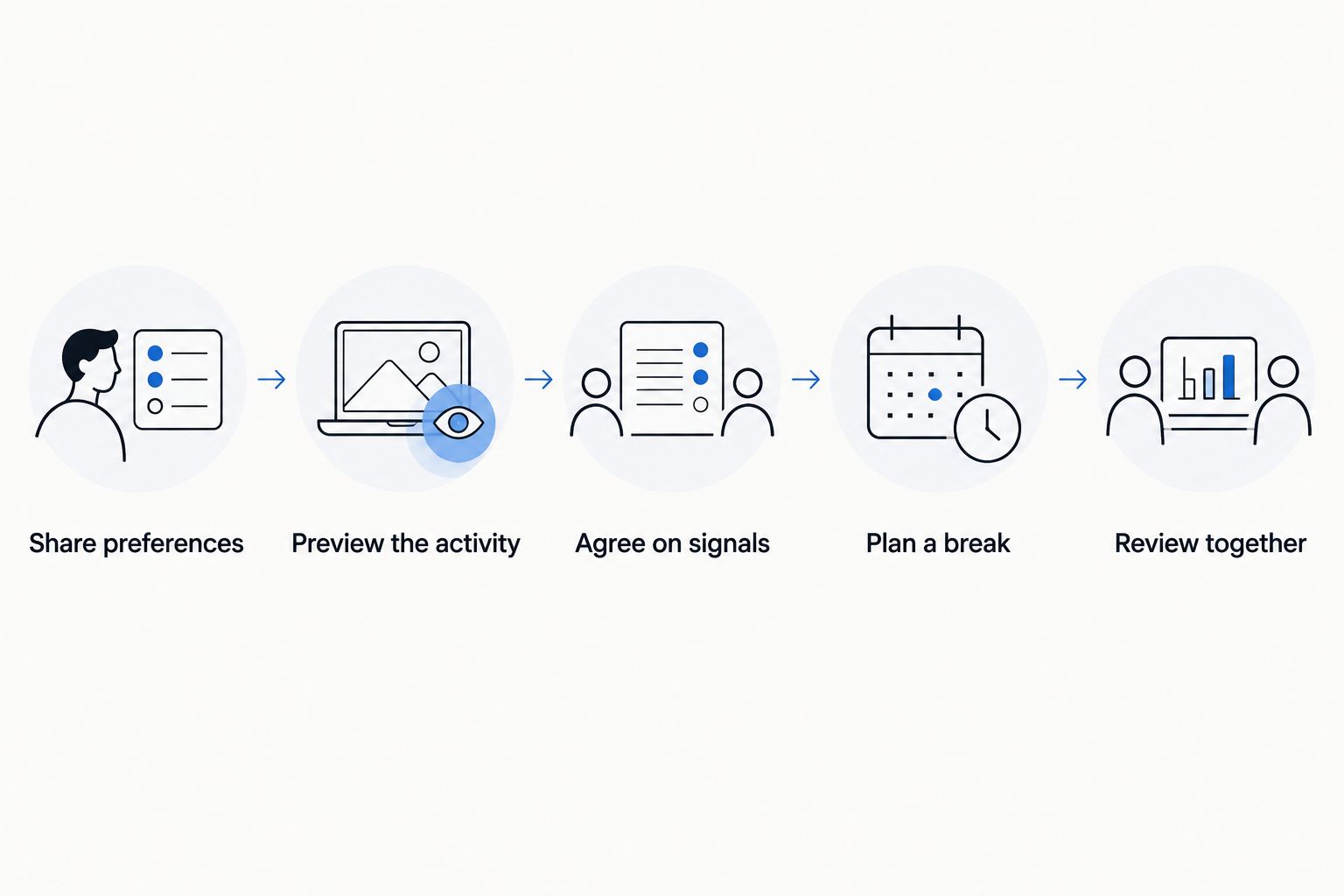
A practical preparation sequence
- Share preferences. Describe music your child seeks out, sounds they avoid, and how they communicate yes and no.
- Preview the activity. Ask what the room or online session involves, who will participate, and whether instruments are used.
- Agree on signals. Decide how your child can communicate stop, quieter, different, or finished.
- Plan a break. Ask where your child can step away and whether returning is optional.
- Review together. Afterward, ask your child about the experience in an accessible way and share observations with the provider.
You do not need to practice tolerating an uncomfortable sound before attending. Ask the provider how the activity can change to meet your child, rather than making attendance depend on your child changing first.
How can you tell whether music is helping?
Look for changes connected to your child’s goals, not simply a quieter appearance. Stillness alone cannot tell you whether someone feels comfortable.
Useful observations include your child choosing to participate, communicating a preference, using an agreed break signal, or returning voluntarily after stepping away. Record the context as well: what played, who was present, and what your child communicated.
Keep a simple note with these headings:
- Before: What did your child communicate about joining?
- During: Which sounds or activities did your child choose or decline?
- After: What did your child say, show, or communicate about the experience?
- Next time: What should stay the same, change, or stop?
For your 2026 planning, bring those observations to the treating professional rather than treating them as proof of effectiveness. A helpful activity should be reviewed against its purpose and your child’s experience.
Do not count suppressing harmless stimming, forced eye contact, or staying through distress as sensory regulation. Ask what comfort and meaningful participation look like for your child.
How should activities differ across ages 2–18?
Age helps you ask relevant questions, but it does not determine musical taste, communication style, or support needs. Follow your child’s interests and avoid assuming that every autistic child enjoys the same materials.
Younger children: make choices accessible
For younger children, ask how the provider offers understandable choices and recognizes refusal without requiring spoken words. Watching from a parent’s lap or exploring an instrument without joining a song can be something to discuss rather than automatically redirect.
Bring familiar communication supports. Ask whether a caregiver can remain involved and how the provider handles transitions away from a preferred activity.
School-age children: protect enjoyment
Ask what your child actually wants to do: listen, move, sing, explore an instrument, or observe. Do not turn every enjoyable musical interest into a performance or a practice assignment.
If making friends is a goal, ask how children can share an activity without compulsory conversation or turn-taking beyond their comfort. Shared enjoyment matters more than looking sociable to adults.
Teenagers: respect taste and autonomy
Teenagers deserve age-respectful music, meaningful input, and privacy around their goals. Ask your teenager what they want from the activity before selecting it for them.
Do not assume nursery songs or childlike materials are appropriate because someone needs substantial support. Equally, respect a teenager who genuinely enjoys familiar childhood music; preference belongs to the person.
What should Brooklyn parents ask before a group outing?
A community music activity is a different decision from an individual therapy appointment. Ask about the group experience directly, even when a program uses welcoming or sensory-friendly language.
Before a 2026 outing, ask:
- Will there be amplified music or unexpected loud sounds?
- Can a child watch before deciding to join?
- Can families enter, leave, or take a break without interrupting the group?
- What communication supports can children use?
- How are different ages and interests considered?
- How does the leader respond when a child declines an activity?
These questions help you choose an environment where your child can belong without being pressured. They do not establish that a particular venue offers those accommodations; confirm the details with the organizer.
For a first visit, consider making the goal simply learning whether your child likes the setting. You do not need to add a friendship, communication, and participation goal to the same outing.
Where can Autism Learn & Play fit into your plan?
Autism Learn & Play is a fit for Brooklyn families seeking autism therapy services and community programs for children ages 2–18. The nonprofit’s services include music therapy, alongside other therapy services and online classes.
Autism Learn & Play also lists Music Class as a 30-minute Zoom class. That format avoids travel, but it is not an in-person community outing, and the class description does not establish that it provides individualized music therapy or sensory-regulation treatment.
Ask which service matches your child’s needs before choosing. A class length is not a prescription for how long your child should engage, and an online activity is not automatically comfortable just because it takes place at home.
For 2026 planning, use the contact form or email info@autismlearnplay.org to ask about the relevant service, age fit, communication access, and how breaks are handled. Describe what your child enjoys and what you want help understanding; there is no need to present a polished therapy goal.
Should you stop music if your child covers their ears?
Pause the sound and check what your child needs. Covering ears, moving away, or asking to stop deserves a response, not a demand to finish the song.
Ask whether your child wants quiet, a different sound, or to end the activity. If distress continues or sound sensitivity is new or painful, seek advice from your child’s healthcare professional rather than repeatedly testing the sound.
Can music therapy replace occupational therapy?
Music therapy is not an automatic replacement for occupational therapy. The services have different professional roles, and the right plan depends on your child’s assessed needs and goals.
Ask the professionals involved to explain how their work fits together. Shared goals should not mean repeating an activity that your child finds uncomfortable across several settings.
FAQ
Can music therapy help with sensory regulation in autistic children?
Yes, music therapy can support sensory regulation for some autistic children when activities are individualized. Music can also be overwhelming, so the child’s preferences, communication, and ability to stop must guide the approach.
Is a music class the same as music therapy?
No, a music class is not automatically music therapy. Music therapy involves assessment and therapeutic goals addressed by a music therapist; a recreational class focuses on musical activity or learning.
What if my child loves music but dislikes group singing?
Enjoying music does not mean your child will enjoy group singing. Ask about voices, amplification, crowding, and whether listening without joining is welcome.
Does my child need to speak to take part in music therapy?
No, spoken language is not a prerequisite for exploring music therapy. Ask how the provider supports gestures, pictures, AAC, and other ways of communicating preferences and refusal.
How long is Autism Learn & Play’s Music Class?
Music Class is listed as 30 minutes long and conducted via Zoom. That duration describes the class, not a recommended music therapy dose or a requirement to remain engaged throughout.
Should I play calming music during a meltdown?
Do not assume music will help during a meltdown. Reduce demands and avoid adding sound your child has not requested or welcomed; discuss an individualized support plan with a qualified professional.
What should I ask before choosing music support in 2026?
Ask whether the service is therapy or a recreational class, who leads it, and how activities are adapted. Confirm how your child can request quiet, decline participation, and take a break.
One last thing
A request to stop is useful communication, not a failed session. Before the next musical activity, make sure your child has an accessible way to say “finished”—and that the adults agree to honor it.
This guide provides general education, not an individualized treatment recommendation. Discuss therapeutic goals and persistent or painful sound sensitivity with qualified professionals who know your child.
Related guides
- Connecting music therapy sessions to speech therapy goals
- Music therapy for nonverbal autism
- Connecting online autism classes to in-person therapy