Best overall for individualized pacing: private adapted swim lessons. Best for caregiver-supported introductions: parent-child lessons. Best for practicing alongside peers: small adapted groups. This 2026 guide compares sensory friendly swim classes for autism by lesson format, helping Brooklyn families choose around their child’s comfort, communication, and water-safety needs.
- For sensory friendly swim classes for autism, prioritize individualized instruction over a sensory-friendly label.
- Private adapted lessons suit children who need flexible pacing; small groups suit children ready for shared instruction.
- Ask about pool noise, supervision, communication supports, and your child’s right to pause before enrolling.
- Autism Learn & Play supports Brooklyn families through community programs; this guide compares swim lesson formats.
Why this matters
A swim class involves more than time in the water. Your child also encounters changing rooms, echoes, wet floors, unfamiliar instructions, and transitions between activities. Choose the whole experience, not just the lesson description.
For Brooklyn families planning activities in 2026, the trip home matters too. Consider whether transportation, changing, and another scheduled activity leave enough room for your child to recover comfortably.
Autism Learn & Play is a Brooklyn nonprofit for families seeking autism community programs and educational support. Explore Autism Learn & Play for that broader support; evaluate swim instruction separately using the questions below.
What makes the best sensory-friendly swim class?
Look for specific practices you can discuss with an instructor before enrollment:
- Individual pacing: Ask whether your child can observe, approach the water gradually, and repeat familiar activities without pressure.
- Manageable surroundings: Discuss echoes, whistles, nearby classes, lighting, splashing, and changing-room traffic.
- Clear communication: Ask whether instructors use demonstrations, pictures, gestures, or your child’s established communication method.
- Defined supervision: Identify who supervises your child during instruction, waiting, changing, and handoffs.
- Respectful participation: Confirm that requests for breaks and signs of distress receive a response, rather than being treated as disobedience.
- Meaningful fit: Match the lesson to your child’s interests, age, water experience, and preferences about other swimmers.
A sensory-friendly label does not answer these questions. Ask the instructor to describe what would happen during your child’s actual lesson, including what changes when something feels uncomfortable.
Sensory-friendly swim classes at a glance
These rankings compare formats rather than named swim schools. Each format has a different purpose; none guarantees a quiet pool or individualized support.
| Rank and format | Best for | Main advantage to assess | Key limitation |
|---|---|---|---|
| 1. Private adapted lessons | Individualized pacing | Dedicated instruction with adjustable activities | A private lesson can still happen in a busy pool |
| 2. Parent-child lessons | Caregiver-supported introductions | A familiar adult participates in the experience | Caregiver participation does not establish autism-specific expertise |
| 3. Small adapted groups | Practicing alongside peers | Shared activities with planned accommodations | Waiting and splashing still need consideration |
| 4. Teen-focused adapted lessons | Age-respectful participation | Instruction organized around older swimmers | The age label does not establish skill-level fit |
| 5. Supported inclusive lessons | Joining a general community class | Participation alongside a broader peer group | Accommodations need agreement before enrollment |
1. Private adapted lessons: best for individualized pacing
Private adapted swim lessons put individualized instruction at the center of the session. Ask how the instructor changes directions, activities, and transitions around your child, rather than simply delivering a standard lesson without other students.
Best for: Children who need flexible pacing, fewer competing instructions, or a carefully planned introduction to water.
For your first conversation in 2026, describe what helps your child feel secure. That might include watching a demonstration, knowing the activity order, or having a clear way to request a pause. Ask how the instructor would respond to each need.
Private adapted lesson pros:
- Activities can focus on your child’s current water experience.
- Instructions can follow your child’s communication preferences.
- Peer-related waiting is not part of the lesson format.
Private adapted lesson cons:
- Other classes can still create noise nearby.
- The format does not provide a peer group.
- Individual attention does not replace checking instructor qualifications.
Ask where lessons occur relative to open swimming and other instruction. A dedicated instructor and a calm setting are separate considerations.
Verdict: Buy only when the instructor’s approach and the pool environment both fit your child.
2. Parent-child lessons: best for caregiver-supported introductions
Parent-child lessons involve a caregiver in the water or lesson activities, according to the program’s rules. They suit families who want a familiar adult involved while a child explores the setting and meets an instructor.
Best for: Children whose preferred introduction includes active caregiver participation.
For children ages 2–5, ask about supported entry, simple play, and transitions out of the water. Do not assume this format is limited to young children: an older child’s preference for caregiver involvement deserves consideration too, subject to the program’s participation rules.
Parent-child lesson pros:
- A familiar adult can help communicate preferences.
- Caregivers can observe teaching directions firsthand.
- Shared activities offer a clear starting point for participation.
Parent-child lesson cons:
- The caregiver must be comfortable with the required role.
- Group versions still involve other swimmers and waiting.
- Caregiver involvement is not a substitute for qualified instruction.
Before enrolling, clarify who gives directions and who provides physical assistance. Your child should not have to manage competing instructions from several adults.
Verdict: Buy when caregiver participation is welcome to your child and responsibilities are clearly explained.
3. Small adapted groups: best for practicing alongside peers
Small adapted groups combine swimming instruction with participation near other children. Ask what makes the group adapted: the answer should describe teaching practices, communication supports, or environmental adjustments rather than rely on the group’s name.
Best for: Children ready to share an activity who still need planned accommodations.
For children ages 6–12, compare water experience and preferred activities as well as age. A child who enjoys watching peers does not necessarily want competitive games, and a confident swimmer can still need support during transitions.
Small adapted group pros:
- Children participate alongside peers with a shared activity.
- Structured games provide something concrete to do together.
- Families can assess whether recurring group participation feels comfortable.
Small adapted group cons:
- Splashes and unexpected sounds remain part of group swimming.
- Waiting requires a clear supervision plan.
- A shared diagnosis does not establish compatible needs.
Ask what happens while another swimmer receives instruction. Find out whether your child waits in the water, on the deck, or with a caregiver, and who supervises that period.
Friendship is an opportunity, not a promised outcome. Watching, swimming nearby, or joining a brief shared game are all valid ways to participate.
Verdict: Buy when shared instruction suits your child and waiting periods have a clear plan.
4. Teen-focused adapted lessons: best for age-respectful participation
Teen-focused adapted lessons organize instruction around older participants. Ask about the actual activities, language, changing arrangements, and opportunities for choice rather than assuming the teen label answers those questions.
Best for: Swimmers ages 13–18 who want instruction with an age-appropriate peer context.
Include your teenager in the decision. Ask whether they prefer individual instruction, peers nearby, a particular swimming goal, or caregiver support during arrival rather than throughout the lesson.
Teen-focused lesson pros:
- Families can seek peers closer to their teenager’s age.
- Lesson goals can reflect the teenager’s own interests.
- Planning can explicitly address privacy and independence preferences.
Teen-focused lesson cons:
- Similar ages do not mean similar swimming experience.
- Group activities still need individual adjustments.
- Privacy arrangements require a separate conversation.
For a 2026 enrollment decision, ask the instructor how a beginner joins without being singled out. Also ask how a teenager declines an activity or requests help without having to explain personal information to the group.
Verdict: Buy when your teenager’s preferences shape the plan, not merely the class placement.
5. Supported inclusive lessons: best for community participation
Supported inclusive lessons place your child in a general swimming class with agreed accommodations. This format fits families seeking a neighborhood activity alongside a broader group of children, provided the teaching and supervision match the child’s needs.
Best for: Children who want a general community class and have a workable support plan.
Discuss adjustments before the first session. Examples to ask about include a visual activity order, a consistent demonstration, or a familiar way to request a break; these are questions, not assumed features.
Supported inclusive lesson pros:
- Participation centers on a shared neighborhood activity.
- Children can join peers without choosing a diagnosis-specific group.
- Planning can focus on the individual rather than a label.
Supported inclusive lesson cons:
- General instructors need clear information about agreed supports.
- Shared facilities can limit environmental changes.
- A vague promise to accommodate leaves practical questions unanswered.
Ask who communicates the plan if the regular instructor is absent. Confirm that essential safety and communication information reaches the person teaching that day.
Verdict: Hold enrollment until the instructor confirms the accommodations and supervision responsibilities.
Plan the first visit around your child
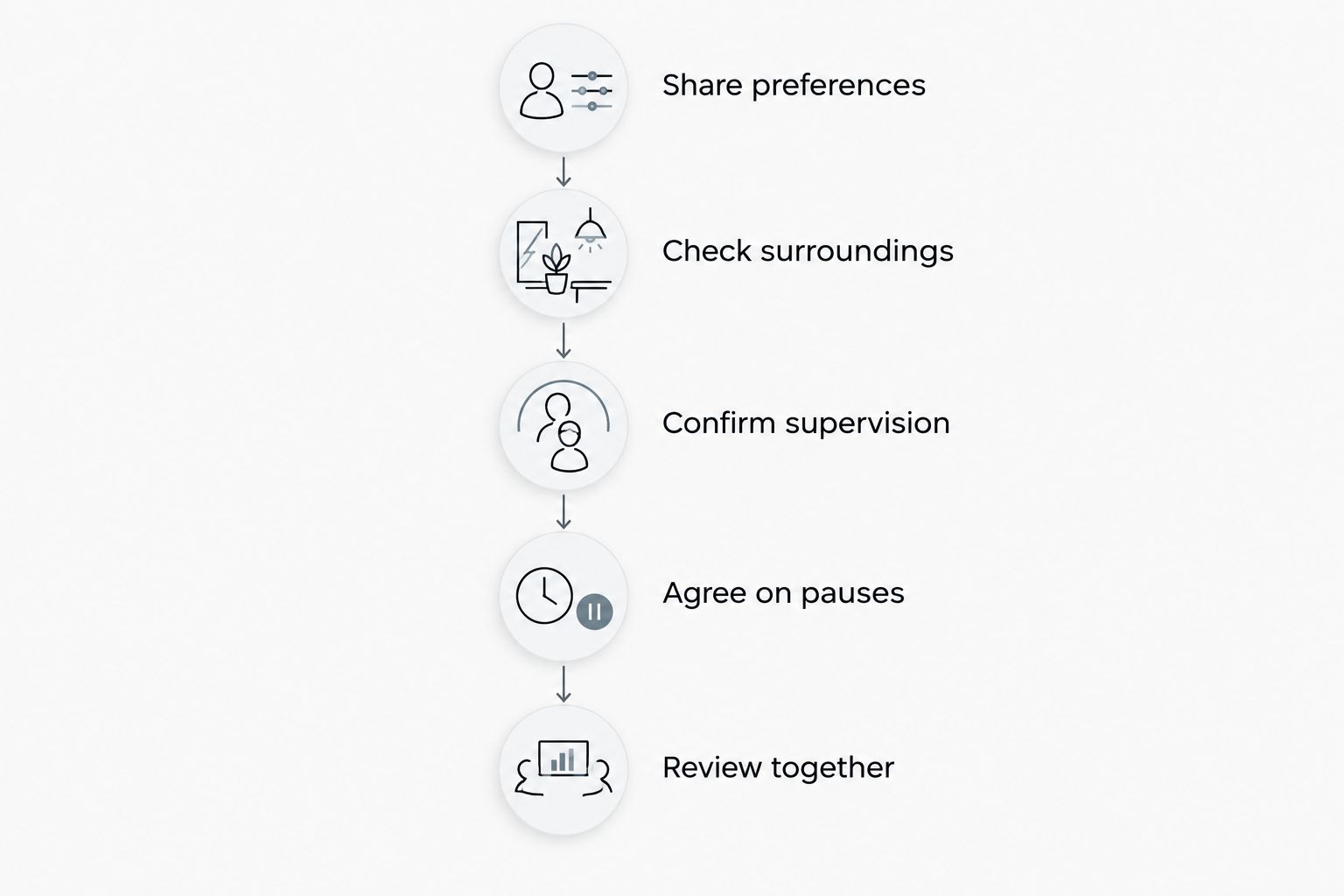
Use this sequence when comparing sensory friendly swim classes for autism in 2026. You do not need to describe every part of your child’s history; start with information that affects participation and safety.
- Share preferences: Explain communication methods, sensory dislikes, interests, and how your child signals discomfort.
- Check surroundings: Ask about the route from arrival to changing, pool entry, breaks, and departure.
- Confirm supervision: Identify the responsible adult during each transition, not just active instruction.
- Agree on pauses: Establish how your child requests a break and where that break happens safely.
- Review together: After the visit, include your child’s response when deciding what to repeat or change.
Keep communication supports usable around water. If your child uses a communication device, ask how staff will keep a reliable communication method accessible without exposing equipment to water beyond its stated protection.
Swimming lessons do not replace active adult supervision around water. Clarify the handoff between caregiver and instructor each time; do not assume another adult has taken responsibility.
How the formats are ranked
The ranking prioritizes control over pacing first, then caregiver involvement, peer participation, age fit, and participation in a general community class. It is a decision guide, not a scorecard of individual providers.
For your family’s 2026 choice, a lower-ranked format can be the better fit. A teenager seeking peers has a different goal from a young child who wants a familiar adult nearby.
Which swim class should you choose?
Start with private adapted instruction if your main need is individualized pacing. Choose parent-child lessons for caregiver-supported introductions, or a small adapted group when shared participation is the priority.
For teens, protect age-respectful instruction and personal choice. Consider supported inclusive lessons when the general class matches your child’s interests and the instructor confirms the practical supports.
For community-program questions beyond swimming, use the contact form to reach Autism Learn & Play. Keep questions about a particular swim class directed to that class’s instructor.
FAQ
What are the best sensory friendly swim classes for autism?
Private adapted lessons are the strongest starting point when individualized pacing is your priority. Parent-child lessons, small adapted groups, teen-focused instruction, and supported inclusive lessons serve different participation goals.
How do I find a sensory-friendly swim class in Brooklyn?
Ask local swim programs to describe their actual teaching practices, pool conditions, and supervision arrangements. Explain your child’s needs and confirm the specific supports before enrolling.
Are private swimming lessons better than group lessons for autistic children?
Private lessons are a better fit when your child needs individualized pacing; groups fit a goal of shared participation. Compare the instructor and environment rather than choosing by format alone.
What should I ask before the first swim lesson?
Ask who supervises your child, how breaks work, and how the instructor communicates. Also discuss nearby pool activities, changing arrangements, and the handoff back to you.
Can a nonspeaking child take swimming lessons?
Spoken language should not be the only way a child can receive directions or request help. Ask how the instructor will use demonstrations, gestures, pictures, or the child’s established communication method safely around water.
What if my child does not want to enter the pool?
Pause and discuss a gentler introduction rather than forcing entry. Ask whether observation or another agreed introductory activity can be part of the instruction plan.
Does Autism Learn & Play offer sensory-friendly swimming lessons?
Contact Autism Learn & Play directly to ask about swimming-related programming. Its stated services include therapy, community programs, and online classes for children ages 2–18; do not assume a swim offering from that broader description.
One last thing
Ask one question that class descriptions often leave unanswered: What happens if my child wants to stop halfway through? A clear response tells you how the instructor handles communication, a safe exit, caregiver handoff, and respect for your child’s choices.
Related guides
- Can siblings join autism community programs together?
- Best social skills games for autistic teens
- Family support groups for autism in Brooklyn