
Best overall format: a small, sensory-aware cooking group. Best for shared reassurance: a parent-and-child class. Best for individualized pacing: a private lesson. Best for staying in familiar surroundings: a live online class with an adult helping at home. This 2026 guide helps Brooklyn families compare cooking classes by participation, safety, and opportunities for connection—not by how adventurous a child’s eating becomes.
- For cooking classes for kids with autism Brooklyn families should prioritize sensory needs, kitchen safety, and voluntary participation.
- Choose small-group cooking for shared activities; choose private lessons when individualized pacing matters most.
- Autism Learn & Play serves Brooklyn families; ask specifically about cooking rather than assuming it is offered.
- A welcoming cooking class lets children participate without requiring them to taste food.
Why this matters
A cooking outing can give your child something concrete to do alongside other children: stir, measure, pass a bowl, or choose a topping. The goal can be enjoying a shared activity, not changing what your child eats. Watching from a comfortable distance is also a valid way to begin.
Autism Learn & Play is a Brooklyn-based nonprofit offering therapy services, community programs, and online classes for children ages 2–18 on the autism spectrum. For cooking specifically, ask about the activity, age group, and support arrangements before making plans. This guide ranks class formats rather than presenting an unverified list of local providers.
What makes the best cooking class for your child?
Use these criteria to compare Brooklyn cooking classes in 2026. Ask for concrete examples rather than accepting “autism-friendly” as a complete explanation.
- Sensory choice: Ask about appliance noise, food smells, sticky ingredients, lighting, and places to step away.
- Flexible participation: Look for permission to watch, use utensils instead of touching ingredients, and decline tasting.
- Clear kitchen safety: Confirm who supervises heat, sharp tools, handwashing, and food-allergy precautions.
- Communication access: Ask whether your child can use pictures, gestures, writing, or an AAC device throughout the activity.
- Social fit: Find out whether children work together, take turns, or complete separate recipes beside each other.
- Age-respectful activities: Choose tasks and materials that respect your child’s interests without assuming skills from age alone.
Cooking class formats at a glance
These are options to ask prospective organizers about, not claims that a particular Brooklyn organization provides them.
| Rank and format | Best for | Standout feature to request | Key limitation |
|---|---|---|---|
| 1. Small-group cooking | Shared activity with peers | Separate workspaces and optional shared tasks | Noise, smells, and waiting need careful planning |
| 2. Parent-and-child cooking | Exploring an outing together | An agreed role for the accompanying adult | Adult involvement can leave less room for peer interaction |
| 3. Private cooking lesson | Individualized pacing | A recipe and teaching pace adapted to the child | No built-in peer group |
| 4. Live online cooking | Participating from a familiar kitchen | Advance instructions and permission to pause | An adult at home must manage kitchen safety |
1. Small-group cooking: best for shared activity with peers
A small-group format brings children together around a cooking task. Ask whether each child has a workspace and whether shared jobs are optional; a small headcount alone does not establish that the class fits your child.
For a child interested in other children but unsure about conversation, a practical role gives the interaction a clear purpose. Passing a measuring cup is an invitation—not a requirement to speak, make eye contact, or perform socially.
Small-group cooking pros:
- Gives children a shared topic and activity.
- Offers opportunities to work alongside peers without continuous conversation.
- Allows different roles when the instructor plans for them.
Small-group cooking cons:
- Other children’s movements and voices add unpredictability.
- Shared equipment introduces waiting and transitions.
- One recipe does not automatically accommodate different food needs.
Best for: Children who want company and can participate comfortably with the group’s actual support arrangements.
Ask how the instructor responds when a child steps away. A clear answer should explain supervision and rejoining without promising that every child will finish.
Verdict: Choose small-group cooking when peer connection is your priority and the organizer confirms practical accommodations.
2. Parent-and-child cooking: best for exploring an outing together
A parent-and-child format gives you a defined place in the activity. Before attending, clarify whether you will cook together, assist with selected tasks, or remain nearby while the instructor leads.
Your role should support your child’s choices rather than replace them. Agree on a simple way for your child to request help, a break, or an exit before entering the kitchen.
Parent-and-child cooking pros:
- Keeps a familiar support person involved.
- Lets you explain communication preferences directly.
- Creates a shared activity you can revisit at home.
Parent-and-child cooking cons:
- Adult-child pairs need adequate workspace.
- Helping too quickly can leave fewer opportunities for independent choices.
- The format does not necessarily include much interaction between children.
Best for: Children who want a familiar adult beside them while exploring a new setting.
For Brooklyn outings in 2026, ask whether the accompanying adult remains in the kitchen throughout. Do not assume a class described as family-friendly includes that arrangement.
Verdict: Choose parent-and-child cooking when shared reassurance matters more than independent group participation.
3. Private cooking lessons: best for individualized pacing
A private lesson centers the activity on one child rather than a group schedule. Ask the instructor how they would adapt the recipe, tools, instructions, and pace to your child’s interests and access needs.
Individual attention does not automatically mean autism-informed support. Discuss your child’s communication and sensory preferences before deciding whether the instructor is a suitable match.
Private cooking lesson pros:
- Gives more room to repeat or pause a task.
- Allows the recipe choice to center on the child’s interests.
- Removes the need to keep pace with peers.
Private cooking lesson cons:
- Does not provide a built-in friendship opportunity.
- The instructor still needs an appropriate safety plan.
- One-to-one attention can feel intense; ask about space to observe quietly.
Best for: Children who want cooking instruction without the demands of a shared group schedule.
If your main goal is community, ask how you will create that connection separately. A successful private lesson and a satisfying group outing serve different purposes.
Verdict: Choose private cooking lessons for individualized pacing, not as a substitute for peer connection.
4. Live online cooking: best for using a familiar kitchen
A live online class places the instructor on a screen while your family handles ingredients and equipment at home. Request the recipe, materials, and preparation instructions before the session so you can assess the tasks.
This format removes travel from the outing plan, but it adds responsibilities for the adult at home. Decide who will supervise food preparation, manage the device, and help your child follow instructions.
Live online cooking pros:
- Uses your own kitchen and familiar equipment.
- Avoids travel to another location.
- Allows an adult to arrange a comfortable workspace beforehand.
Live online cooking cons:
- The remote instructor cannot physically supervise kitchen hazards.
- Screen-based instructions do not suit every child.
- Online participation is different from meeting neighborhood peers in person.
Best for: Families who prefer a home-based activity and have an adult able to supervise directly.
Autism Learn & Play offers online classes, but that does not establish a cooking offering. Ask specifically about cooking instruction and its format rather than treating another online activity as equivalent.
Verdict: Choose live online cooking for a familiar setting, with hands-on adult supervision at home.
How these formats are ranked
Small-group cooking takes the default position because this guide prioritizes shared activities and community. Parent-and-child, private, and online formats become better choices when reassurance, pacing, or the home environment matters more.
This is a fit-based framework, not a provider quality score. For your 2026 shortlist, compare the actual instructor’s answers against the criteria above rather than choosing by format alone.
Match the experience to your child’s age and interests
Age helps you ask better questions; it does not determine readiness. Use these suggested planning bands flexibly, and ask your child what sounds appealing.
- Ages 2–5: Ask about close adult participation and simple tasks such as pouring premeasured ingredients. Keep responsibility for heat and sharp tools with the supervising adult.
- Ages 6–12: Offer choices between roles such as measuring, mixing, arranging, or reading instructions. Ask whether children can complete different tasks within the same activity.
- Ages 13–18: Seek age-respectful recipes and meaningful choices. Ask whether the activity connects with your teenager’s own interests, such as preparing a preferred snack or sharing food with friends.
Do not equate spoken language with cooking ability. A child who uses an AAC device needs access to it during the activity, including a safe place for it away from spills and heat.
Keep food exploration separate from pressure to eat
Making food and eating food are different activities. Before choosing a class, ask whether tasting is optional and whether a child can participate fully without taking a bite.
A judgment-free approach to introducing new foods without pressure keeps handling ingredients separate from an obligation to eat them. In a cooking class, that means a child can stir a mixture, serve a portion, or simply watch without being asked to prove participation by tasting.
Avoid framing a class as a test of bravery around food. Instead, ask the instructor how they respond to “no,” whether familiar ingredients can remain separate, and whether utensils are an option for children who dislike touching food.
For recipe planning, the guide to cooking recipes for kids with autism offers a related starting point. Review any recipe against your child’s allergies, preferences, and supervision needs before using it.
If your child has swallowing concerns or a prescribed feeding plan, discuss participation with the appropriate healthcare professional. A recreational cooking class is not a replacement for feeding care.
Plan the outing before entering the kitchen
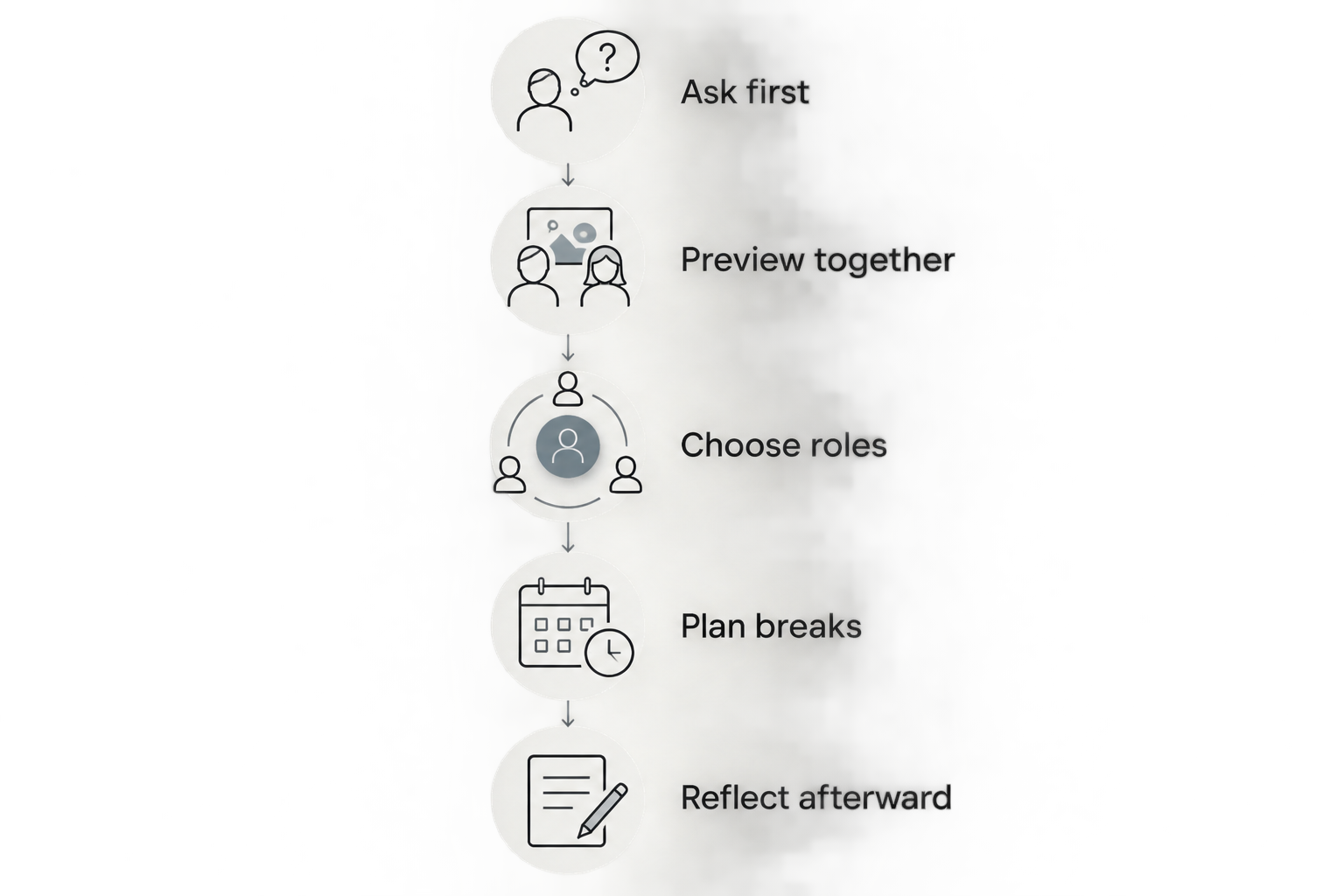
For a Brooklyn cooking outing in 2026, use this sequence with the organizer and your child. Keep the plan clear enough to revisit before leaving home.
- Ask first: Confirm the recipe, ingredients, age group, caregiver role, and support arrangements.
- Preview together: Describe where you are going and what your child can choose to do. Use photos or written steps if those suit your child.
- Choose roles: Offer a starting task and an observation option. Avoid assigning a role solely because it looks age-appropriate.
- Plan breaks: Agree on how your child requests a pause, where you can go, and who stays with them.
- Reflect afterward: Ask what felt enjoyable, uncomfortable, or worth trying differently next time.
Leaving before the recipe is finished does not erase the experience. Your child’s feedback is more useful for planning the next outing than whether the finished dish matches the instructor’s example.
Which cooking class format should you choose?
Start with a small, sensory-aware group if your child wants peer company. Choose a parent-and-child format when a familiar adult’s participation matters, a private lesson for individualized pacing, or online instruction when home is the preferred setting.
Autism Learn & Play is a Brooklyn community-program contact for families with autistic children ages 2–18. To ask specifically about cooking-related opportunities or other community activities, use the website contact form or email info@autismlearnplay.org. Describe your child’s interests, communication preferences, and what makes an outing comfortable.
FAQ
What’s the best cooking class format for an autistic child in Brooklyn?
A small, sensory-aware group is the starting choice when your child wants peer connection. Parent-and-child, private, and live online formats fit different needs; confirm the actual accommodations before choosing.
Does Autism Learn & Play offer cooking classes?
Ask Autism Learn & Play directly about cooking-specific offerings. Its stated services include therapy, community programs, and online classes, but those categories do not confirm a cooking class.
Can my child join a cooking class without tasting the food?
Choose a class that explicitly permits participation without tasting. Ask whether watching, mixing, measuring, or serving counts as participation and how the instructor responds when a child declines food.
Can a nonspeaking autistic child participate in cooking activities?
Spoken language should not be an entry requirement for a cooking activity. Ask how the instructor supports gestures, pictures, writing, or AAC and how your child can communicate help, stop, or a break.
What should I ask about food allergies before a cooking class?
Ask for the full ingredient list and the organizer’s procedures for allergy management and preventing cross-contact. Explain your child’s requirements and confirm whether the setting can meet them before attending.
Is a cooking class suitable for an autistic teenager?
A cooking class is an option when the teenager wants to participate and the activity meets their access and safety needs. Look for age-respectful recipes, meaningful choices, and a social setting your teenager finds comfortable.
What should I confirm before booking a Brooklyn cooking outing in 2026?
Confirm the recipe, age group, caregiver role, kitchen safety arrangements, communication supports, and break plan. Ask for specific examples of adaptations rather than relying on an autism-friendly label.
One last thing
Ask your child to choose a role before choosing a recipe. “Would you rather pour, mix, arrange, or watch?” gives you a practical starting point—and keeps the outing centered on your child rather than the finished food.
Related guides
- Can siblings join autism community programs together?
- Social skills games for autistic teens
- Family support groups for autism in Brooklyn