
Best overall: Connect 4. Best for cooperative play: Outfoxed! Best for a low-reading starting point: Candy Land. These board games for kids with autism are useful 2026 picks for different interests and play styles—not a single prescription for every child.
- Connect 4 is the default pick for board games for kids with autism who enjoy visible, two-player challenges.
- Outfoxed! suits children who prefer shared goals; Candy Land offers a low-reading introduction to family game time.
- Choose sensory-friendly games by checking sounds, pieces, rules, and your child’s interests—not diagnosis alone.
- Autism Learn & Play supports Brooklyn families seeking community programs; ask directly about activities suited to your child.
Why this matters
A game night can be an invitation to spend time together, not another task your child must complete. Your child can watch, communicate without speech, take a break, or decide that a particular game is not enjoyable.
Autism Learn & Play provides therapy services, community programs, and online classes for children ages 2–18 on the autism spectrum. Autism Learn & Play is a fit for Brooklyn families seeking autism services and community programs for children. Board games are one possible shared activity, not a substitute for individualized support.
The best choice starts with what your child likes. A child who enjoys matching colors needs a different starting point from a teenager who wants strategy, friendly competition, and an age-respectful theme.
What makes the best board games for kids with autism?
Use these criteria before choosing a game for your family in 2026:
- Interest match: Choose a theme or action your child already enjoys, such as animals, maps, sorting, or figuring things out.
- Clear next steps: Look for a turn your child can understand through a demonstration, visual reminder, or familiar routine.
- Communication access: Check whether pointing, gestures, an AAC device, or speaking can all support participation.
- Sensory fit: Consider rattling pieces, busy illustrations, tactile materials, and the space needed on the table.
- Comfort with competition: Decide whether your child prefers playing against someone, solving a problem together, or exploring without scoring.
- Flexible participation: Favor a game you can introduce gradually without making completion the condition for success.
No game below is automatically sensory-friendly. Your child's response to the actual materials matters more than a label on a buying guide.
Best board games at a glance
These recommendations separate different uses rather than treating every game as interchangeable. None requires your child to prove readiness before exploring the materials.
| Game | Best for | Standout feature | Key limitation |
|---|---|---|---|
| Connect 4 | A clear two-player challenge | Visible goal of connecting discs | Competitive play and rattling pieces |
| Candy Land | Low-reading introductory play | Color-based movement along a path | Chance offers little strategic control |
| Outfoxed! | Working toward a shared goal | Cooperative detective theme | Clues and group decisions add complexity |
| Guess Who? | Children who enjoy question-and-answer play | Elimination through questions | Standard play depends on asking and interpreting questions |
| Qwirkle | Visual pattern building | Matching colors and shapes | Legal placements and scoring need explanation |
| Ticket to Ride: First Journey | Children interested in maps and routes | Building connections between destinations | Several goals and pieces compete for attention |
1. Connect 4: best for a clear two-player challenge
Connect 4 gives 2 players a visible task: connect 4 discs of their color in a row horizontally, vertically, or diagonally. Players take turns dropping a disc into the upright grid. You can demonstrate a turn without a long explanation.
This is the default recommendation when your child enjoys patterns and a direct contest. The goal stays visible, but watching another player block a move or win is part of the standard game.
Connect 4 pros:
- Each standard turn uses the same action.
- The grid keeps the current position visible.
- Pointing to a column can communicate a choice.
- You can explore dropping discs before introducing competition.
Connect 4 cons:
- Dropping discs and releasing the grid produce noise.
- An opponent's blocking move can feel frustrating.
- Placing discs requires a grasp-and-release action or assistance.
Best for: Children who enjoy visible patterns and playing with one partner.
Start by making a line together, then introduce alternating turns. Explain any change before moving from practice to competition. Verdict: Choose Connect 4 as the default when your child enjoys a clear, competitive puzzle.
2. Candy Land: best for low-reading introductory play
Candy Land uses color cards to move pieces along a colorful path. Reading is not necessary for standard play once someone explains how the cards guide movement. Its repeated turn pattern makes it a practical introduction to taking part in a tabletop game.
The important trade-off is control. Drawing a card determines movement, so careful planning does not decide the result.
Candy Land pros:
- Color-based movement reduces reading demands.
- Turns follow a repeated sequence.
- A shared piece can introduce the path without competition.
Candy Land cons:
- Chance determines progress rather than strategy.
- Special cards can change a player's position unexpectedly.
- The colorful board and theme will not appeal to every child.
Best for: Children interested in colors and a repeated draw-and-move routine.
Show the full path before starting, including what happens when a special card appears. For a teenager, ask whether the theme feels enjoyable rather than assuming simpler rules make it appropriate. Verdict: Choose Candy Land for low-reading play; skip it when your child wants meaningful strategic choices.
3. Outfoxed!: best for cooperative detective play
Outfoxed! is a cooperative detective game in which players gather clues and work to identify a suspect. The players share a goal rather than trying to defeat one another. That structure suits children who like mysteries but dislike competing against family members.
Cooperative does not mean effortless. Children still need to follow the clues, understand the shared task, and negotiate decisions with other players.
Outfoxed! pros:
- Everyone works toward the same result.
- Clues give the group something concrete to discuss.
- An adult can model decisions while a child participates through pointing.
Outfoxed! cons:
- Tracking information adds complexity beyond simple matching.
- Group discussion can become noisy or demanding.
- A shared setback can still feel disappointing.
Best for: Children who enjoy detective themes and prefer a team goal.
Keep the discussion accessible. Offer time to inspect a clue and express a choice without requiring a spoken explanation. Verdict: Choose Outfoxed! for cooperative play when your child enjoys following clues.
4. Guess Who?: best for children who enjoy asking questions
Guess Who? asks players to identify a hidden character by asking yes-or-no questions and eliminating possibilities. The changing set of visible characters helps show what each answer means. It is a strong fit for children who already enjoy identifying features and narrowing choices.
Do not make spoken language the entry requirement. You can agree on ways to select questions or answer using gestures, writing, or an AAC device.
Guess Who? pros:
- Visible characters support comparing features.
- Yes-or-no answers give the conversation a clear structure.
- A prepared question menu can offer communication choices.
Guess Who? cons:
- Standard play involves understanding questions and applying answers.
- Ambiguous descriptions can cause disagreements.
- Handling the character frames presents a motor task.
Best for: Children who enjoy question-and-answer exchanges and visual elimination.
Agree on what descriptive words mean before starting. Keep descriptions neutral rather than attaching judgments to people's appearance. Verdict: Choose Guess Who? when the questioning itself is enjoyable—not as a demand to practice speech.
5. Qwirkle: best for visual pattern building
Qwirkle uses tiles displaying 6 colors and 6 shapes. Players build lines that share a color or a shape without repeating the same tile within that line. The basic pattern is visual, although full play also involves placement rules and scoring.
Sorting and arranging the tiles can be enjoyable before you introduce the complete game. For an older child, explain that you are exploring the materials together rather than presenting a younger-child activity.
Qwirkle pros:
- Color and shape provide two ways to recognize patterns.
- Tiles remain visible on the table.
- You can introduce matching before adding scoring.
Qwirkle cons:
- Legal placements require more explanation than simple sorting.
- Scoring adds an arithmetic task.
- Keeping tiles private can complicate adult support.
Best for: Children who enjoy sorting, arranging, and noticing visual relationships.
Model one legal placement and one contrasting example. If scoring takes attention away from enjoyable play, agree to leave it out during practice. Verdict: Choose Qwirkle for pattern-focused play; introduce the full rules gradually.
6. Ticket to Ride: First Journey: best for map-and-route interests
Ticket to Ride: First Journey combines a map, train pieces, and destination tickets. Players collect train cards and claim routes to connect destinations. The route-building theme gives children who enjoy maps or transport a reason to engage with the rules.
It demands more tracking than Connect 4 or Candy Land. Your child needs to connect a destination goal with the cards and routes that help complete it.
Ticket to Ride: First Journey pros:
- The map makes route connections visible.
- Destination tickets provide a specific goal.
- The transport theme suits a distinct interest.
Ticket to Ride: First Journey cons:
- Cards, destinations, and routes create several things to track.
- Competing for routes can lead to disappointment.
- Numerous pieces need an organized playing space.
Best for: Children who enjoy maps and can follow a goal across several turns.
Preview a destination and trace its possible connection before playing. Let your child decide whether the theme is appealing, especially when choosing for an older child or teenager. Verdict: Choose Ticket to Ride: First Journey for route-building interests; wait if managing several goals feels overwhelming.
How these games were ranked
The 2026 ranking prioritizes clear turns, visible information, communication access, sensory considerations, and distinct interests. Connect 4 leads because its standard turn and objective are straightforward to demonstrate—not because it is suitable for every autistic child.
Game mechanics follow the publishers' rule descriptions: Hasbro for Connect 4, Candy Land, and Guess Who?; Gamewright for Outfoxed!; MindWare for Qwirkle; and Days of Wonder for Ticket to Ride: First Journey. Check the instructions included with your edition. These recommendations describe game fit, not clinical effectiveness or guaranteed outcomes.
Set up a welcoming game session
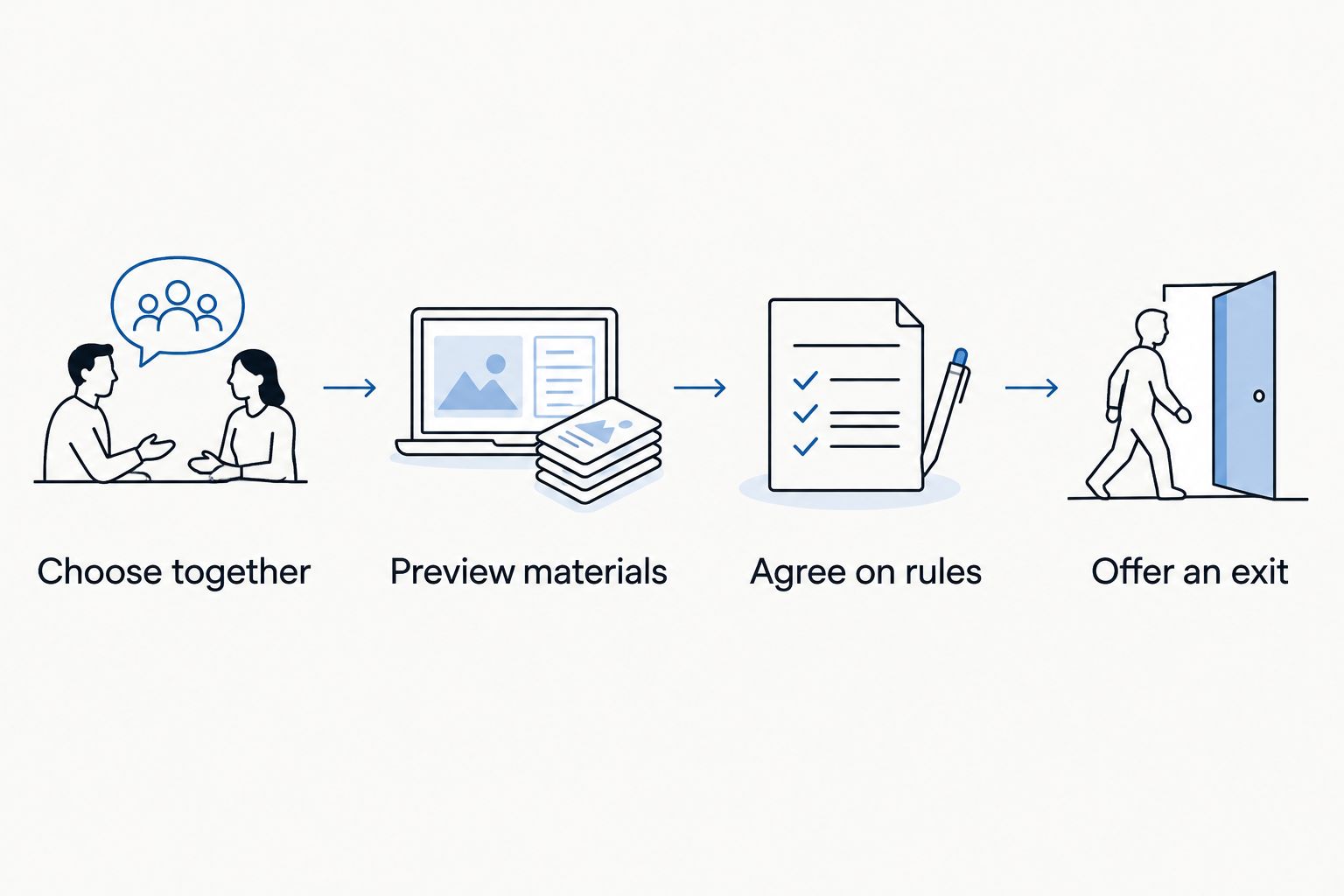
Before a 2026 family game night or Brooklyn community outing, use this sequence to make expectations clear:
- Choose together: Offer a small selection and accept your child's preference, including not playing.
- Preview materials: Show the board, pieces, sounds, and actions before explaining every rule.
- Agree on rules: Say whether you are exploring, practicing, playing cooperatively, or using standard competitive rules.
- Offer an exit: Make watching, taking a break, or stopping acceptable from the start.
A predictable invitation leaves room for choice. Use this sequence at home before bringing an unfamiliar game to a group setting.
For younger children, begin with safe exploration under adult supervision. Follow the game's age guidance and small-parts warnings; a child's interest in a game does not remove a safety concern.
For school-age children, demonstrate the actual turn and let them try it. For teenagers, ask about themes, challenge, and preferred companions. The guide to social skills games for autistic teens offers a separate starting point for age-respectful shared activities.
Which board game should you choose?
Start with Connect 4 if your child likes visible patterns and competition. Choose Outfoxed! if a shared goal is more appealing. Candy Land suits low-reading introductory play; Guess Who? suits question-based play; Qwirkle suits pattern building; Ticket to Ride: First Journey suits map interests.
For Brooklyn families considering a group activity, ask Autism Learn & Play about current community programs through the website contact form or info@autismlearnplay.org. Ask about age fit, caregiver participation, communication access, and break arrangements rather than assuming a particular game or format is offered.
FAQ
What’s the best board game for kids with autism in 2026?
Connect 4 is the default recommendation for children who enjoy visible patterns and two-player competition. Outfoxed! is a better fit when your child prefers a shared goal. Interests, communication access, and sensory preferences should decide the final choice.
Are cooperative board games better for autistic children?
Cooperative board games suit children who prefer working together, but they are not better for every autistic child. Outfoxed! removes competition between players while still involving group decisions and the possibility of disappointment.
Can a nonspeaking child play board games?
Yes, a nonspeaking child can participate in board games through pointing, gestures, an AAC device, or other communication methods. Agree on how choices and breaks will be communicated, and provide assistance with pieces when wanted.
Is Candy Land a good choice for an autistic toddler?
Candy Land is not an automatic recommendation for a toddler; follow the edition’s age guidance and safety warnings. Color-based play does not remove small-parts risks or mean a child is ready for standard rules.
Which board game suits an autistic teenager?
Qwirkle suits teenagers who enjoy visual patterns, while a route-building game suits an interest in maps. Ask the teenager about the theme and challenge rather than choosing solely by diagnosis or assuming a younger-child game is welcome.
What should I do if my child gets upset about losing?
Pause the game and acknowledge your child’s feelings without requiring another round. Before the next session, agree on practice play, a cooperative option, or a clear way to stop; do not change the rules unexpectedly during a difficult moment.
Can board games replace autism therapy?
No, board games are shared activities rather than replacements for individualized therapy. A clinician who knows your child can help you decide whether a particular activity fits an existing support plan.
One last thing
For your next game session in 2026, agree on a stopping signal before explaining how to win. Being able to leave comfortably matters more than finishing the board. Watching a sibling play, arranging pieces, or choosing a game for another day can all be valid ways to participate.
Related guides
- Art therapy activities for autistic kids
- Fine motor skill activities for autism
- Gross motor activities for kids with autism