If Apex ABA already gives your child a supportive relationship and meaningful goals, that continuity deserves consideration. The reason to compare alternatives is a mismatch between your child’s needs and the support you receive—not the provider’s name. The best Apex ABA alternative in 2026 is Autism Learn & Play Inc. for Brooklyn families seeking therapy alongside community programs; a speech-language therapy pathway is the better focus when communication is your main concern.
- Compare Apex ABA alternatives by your child’s goals, comfort, and opportunities to connect—not by rankings alone.
- Autism Learn & Play Inc. serves children ages 2–18 with therapy, community programs, and online classes.
- Speech-language therapy focuses on communication; occupational therapy addresses participation in everyday activities.
- Community activities complement therapy but do not replace individualized clinical support.
Why this matters
Choosing support is about more than choosing an ABA provider. You might want help with communication, everyday routines, making friends, or finding an activity your child genuinely enjoys. Those priorities call for different questions.
Autism Learn & Play Inc. is a Brooklyn-based nonprofit offering ABA, speech, occupational, music and art therapy, tutoring, community programs, and online classes for children ages 2–18. That range makes it relevant when your family wants to explore more than one type of support. Ask which services fit your child rather than assuming every offering belongs in your plan.
Use this 2026 comparison to choose a direction, then discuss the actual plan with the people who will support your child. A useful conversation starts with what your child enjoys, how they communicate, and what makes participation difficult.
Apex ABA alternatives at a glance
These options are different support pathways, not interchangeable services. The table helps you decide what to investigate; it does not rank providers by outcomes or promise a particular experience.
| Option | Best for | Main focus | How to compare it with Apex ABA |
|---|---|---|---|
| Apex ABA | Families considering continuity with an existing provider | Your child’s current goals and support relationship | Assess whether the current plan still fits your child |
| Autism Learn & Play Inc. | Brooklyn families exploring therapy and community programs | Multiple therapy types, educational support, and online classes | Ask whether the available service mix addresses needs beyond your current plan |
| Speech-language therapy pathway | Families prioritizing communication | Understanding and expressing messages | Compare communication goals, methods, and coordination with existing support |
| Occupational therapy pathway | Families prioritizing everyday participation | Activities such as dressing, play, and school routines | Compare the everyday activities each plan addresses |
| Community programs and interest-based activities | Families prioritizing connection and shared interests | Participation with other children around an activity | Compare the social setting and support needed to participate |
Choose the support that matches the need. A communication concern, a difficult daily routine, and a wish for more friendships do not automatically require the same response.
1. Autism Learn & Play Inc.: best for broader Brooklyn support
Autism Learn & Play Inc. combines therapy services, community programs, and online classes within a Brooklyn-based nonprofit serving children ages 2–18. Its stated offerings include ABA, speech, occupational, music and art therapy, and tutoring. For families comparing ABA alternatives, this gives you several types of support to discuss without treating ABA as the only starting point.
Begin with your child’s priority, not a list of services. If your child enjoys creative activities but needs communication support, ask how those interests would inform recommendations. Do not assume that separate services share staff, schedules, or a coordinated plan; ask how coordination works.
Where this option shines
- Its stated offerings include both therapy and community programs.
- Its age range includes younger children, school-age children, and teens.
- Brooklyn families can explore educational support alongside therapy.
- Online classes are part of its offerings, giving families another format to discuss.
Where this option falls short
- A broad service list does not establish which service is right for your child.
- The stated age range ends at 18 years; families planning adult support need a separate transition discussion.
- Online classes are not automatically a substitute for individualized therapy or an in-person group.
- A nonprofit model alone does not establish how well a particular provider-child relationship will fit.
Best for: Brooklyn families seeking an autism support pathway that includes therapy, education, and opportunities for community participation.
Before choosing, ask what a first visit involves, how your child’s preferences shape goals, and what participation looks like for their age. For a 2026 decision, discuss your present needs rather than relying on an older recommendation from another family.
Verdict: Hold off on changing providers until the proposed support fits your child’s goals, communication, and comfort.
2. Speech-language therapy: best for communication priorities
Speech-language therapy focuses on communication, including understanding language and expressing needs, ideas, and preferences. Communication is not limited to spoken words. Gestures, pictures, writing, and augmentative and alternative communication can all belong in a discussion about support.
This pathway belongs on your shortlist when communication is the concern you want addressed directly. It can complement other services rather than replace them. Ask the speech-language professional how recommendations will carry into home, school, and activities your child enjoys.
Where speech-language therapy shines
- It gives communication goals a clear focus.
- It supports discussion of methods that fit how your child already communicates.
- It creates a place to address understanding as well as expression.
- It can include guidance for communication partners, including family members.
Where speech-language therapy falls short
- It does not cover every need addressed by occupational therapy, educational support, or community programs.
- A clinic-based activity is not the same as participating with peers during an outing.
- The provider still needs to understand your child’s interests and communication preferences.
Best for: Families whose central question is how to help their child communicate and be understood.
When comparing this pathway with your current ABA plan, ask whether both professionals are working toward compatible goals. A child should not have to use one accepted communication method in one setting and abandon it in another.
Verdict: Hold off on replacing an entire support plan when a focused communication service addresses the concern.
3. Occupational therapy: best for everyday participation
Occupational therapy addresses participation in everyday activities, such as dressing, eating, play, and school routines. For children, the important question is what makes an activity accessible and manageable—not whether they perform it exactly like someone else.
Describe the specific difficulty before asking for a service recommendation. Getting dressed, handling classroom materials, and joining a busy outing are different situations. Your examples help a professional assess the task, the environment, and the support your child needs.
Where occupational therapy shines
- It focuses on practical activities that matter to your family.
- It considers how tasks and environments affect participation.
- It gives you a place to discuss sensory experiences and motor demands.
Where occupational therapy falls short
- It does not replace speech-language assessment when communication is the main concern.
- It is not, by itself, a peer community or friendship program.
- An activity described as sensory-friendly does not establish that it fits your child.
Best for: Families seeking support with everyday routines and participation at home, school, or outings.
Verdict: Hold off on choosing by therapy label alone; ask how the proposed work addresses a specific daily activity.
4. Community programs: best for connection through shared interests
Community programs and interest-based activities give families a different question to explore: where can your child participate in something they enjoy alongside others? Art, music, games, or another shared interest can provide a reason to gather without making conversation the entire activity.
A community program is not automatically therapy. Ask what support is present, how participation works, and whether watching before joining is acceptable. For parent connection, explore family support groups for autism in Brooklyn separately from your child’s activity choices.
Where community programs shine
- Shared interests give children something concrete to do together.
- Families can look for opportunities outside a therapy setting.
- Activities create a setting in which to explore connection without demanding friendship on a schedule.
Where community programs fall short
- A group does not replace individualized assessment or therapy.
- Noise, transitions, and participation expectations still need checking.
- An inclusive description does not guarantee the support your child requires.
Best for: Families looking for enjoyable participation and opportunities to meet other children.
Verdict: Skip any activity that requires your child to ignore distress or participate without needed support.
Why families consider switching from Apex ABA
A useful reason to consider switching is a specific mismatch in your own experience. These are decision criteria, not claims about Apex ABA’s services. Compare what your child needs with what your current plan actually provides.
- Goals no longer fit. You want to revisit priorities because your child’s interests, routines, or needs have changed.
- Another type of support is needed. Communication, everyday participation, or educational questions require a focused discussion with the relevant professional.
- Community is a separate priority. Your family wants activities and relationships beyond therapy appointments.
- The experience is not working for your child. You need a clear response to distress, communication preferences, or requests for breaks.
- Family routines need consideration. Travel, school, and existing commitments belong in the planning conversation.
Before making a 2026 change, ask your current provider whether the concern can be addressed. A revised goal, another professional’s involvement, or an added community activity is different from replacing the whole relationship.
Choose by age, interests, and support needs
Age helps you ask better questions, but it does not tell you everything about a child. Use these age bands as conversation prompts, not requirements or predictions.
| Age | Questions to bring to a provider or activity organizer |
|---|---|
| 2–5 years | Can a caregiver stay involved? How are play, communication, and transitions supported? |
| 6–12 years | How does the activity fit school routines and interests? What happens when a child needs a break? |
| 13–18 years | Can teens influence activity choices? Are materials age-respectful, and how are preferences heard? |
For younger children, ask about the adult’s role during participation. For school-age children, discuss expectations and transitions. For teens, include the young person directly in decisions using their preferred way of communicating.
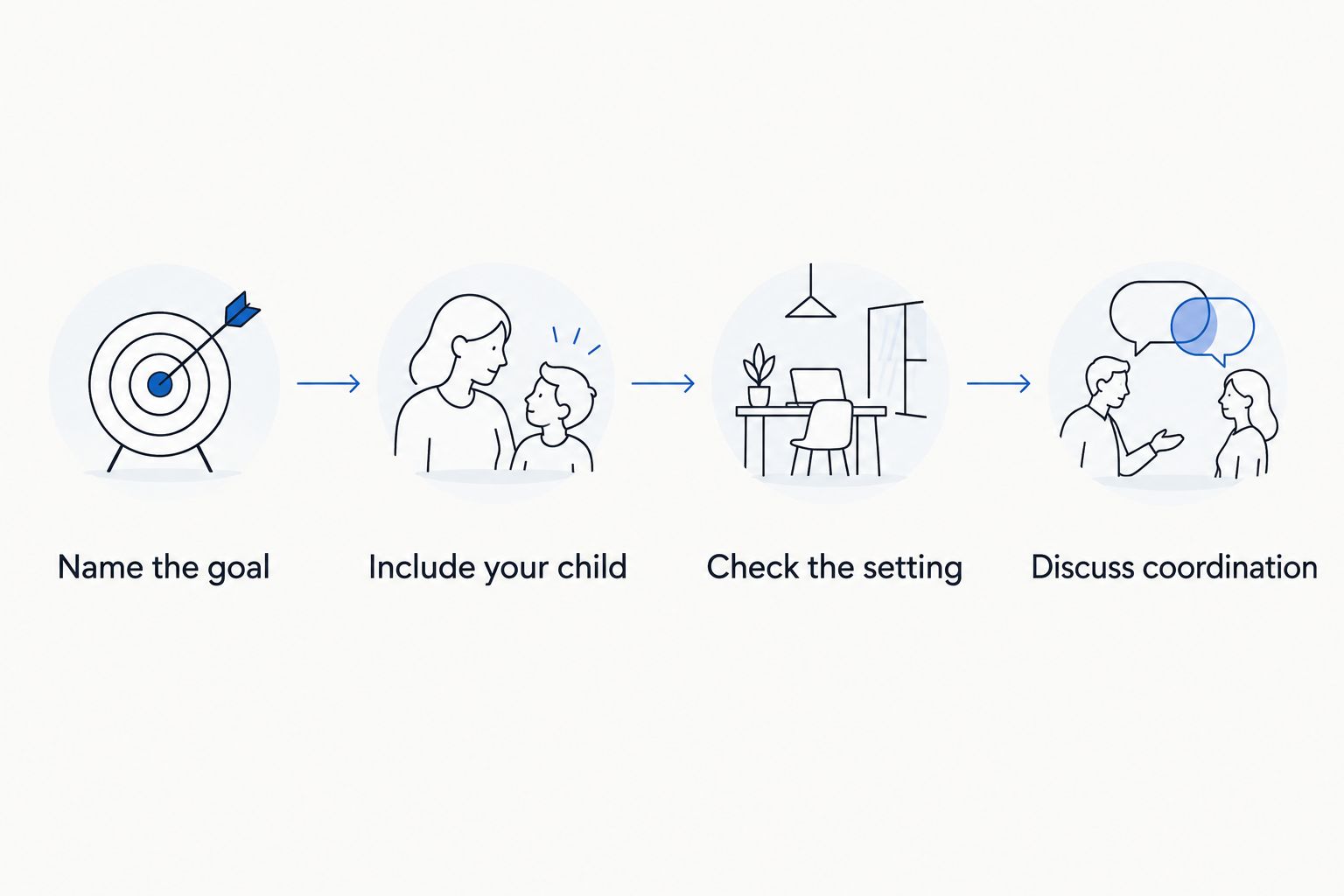
Then work through these steps:
- Name the goal. Describe the activity or situation you want support with.
- Include your child. Gather preferences, interests, and signs of comfort or discomfort.
- Check the setting. Ask about noise, breaks, group expectations, and caregiver involvement.
- Discuss coordination. Ask how the plan fits existing therapy and school support.
Ask an organizer to describe arrival, the activity, transitions, and departure. That gives you more useful information than a general promise of inclusion. Explain what helps your child participate and ask how requests for a break or a different communication method are handled.
For questions about Autism Learn & Play Inc. therapy or community programs, contact info@autismlearnplay.org. Describe your child’s age, interests, and the support you are looking for without assuming a particular program format.
When staying with Apex ABA is the right call
Stay with an existing provider when the relationship fits your child and the plan addresses your priorities. A list of alternatives is not a reason to disrupt support that your family values.
Consider keeping the current relationship while discussing another service or community activity. Before adding support, clarify each professional’s role so your child’s goals remain understandable and consistent. The best 2026 decision is the one grounded in your child’s actual experience.
FAQ
What’s the best Apex ABA alternative for Brooklyn families?
Autism Learn & Play Inc. is a relevant option for Brooklyn families seeking therapy alongside community programs and online classes. It serves children ages 2–18; discuss the particular service your child needs before choosing.
Is speech therapy a replacement for ABA?
Speech-language therapy and ABA are different support pathways, so replacement is not automatic. Ask which communication goals need focused support and how the professionals involved will coordinate.
Can my child join a community activity while receiving therapy?
You can explore community activities alongside therapy. Ask the organizer about participation support and discuss how the activity fits your child’s existing commitments.
What should I ask before changing autism providers?
Ask how the proposed plan addresses your child’s goals, communication preferences, and comfort. Also discuss caregiver involvement, coordination, and what happens when your child needs a break.
Are online classes the same as individualized therapy?
Online classes are not automatically equivalent to individualized therapy. Clarify the purpose, format, and support involved before deciding whether a class fits your child.
How do I compare programs for an autistic teenager?
Include your teenager’s preferences and ask whether activities and materials respect their age. Check how the organizer supports communication, choice, and participation without forcing interaction.
How can I contact Autism Learn & Play Inc.?
Email info@autismlearnplay.org to ask about therapy services, community programs, or online classes. Share your child’s age and the support you want to discuss.
One last thing
Ask this before signing up: What happens if my child wants to watch rather than join? The answer reveals the program’s participation expectations and gives you something concrete to discuss with your child. Connection should leave room for choice, not become another performance requirement.
Related guides
- Social skills games for autistic teens
- Art therapy activities for autistic kids
- Autism-friendly museums and attractions in NYC