For autistic toddlers, animal-assisted therapy is a goal-directed service that includes an animal to support an individualized therapeutic aim, such as communication or participation in play. Animal therapy for autistic toddlers should follow your child’s interests, comfort, and safety needs—not pressure them to touch an animal or behave a certain way.
- Animal therapy for autistic toddlers requires individualized goals, qualified professionals, and attention to both child and animal safety.
- Autism Learn & Play offers Brooklyn families therapy services and community programs; ask separately about animal-assisted services.
- A petting-zoo visit is an outing, not automatically animal-assisted therapy.
- Choose sensory-friendly outings that welcome observation, communication supports, breaks, and leaving early.
Why animal-assisted therapy matters for autistic toddlers
An interest in animals gives you a starting point for choosing an activity—not proof that animal-assisted therapy is the right service. Your toddler might enjoy watching a dog from across a room while finding barking, fur, or unexpected movement uncomfortable.
For Brooklyn families planning activities in 2026, the practical question is whether an experience fits your child’s everyday needs. Consider the journey, waiting area, bathroom access, and return home alongside the animal interaction itself.
Start with the goal, then choose the setting. If your main concern is participation in dressing, play, or daily routines, discuss it with your child’s clinician. This guide to occupational therapy for autistic toddlers explains another route to individualized support.
Animal-assisted therapy is not a cure for autism. An enjoyable encounter also does not establish that a treatment is effective; your child’s goals and experience need their own review.
How to choose animal therapy for your toddler
Start with your child’s interests and boundaries
Begin without booking anything. Look at animal pictures together, use a familiar toy animal during play, or notice your child’s response when an animal passes at a comfortable distance. These are ways to learn preferences, not tests your toddler needs to pass.
At age 2 years, your child might show interest by looking, approaching, or bringing you a picture. At age 3 years, your child might use words, gestures, pictures, or a communication device to request more or signal that they are finished. Let their actual communication guide you rather than assuming skills from age alone.
A child who loves animal books does not necessarily want contact with a live animal. Keep that distinction central to your 2026 activity plans.
- Notice which animals your child seeks out or avoids.
- Record responses to movement, sound, smell, and proximity separately.
- Accept turning away, moving back, or pushing something aside as meaningful communication.
- Offer observation without requiring touching or feeding.
- Avoid surprise introductions, including encounters arranged as a treat.
Define one useful goal with your child’s clinician
Write down what you hope will become easier in daily life. Examples include requesting a break, sharing an enjoyable activity with a caregiver, or participating in play. These are possible planning goals, not promised results of animal contact.
Bring that goal to your child’s pediatrician or treating professional. Ask whether involving an animal serves the goal and what a suitable alternative would look like. You do not need to arrange animal contact before having this conversation.
A good plan explains why the animal is included. Enjoyment matters, but therapy also needs a clear purpose, an appropriately qualified professional, and a way to review whether the approach fits your child.
- Choose a goal connected to your child’s everyday life.
- Describe what participation would look like without requiring speech or eye contact.
- Ask how the professional will recognize discomfort or refusal.
- Discuss allergies, asthma, skin concerns, and other relevant health needs.
- Agree on what would prompt changing or stopping the activity.
Separate therapy from community outings
Before comparing providers, decide whether you want a clinical service, a recreational experience, or a chance to connect with other families. You can make this distinction yourself by asking who leads the activity and whether it follows an individualized treatment plan.
Autism Learn & Play suits Brooklyn families seeking therapy services and community programs for autistic children ages 2–18. Its services include speech, occupational, music, and art therapy, alongside other services and online classes; ask directly about animal-assisted options rather than assuming they are included.
For help discussing the nonprofit’s services, use the contact form or email info@autismlearnplay.org. Share your toddler’s age, interests, communication preferences, and the kind of support you want.
- Ask whether the activity is therapy, recreation, or an educational visit.
- Request the treating professional’s qualifications when therapy is advertised.
- Ask who handles the animal and who supports your child.
- Confirm whether toddler participation requires a caregiver beside the child.
- Ask how goals and session notes are shared with families.
Check the setting before committing
Use a phone call or written questions to understand the setting before bringing your toddler. Ask about the actual experience—not simply whether a program calls itself sensory-friendly. A quiet entrance does not tell you what happens once animals or other visitors arrive.
For your 2026 shortlist, consider the entire visit from arrival to departure. Ask whether your child can observe first, keep distance, take a break, and leave without completing the planned activity.
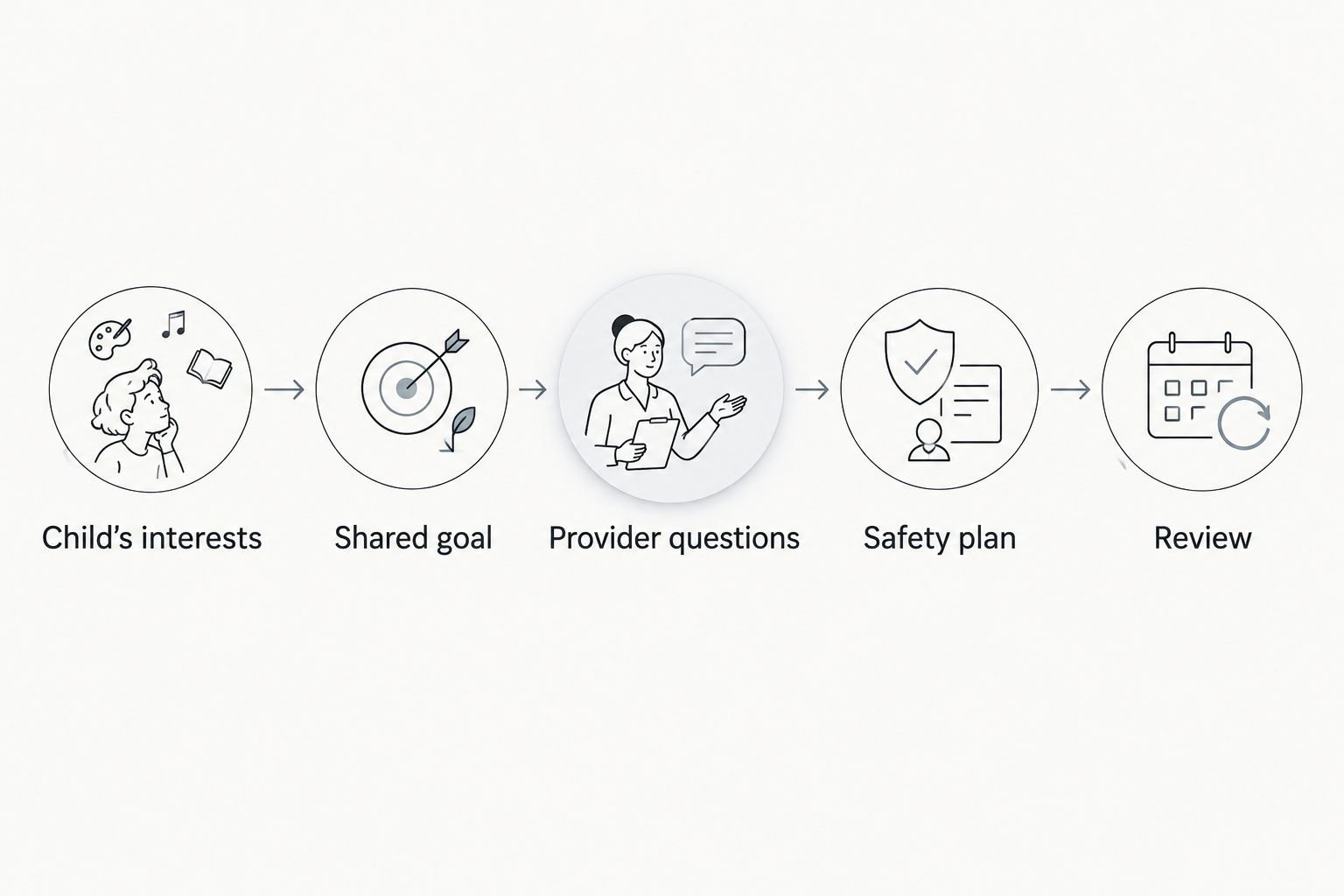
The following planning sequence keeps your child’s needs ahead of the booking decision: Child’s interests, Shared goal, Provider questions, Safety plan, Review. Return to an earlier step whenever something does not fit.
A provider’s answers should help you picture the visit. If the response remains vague, request clarification before deciding whether the setting meets your family’s needs.
- Ask about barking, odors, flooring, crowding, and waiting areas.
- Request details about a separate break space and the exit route.
- Ask whether pictures of the setting can help you prepare your child.
- Confirm handwashing arrangements and rules about food near animals.
- Ask how staff respond when either the child or animal needs distance.
Build a safety and communication plan
Start with supports your toddler already uses. Bring their usual communication tools, explain familiar signals for stopping, and agree with the provider that participation remains optional. Do not make access to a break depend on completing a task.
Live animals introduce considerations that books and pretend play do not: bites, scratches, allergies, and germs. Discuss your child’s health needs with their pediatrician and the provider before contact. Wash hands with soap and water after animal contact, and keep eating separate from animal areas.
An adult responsible for the animal should manage the animal throughout the encounter. Your role is not to divide attention between handling an unfamiliar animal and supporting your toddler.
- Identify who supervises your child and who handles the animal.
- Share your child’s ways of communicating yes, no, help, and finished.
- Keep your child’s communication device or picture supports accessible.
- Ask staff to prevent licking of faces, contact with open skin, and unsafe handling.
- Follow the provider’s hygiene rules and your pediatrician’s advice.
- Leave or pause when your child or the animal shows discomfort.
Review comfort, participation, and family fit
Afterward, describe what happened rather than judging whether your toddler was good at the activity. Looking from the doorway, requesting distance, or choosing to leave gives you useful information. None is a failure.
For a therapeutic service, ask the clinician to relate observations to the agreed goal. For a community outing, consider enjoyment, accessibility, and opportunities for connection. Keep those reviews separate: a pleasant afternoon does not need to become a treatment claim.
In 2026, keep a simple family record that includes the journey and time afterward. An activity that looks manageable inside the room still needs to fit your family’s day.
- Note what your child approached, watched, enjoyed, or declined.
- Record which supports helped and which demands felt unnecessary.
- Ask the clinician what the observations mean for the treatment goal.
- Consider whether travel and transitions were manageable.
- Decide together whether to repeat, adapt, pause, or choose an animal-free option.
Compare options for your toddler
Choose by purpose, not by the presence of an animal. Each option below serves a different need; none is automatically the best choice for every autistic toddler. Age suitability, qualifications, and accommodations need confirmation with the individual provider.
| Option | Best for | Main advantage | Key limitation |
|---|---|---|---|
| Animal-assisted therapy | Families exploring an animal-supported clinical goal | Connects animal involvement to an individualized therapeutic purpose | Requires appropriate professional oversight and a child-and-animal safety plan |
| Supervised animal visit | Families seeking a recreational encounter | Offers a chance to observe or interact without making treatment the purpose | Does not automatically include clinical assessment or individualized goals |
| Therapeutic riding | Families exploring an adapted equine activity | Provides an organized horse-related setting | Toddler suitability and physical requirements need careful confirmation; it is not interchangeable with other therapies |
| Animal-free play or community activity | Children who prefer predictable materials or distance from animals | Removes the need for direct live-animal contact | Does not provide the live-animal experience some children seek |
Autism Learn & Play’s therapy and community programs offer another starting point for discussing your family’s needs. The nonprofit serves children ages 2–18, so ask specifically about toddler fit rather than assuming an activity designed for older children will suit your child.
An online class is also a different format from an animal encounter or an in-person peer activity. Consider your toddler’s interest in the format and the caregiver support involved; do not treat these options as interchangeable.
Common mistakes families can avoid
Treating animal contact as the goal
Touching an animal is not necessary for an outing to be meaningful. If your child enjoys observing from a distance, respect that choice rather than turning the visit into practice at tolerating unwanted contact.
Accepting a therapy label without questions
A friendly animal and an encouraging adult do not explain what a clinical service includes. Ask about professional qualifications, individualized goals, documentation, and animal handling before treating an experience as therapy.
Planning around an older sibling
An older child’s enthusiasm does not establish toddler readiness. When siblings attend together, ask how their activities, supervision, and opportunities for breaks will differ; neither child should have to follow the other’s pace.
Ignoring the trip home
Consider transportation, transitions, and recovery alongside the activity. For Brooklyn outings in 2026, plan a straightforward exit and avoid making additional stops a condition of leaving.
Expecting animals to create friendships automatically
Shared interest gives families something to talk about, but it does not guarantee peer connection. Ask whether an outing includes opportunities for children to play alongside one another and whether caregivers can meet without pressuring children to interact.
FAQ
What is animal therapy for autistic toddlers?
Animal-assisted therapy involves an animal within a goal-directed service led by an appropriately qualified professional. A recreational animal visit is different because it does not automatically include assessment, individualized treatment goals, or clinical review.
Can animal therapy cure autism?
No, animal therapy does not cure autism. Decisions should focus on your child’s comfort, interests, participation, and individualized support needs—not promises to remove autistic traits.
What if my toddler likes animals but does not want to touch them?
Your toddler can enjoy animals without touching them. Choose an experience that welcomes observation and distance, and do not make contact a requirement for praise or participation.
Is animal-assisted therapy safe for every autistic toddler?
No, suitability requires an individual safety review. Discuss allergies, relevant health conditions, hygiene, animal handling, and your child’s ability to remain safely supported with the provider and pediatrician.
Does Autism Learn & Play provide animal-assisted therapy?
Ask Autism Learn & Play directly whether animal-assisted therapy is part of its services. The nonprofit provides therapy services, community programs, and online classes, but those offerings do not establish that animal-assisted therapy is included.
Should animal therapy replace speech or occupational therapy?
Do not replace an existing therapy plan without discussing the decision with your child’s treating professional. Ask whether an animal-assisted approach serves an agreed goal and how it would fit alongside current support.
How do I prepare my autistic toddler for an animal outing?
Explain the visit using communication your toddler understands and confirm the setting’s rules beforehand. Bring familiar communication supports, identify a break area, and make a plan to leave if your child needs to stop.
One last thing
A successful first encounter can end before touching an animal. Your toddler might look, communicate that they are finished, and leave with you—that is a valid boundary to honor.
For your next outing, choose one experience that welcomes your child as they are. Friendship and community should not require hiding discomfort or giving up a reliable way to say no.
Related guides
- Can siblings join autism community programs together?
- Autism-friendly museums and attractions in NYC
- Family support groups for autism in Brooklyn