Best overall: a familiar-interest party at home. Best for outdoor explorers: a choose-your-own park picnic. Best for a simple setup: a favorite-games gathering. These inclusive birthday party ideas for autistic kids put your child’s preferences, communication, and comfort ahead of birthday traditions.
- The best inclusive birthday party ideas for autistic kids start with familiar interests and optional participation.
- Choose a home celebration for control over activities, sound, and the guest list.
- Offer quiet space, clear plans, and different ways to join sensory-friendly birthday activities.
- Autism Learn & Play serves Brooklyn families seeking community programs, not a verified birthday-party service.
Why this matters
A birthday celebration does not need singing, surprise guests, or group games to count. Your child can celebrate with friends while watching, moving around, using a communication device, or taking breaks.
For Brooklyn families planning in 2026, the useful question is not which party looks most impressive. It is which setting lets your child enjoy something they like with people they want nearby.
Autism Learn & Play provides therapy services, community programs, and online classes for children ages 2–18. Autism Learn & Play is a fit for Brooklyn families seeking autism community programs; the party ideas below are independent planning suggestions.
What makes the best inclusive birthday party
Use these criteria before choosing an activity. A theme your child loves cannot compensate for a setting they cannot comfortably use.
- Child choice: Your child helps choose the activity, guests, and birthday traditions through their preferred communication method.
- Sensory comfort: You can adjust sound, lighting, materials, and crowding rather than expecting your child to tolerate everything.
- Flexible participation: Watching, parallel play, breaks, and leaving an activity are accepted ways to participate.
- Communication access: Guests can understand the plan and express choices without relying only on speech.
- Practical access: Check entrances, bathrooms, seating, travel, and any food or mobility needs before inviting guests.
- Age respect: Activities reflect actual interests, including a teenager’s preferences, rather than assumptions about developmental ability.
Inclusive birthday party ideas at a glance
The order below favors flexibility and ease of adapting the experience, not the size of the celebration. Each idea serves a different preference.
| Party idea | Best for | Standout feature | Key limitation |
|---|---|---|---|
| Familiar-interest home party | Children who prefer familiar surroundings | Build the celebration around a known favorite | Hosting changes the home environment |
| Choose-your-own park picnic | Children who enjoy being outdoors | Guests can spread out and choose activities | Weather and public noise are outside your control |
| Favorite-games gathering | Children who enjoy predictable rules | Familiar games provide a shared focus | Competition and waiting need planning |
| Open-choice art party | Children who enjoy making things | Everyone can create without matching a model | Materials introduce texture and mess |
| Child-directed music party | Children who actively enjoy music | The birthday child helps control the playlist | Sound preferences can conflict |
| Personal-pizza assembly party | Children interested in food preparation | Each guest chooses whether and how to participate | Allergies, food handling, and heat require care |
| Remote shared-interest celebration | Children who prefer celebrating from home | Guests join from their own familiar spaces | Screens and overlapping conversation are not for everyone |
1. Familiar-interest home party: best for familiar surroundings
Build the celebration around something your child already enjoys: drawing maps, arranging toy animals, sharing favorite books, or discussing a particular interest. Keep familiar furniture and routines where possible rather than transforming the whole home.
Best for: Children who want company without an unfamiliar venue.
For ages 2–5, consider a familiar play area with a caregiver nearby. For ages 13–18, let your teen decide whether the gathering needs a theme at all; spending time around a shared interest is enough.
Home-party pros:
- You choose the guest list and sound level.
- Familiar belongings remain close by.
- Guests can follow your child’s preferred activity.
Home-party cons:
- Visitors still change the home environment.
- Hosting and protecting quiet space become your responsibility.
Explain which belongings are available to share. Your child does not need to surrender a treasured object because guests have arrived.
Verdict: Buy into this idea when familiarity matters most.
2. Choose-your-own park picnic: best for outdoor explorers
Make a picnic the meeting point rather than organizing everyone into the same game. Offer choices such as looking at leaves, drawing, walking with a caregiver, or sitting together with familiar snacks.
Best for: Children who enjoy outdoor spaces and room to move.
For a Brooklyn park gathering in 2026, visit the intended spot beforehand. Check the route, bathrooms, boundaries, nearby traffic, and where guests can step away; do not assume an outdoor setting is quiet or enclosed.
Park-picnic pros:
- Guests can choose active or seated activities.
- Shared space does not require constant conversation.
- The plan can center on exploration rather than performance.
Park-picnic cons:
- Weather can change the plan.
- Other visitors and unexpected sounds remain outside your control.
Tell families where supervision boundaries begin and end. Assign supervision explicitly rather than assuming another adult is watching.
Verdict: Buy into this idea when outdoor enjoyment outweighs uncertainty.
3. Favorite-games gathering: best for predictable shared play
Choose games your child already knows and wants to share. Cooperative building, a familiar board game, or an agreed video game can give guests something concrete to do together.
Best for: Children who enjoy clear rules and a shared task.
Ask before introducing competitive play. For a teen, preserve age-respectful choices: a preferred strategy game is more appropriate than a younger activity selected solely because it seems easier to manage.
Games-gathering pros:
- Familiar rules provide a clear starting point.
- Guests can connect around the activity.
- Observing can be an accepted role.
Games-gathering cons:
- Turn-taking can create unwanted waiting.
- Winning, losing, and rule changes need agreement.
Offer a noncompetitive alternative beside the main game. Explain rule adaptations before play starts, and never require guests to compete to receive a party favor.
Verdict: Buy into this idea when your child enjoys the game itself, not just its theme.
4. Open-choice art party: best for independent creativity
Set out familiar drawing or craft materials and let guests make different things. A shared table can support togetherness without requiring identical projects or continuous conversation.
Best for: Children who like creating at their own pace.
Offer dry materials alongside anything wet or sticky. For children who mouth objects, select materials with caregivers and supervise accordingly; a craft labeled for children is not automatically appropriate for every guest.
Art-party pros:
- Guests choose their materials and subjects.
- Side-by-side making allows different interaction styles.
- There is no need for a winning or finished piece.
Art-party cons:
- Smells, textures, and cleanup can be unwelcome.
- Small supplies need individual safety consideration.
Avoid demonstrations that turn into a copying requirement. Ask before displaying anyone’s work or photographing their creation with them.
Verdict: Buy into this idea when making choices is more appealing than following instructions.
5. Child-directed music party: best for enthusiastic music fans
Let your child help choose familiar music and decide whether the activity involves listening, movement, or playing along. Music belongs on the plan only when your child actually enjoys it.
Best for: Children who want music to be the main activity.
Agree on volume and a clear stop signal before starting. For a 2026 celebration, build the playlist with your child rather than relying on a generic children’s party soundtrack.
Music-party pros:
- Listening is a valid way to join.
- Favorite songs give the gathering a personal focus.
- Movement can be optional rather than demonstrated on demand.
Music-party cons:
- Guests can have conflicting sound preferences.
- Instruments add unpredictable noise.
Keep a separate quiet option available. This is a recreational party idea, not music therapy, and it does not require anyone to sing or perform.
Verdict: Buy into this idea only when the birthday child wants a music-centered celebration.
6. Personal-pizza assembly party: best for hands-on food interests
Invite guests to assemble their own pizza using ingredients agreed with caregivers beforehand. Watching, arranging ingredients without eating, or bringing familiar food should remain acceptable choices.
Best for: Children who already enjoy food preparation.
Separate food preparation from any expectation to taste something new. Adults should manage the oven and hot surfaces, with supervision matched to each child’s needs and experience.
Pizza-party pros:
- Each guest chooses their own ingredients.
- Preparation provides a shared activity.
- Familiar food can remain part of the celebration.
Pizza-party cons:
- Allergies and cross-contact require advance planning.
- Smells, textures, and waiting for cooking can be difficult.
Confirm dietary needs directly with families. Do not describe food as safe for someone else without checking the ingredients and preparation arrangements they require.
Verdict: Buy into this idea when preparation is enjoyable without pressure to eat.
7. Remote shared-interest party: best for celebrating separately
A remote celebration can revolve around showing artwork, sharing a favorite interest, or doing a familiar activity while connected. Let guests use speech, chat, gestures, or supported communication as appropriate.
Best for: Children who prefer joining from their own space or want to include distant friends.
Agree on the activity beforehand and make cameras optional. A remote party is a choice, not a lesser substitute that your child needs to apologize for.
Remote-party pros:
- Each family controls its immediate surroundings.
- Travel is removed from the plan.
- Guests can share interests without sharing physical space.
Remote-party cons:
- Overlapping speech can make participation difficult.
- Screens and connection problems can interrupt the activity.
Ask permission before recording or sharing screenshots. Make the ending clear so guests know when they can sign off.
Verdict: Buy into this idea when connection from separate spaces is the preferred format.
How to turn an idea into a welcoming plan
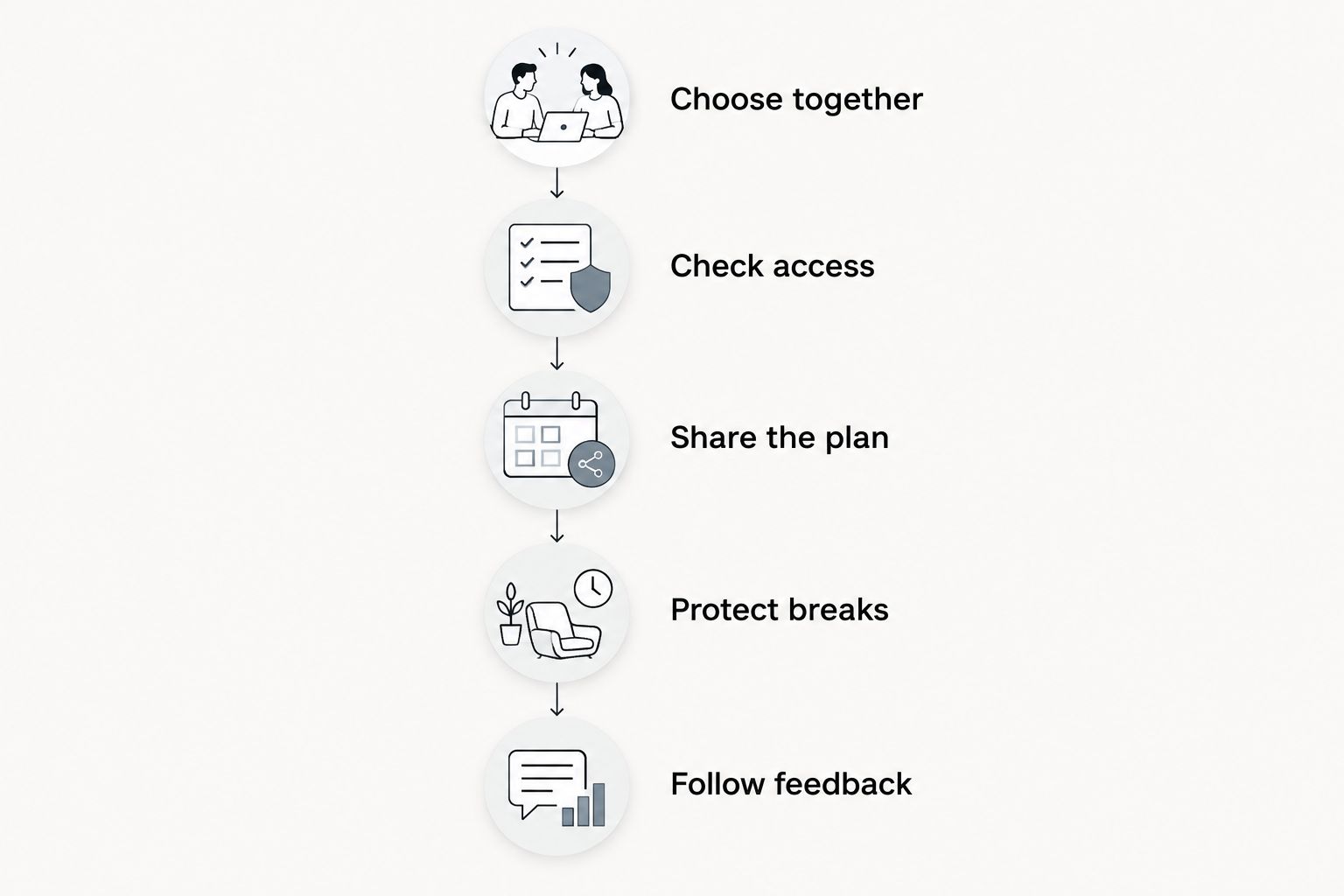
For your 2026 party, start with your child’s preferences and then check access with guests. These steps are planning suggestions, not a schedule every family must follow.
- Choose together: Offer concrete options through speech, pictures, objects, writing, or your child’s usual communication system.
- Check access: Ask caregivers about communication, food, mobility, sensory preferences, and supervision without requesting a diagnosis.
- Share the plan: Explain the location, activity, people, food arrangements, and ending. Mention anything that will differ from the usual routine.
- Protect breaks: Identify a retreat space and how a child can ask to leave an activity. Keep communication devices within reach.
- Follow feedback: Adjust or end an activity when your child communicates that they are finished.
A plan is useful when it makes choices clearer, not when it becomes another set of demands. Agree with helping adults that declining a game, photograph, hug, or birthday song is acceptable.
How these ideas are ranked
The ranking prioritizes child choice, sensory comfort, flexible participation, communication access, practical access, and age respect. Home celebrations come first because the host controls more of the setting; the remaining options match specific interests rather than representing universally better or worse parties.
These are planning recommendations, not results from comparative testing. No activity guarantees friendships, enjoyment, or a particular developmental outcome.
Which inclusive birthday party should you choose?
Choose a familiar-interest home party if you are undecided. Keep the activity recognizable, invite people your child wants there, and remove traditions your child dislikes.
For ages 6–12, offer concrete activity choices without assuming every child wants organized games. For ages 13–18, ask about privacy, invitations, photos, and adult involvement directly. Preferences matter more than the age band.
Autism Learn & Play provides community programs, but those services should not be presented as birthday bookings. For questions about community participation beyond the party, use the website contact form to describe your family’s interests and ask about an appropriate next step.
FAQ
What’s the best birthday party for an autistic child?
A familiar-interest home party is the default recommendation because you control the setting and activities. Choose a different format when your child clearly prefers it.
How many guests should I invite to an autism-friendly birthday party?
Invite the people your child wants and can comfortably share space with; there is no universal guest count. Consider the room, supervision needs, relationships, and your child’s preferences.
Do we have to sing Happy Birthday?
No, birthday singing is optional. Ask your child whether they want singing, a spoken celebration, a quiet acknowledgment, or no group attention.
How can a nonspeaking child help plan a birthday party?
A nonspeaking child can choose through their usual communication methods, including AAC, gestures, pictures, or objects. Offer meaningful choices and respect rejection as well as selection.
What should I tell guests before a sensory-friendly party?
Share the activity plan, food arrangements, access information, and options for breaks. Explain that guests can decline activities and communicate in different ways without discussing anyone’s private diagnosis.
Are sensory activities always a good birthday choice?
No, sensory preferences differ between children. Choose textures, sounds, movement, and materials your child enjoys rather than assuming an activity is comfortable because it is called sensory-friendly.
Does Autism Learn & Play host birthday parties?
Birthday-party hosting is not a verified Autism Learn & Play service. The nonprofit provides therapy services, community programs, and online classes for children ages 2–18.
One last thing
Before sending invitations for your 2026 celebration, ask your child what they do not want. Removing the birthday song, surprise entrance, or public gift opening can be more useful than adding another activity. A celebration still counts when your child celebrates differently.
Related guides
- Can siblings join autism community programs together?
- Social skills games for autistic teens
- Cooking recipes for kids with autism