
Getting into an autism summer program takes as long as the provider needs to confirm your child’s placement and start date; there is no single enrollment timeline that applies to every program. For summer 2026, ask for the next enrollment step and a written start-date confirmation, because submitting an inquiry is not the same as securing a place.
- How long does it take to get into an autism summer program? Get a provider-confirmed timeline, not an assumed deadline.
- Autismlearnplay serves children ages 2–18; ask directly about summer programs and your child’s support needs.
- Separate an inquiry, an application, and a confirmed start when planning summer activities.
- Choose community programs around your child’s interests, communication, sensory comfort, and opportunities to connect.
How long does it take to get into an autism summer program?
Use a confirmed start date—not the date you first contacted a program—to plan your summer. Ask the provider to explain what must happen between your inquiry and your child’s first session. Request a specific next step rather than accepting an open-ended instruction to check back.
For your summer 2026 planning, use the following questions to distinguish progress from confirmation. These are planning checkpoints, not a claim that every provider follows the same admission process.
| Enrollment checkpoint | What to ask | What it means for your plans |
|---|---|---|
| Initial inquiry | Who handles enrollment, and what should I do next? | You have started a conversation, not confirmed attendance. |
| Application or intake | What information do you need, and is my submission complete? | You can identify any action still needed from your family. |
| Support discussion | How will you address my child’s communication, sensory, and daily support needs? | You can assess whether the program fits your child. |
| Placement decision | Has my child been accepted for the dates requested? | You can distinguish a decision from continued consideration. |
| Confirmed start | Can you confirm the first day, schedule, and arrival instructions in writing? | You have concrete details for preparing your child. |
If educational goals are part of your decision, read about connecting summer programs to your child’s IEP meeting. Share relevant goals when asked, without assuming a community program provides the services listed in an IEP.
Why this matters
Summer planning involves more than choosing an activity. You are also arranging transportation, family schedules, communication supports, and a setting where your child feels welcome.
A clear enrollment conversation gives you something practical to work with. It also leaves room to ask about friendship, shared interests, and participation instead of focusing only on paperwork.
A suitable program needs to fit your child, not just your calendar. For summer 2026, keep both questions together: “When can my child start?” and “What will participation actually look like?”
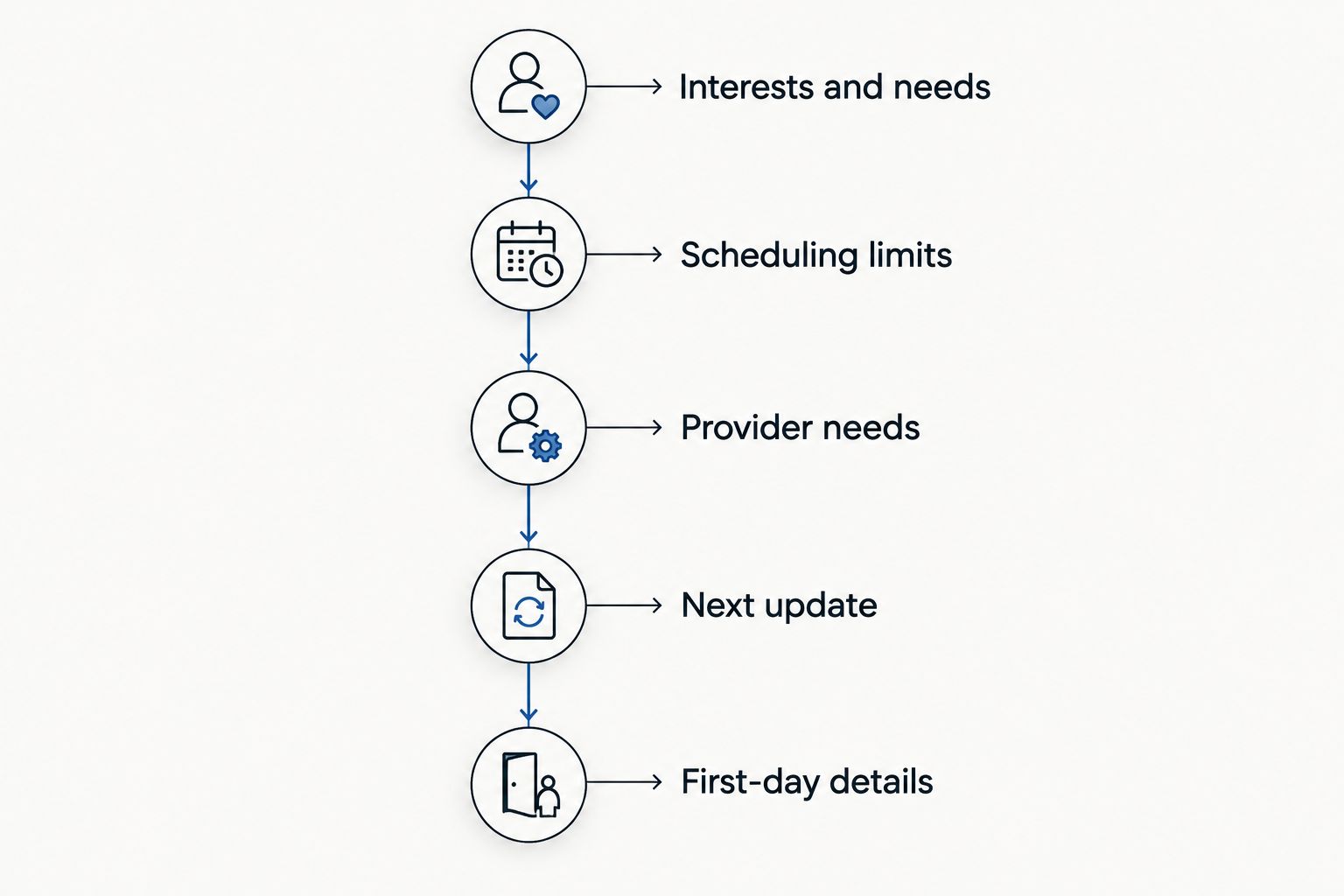
How do I move from an inquiry to a confirmed start?
Use this sequence to organize your conversations. Ask the provider which steps apply rather than assuming every item is required.
1. Describe your child’s interests and needs
Start with what your child enjoys: drawing, movement, stories, games, music, or spending time outdoors. Explain how your child communicates, asks for help, and shows that a break is needed.
Prepare a 1-page family summary if that helps you keep the conversation focused. Include only relevant information, and ask how to share sensitive records securely before sending them.
2. State your dates and scheduling limits
Give your preferred start date and explain which parts of your schedule are flexible. If you have flexibility, offer 2 preferred start dates rather than saying that any arrangement works.
Ask whether enrollment applies to a specific session, a recurring schedule, or another arrangement. Do not assume that acceptance for one activity also covers other dates or outings.
3. Clarify what the provider needs
Ask whether there is an application, a family conversation, a visit, or any other step before a decision. Then ask who is responsible for arranging it.
Request the exact documents the provider needs, if any. Avoid sending a full history simply because you are worried that more paperwork will speed things up.
4. Agree on the next update
Before ending the conversation, ask who will contact whom and when. Record the agreed follow-up date beside the staff member’s name.
If the provider cannot confirm a start, ask what remains unresolved. That answer is more useful than repeatedly asking whether there is news.
5. Confirm the first-day details
Once the provider confirms a place, request the start date, meeting location or online access instructions, schedule, and any preparation steps. Check the arrival and departure arrangements for an in-person activity.
Tell your child what is confirmed in a communication format that works for them. Avoid presenting tentative plans as promises.
Why the enrollment timeline varies
Ask providers about the following factors instead of applying a general waiting-time estimate to your family. Each question helps establish the timeline for the particular program you are considering.
- Enrollment process: Is there anything to complete between the first inquiry and a placement decision?
- Requested dates: Can the provider confirm the session or start date your family wants?
- Age grouping: Which group would your child join, and how does the provider decide whether it is a suitable match?
- Individual support: What arrangements need discussion before your child participates comfortably and safely?
- Activity format: Are you asking about a community outing, an ongoing group, an online class, or therapy services?
- Unfinished steps: Is any requested information or family action still outstanding?
For summer 2026, keep a simple record with the provider’s name, your requested dates, the next action, and the agreed follow-up. This is a family planning aid, not a substitute for the provider’s confirmation.
What should I ask for my child’s age?
Age is a starting point, not a complete description of your child. Ask about interests, communication, personal care, and the support needed to take part without pressure.
Ages 2–5: Ask about routines and caregiver involvement
For a younger child, ask how arrival, transitions, meals, toileting, and breaks are handled when those needs apply. Clarify whether a caregiver stays, participates, or leaves during the activity.
Describe familiar routines that help your child feel comfortable. Ask whether the provider can explain the activity beforehand so you can prepare your child without inventing details about the day.
Ages 6–12: Ask what shared play looks like
For school-age children, ask how children join an activity and what happens if someone wants to watch first. Discuss access to communication tools and ways to take a break.
Ask about shared interests rather than expecting every child to enjoy the same game. Friendship opportunities should leave room for different ways of joining in, including playing alongside others before participating together.
Ages 13–18: Include your teen in the decision
Ask your teen what they want from the summer: a shared interest, time with peers, a creative activity, or another personally meaningful experience. Include their preferences in the enrollment conversation.
Check that activities and communication are age-respectful. Ask about choice, privacy, and how participants can decline an activity or request a different way to participate.
What should I ask about community outings?
Before choosing an outing-based program, request a description of the actual plan. Ask where children meet, how they travel, what participation involves, and how families receive updates.
Bring up the details that matter for your child rather than relying on a general “sensory-friendly” label:
- Sound and crowds: What should your child expect, and what choices exist if the setting feels overwhelming?
- Breaks: Where can your child step away, and who supports that transition?
- Communication: How can your child ask for help, decline, or share a preference?
- Food and personal care: What arrangements should your family discuss beforehand?
- Changes of plan: How will staff explain a change in destination or activity?
These are questions to verify with the organizer, not promises about any particular outing. Your child deserves a clear, welcoming plan that respects their needs and preferences.
What should I do while waiting for a decision?
Keep tentative activities separate from confirmed commitments. Tell your child only what you know, especially if changes to an expected plan are difficult for them.
You can also prepare a flexible family activity around an existing interest. Drawing together, reading a familiar story, or visiting a familiar play space does not need to become a substitute therapy session.
If you are considering another organized activity, check its format and suitability independently. An online class, community group, and summer camp are different experiences; one should not be described as equivalent to another.
For your 2026 planning, write down 3 questions before each follow-up: What is complete? What is still needed? When should we speak again? Keep the conversation specific and respectful.
Who can Brooklyn families contact about local support?
Autismlearnplay is a relevant starting point for Brooklyn families seeking autism community programs for children ages 2–18. The nonprofit provides therapy services, community programs, and online classes; ask directly which options match your child’s interests and needs.
Autismlearnplay’s range of services gives families several categories to discuss. It does not establish a summer enrollment timetable or confirm that a particular activity meets your family’s scheduling or support needs.
Use the contact form or email info@autismlearnplay.org to ask about Autismlearnplay autism community programs. Include your child’s age, preferred summer dates, interests, and the best way to reach you; ask how to share any additional personal information securely.
Is my child enrolled once I submit an inquiry?
An inquiry alone is not confirmation of a start date. Ask the provider to state whether your child’s place is confirmed and whether anything remains for your family to complete.
Save the response with your planning notes. A clear written answer helps you avoid confusing an acknowledgment with an enrollment decision.
Should I choose the earliest start date?
Choose a suitable program before prioritizing the earliest start. Ask whether the activity, age group, communication approach, and support arrangements fit your child.
An earlier date does not answer those questions. Your child’s comfort and preferences belong in the decision alongside your family’s practical needs.
Can I plan a visit before committing?
Ask whether a visit or introductory conversation is part of the provider’s process. Do not assume that either is offered or required.
If a visit is possible, ask what your child will see and whether they can observe without joining immediately. Use the opportunity to discuss the actual activity rather than expecting your child to demonstrate readiness.
FAQ
How long does it take to get into an autism summer program?
There is no single enrollment timeline that applies to every autism summer program. Ask the provider which steps apply to your child and request a confirmed start date before treating attendance as settled.
When should I contact a program about summer 2026?
Contact a program when you begin making your summer 2026 plans and ask for its enrollment dates. Use the provider’s stated process rather than assuming a general application deadline.
Does submitting an application mean my child has a place?
Submitting an application does not by itself confirm your child’s place. Ask for the enrollment decision, start date, and any remaining steps in writing.
What should I tell a summer program about my autistic child?
Share your child’s interests, communication preferences, and relevant support needs. Ask what information the provider requires and how to send sensitive records securely.
Can a nonspeaking child join an autism summer program?
Ask the specific program how it supports nonspeaking children and the communication methods your child uses. Confirm those arrangements directly rather than assuming that an autism-focused label answers the question.
What should I ask about a summer program for my autistic teen?
Ask about age-respectful activities, shared interests, choice, privacy, and communication support. Include your teen’s preferences in the discussion about whether the program is a good fit.
Does Autismlearnplay provide programs for children and teens?
Autismlearnplay provides therapy services, community programs, and online classes for children ages 2–18 on the autism spectrum. Contact the organization directly about summer options, enrollment steps, and your child’s needs.
One last thing
Ask what your child can choose—not only what your child will do. The answer gives you a concrete way to discuss comfort, participation, and a judgment-free experience.
A useful final question is: “If my child wants to watch, take a break, or communicate differently, what happens next?” Get that answer alongside the start date.
Related guides
- Summer programs for autistic teens
- Can my autistic child join a typical summer camp with support?
- Can siblings join autism community programs together?