
Instead of reconstructing summer activities from memory before your child’s IEP meeting, keep a short record of what your child did, enjoyed, and needed help with. Connect those observations to current IEP goals so the school team can discuss which supports belong in the classroom—not simply whether summer went well.
- Connect summer program progress and IEP meeting preparation by recording activities, supports, and your child’s perspective.
- Autism Learn & Play serves Brooklyn families seeking therapy, community programs, and online classes for autistic children ages 2–18.
- Summer observations inform IEP discussions; they do not automatically change school services or establish extended school year eligibility.
- Bring a brief summary, relevant examples, and specific questions about classroom support and friendships.
Why this matters
A child might join a shared art activity when materials are within reach, communicate a break through AAC, or enjoy being alongside peers without joining their game. Those details tell an IEP team more than a general statement that the child participated.
Autism Learn & Play is best for Brooklyn families seeking therapy services, community programs, and online classes for autistic children ages 2–18. Start with Autism Learn & Play when exploring support, and ask directly about your child’s needs rather than assuming a particular summer activity or reporting process is offered.
For your 2026 summer notes, focus on access, communication, comfort, and connection. A useful record shows what helped your child participate—and what your child wanted to avoid or change.
Before you start
- Gather the current plan and relevant contacts. Have your child’s IEP, recent school updates, and the school team’s preferred way to receive parent information. For a younger child using a different early-childhood plan, confirm the appropriate planning process rather than assuming an IEP applies.
- Ask what the summer provider actually records. Request permission procedures before staff exchange information with the school. Do not assume a community program produces clinical reports or measures school goals.
- Separate community programming from extended school year services. A summer outing or privately arranged program is not automatically an IEP service. Extended school year decisions follow the school’s individualized process; community participation does not establish eligibility.
The non-obvious gotcha: the same activity can require very different support in different settings. Joining a familiar summer group does not establish that your child can manage a noisy classroom activity without help.
Goal selection
Choose a focus before collecting notes
- Read the current IEP and select goals connected to activities your child will actually encounter. Keep the first worksheet to 2 goals as a manageable starting point, not a limit on your child’s needs.
- Create your own worksheet with these labels: Current goal, Child’s priority, Summer opportunity, Support used, and Question for school. These are suggested worksheet headings, not fields in a required school form.
- Ask your child what matters to them, using speech, AAC, pictures, gestures, or another familiar communication method. Include preferences about company, activities, breaks, and privacy.
- Identify where a relevant opportunity could occur naturally. Shared materials, choosing an activity, asking for help, and leaving an uncomfortable space can all be useful contexts without turning recreation into a lesson.
For a 2026 planning sheet, label the record clearly so older observations do not get mixed with the current summer. Keep the original IEP wording beside your plain-language description; this helps distinguish an existing goal from a new concern.
Expected result: You have a small set of relevant questions, not a checklist that follows your child through every moment of summer.
Adjust the focus to your child’s age
For younger children, record how they communicate choices, explore materials, and seek support during play. Include the adult assistance that made participation possible.
For school-age children, notice access to shared activities, transitions, friendships, and opportunities to decline. Do not count quiet participation as a problem simply because another child participates differently.
For teenagers, ask which observations they agree to share. Planning might include communicating boundaries, arranging a meeting place, choosing a community activity, or requesting help without drawing unwanted attention.
Summer observations
Record what happened and what helped
- Write the Date and setting soon after a relevant activity. Include the type of environment, such as an outdoor group, library activity, or art table, without recording other children’s identifying information.
- Describe What happened in observable terms. Record the action rather than assigning a label such as uncooperative, distracted, or successful.
- Add Support used. Note visual information, familiar materials, AAC access, adult prompts, a quieter location, or extra processing time when those supports were actually present.
- Record Child’s response and Question for school. Distinguish your child’s own communication from your interpretation, and connect the observation to an educational question.
Use 1 brief entry per relevant activity as a starting routine. You do not need to document every outing, and you should stop recording when doing so interferes with helping or enjoying time with your child.
Expected result: Another adult can understand the activity, the support, and the remaining question without having attended the outing.
Choose evidence that answers the question
Different records serve different purposes. Use the least intrusive option that gives the school team useful context.
| Record type | Best for | Strength | Limitation |
|---|---|---|---|
| Parent observation | Community outings and family routines | Captures the setting and your child’s preferences | Reflects the situations you witnessed, not every setting |
| Activity sample | Drawing, writing, or another shareable creation | Gives the team something concrete to discuss | Does not show the help provided unless you describe it |
| Staff summary | Activities observed by program staff | Adds another adult’s account of participation | Detail and measurement vary; a formal report is not guaranteed |
| Child reflection | Preferences, comfort, and personal priorities | Centers your child’s experience | Requires an accessible way to communicate and willingness to share |
Do not turn casual notes into percentages unless you recorded both the opportunities and the responses consistently. An isolated example is an example—not proof that an IEP goal is mastered.
Meeting summary
Turn observations into school questions
- Prepare a 1-page summary titled Summer 2026 observations. Include current goals, relevant examples, effective supports, your child’s priorities, and questions that need discussion.
- Select 2 contrasting examples when you have them: one situation that felt manageable and another that required different support. Describe the differences in setting rather than ranking your child’s behavior.
- Send the summary using the school’s agreed process before the meeting. Ask how the team will receive and review it; do not assume an attachment has reached everyone.
- At the meeting, connect each example to a question about classroom access, communication, instruction, or participation. Ask what additional school observations would help the team decide.
Expected result: Your summer record leads to a specific discussion about school support, rather than becoming an activity recap.
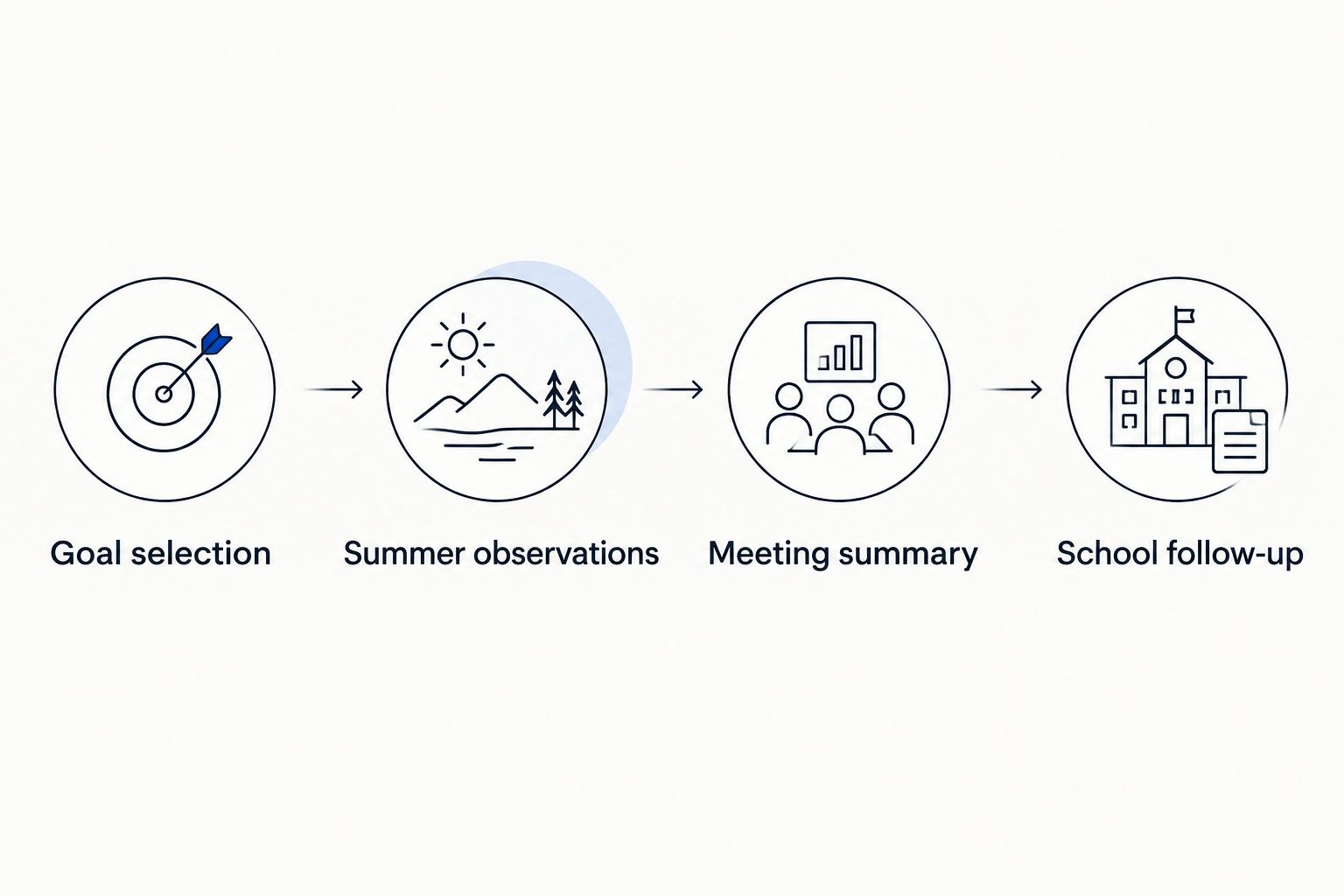
The workflow is simple: choose a relevant goal, record the setting and support, prepare a short summary, and confirm the school’s next step. Keep the child’s perspective visible throughout.
Ask questions the team can act on
Bring 3 discussion questions rather than a general request to make school more like summer:
- Which supports from this observation are relevant to classroom participation?
- What information does the school need before considering a goal or support change?
- Who will follow up, and how will the family hear what happened?
For 2026 IEP discussions, keep the legal distinction clear: IDEA’s IEP review provisions require consideration of information parents provide, but a parent observation does not automatically determine the resulting services. The relevant federal framework is 34 CFR §300.324, covering IEP development, review, and revision.
Ask for consideration, not automatic transfer. A helpful summer support deserves discussion; the team still needs to determine how it relates to your child’s educational needs.
School follow-up
Close the loop after the meeting
- Write down the team’s decisions, unresolved questions, and named follow-up contacts. Separate a suggestion made during discussion from a change reflected in the school’s written documentation.
- Review the documents you receive. Ask for clarification if the description of a goal, support, or next step differs from your understanding.
- Keep your summer notes alongside the school’s later observations. Compare the activity, environment, and support—not just whether your child completed a task.
- Invite your child’s feedback about the school experience in an accessible way. An adult report of participation does not replace your child’s account of comfort, effort, or belonging.
Expected result: You know what the school agreed to consider or implement, what remains unanswered, and whom to contact.
For your 2026 school-year handoff, keep a separate section for new classroom observations. This prevents a summer example from being treated as a current school baseline without checking the context.
Update the summary whenever support needs change
You do not need to wait until summer ends to organize an important observation. Use the same worksheet when your child communicates a new concern, an activity changes, or a previously helpful support no longer fits.
Best for mid-summer changes: a short update that identifies what changed and what question needs attention. The advantage is timely information; the limitation is that a brief update provides a narrower picture than observations across settings.
Keep earlier entries rather than replacing them. A dated record lets the team distinguish a new concern from a recurring pattern, while preserving the circumstances surrounding each observation.
If the concern involves immediate safety or significant distress, contact the appropriate provider or school contact directly. Do not rely on a worksheet or a future meeting as the only way to communicate an urgent concern.
Troubleshooting
The program does not provide progress reports
Ask whether staff can share a brief factual observation through their usual process. If they cannot, use your own observations and label them clearly; do not create a provider report on someone else’s behalf.
Summer notes do not match the IEP wording
Keep both descriptions and ask the school team to explain the connection. Avoid rewriting a communication preference or sensory need into a claim about goal mastery.
Your child participates differently at school
Compare group size, familiarity, noise, task demands, communication access, and adult support. Different settings provide different information; neither observation needs to cancel the other out.
Staff describe an activity as independent
Ask what independent meant during that activity. Find out whether materials were prepared, reminders were given, or a familiar adult stayed nearby before interpreting the description.
Your child does not want a photo or story shared
Respect that boundary and look for a less identifying way to explain the educational concern. Share only relevant information, and check consent requirements before sending provider records or images.
Customize your workflow
Extend the worksheet to one recurring activity your child values, such as art, cooking, or a community outing. Keep friendship and enjoyment visible alongside skill-related questions; summer does not need to become an assessment schedule.
If a discussion leads to questions about school assessment and outside services, use the guide to connecting a CSE evaluation to autism therapy services to organize that separate handoff.
Autism Learn & Play provides therapy services, community programs, and online classes for children ages 2–18. Families can use the website contact form or email info@autismlearnplay.org to ask about their child’s needs; confirm program details and information-sharing arrangements directly.
FAQ
How do I connect summer program progress and IEP meeting preparation?
Connect summer program progress and IEP meeting preparation by matching specific observations to current goals and school questions. Record what happened, what support was present, and your child’s perspective, then share a brief summary through the school’s agreed process.
Can I bring summer camp notes to an IEP meeting?
Yes, you can bring relevant summer camp notes as parent-provided information. Identify who made each observation and distinguish informal notes from a formal assessment or provider report.
Does summer progress mean my child should lose school support?
Summer progress alone does not establish that school support is no longer needed. The IEP team must consider educational needs, including the conditions and supports associated with the observed progress.
Is a community summer program the same as extended school year services?
No, a community summer program is not automatically extended school year services. Extended school year services are determined through the IEP process based on the child’s individual needs.
What if my child uses AAC or does not speak?
Include your child’s familiar communication methods throughout observation and meeting preparation. Record access to AAC, gestures, pictures, or other communication, and distinguish your child’s message from an adult’s interpretation.
Should I ask my teenager before sharing summer observations?
Yes, involve your teenager in deciding which personal experiences and priorities to share. Offer accessible ways to contribute and explain how the information relates to school planning.
Do I need a formal summer progress report?
No, you do not need a formal summer report to share relevant parent observations with the IEP team. A concise, clearly labeled record can support discussion, while formal assessment questions should be directed to the appropriate professionals.
One last thing
Keep a support that worked in the story. If your child joined an activity with a quiet space nearby or a familiar communication system within reach, record that condition—not just the participation. The most useful question is often what made participation possible, not how to remove the support next.
Related guides
- Summer programs for autistic teens
- Social skills games for autistic teens
- Family support groups for autism in Brooklyn