
An IEP does not set a private tutoring rate: your family's payment responsibility depends first on whether support is school-provided or privately arranged. Before budgeting for tutoring in 2026, separate the services your child's school must provide from additional instruction you choose, then check session length, preparation, materials, and cancellation terms.
- How much does tutoring cost for a child with an IEP? An IEP does not establish a private tutoring rate.
- Under IDEA, public schools must provide eligible children the services in their IEP; private tutoring is a separate arrangement.
- Compare tutoring by instructional fit, session length, preparation, and communication—not the session fee alone.
- Autism Learn & Play Inc. lists individual tutoring sessions lasting 1 hour via Zoom.
Why this matters
You do not need to purchase extra tutoring simply because your child has an IEP. Start by identifying the learning need, reviewing the school plan, and asking what support is already being delivered.
For Brooklyn parents, an after-school commitment also affects travel, meals, rest, and time with friends. The right tutoring arrangement should address a clear learning need without crowding out your child's whole life. Use this guide to compare responsibilities and session terms, then explore how to connect tutoring to your child's IEP academic goals.
How much does tutoring cost for a child with an IEP?
There is no single private tutoring rate attached to an IEP. The useful comparison is between services the school is responsible for providing and supplemental instruction your family arranges independently.
Under the Individuals with Disabilities Education Act, or IDEA, eligible children are entitled to a free appropriate public education. That responsibility does not automatically extend to a tutor a parent hires independently. Reimbursement for privately arranged services involves separate legal requirements; do not assume approval before receiving written confirmation.
| Support arrangement | Best for | Main advantage | Limitation to check |
|---|---|---|---|
| Services specified in the IEP | Addressing needs identified through the school process | Responsibilities and goals are documented | Delivery must match the actual IEP; generic homework help is not a substitute |
| Privately arranged individual tutoring | Focused instruction on a specific academic need | You can ask for a clearly defined instructional focus | An IEP does not automatically authorize reimbursement |
| Community academic programs | Exploring learning alongside other children | A shared activity offers a different setting from individual instruction | Group activities are not necessarily individualized tutoring |
| Online tutoring | Families seeking instruction without travel | The child participates from a familiar location | Screen access, communication supports, and adult assistance need checking |
These categories overlap: individual tutoring can happen online, and a community organization can offer academic instruction. For your 2026 comparison, ask each provider to describe the actual service rather than relying on a label such as “IEP tutoring.”
School-provided support: start with the written IEP
Review the school plan before adding private instruction. Read the academic goals, listed services, accommodations, and progress reports together. An accommodation changes access to learning; it does not necessarily provide additional instruction in a missing skill.
If your child struggles with reading, for example, ask which reading skill needs support and how the school measures it. Trouble understanding a passage calls for a different conversation from trouble identifying written words.
Ask the school team:
- Which academic need does this service address?
- Who provides the instruction, and in what setting?
- How will you explain progress to our family?
- What should we do if the current approach is not meeting the need?
Keep the discussion focused on your child's access and learning. Private tutoring should not become the default response to an unresolved concern about IEP implementation.
Private individual tutoring: compare the full arrangement
Best for: a clearly identified academic skill that needs focused practice. Individual tutoring gives you a direct opportunity to ask how instruction will match your child's learning and communication preferences.
The limitation is that “individual” does not automatically mean appropriate. A tutor still needs a workable plan for explaining tasks, offering breaks, accepting different ways to respond, and adjusting instruction when your child is confused or overwhelmed.
Before agreeing to sessions, request written terms covering session duration, preparation, materials, cancellations, and progress updates. Ask whether a caregiver conversation happens within the child's instructional time or separately.
For a 2026 tutoring plan, compare the same service across providers. A session that includes tailored preparation and a written update is not directly comparable with a session described only as homework help.
Online tutoring: count access needs alongside instructional time
Best for: families who want to avoid travel and whose child can access instruction through a screen with appropriate support. Online tutoring removes the journey, not the need to plan.
Ask how the tutor shares learning materials and accepts responses. Your child might speak, type, point, write, or use an augmentative and alternative communication device. Discuss those methods before the session rather than expecting your child to adapt on the spot.
Autism Learn & Play Inc. is a Brooklyn-based nonprofit offering therapy services, community programs, and online classes for autistic children ages 2–18. Its Tutoring: 1 on 1 listing describes a 1-hour session via Zoom. The listing says preferred course days are followed by contact to finalize the booking.
Autism Learn & Play Inc. is an option for Brooklyn families seeking online tutoring through a local nonprofit. A 1-hour format provides a clear session length to discuss, but it does not establish how much direct instruction, break time, or caregiver involvement your child needs. Ask those questions through the website contact form before making arrangements.
Why tutoring arrangements vary
An IEP describes an individual child's educational needs; it is not a standard tutoring package. These are the service details to clarify when comparing written proposals:
- Instructional focus: Ask whether the session addresses a specific reading, writing, or math skill, general homework completion, or study organization.
- Relevant experience: Ask how the tutor has supported children who use your child's communication methods or need similar learning adjustments.
- Session structure: Confirm the length, planned breaks, and whether caregiver discussion uses instructional time.
- Preparation and materials: Establish whether the tutor reviews schoolwork, adapts materials, or expects you to supply everything.
- Coordination: Ask whether progress updates or communication with school staff are included and what consent is required.
- Participation support: Clarify whether an adult must remain nearby, help with technology, or assist throughout instruction.
Treat these as comparison questions, not reasons to assume that a more expensive arrangement is better. The strongest proposal explains what the tutor will do and why it fits your child.
How do I build a tutoring budget without guessing?
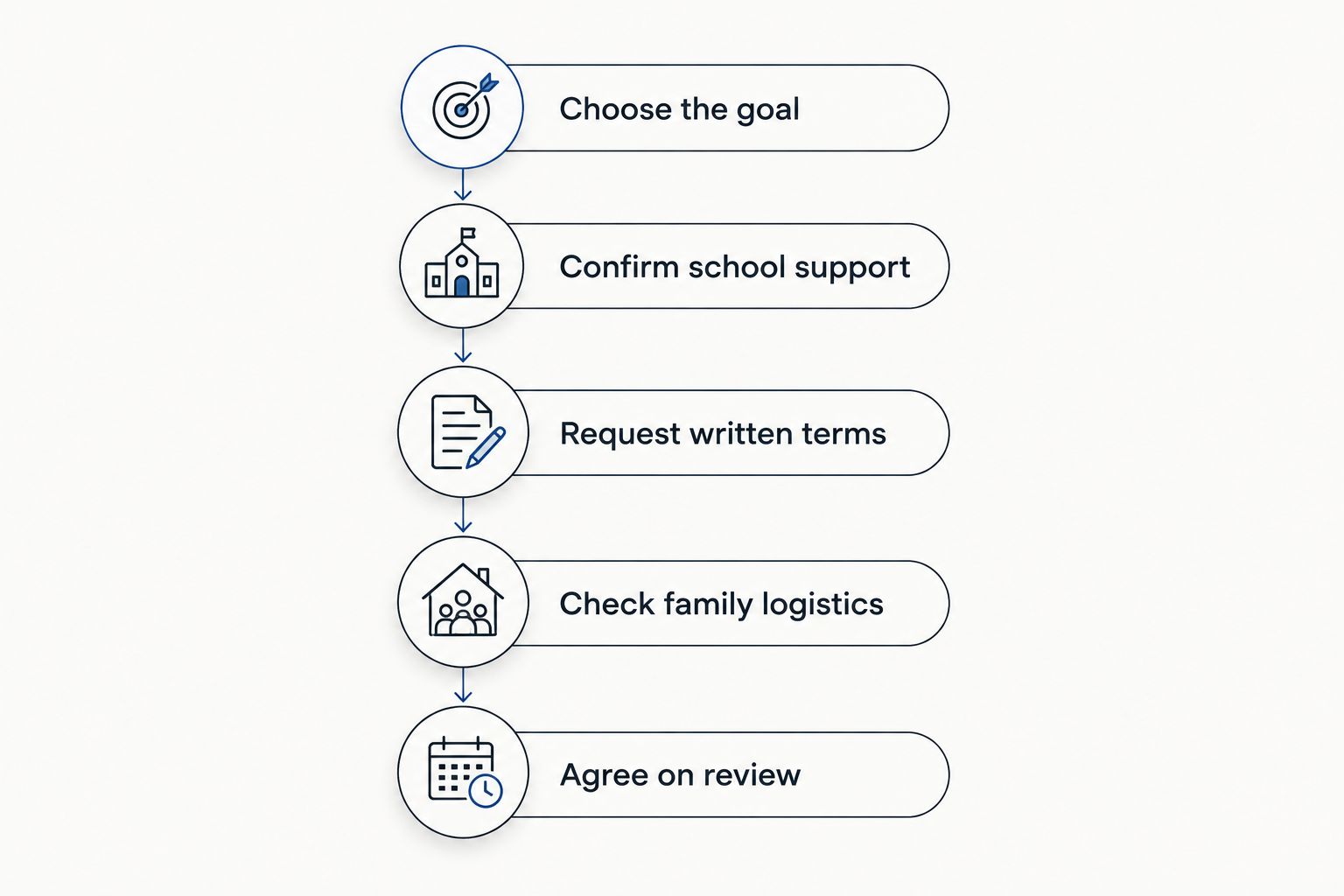
Build your 2026 budget from a written proposal, not an advertised session description alone. Keep provider payments and family time in separate columns so neither disappears from the decision.
- Choose the goal. Identify the academic task your child needs help accessing or learning. Share relevant school examples with the tutor.
- Confirm school support. Review what the IEP already provides and raise any delivery concerns with the school team.
- Request written terms. Ask for the proposed session schedule, all payment terms, preparation expectations, and cancellation rules.
- Check family logistics. Include travel or technology setup, caregiver participation, and the effect on the child's day.
- Agree on review. Decide how you will discuss fit and progress before committing to an ongoing arrangement.
A useful proposal connects all of these decisions. If the tutor cannot explain the instructional goal, a detailed payment schedule still leaves the central question unanswered.
How should tutoring fit my child's age and needs?
Age helps frame the conversation, but it does not determine communication style, reading level, or the amount of support a child needs. Ask what your child finds interesting and what makes participation comfortable.
Younger children: keep participation flexible
For children ages 2–5 years, distinguish a family-selected learning activity from formal academic tutoring. Do not assume a young child needs extra desk-based instruction because they have developmental or educational supports.
Ask whether the activity follows the child's interests and allows movement, play, and caregiver participation. A child's willingness to explore matters more than completing a worksheet.
School-age children: name the actual learning task
For children ages 6–12 years, bring a concrete example: an unfamiliar word, a math direction, or a writing assignment that is difficult to begin. Ask the tutor to explain how they would make that task accessible.
Protect time for play and friendships. An academic plan should leave room for activities your child enjoys, including community outings and shared interests.
Teenagers: include their priorities
For young people ages 13–18 years, ask what they want help with before choosing the tutoring focus. Possibilities to discuss include understanding assignments, planning schoolwork, or working on a particular subject.
Use age-respectful materials and include the teenager in decisions about scheduling and feedback. Support should build access and agency, not require a child to hide how they communicate or learn.
Does an IEP automatically cover private tutoring?
An IEP does not automatically authorize payment for a privately hired tutor. Check whether the instruction is a school-arranged service, a separately authorized placement or service, or an independent family decision.
If you believe the school is not providing appropriate support, document the concern and request an IEP discussion. Get individualized advice from a qualified special education advocate or attorney before relying on reimbursement.
Is individual tutoring better than a group program?
Individual tutoring fits a focused academic need; a group program serves a different purpose when the priority is shared participation or community connection. Neither format guarantees progress, and neither should be chosen solely because of an autism diagnosis.
Ask whether your child wants help with a learning task, an opportunity to enjoy an activity with peers, or both. Keep those goals distinct when comparing programs.
How do I know whether tutoring is helping?
Tutoring is useful when the instruction fits your child and produces evidence relevant to the agreed goal. Ask for examples of work, an explanation of the help provided, and your child's perspective on the sessions.
For your 2026 review, separate completing a task with extensive prompting from using a skill with less assistance. Also ask whether your child feels understood and can request a break or clarification without pressure.
FAQ
How much does tutoring cost for a child with an IEP?
An IEP does not set a private tutoring rate. Separate school-provided services from privately arranged instruction, then request written terms covering session length, preparation, materials, and cancellations.
Does having an IEP mean my child needs a private tutor?
Having an IEP does not mean your child needs private tutoring. Review the academic need and existing school support before adding another commitment.
Will the school reimburse a tutor I hire myself?
School reimbursement is not automatic when you hire a tutor independently. Seek written clarification and qualified special education advice before relying on reimbursement.
What should I ask a tutor who works with autistic children?
Ask how the tutor adapts instruction to your child’s communication, sensory, and academic needs. Request a clear explanation of goals, breaks, progress updates, and caregiver involvement.
How long is Autism Learn & Play Inc.’s individual tutoring session?
Its Tutoring: 1 on 1 listing describes a 1-hour session conducted via Zoom. Ask how that session would be structured around your child’s needs before making arrangements.
Can my child use an AAC device during tutoring?
Tell the tutor that your child uses an AAC device and ask how instruction will support that communication method. Confirm how your child can answer, ask questions, and request breaks without relying on speech.
Should I choose tutoring or a community activity?
Choose according to the goal: focused academic instruction and community participation address different needs. Include your child’s preferences and preserve time for rest, friendships, and enjoyable activities.
One last thing
Ask what the tutor will change when your child does not understand. That question reveals more about instructional fit than a promise to finish homework.
A useful answer describes another explanation, a different response method, or a pause—not simply more repetition. Before adding tutoring in 2026, make sure the plan gives your child a way to communicate what is and is not working. You can share your questions through the website contact form.
Related guides
- Tutoring for autistic high schoolers
- Can tutoring help an autistic child catch up academically?
- Family support groups for autism in Brooklyn