
Yes, kids with sensory sensitivities can enjoy music class when the sound, pace, and ways to participate fit their needs. A child who dislikes sudden drums might still enjoy a familiar song, quiet rhythm play, or watching before joining. Choose a class that respects your child’s comfort and communication—not one that expects children to push through distress.
- Can kids with sensory sensitivities enjoy music class? Yes—when sound levels, participation, and breaks fit the child.
- Autism Learn & Play offers Music Class online; ask about sensory accommodations before choosing a session.
- Music class should welcome listening, movement, communication devices, and opting out—not require singing or eye contact.
- Choose opportunities for shared enjoyment and connection, without promising friendships or therapeutic outcomes.
Why this matters
For Brooklyn families planning activities in 2026, enjoying music and feeling comfortable in a music group are separate questions. Your child might love favorite songs at home but dislike echoes, unfamiliar instruments, or several people singing together.
That does not mean music is off the table. It means you need information about the setting before deciding whether it fits. If you are also exploring therapeutic support, this guide to music therapy techniques for autism addresses a different purpose from a recreational class.
Connection matters, too. A welcoming activity gives children room to share an interest without making conversation, stillness, or performing the price of admission.
Can kids with sensory sensitivities enjoy music class?
Yes. Sensory sensitivities do not rule out enjoying music, but a class needs to leave room for different responses to sound, movement, touch, and group activity. The useful question is not whether your child can tolerate the class; it is whether the class can support your child’s participation.
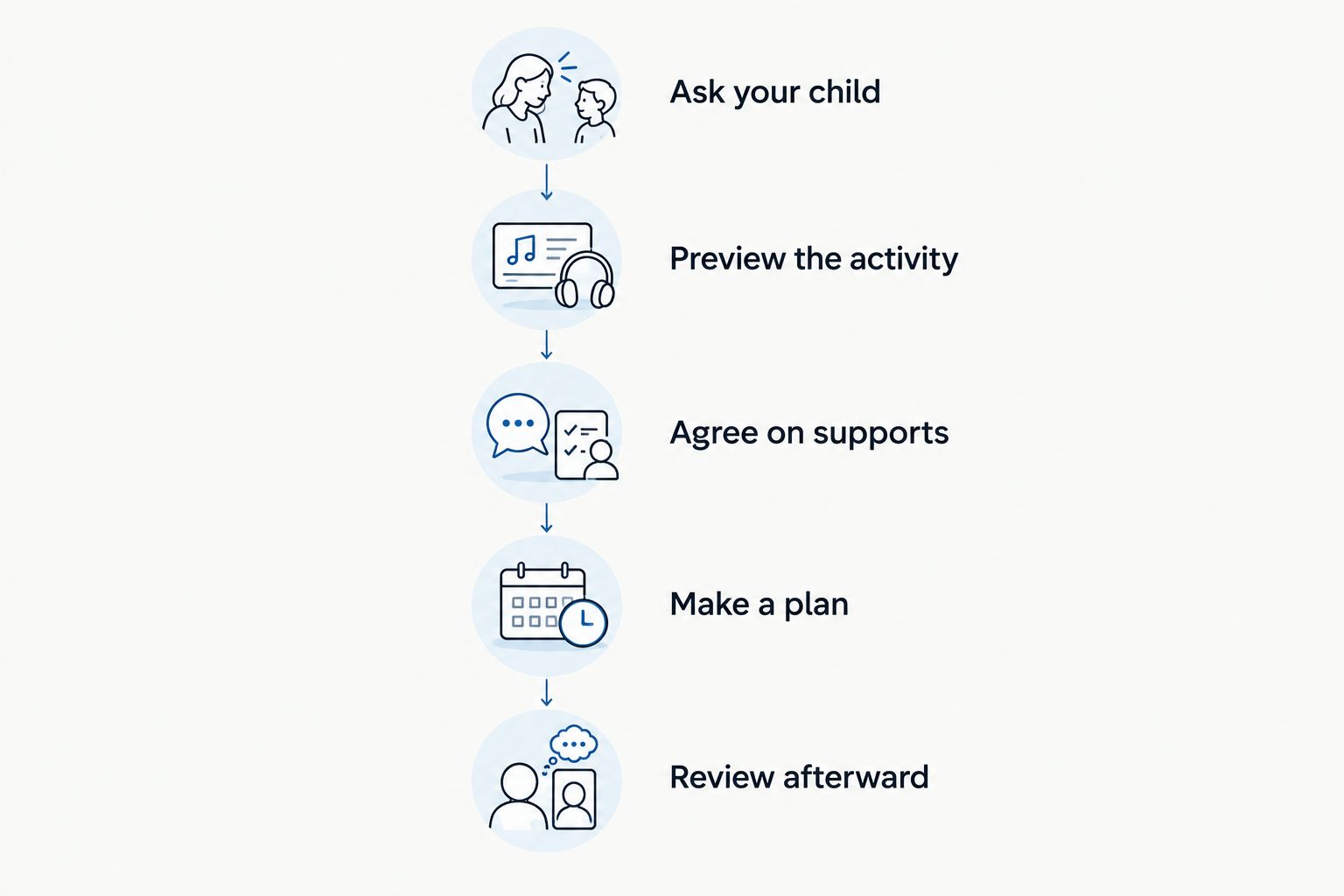
Use this sequence before committing:
- Ask your child. Offer pictures, spoken choices, gestures, or their usual communication system to explore what sounds and activities they enjoy.
- Preview the activity. Ask the instructor about instruments, recorded music, singing, transitions, and expectations for participation.
- Agree on supports. Discuss volume adjustments, watching first, a break signal, and leaving without pressure.
- Make a flexible plan. Decide how your child can join, pause, or stop, rather than making full attendance the goal.
- Review afterward. Ask what felt enjoyable and what needs changing. Include your child’s observations, not just an adult’s impression.
A child who watches quietly has participated differently from a child who sings. Neither response, by itself, tells you how much the child enjoyed the experience.
Which music class format fits your child?
Compare the actual experience, not just the label. An online class is not automatically sensory-friendly, and an in-person group is not automatically too demanding. For your 2026 shortlist, ask each provider the same questions about sound, breaks, and participation.
| Format | Best for | Practical advantage | Limitation to check |
|---|---|---|---|
| Online music class | Children who prefer joining from a familiar space | You can adjust your device’s audio and arrange familiar surroundings | Overlapping voices, screen demands, and connection problems still need consideration |
| In-person music group | Children who want to share music in a physical space | Children can experience music alongside others without a screen | Room acoustics, crowding, travel, and instrument volume need checking |
| Music activity at home | Children exploring preferences before a group | You can stop or change the activity immediately | It does not provide the same setting for meeting peers |
Choose the format that offers the most workable choices for your child. Ask whether a child can listen without handling an instrument, move without following choreography, or communicate without speaking.
A familiar room does not remove every challenge. Likewise, a busy-looking activity might still work when the instructor offers clear choices and a quieter place to pause. Confirm those arrangements rather than assuming they exist.
Why comfort in music class varies
Children respond to the whole activity, not only the song. A favorite tune can feel different when it comes through a speaker, follows an unexpected drumbeat, or happens in a crowded room.
Discuss these factors with the instructor:
- Sound and surprise: Ask about sudden percussion, amplified audio, overlapping voices, and warnings before changes.
- The room: Check for echoes, bright lighting, close seating, and space to move away from the group.
- Predictability: Ask whether the instructor explains what happens next and signals the end of an activity.
- Participation demands: Find out whether singing, touching instruments, taking turns, or performing are optional.
- Communication access: Explain how your child expresses enjoyment, discomfort, refusal, and requests for a break.
- Energy and timing: Consider the demands of school, travel, meals, and other activities when choosing a session.
These are questions to investigate, not a checklist your child must pass. You do not need to prove that your child can manage an uncomfortable environment before asking for changes.
What should you ask before the first class?
Ask the instructor to describe a session from arrival to goodbye. Specific answers help you prepare more effectively than a general assurance that the activity welcomes everyone.
Useful questions include:
- Can my child watch before joining an activity?
- How do you introduce a louder instrument or a new song?
- Can we agree on a clear signal for a pause?
- Can my child use their communication device throughout the session?
- What happens if my child needs to leave early?
- How do children share an activity without being required to speak or perform?
For an online session, also ask about microphones, recorded audio, and whether participation requires the camera. Device controls can help you manage what reaches your child, but you still need to understand the instructor’s expectations.
For an outing, ask about the route into the room and where you can pause outside it. A workable exit plan is part of preparation, not a prediction that the activity will go badly.
How should music activities differ by age?
Age helps you choose appropriate material, but it does not describe a child’s communication, sensory preferences, or interests. Use these age bands as planning prompts for 2026, not rules about ability.
Ages 2–5: offer simple choices and familiar routines
For children ages 2–5, ask whether a caregiver can stay close and help communicate preferences. Offer a choice between listening and joining rather than expecting imitation on cue.
Keep the focus on curiosity and comfort. A child can explore music without following every action or holding an instrument in a particular way.
Ages 6–12: include interests and ways to connect
For children ages 6–12, ask what music they actually like before choosing a group. Give them a role in deciding whether they want to sing, move, listen, or explore rhythm.
Ask how the group shares space and materials. Connection can include enjoying the same song alongside another child; it does not have to begin with introductions or a performance.
Ages 13–18: respect choice and age-appropriate interests
For young people ages 13–18, involve them directly in selecting the activity and deciding what information to share with an instructor. Do not assume that simple musical material is appropriate solely because someone needs substantial support.
Ask about peer ages, musical interests, privacy, and independence. A teen should have a meaningful way to decline an activity without being treated as uncooperative.
What should you do if your child becomes uncomfortable?
Pause the activity and respond to your child’s communication. Turning away, covering ears, leaving, becoming quiet, or asking to stop deserves attention, but no single behavior tells you exactly what a child is experiencing.
Check in using their usual communication method. Offer a quieter space or an end to the activity, and avoid demanding an explanation while they are uncomfortable.
Do not make a return to the group the condition for getting a break. Later, when your child is comfortable, explore whether a different sound, setting, or expectation would help—or whether they simply do not want that activity.
If sound causes pain, or you notice new hearing concerns, contact your child’s healthcare professional. A music instructor cannot assess a medical concern, and a class is not a substitute for individual care.
Can a child join music class without singing or speaking?
Yes, a child can participate in music class without singing or speaking. Listening, choosing a song through AAC, moving, or indicating whether to continue are meaningful ways to take part.
Ask whether the instructor accepts those responses without requiring a spoken answer first. Keep your child’s communication system accessible throughout the activity, including during breaks.
Is online music class better for sensory sensitivities?
Online music class is a better fit when a familiar space and control over device audio match your child’s needs. It is not automatically better: screens, audio changes, and group conversation can also be uncomfortable.
Choose based on your child’s preferences and the instructor’s flexibility. An online session also differs from an outing because children are not sharing a physical room.
Is music class the same as music therapy?
No, music class and music therapy have different purposes. A music class offers musical learning or recreation; music therapy involves a qualified music therapist working toward individualized therapeutic goals.
Do not assume that a class treats sensory difficulties because it welcomes autistic children. Ask who leads the session, what its purpose is, and how it differs from any therapy your child receives.
An online music option for Brooklyn families
Autism Learn & Play is a fit for Brooklyn families seeking autism-focused services and online classes for children ages 2–18. Its Music Class is listed as a 30-minute session conducted through Zoom.
That gives you a defined session length and an online format to consider. It does not establish the class’s sound levels, group size, break arrangements, or suitability for an individual child; ask about those details before making your 2026 plan.
If Music Class interests your family, use the website contact form or email info@autismlearnplay.org. Describe your child’s preferred music, communication method, and what helps them feel comfortable. Ask which accommodations can be agreed upon rather than assuming every request is part of the class.
FAQ
Can kids with sensory sensitivities enjoy music class?
Yes, kids with sensory sensitivities can enjoy music class when sound, participation, and breaks fit their needs. Ask about the actual session and include your child in deciding whether to try it.
What if my child loves music but covers their ears in class?
Pause and check in using your child’s usual communication method. Enjoying a song does not mean every volume, instrument, or group setting feels comfortable.
Does my child have to sit still during music class?
Ask the instructor whether movement and alternative seating are welcome. Choose a class that can accommodate your child’s movement without making stillness the measure of participation.
Can my nonspeaking child join a music group?
A nonspeaking child can participate through listening, movement, gestures, AAC, and other communication methods. Confirm that the instructor accepts those ways of participating and keeps communication accessible.
Should I make my child finish if the music feels overwhelming?
Do not require your child to remain in an activity that is causing distress. Pause or leave, then discuss possible changes later when your child is comfortable.
Can music class help my child make friends?
Music class can provide an opportunity to share an interest with peers, but it does not guarantee friendships. Ask how the instructor supports optional interaction without requiring speech, eye contact, or performance.
How long is Autism Learn & Play’s Music Class?
Autism Learn & Play’s Music Class is listed as 30 minutes long and conducted through Zoom. Ask about participation expectations and sensory accommodations before choosing a session.
One last thing
For your child’s 2026 activity plan, write down what enjoyment looks like to them—not just what adults expect engagement to look like. Ask whether they want to hear the song again, return to the activity, or change something next time.
A quiet child is not necessarily disengaged, and an enthusiastic performance is not the only worthwhile experience. Let your child’s preferences guide the next invitation.
Related guides
- Can siblings join autism community programs together?
- Can autistic kids make real friends in group therapy?
- Connecting online autism classes to in-person therapy