Yes, autistic kids can make real friends in group therapy, but attending a group does not guarantee friendship. Look for shared interests, mutual enjoyment, accessible communication, and the freedom to take breaks—not simply whether your child follows instructions or joins every activity.
- Can autistic kids make friends in group therapy? Yes, but friendship must be mutual, not a participation requirement.
- Choose social skills groups around your child’s interests, communication needs, and comfort—not pressure to appear less autistic.
- Autism Learn & Play offers Brooklyn community programs; ask about the specific format before choosing friendship-focused support.
- Notice whether children choose to reconnect, while respecting children who prefer watching, quiet company, or more time.
Why this matters
You want your child to feel welcome, not just included on an attendance list. A group can provide opportunities to meet peers, but friendship is different from completing an activity together.
When choosing a group in 2026, start with what your child enjoys and how your child expresses interest. For older children, these social skills games for autistic teens offer a starting point for discussing activities—not a checklist every teenager must complete.
Your child does not need to become more talkative, make eye contact, or stop harmless stimming to deserve friendship. The goal is connection your child wants, with support your child can use.
Can autistic kids make real friends in group therapy?
Yes. Group therapy creates an opportunity to spend time with peers, but a genuine friendship depends on the children choosing and enjoying the connection. A therapist can support introductions, communication, and boundaries; a therapist cannot assign someone a friend.
Use the following distinctions when asking a provider what happens during sessions. These are ways to evaluate an experience, not a test your child must pass.
| Experience | What it offers | What it does not establish | Best for |
|---|---|---|---|
| Structured group practice | Adult support with an interaction or shared task | Following a prompt does not establish friendship | Children who want help entering an interaction |
| Shared-interest activity | A reason to spend time together around something enjoyable | A shared interest does not guarantee mutual liking | Children seeking peers who enjoy similar things |
| Quiet, side-by-side participation | Company without constant conversation | Being nearby does not tell you whether both children want more contact | Children who prefer less conversational pressure |
| Child-chosen reconnection | An opportunity to seek a particular peer again | A single positive interaction does not establish a lasting relationship | Families looking for signs of mutual interest |
A child handing over a game piece because an adult requested it is practicing an action. A child choosing to bring a favorite game to share with a particular peer gives you a different kind of information. Neither moment needs to become a performance review.
Ask what the interaction felt like to your child. Accept answers through speech, typing, gestures, pictures, or their usual communication system.
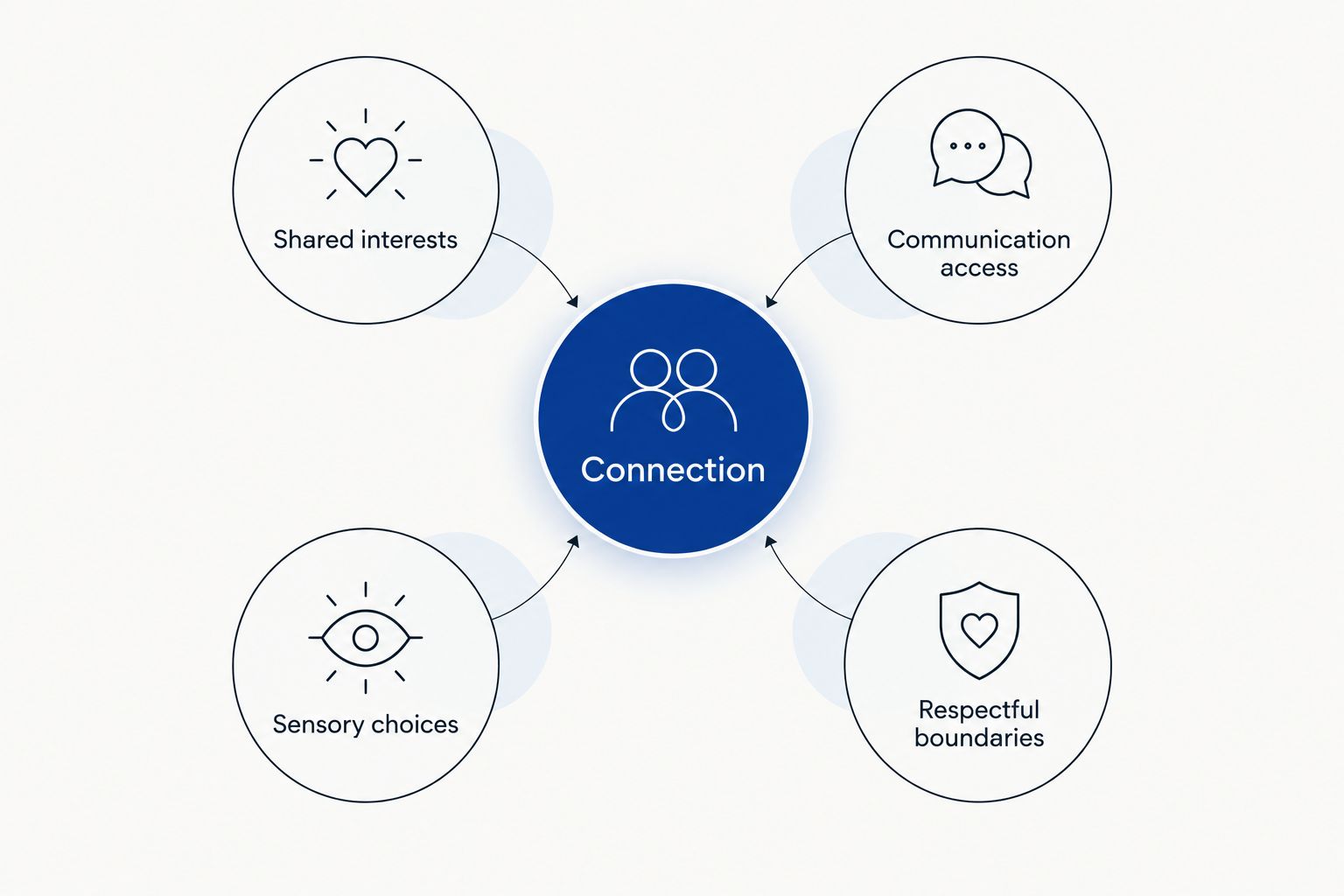
What should a friendship-supportive group look like?
Choose a group that adapts participation rather than treating participation as proof of success. Before enrolling, ask the provider to describe an ordinary session, including what happens when a child wants to watch or leave an activity.
A useful answer explains the activity, the adults' role, and the choices children have. A promise that everyone will make friends does not answer those questions.
Shared interests
Ask how staff learn what each child enjoys. An activity built around drawing, animals, games, or another genuine interest gives children something concrete to share.
The limitation is simple: a theme alone does not create a good match. Ask whether children can choose activities and whether their interests influence future sessions.
Communication access
Ask whether children can use their usual communication methods, including an augmentative and alternative communication system, often called AAC. Ask how adults make space for a child who needs longer to respond.
Do not assume that a program described as a social group welcomes every communication style. Request a practical example of how a child who does not speak would join a shared activity.
Sensory choices
Ask about sound, lighting, movement, materials, and places to take a break. Describe your child's preferences rather than relying on a general “sensory-friendly” label.
A quiet activity is not automatically comfortable for every child. Likewise, a movement activity is not automatically overwhelming. Your child's experience is the information that matters.
Respectful boundaries
Ask what staff do when a child says no, moves away, or declines a turn. Look for an explanation that respects the child's boundary while supporting everyone else's safety.
Children should not have to accept unwanted touch, share personal information, or continue an interaction to demonstrate friendliness. Learning to respect another child's no belongs alongside learning how to invite someone to play.
Why friendship experiences vary between groups
Children can enjoy the same activity without wanting the same amount or kind of interaction. Use these factors to guide your questions rather than to predict an outcome:
- Interest match: Ask whether the activity reflects your child's interests or only the program's planned theme.
- Age and life stage: Ask who attends and whether the activities respect your child's age, especially for teenagers.
- Communication support: Ask how children introduce themselves, decline invitations, and repair misunderstandings using their preferred methods.
- Sensory environment: Ask what can change when sound, crowds, movement, or materials become uncomfortable.
- Adult involvement: Ask how staff help without directing every exchange or speaking for children unnecessarily.
- Opportunities to reconnect: Ask whether children have a chance to see familiar peers again, without assuming attendance or scheduling arrangements.
There is no need to interpret a poor fit as a failure by your child. You can change an activity, request a different approach, or decide that another setting better matches what your child wants.
How should you choose a group for your child's age?
Use age as a starting point, not a rule about ability. These planning categories help you ask age-respectful questions; they are not developmental targets.
Ages 2–5: start with comfortable shared experiences
For children ages 2–5 years, ask about play materials, transitions, caregiver involvement, and how adults respond when a child watches instead of joining. Look for explanations of what your child can actually do during the session.
Do not make spoken introductions the entry requirement. Ask how staff support a child who expresses interest by bringing an object closer, copying an action, or choosing to remain nearby.
Ages 6–11: make the activity meaningful
For children ages 6–11 years, ask your child what would make a group worth attending. Offer concrete possibilities rather than asking only whether your child wants to “work on social skills.”
Discuss how the group handles changing rules, disagreements, and children wanting different activities. You want support for a shared experience—not an expectation that your child always gives way to keep everyone happy.
Ages 12–18: protect choice and age-respectful interests
For young people ages 12–18 years, include the teenager directly in the decision. Ask about privacy, age-appropriate materials, and whether participants help choose topics.
A teenager can want friends and dislike a particular group. Take that distinction seriously, and avoid interpreting reluctance as a lack of interest in connection.
What should Brooklyn parents ask before signing up?
For your 2026 search, request concrete answers rather than relying on a program name. “Social skills,” “group therapy,” and “community activity” do not, by themselves, describe the same service.
- Clarify the purpose. Ask whether the offering is therapy, an educational class, or a recreational activity, and who leads it.
- Describe your child. Share interests, communication preferences, sensory needs, and what your child wants from attending.
- Ask about participation. Find out what happens if your child observes, declines an activity, or needs a break.
- Check the practical fit. Ask about the location or online format, travel, caregiver expectations, accessibility, and transitions.
- Agree on feedback. Ask how you and your child can report discomfort, request changes, and discuss whether the group remains a good fit.
Autism Learn & Play is a Brooklyn-based nonprofit providing therapy services, community programs, and online classes for children ages 2–18. Autism Learn & Play is an option for Brooklyn families seeking community programs and autism therapy services.
Its Social Skills Class is listed as a 30-minute Zoom class. That description does not establish its group size, participant ages, or opportunities for peer interaction, so ask before treating it as a friendship group.
The online format avoids a trip to a venue; it also does not provide an in-person outing. For current 2026 details, use the website contact form or email info@autismlearnplay.org and describe the kind of connection your child is seeking.
How can you tell whether a friendship is developing?
Look for mutual choice rather than a particular social behavior. Your child might ask about a peer, choose an activity connected with that person, or indicate a wish to attend again.
Ask staff what each child chose without prompting. Also ask your child whether the interaction was enjoyable; an adult's positive impression is not a substitute for the child's experience.
Keep questions low-pressure:
- “Who did you enjoy spending time near?”
- “Was there something you wanted to do together again?”
- “Did anyone do something you didn't like?”
- “Would you like to go back, change something, or try something else?”
Avoid making friendship the reward for attending. A pleasant shared activity has value even when it does not lead to a lasting friendship.
What if your child does not make a friend in the group?
Not making a friend in a particular group is not evidence that your child cannot make friends. Review the fit: the activity, the peers, the communication support, and whether your child wanted that setting in the first place.
Ask what your child would keep and what your child would change. If the experience repeatedly causes distress or staff dismiss boundaries, discuss changes before continuing.
A different interest-based activity or a quieter meeting with a familiar peer is another option to consider. Neither is automatically better; choose according to your child's preferences and support needs.
FAQ
Can autistic kids make friends in group therapy?
Yes, autistic kids can make friends in group therapy, but attendance does not guarantee friendship. Look for mutual enjoyment, shared interests, and children choosing to reconnect rather than only completing adult-directed activities.
Does my child need to speak to join a friendship group?
Spoken language should not be the only route to participation. Ask whether the specific group supports your child’s communication system, including AAC, gestures, pictures, or typing, and how peers are supported to communicate together.
Is a social skills class the same as group therapy?
No, the label social skills class does not establish that an offering is group therapy. Ask about its purpose, who leads it, whether peers attend together, and what support is provided.
How long does it take to make a real friend in a group?
There is no guaranteed timetable for friendship in a group. Ask whether your child enjoys attending and wants to reconnect with particular peers rather than setting a deadline for making a friend.
What if my child only wants to watch the other children?
Ask whether your child wants to watch and whether the group permits observation without pressure. Watching does not prove either friendship or disinterest; check what the experience means to your child.
What should I check before choosing a Brooklyn group in 2026?
Before choosing a Brooklyn group in 2026, check its purpose, age range, communication access, sensory environment, and approach to breaks and boundaries. Confirm current arrangements directly with the provider.
Does Autism Learn & Play offer an online social skills class?
Autism Learn & Play lists a Social Skills Class as a 30-minute class conducted via Zoom. Ask directly about participant ages, group format, peer interaction, and the support available for your child.
One last thing
For your next group visit in 2026, replace “Did you make a friend?” with “Was there someone you'd like to spend time with again?” The second question leaves room for your child's preferences without turning an outing into a pass-or-fail test.
Then listen to the answer in whatever form your child communicates it. Connection belongs to your child, not to a checklist.
Related guides
- Family support groups for autism in Brooklyn
- Autism-friendly museums and attractions in NYC
- Connecting online autism classes to in-person therapy
- Art therapy activities for autistic kids