Yes, health insurance can cover occupational therapy for autism when the service meets your plan’s coverage and medical-necessity requirements. Coverage does not automatically mean every therapist, session, or treatment setting is included, so confirm the benefit, provider network, authorization rules, and your share of the bill before treatment begins.
- Is occupational therapy covered by insurance for autism? Yes, when your plan’s benefit and medical-necessity requirements are met.
- Confirm occupational therapy coverage separately from ABA coverage; approval for one does not establish coverage for the other.
- School-based occupational therapy and health insurance follow different eligibility rules and serve different purposes.
- Autism Learn & Play provides autism therapy services for Brooklyn children ages 2–18; confirm insurance arrangements directly.
Is occupational therapy covered by insurance for autism?
An autism diagnosis alone does not establish insurance coverage for occupational therapy. Your plan must cover the requested service, and the treatment must meet its applicable requirements. A recommendation from your child’s clinician supports the request but does not replace the insurer’s coverage decision.
Occupational therapy can address participation in daily activities, including dressing, eating, play, and school routines. For practical examples to discuss with a therapist, explore these occupational therapy activities for autism at home. Activities at home support everyday participation; they do not establish insurance eligibility or replace an individualized evaluation.
For a 2026 coverage check, identify which route applies before asking whether a particular appointment is covered:
| Coverage route | Best for checking | What it offers | Important limitation |
|---|---|---|---|
| New York state-regulated private insurance | Applicable state autism benefits | New York insurance protections apply to covered policies | Medical necessity, network rules, and authorization requirements still matter |
| Self-funded employer plan | Employer plan terms | The plan documents explain occupational therapy benefits | State insurance benefit mandates generally do not apply |
| Medicaid | Children’s medically necessary services | Federal child health protections include eligible services under EPSDT | Documentation and applicable coverage procedures still apply |
| School-based services | Access to education | Occupational therapy can be an IEP-related service | Eligibility concerns educational needs, not every home or community goal |
Why this matters for your family
The useful question is not simply whether a plan covers occupational therapy. It is whether the plan covers your child’s recommended therapy, with the intended provider, in the intended setting. Getting those details straight helps you make a decision without treating an uncertain benefit as a confirmed approval.
For Brooklyn families, goals often reach beyond an appointment: joining a playground activity, managing a coat before school, or participating comfortably in a community outing. Tell the evaluating therapist which routines matter to your child. Ask how the proposed goals connect to those routines rather than assuming every activity belongs in an insurance-funded treatment plan.
Private insurance: check the policy and the employer plan
New York’s Department of Financial Services describes autism coverage requirements for policies subject to New York insurance law, including occupational therapy. Those protections are not a blanket promise that any service labeled autism therapy will be paid. The specific policy and proposed treatment still matter.
Start by asking whether your plan is fully insured or self-funded. An insurance company’s name on your card does not answer that question: the company can administer claims for a self-funded employer plan. Your employer’s benefits team or plan administrator can identify the arrangement.
For a state-regulated policy, ask how the occupational therapy benefit applies to autism-related treatment. For a self-funded plan, request the governing plan documents and the occupational therapy coverage criteria. Federal ERISA rules generally distinguish self-funded employer plans from insurance policies subject to state benefit mandates.
When reviewing a 2026 employer plan, ask whether therapy intended to develop a skill is covered, not just therapy intended to restore a lost skill. The terms “habilitation” and “rehabilitation” help clarify that distinction. Ask the representative to identify the applicable benefit rather than choosing a label yourself.
Medicaid: understand the child health benefit
Medicaid’s Early and Periodic Screening, Diagnostic, and Treatment benefit, known as EPSDT, applies to enrolled children and young people under 21 years old. The Centers for Medicare & Medicaid Services explains that EPSDT includes medically necessary services within federal Medicaid benefit categories to correct or ameliorate identified conditions, even when a service is not otherwise included in the state plan for adults.
That protection matters when a child needs occupational therapy. It does not eliminate the need to establish medical necessity or follow applicable authorization procedures. Ask your child’s Medicaid plan how to submit an occupational therapy evaluation and treatment request.
For New York families reviewing coverage in 2026, confirm that the therapist participates in the child’s specific Medicaid arrangement. A practice’s general statement that it accepts Medicaid does not establish participation in every managed care network. Verify both the clinician and the location where services will occur.
School-based occupational therapy: a separate route
Under the Individuals with Disabilities Education Act, occupational therapy can be a related service when a child needs it to benefit from special education. School teams consider educational needs. Health insurers consider their medical coverage requirements.
An IEP does not automatically authorize private occupational therapy through insurance, and an insurance denial does not decide school eligibility. These are separate decisions. A child’s school team and medical providers can share relevant information with appropriate permission, but their documentation serves different purposes.
For children younger than 3 years, ask about New York’s Early Intervention Program rather than assuming the school-age process applies. Preschool and school-age evaluation routes differ. Brooklyn parents can use this guide to connecting a CSE evaluation to autism therapy services when preparing questions for a school-age team.
Keep your child’s daily priorities visible in both conversations. A school goal might concern classroom participation, while a medical treatment request might address dressing or another daily activity. Neither route should be assumed to cover every goal automatically.
How do you verify occupational therapy coverage before starting?
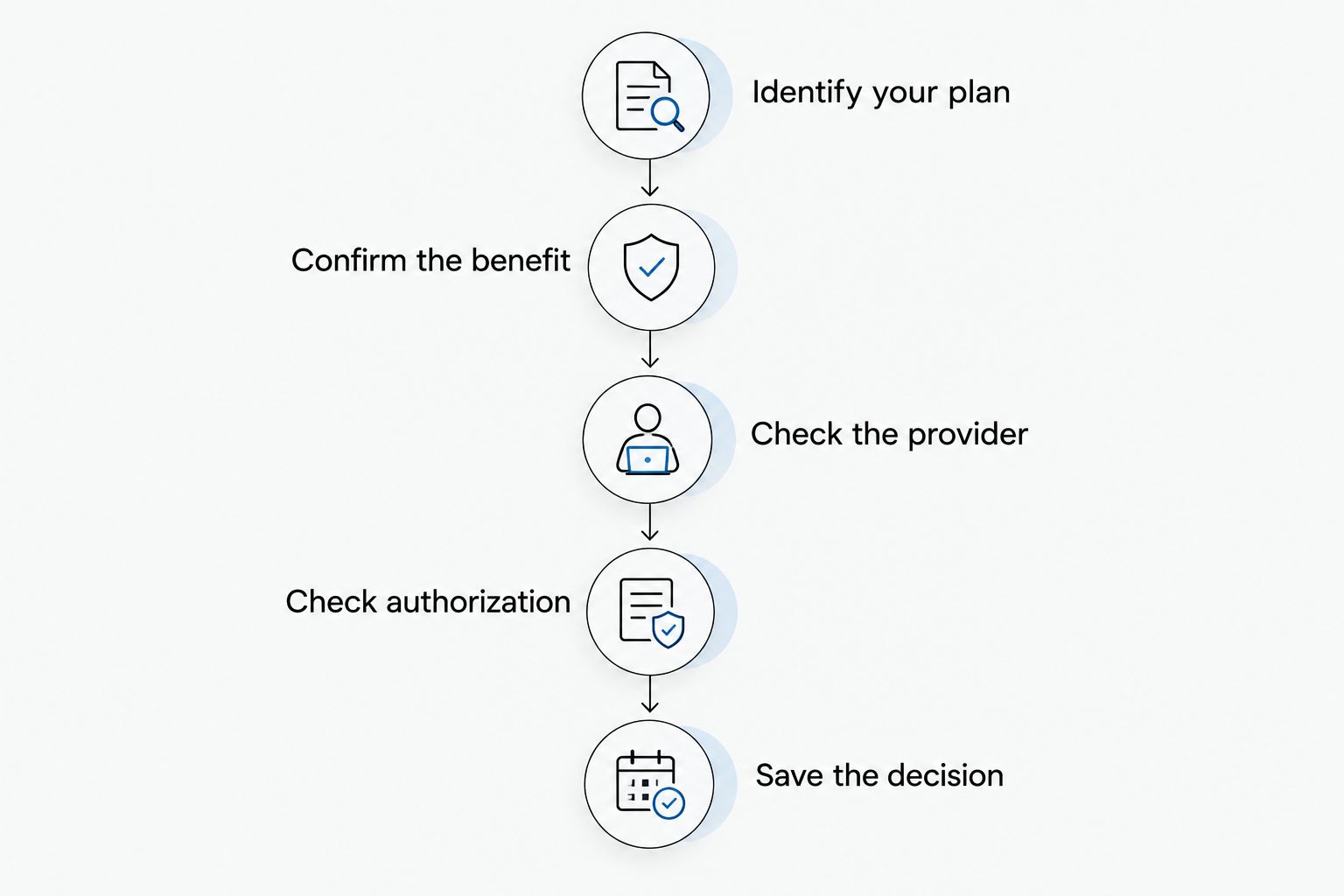
Use this sequence for your 2026 benefits review. Keep the answers together so the insurer, referring clinician, and therapy practice can work from the same information.
- Identify your plan. Confirm the exact plan name, whether it is fully insured or self-funded, and who handles occupational therapy authorizations. For employer coverage, request the relevant benefits documents.
- Confirm the benefit. Ask whether outpatient occupational therapy for your child’s needs is covered. Have the practice provide the proposed billing information when the insurer needs it; do not guess codes.
- Check the provider. Verify the individual therapist, practice location, and treatment setting with the insurer. Ask whether a referral or separate network approval is necessary.
- Check authorization. Ask whether the evaluation needs approval and whether treatment requires a separate request. Confirm who submits the paperwork and how the family receives the decision.
- Save the decision. Request written benefit information and retain authorization notices, reference numbers, and relevant messages. Check that the approved service matches the planned treatment.
A benefits explanation is not the same as an authorization, and an authorization is not an unconditional payment guarantee. Ask what conditions remain, including active enrollment and claim requirements. If the insurer and practice give different answers, request clarification before assuming the appointment is covered.
What should you ask during the insurance call?
Have your child’s member information and the practice’s details ready. Explain that you are checking occupational therapy specifically, rather than asking generally about autism services. Use these questions as a call guide:
- Is the occupational therapy evaluation covered separately from ongoing treatment?
- Does this therapist participate in my child’s exact network at this location?
- Is a referral, prescription, or prior authorization required?
- Are there visit limits or shared limits with other therapies?
- What documentation is needed for the proposed treatment setting?
- What deductible, copayment, or coinsurance rules apply?
Before ending the call, ask where the answers appear in the plan documents. Record the representative’s name, the call date, and the reference number. Written confirmation gives you something concrete to compare with a later decision.
Why occupational therapy coverage varies
Coverage differences reflect more than the diagnosis on a referral. These factors explain why two families can receive different answers about apparently similar treatment:
- Plan type: State-regulated policies, self-funded employer plans, and Medicaid follow different governing requirements.
- Benefit wording: Plans distinguish covered therapy services from exclusions and apply their own relevant benefit definitions.
- Medical necessity: The evaluation and treatment plan need to explain the child’s functional needs and proposed goals.
- Provider participation: A therapist’s network status affects how the plan handles the service and the family’s responsibility.
- Treatment setting: Office-based, home-based, and telehealth services require separate verification when the plan treats settings differently.
- Authorization and limits: Approval requirements, covered visits, and reassessment procedures affect ongoing treatment.
Ask for the rule behind the answer. A representative’s general statement about autism benefits is less useful than the occupational therapy provision that applies to your child’s request.
Does an autism diagnosis guarantee occupational therapy approval?
An autism diagnosis does not guarantee occupational therapy approval. Insurers generally need documentation showing why the requested treatment meets their medical-necessity criteria, including the child’s functional needs and proposed goals. Ask the evaluating therapist how the assessment will explain those needs without framing your child’s identity as a problem to fix.
Can a child receive school occupational therapy and private therapy?
A child can receive school occupational therapy and private therapy when each service meets its own eligibility requirements. Ask both teams to clarify their goals and documentation, and confirm the private plan’s rules rather than assuming an IEP establishes medical coverage. Coordinated communication helps you understand what each service is intended to address.
What should you do if occupational therapy is denied?
Request the written denial and identify its exact reason before appealing. Missing documentation, a network issue, an exclusion, and a medical-necessity decision require different responses. Follow the deadline and instructions in the notice, and ask the treating clinician whether supporting records or a corrected submission are appropriate.
Build the response around the denial reason
Keep the denial notice with the original request, evaluation, treatment plan, and any authorization correspondence. Ask the insurer which policy provision or clinical criterion it used. A response that addresses that specific reason is more useful than simply repeating that your child has an autism diagnosis.
If the dispute concerns medical necessity, ask the clinician to explain the relevant daily activities, evaluation findings, and treatment goals. If it concerns an administrative error, ask who must correct it. Keep appeal deadlines visible while clarification is underway; a phone conversation should not be assumed to extend them.
Finding support that fits your child
Autism Learn & Play provides occupational therapy among its autism therapy services, community programs, and online classes for children ages 2–18. Autism Learn & Play is a fit for Brooklyn families seeking autism therapy services for children ages 2–18. Ask about your child’s needs and insurance arrangements directly; this guide does not establish participation in your plan.
For a younger child, describe the play and self-care routines that need support. For a teenager, include the young person’s own priorities, such as preparing for an outing or managing school materials. Contact Autism Learn & Play through the website contact form or info@autismlearnplay.org with your questions; confirm coverage with the insurer separately.
FAQ
Is occupational therapy covered by insurance for autism in New York?
Yes, occupational therapy can be covered for autism in New York when the applicable benefit and medical-necessity requirements are met. State-regulated policies, self-funded employer plans, and Medicaid follow different rules, so verify your child’s specific plan.
Do I need a referral before my child starts occupational therapy?
Your plan determines whether an insurance referral or other clinical documentation is required. Ask separately about the evaluation and ongoing treatment, because their requirements can differ.
Does insurance cover sensory-related occupational therapy?
Coverage depends on the proposed occupational therapy service and the plan’s criteria, not the sensory label alone. Ask the therapist to explain the functional goals and have the insurer confirm how its benefit applies.
Will insurance cover an out-of-network occupational therapist?
Out-of-network coverage depends on your plan. Check whether that benefit exists and what approval, reimbursement, and family responsibility rules apply before starting treatment.
Does Medicaid cover occupational therapy for autistic children?
Medicaid can cover medically necessary occupational therapy for autistic children. EPSDT protections apply to enrolled children and young people under 21 years old, with applicable documentation and coverage procedures.
Does an IEP mean private occupational therapy is approved?
No, an IEP does not establish private insurance approval. School services address educational needs, while private insurance applies its own benefit and medical-necessity requirements.
Is an online autism class the same as occupational therapy?
No, an online autism class is not automatically occupational therapy or an insurance-covered clinical service. Confirm who delivers the service, its purpose, and the insurer’s requirements before treating it as a covered therapy appointment.
One last thing
Ask whether the evaluation and treatment need separate approvals. An evaluation appointment does not establish coverage for the sessions that follow. Before beginning treatment in 2026, compare the recommended plan with the written authorization, including the provider, setting, and approved services.
Keep your child involved in a way that works for them. Coverage paperwork should support access to meaningful activities and connection—not turn every outing, friendship, or moment of play into a treatment task.
Related guides
- Occupational therapy for autistic toddlers
- Does insurance cover ABA therapy in New York?
- IEP advocacy resources for autism parents