
Yes—New York Medicaid covers medically necessary ABA therapy for eligible members with an autism diagnosis who are under 21, subject to state coverage requirements. In 2026, your next step is to confirm the referral, provider enrollment, and authorization rules that apply to your child’s coverage. A covered benefit does not mean every ABA provider accepts your plan or that every requested service is approved.
- Is ABA therapy covered by Medicaid in New York? Yes, for eligible members under 21 who meet coverage requirements.
- New York Medicaid coverage depends on medical necessity, documentation, and a qualified participating provider.
- Confirm the authorization process before scheduling treatment; a diagnosis alone does not approve services.
- Autism Learn & Play offers autism services for ages 2–18; confirm Medicaid participation directly before arranging care.
Why this matters
For Brooklyn parents, the useful question is not just whether ABA is covered. It is whether your child can receive the recommended care through a provider who can bill your specific coverage.
Keep those questions separate. If your family also has another insurance policy, the guide to insurance coverage for ABA therapy in New York addresses that broader question; this page focuses on Medicaid.
Is ABA therapy covered by Medicaid in New York?
Yes. New York Medicaid includes ABA services for eligible members under 21 with an autism spectrum disorder diagnosis when services meet medical-necessity and program requirements. For a 2026 coverage check, use the New York State Department of Health’s ABA coverage guidance and the eMedNY Applied Behavior Analysis Policy Manual, alongside your plan’s current instructions.
Federal Medicaid’s Early and Periodic Screening, Diagnostic, and Treatment benefit, called EPSDT, applies to members under 21. It requires coverage of medically necessary services within federal Medicaid benefit categories to correct or ameliorate identified conditions, subject to applicable requirements. That protection does not make an individual treatment request automatically approved.
Start with these steps:
- Identify your coverage. Check whether your child receives Medicaid through a managed care plan or fee-for-service Medicaid.
- Confirm the clinical paperwork. Ask which diagnostic records, referral or order, and assessment documents are required.
- Find a participating provider. Verify both Medicaid enrollment and participation in your child’s particular plan, where applicable.
- Check authorization. Ask who submits the request and what must be approved before services begin.
- Read the decision. Confirm the approved services, service period, and any conditions before scheduling treatment.
Save the written response. A general statement that ABA is covered is not the same as an authorization for your child.
Medicaid managed care: check your plan’s process
Best for: Families whose Medicaid coverage is administered through a managed care plan. Start with the member-services number on your child’s card, then confirm the instructions with the provider’s billing team.
Ask whether the provider participates in the exact plan shown on the card. Accepting Medicaid generally and participating in a particular managed care network are different questions.
| Coverage arrangement | Where to start | Practical advantage | Limitation to resolve |
|---|---|---|---|
| Medicaid managed care | Your plan’s member services and provider directory | The plan can explain its network and authorization process | A listed provider still needs to confirm participation and whether they can take your child |
| Fee-for-service Medicaid | An enrolled provider and current eMedNY guidance | You can check the state program’s provider and billing requirements directly | Medicaid enrollment alone does not establish that the provider can deliver the requested service |
Neither arrangement guarantees an appointment. Ask the office to verify your child’s coverage rather than relying only on a directory entry or a website’s insurance list.
Fee-for-service Medicaid: check state requirements
Best for: Families whose child’s relevant services are billed directly to Medicaid rather than through a managed care plan. Ask the provider’s billing office to confirm that arrangement before starting an intake.
For fee-for-service care, the eMedNY ABA Policy Manual is the state reference for covered services, provider qualifications, and documentation requirements. Ask the office to identify the current requirements that apply to your child’s assessment and treatment.
The benefit is a direct route to checking state rules. The limitation is that your family still needs an appropriately qualified, enrolled provider who can deliver and bill the service; an autism diagnosis does not resolve those steps by itself.
Why ABA coverage decisions vary
The statewide benefit establishes coverage, but individual requests still need review. These factors explain why another family’s approval does not establish what your child will receive:
- Age: The New York Medicaid ABA benefit discussed here applies to members under 21. Ask about transition planning before that eligibility boundary.
- Medical necessity: The request needs to explain the child’s needs and why the proposed services are appropriate.
- Clinical documentation: Diagnostic records, assessments, and the treatment plan must support the request under current requirements.
- Provider qualifications and participation: The clinician and billing provider must meet applicable state and Medicaid requirements.
- Coverage arrangement: Managed care and fee-for-service Medicaid have different administrative routes.
- Requested services: Approval concerns the actual assessment or treatment requested, not simply the label ABA.
For 2026, ask the plan and provider to name the requirement behind any request for more information. That gives you a concrete next action instead of another general coverage conversation.
What should I ask before the first appointment?
Use the first call to clarify the process, not to commit to treatment. You should understand what the appointment is for, what paperwork is needed, and whether the office has verified coverage.
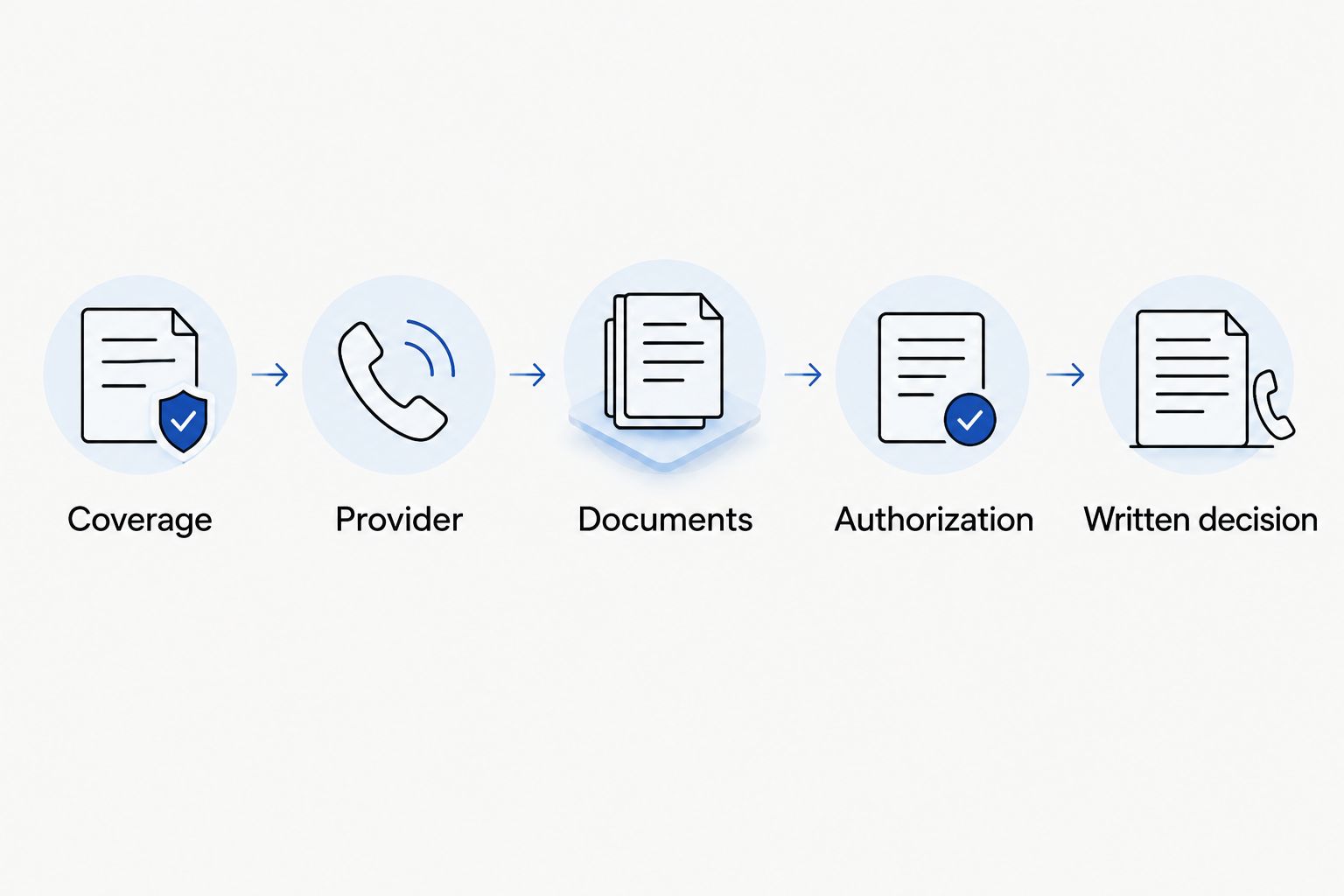
A coverage-call checklist
Keep your child’s Medicaid card and any diagnostic report nearby. Ask these questions and record the answers:
- Coverage: Does this specific plan cover the requested ABA assessment and treatment for my child?
- Provider: Is this clinician and billing organization enrolled and participating for these services?
- Documents: Which records or orders do you need, and who sends them?
- Authorization: Does the assessment require approval, does treatment require approval, and who submits each request?
- Written decision: How will I receive the decision and its effective dates?
- Next step: What should I do if the request is incomplete or denied?
Write down the representative’s name and any reference number. Ask for the relevant policy or instructions in writing so the provider and your family can work from the same information.
What to ask the therapy team
Coverage is only part of choosing care. Ask how the team selects goals, includes your child’s communication preferences, responds to distress, and adjusts activities to sensory needs.
A useful conversation connects treatment to daily life: requesting a break, communicating discomfort, joining a preferred activity, or managing a difficult transition. Choose goals that support your child’s safety, communication, autonomy, and participation—not goals that require appearing less autistic.
Ask how your child can refuse, pause, or change an activity. A coverage approval does not answer whether the approach feels respectful or fits your family.
Does a school IEP replace Medicaid paperwork?
An IEP does not replace Medicaid’s clinical documentation or authorization requirements. School services and medically necessary treatment have different decision-making processes, even when they address related needs.
An IEP can give the treatment team useful context about communication, classroom participation, and existing supports. Ask the school and outside clinicians to coordinate with your permission, without assuming that an educational recommendation automatically authorizes medical treatment.
Keep copies of the documents each team actually requests. Avoid sending an entire school record when a specific evaluation or goal summary is what the clinician needs.
What if Medicaid denies the ABA request?
A denial is a decision about the submitted request, not proof that New York Medicaid never covers ABA. Read the written notice to identify whether the issue involves eligibility, missing records, medical necessity, provider participation, or another stated reason.
Ask the provider to review the notice with you. If information is missing, determine who will supply it; if you disagree with the decision, follow the appeal or fair-hearing instructions that apply to your coverage.
For a 2026 denial, use the deadlines printed on the actual notice rather than a general timeline found online. Ask about expedited review when a delay could seriously jeopardize your child’s health or functioning, and ask whether any continuation-of-services protections apply to an existing service.
Do not assume a resubmission pauses an appeal deadline. Confirm the next action with the plan or Medicaid contact identified in the notice.
What does this mean for children and teens?
A child’s needs do not stay the same across childhood. The under-21 coverage boundary is an eligibility rule, not a recommendation for identical goals, settings, or treatment schedules.
Younger children
For a younger child, ask how the assessment accounts for play, communication, routines, and sensory preferences. Discuss what participation looks like when your child uses gestures, pictures, an AAC device, or limited spoken language.
You can also ask how caregivers will be included. Do not assume that a particular number of treatment hours is appropriate before the individualized assessment.
School-age children
For a school-age child, discuss the full day: school, transportation, meals, preferred activities, and rest. Ask how the proposed schedule fits those needs rather than treating every open hour as treatment time.
Friends and community participation belong in that conversation too. A therapy schedule should be considered alongside opportunities your child enjoys, not in isolation from family life.
Teenagers
For teenagers, include the young person in choosing meaningful goals and discussing privacy. Ask about support for self-advocacy, communication, daily routines, and activities they want to join.
For an 18-year-old, do not assume the under-21 Medicaid ABA benefit ends simply because high school or pediatric arrangements change. Confirm eligibility and begin discussing the eventual transition before age 21.
Where Autism Learn & Play fits
Autism Learn & Play is best suited to families seeking autism therapy, community programs, and online classes for children ages 2–18. The Brooklyn-based nonprofit’s stated services include ABA, speech, occupational, music and art therapy, and tutoring.
That range is relevant when your family is considering support beyond a single therapy. It does not establish Medicaid participation, approval for your child’s care, or a particular program’s suitability.
Use the contact form on the Autism Learn & Play website or email info@autismlearnplay.org to ask about the specific service you need. Include your child’s age, the exact coverage name, and whether your question concerns therapy or a community activity; avoid sending sensitive records until the organization explains how to share them securely.
FAQ
Is ABA therapy covered by Medicaid in New York in 2026?
Yes. New York Medicaid covers medically necessary ABA for eligible members under 21 with an autism diagnosis, subject to state program requirements. Confirm provider participation, documentation, and authorization with your plan or fee-for-service provider.
Does my child need an autism diagnosis for Medicaid ABA coverage?
Yes, the New York Medicaid ABA benefit discussed here requires an autism spectrum disorder diagnosis. Ask which diagnostic records and referral or order documents the provider needs for the request.
Does every ABA provider accept New York Medicaid?
No. Confirm that the provider is appropriately enrolled and, for managed care, participates in your child’s specific plan. A general statement that an office accepts insurance does not establish Medicaid participation.
Does New York Medicaid ABA coverage end at age 18?
No—the ABA benefit discussed here applies to eligible members under 21, not only those under 18. Confirm ongoing eligibility and plan the transition before the under-21 benefit ends.
Will Medicaid approve all the ABA hours a provider recommends?
Not automatically. The requested services must meet medical-necessity and program requirements, and the written decision establishes what is approved. Ask the provider to explain any difference between the request and the decision.
Can my child receive school services and Medicaid-covered ABA?
School services do not automatically rule out medically necessary Medicaid-covered ABA. The services have separate requirements, so ask the clinicians and school team to coordinate without assuming an IEP authorizes treatment.
What should I do if Medicaid denies my child’s ABA therapy?
Read the written denial and review its reason with the provider. Follow the applicable appeal or fair-hearing instructions and deadlines, and ask about expedited review if delay poses a serious health risk.
One last thing
Ask for the approval details, not just the word covered. Before treatment begins, confirm the provider, services, authorization period, and any remaining steps in writing.
Then return to the question that matters at home: does this support help your child participate in life on their own terms? A careful coverage check protects your planning; a respectful, individualized approach protects your child’s place in the process.
Related guides
- Connect your child’s IEP to ABA therapy goals
- Family support groups for autism in Brooklyn
- Connect a CSE evaluation to autism therapy services