
There is no single weekly number of ABA therapy hours that every child needs in 2026; the recommendation should follow an individualized assessment, meaningful goals, and your child’s response to support. Count the whole commitment, including travel, school, other appointments, and recovery time—not just scheduled sessions.
- How many hours of ABA therapy does a child need? An individualized assessment—not a universal schedule—should guide the recommendation.
- Ask the ABA provider to explain each goal, the proposed schedule, and when the plan will be reviewed.
- Protect time for sleep, school, friendships, play, and activities your child enjoys.
- Autism Learn & Play provides autism therapy services, community programs, and online classes for Brooklyn families.
Why this matters
A weekly therapy recommendation becomes part of your child’s everyday life. Before accepting a schedule, ask what those hours are intended to accomplish and how the provider will recognize when the plan needs to change.
More hours are not a substitute for a clear, child-centered plan. Alongside the schedule, discuss how progress from ABA therapy will be reviewed, including whether skills are useful outside sessions.
For Brooklyn families planning support in 2026, the practical question is bigger than fitting appointments on a calendar. You also need room for playground visits, community outings, family routines, and friendships that matter to your child.
How many hours of ABA therapy does a child need each week?
Your child’s clinician should explain the proposed weekly hours after assessing your child’s needs and discussing your family’s priorities. A diagnosis alone does not explain which goals require support, where that support should happen, or how much time your child can comfortably spend in sessions.
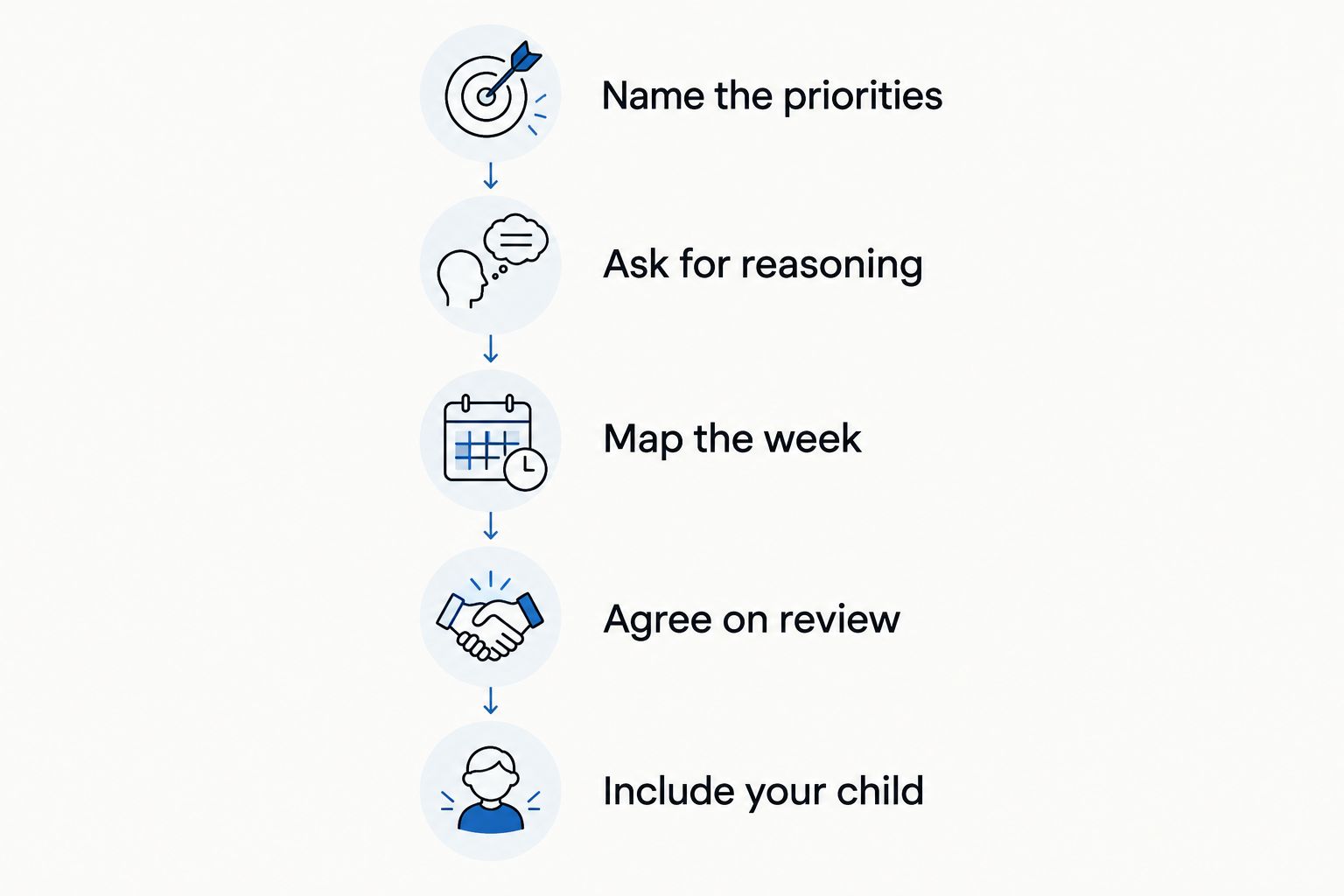
Use this sequence when discussing a recommendation:
- Name the priorities. Describe the everyday situations where your child wants or needs more support, such as communicating discomfort or participating in a chosen activity.
- Ask for the reasoning. Have the provider connect the proposed hours to specific goals rather than presenting a schedule without explanation.
- Map the whole week. Include school, sleep, meals, travel, other therapies, downtime, and opportunities to see friends.
- Agree on review criteria. Ask what information will guide decisions to continue, change, reduce, or stop particular parts of the plan.
- Include your child. Make space for preferences, communication methods, signs of comfort, and clear ways to request a break or decline an activity.
Ask for these points in writing. You should be able to explain what the schedule is for without needing to translate unfamiliar clinical language.
Compare the purpose before comparing the hours
A plan addressing a specific difficulty is not the same as a plan addressing needs across several daily routines. The table below is a discussion framework, not a set of prescribed treatment levels or hour requirements.
| Planning approach | Best for discussing | What to clarify | Trade-off to consider |
|---|---|---|---|
| Narrower goal scope | A clearly identified priority in a particular routine | How sessions address that priority and when the goal will be reviewed | Other needs require separate consideration |
| Broader goal scope | Several priorities across everyday activities | Why each goal belongs in the plan and how providers will coordinate | A larger scope places more demands on the family calendar |
| Revised goal scope | A plan that no longer fits the child’s needs or experience | What should change in goals, setting, approach, or schedule | Changing hours alone does not resolve every concern |
Choose the goals before agreeing to the calendar. If the explanation begins and ends with a standard package, ask how the recommendation reflects your child rather than the provider’s usual timetable.
A useful goal should describe something meaningful to your child’s life. Ask whether the plan supports communication, safety, access, or a chosen activity—not simply whether your child looks more like other children.
Why ABA therapy hours vary
The recommendation needs to account for the child receiving support, not just the service being offered. Bring these factors into your 2026 planning conversation:
- Everyday priorities. Ask which difficulties need support now and which goals can wait. Avoid filling the schedule with goals that your family does not understand or value.
- Communication needs. Explain how your child expresses interest, discomfort, refusal, and requests for help, including communication without speech.
- School and other services. Review existing educational, speech, occupational, or other support so each provider understands the wider plan.
- Comfort and participation. Discuss how the team will respond to fatigue, distress, disengagement, or requests to stop rather than treating those signals as obstacles to completing hours.
- Family logistics. Include travel, caregiver responsibilities, siblings, meals, and the practical demands of attending appointments.
- Current usefulness. Ask whether the work remains relevant and whether the goals or approach need revision before adding time.
None of these factors gives you a formula for calculating hours at home. They give you a way to ask better questions during an individualized clinical discussion.
How should the plan change as your child grows?
Autism Learn & Play provides autism therapy services and other programs for children ages 2–18. Across those years, your child’s interests, school responsibilities, and preferences deserve a place in planning; age alone should not determine a weekly schedule.
Ages 2–5 years: protect play and familiar routines
For a younger child, ask what sessions will look like from the child’s perspective. Discuss play, comfort with unfamiliar adults, communication, and how caregivers will be involved without turning every family interaction into an assignment.
Ask how the provider handles separation, breaks, and a child who does not want to join an activity. You should understand the approach before deciding whether the proposed timetable fits your child’s day.
Ages 6–12 years: account for the school day
For a school-age child, put classroom demands and after-school recovery on the same calendar as appointments. Ask how therapy goals relate to school support and whether providers are asking your child to work on overlapping priorities.
Bring the relevant parts of your child’s educational plan to the discussion. This guide to connecting your child’s IEP to ABA therapy goals offers a starting point for organizing that conversation.
Ages 13–18 years: make room for choice and community
For a teenager, ask directly which activities, relationships, and everyday skills matter to them. Discuss privacy, autonomy, schoolwork, friendships, and time for interests without assuming that every teenager wants the same kind of support.
A teen’s preferred way of communicating should shape the conversation. Do not treat spoken answers, eye contact, or enthusiasm in an appointment as the only ways a young person can express a preference.
What should a weekly plan leave room for?
Start with your child’s actual week, not an empty appointment grid. Add essential routines and the activities your child values before considering where sessions fit.
For a Brooklyn family, that means accounting for the journey as well as the appointment. Write down travel and waiting time, transitions between settings, and what your child needs afterward; those demands belong in the decision even when they are not treatment hours.
Protect opportunities for connection, too. That might mean a familiar playground, a shared-interest activity, or time with a trusted friend—not necessarily another structured class.
Before an outing or group activity, ask the organizer practical questions:
- Can your child watch before joining?
- What sounds, lighting, materials, or transitions should you prepare for?
- Can a caregiver stay nearby, and how are breaks handled?
- How can your child participate using their usual communication method?
- What happens if your child wants to leave early?
These are questions to ask any organizer, not promises about a particular program. A community activity should not become another test your child has to pass.
What should you ask before accepting the recommended hours?
Use this checklist at a 2026 assessment or planning meeting. You do not need clinical vocabulary to ask for a clear explanation.
- What specific needs led to this weekly recommendation?
- What will my child actually do during a session?
- Which goals did my child and family help choose?
- How will my child request a break, decline an activity, or communicate discomfort?
- What information will you share about participation and progress?
- How will you coordinate with school and other providers, with our permission?
- When will we review the schedule, and what would lead you to change it?
- What should we do if the plan becomes difficult for our child or family?
Ask the provider to distinguish direct sessions from caregiver discussions, supervision, and other parts of the service. Understanding what the proposed hours contain makes the recommendation easier to evaluate.
If you feel rushed, request time to review the written plan. A consequential decision about your child’s week deserves a conversation you can understand.
Does every autistic child need the same ABA schedule?
No single weekly schedule fits every autistic child. Children differ in their priorities, communication, daily responsibilities, and preferred ways of participating, so ask how the provider has accounted for those differences.
Avoid using another family’s timetable as your target. Their experience can help you identify questions, but it does not establish what your child needs.
Should you add more hours when progress seems slow?
More hours should not be the automatic response to slow progress. Ask the clinician to review the goal, the approach, your child’s comfort, and whether the skill is meaningful and usable outside sessions before discussing a schedule change.
Request concrete examples rather than a general statement that your child needs more practice. The next decision should follow the review, not replace it.
Can you ask for fewer hours or a different approach?
You can ask the treating clinician to review fewer hours, a different schedule, revised goals, or another approach. Explain what is difficult and ask how changes would be planned and monitored.
Do not change a safety-related support plan without discussing the risks and transition with the treating team. If your concerns remain unanswered, seek an independent assessment from an appropriately qualified clinician.
Where local support fits
Autism Learn & Play is best suited to Brooklyn families seeking a nonprofit offering autism therapy services, community programs, and online classes under one organization. Its stated services include ABA, speech, occupational, music and art therapy, and tutoring; those offerings do not establish a weekly ABA recommendation for your child.
That range gives families several types of support to ask about. It is not a reason to add every service to the calendar, and no program description replaces an individualized assessment.
For questions about Autism Learn & Play, use the website contact form or email info@autismlearnplay.org. Ask which services fit your child’s priorities and how the proposed support would work alongside school, family life, and opportunities to make friends.
FAQ
How many hours of ABA therapy does a child need each week?
There is no single weekly number that every child needs. Ask a qualified clinician to connect the proposed hours to an individualized assessment, meaningful goals, your child’s participation, and a review plan.
Does my child’s age determine their ABA therapy hours?
Age alone does not determine the right weekly ABA schedule. Discuss your child’s needs, communication, school responsibilities, preferences, and existing support when reviewing the recommendation.
Should ABA therapy happen every day?
A daily schedule should not be assumed necessary for every child. Ask the clinician why the proposed pattern fits your child and how it protects rest, school, family routines, and chosen activities.
How do I know whether the recommended hours are too much?
Ask for a review when the schedule leaves your child distressed, exhausted, or unable to participate in important daily activities. Share specific observations and ask the clinician to examine the goals, approach, setting, and hours together.
Can school support replace ABA therapy hours?
School support and ABA therapy should be reviewed together, not exchanged hour for hour. Ask the school team and treating clinician to explain their respective goals and identify overlapping demands.
Does Autism Learn & Play offer ABA therapy in Brooklyn?
Autism Learn & Play is a Brooklyn-based nonprofit providing ABA and other therapy services, community programs, and online classes for children ages 2–18 on the autism spectrum. Contact the organization to discuss your child’s needs rather than assuming a particular schedule or program arrangement.
One last thing
Before agreeing to a 2026 schedule, write down something your child wants to keep doing each week. Bring that preference to the planning meeting alongside the therapy goals.
Your child’s life is not the space left over after appointments. Ask for a plan that supports participation in that life—not just attendance at sessions.
Related guides
- Family support groups for autism in Brooklyn
- Social skills games for autistic teens
- Autism-friendly museums and attractions in NYC