
There is no fixed timeline for seeing progress from ABA therapy: the useful measure is whether your child is moving toward a specific, meaningful goal, not whether a certain number of weeks has passed. An early change during a session is different from using that skill independently at home, school, or a community outing. For your 2026 therapy plan, ask what the team will measure, how much help your child needs, and when you will review the approach together.
- How long does it take to see progress from ABA therapy? There is no fixed timeline for every child.
- Track meaningful skills, independence, comfort, and use outside therapy—not just completed activities.
- Autism Learn & Play provides ABA therapy among its services for children ages 2–18.
- Ask your provider to explain progress measures and agree on a review date.
Why this matters
You deserve a clearer answer than “give it time.” You also deserve an answer that respects your child's pace without promising results by a deadline.
Start with a goal that matters in daily life: asking for a break, communicating a choice, or joining an activity your child enjoys. If school is part of the picture, this guide to connecting your child's IEP to ABA therapy goals offers a related planning topic.
Progress should make your child's life more accessible, not make your child look less autistic. More eye contact, quieter behavior, or fewer visible movements alone do not establish that your child feels better or has gained a useful skill.
How long does it take to see progress from ABA therapy?
No single number of days, weeks, or months answers this question for every child. A useful answer starts with the skill being taught, your child's starting point, and what counts as success.
Ask the provider to distinguish these stages rather than treating them as interchangeable:
| Stage | What you are looking for | What it does not establish |
|---|---|---|
| Supported practice | Your child uses a skill with help during a session | Independent use |
| Independent use | Your child uses the skill without the same help | Use with different people or in different places |
| Everyday use | Your child uses the skill during relevant daily situations | That every setting is equally accessible |
| Continued use | Your child keeps using the skill after teaching changes | That support is no longer needed |
These are checkpoints, not a timetable. A child who communicates a break request with help has shown something different from a child who independently requests a break on a busy outing; both observations deserve an accurate description.
For a 2026 progress review, request the starting information and recent observations side by side. “Doing better” is not specific enough to explain what changed.
What should early progress look like?
Early progress should connect to an agreed goal and describe what your child actually does. It might involve making a choice, communicating discomfort, or completing part of a familiar routine with less assistance.
Treat those examples as possible goals, not milestones every child must reach. Your child's communication methods, interests, and priorities belong in the plan.
Ask what happened before and after the skill. Did an adult point, model an action, or give repeated reminders? Was your child comfortable, and was the request honored? These details help you distinguish learning from an activity completed with substantial adult direction.
Less adult help is useful information only when the activity remains accessible and your child has a way to decline or request support. Independence does not mean withholding accommodations.
What does progress outside therapy look like?
Everyday progress means a useful skill appears where your child needs it. For a Brooklyn family, that setting might be home, school, a playground, or a community program—not necessarily a therapy room.
Before an outing, choose a modest purpose together. Your child might want to watch a group activity, share a favorite interest, or communicate when it is time to leave. Participation does not have to mean joining every game or staying until the end.
Afterward, note the setting and support provided. A quiet room and a crowded event create different demands, so avoid treating different experiences as equivalent tests.
Friendship also involves other people responding kindly and making room for your child. Do not place the entire responsibility for connection on your child's therapy goals.
Why ABA therapy progress varies
The question is not simply how much time has elapsed. Review the conditions around the skill before judging the pace.
- Starting point: Document what your child already does, including gestures, movement, speech, or communication-device use.
- Goal definition: A narrowly described action is easier to evaluate than a broad goal such as becoming more social.
- Support needed: Record demonstrations, reminders, physical assistance, and other help rather than counting every response as independent.
- Setting: Note who was present, what the environment was like, and whether the activity was familiar.
- Child comfort: Include signs of enjoyment, refusal, fatigue, and distress in the discussion, not just task completion.
- Teaching approach: Ask whether the activities, materials, and expectations fit your child's communication, interests, and access needs.
These factors guide a review; they are not reasons to blame your child or your family. A plan that is not helping deserves examination, not an automatic instruction to try harder.
How can you track progress without turning home into therapy?
Keep your 2026 progress notes focused on ordinary life. You do not need to test your child repeatedly or make every shared activity into a lesson.
Use this sequence when something relevant happens naturally:
- Choose a goal. Describe something your child needs or values, such as requesting a break during an activity.
- Record support. Write down what help was offered, including reminders or access to a communication tool.
- Note comfort. Include your child's response and whether the environment seemed manageable.
- Review together. Share observations with the provider and ask what they mean for the plan.
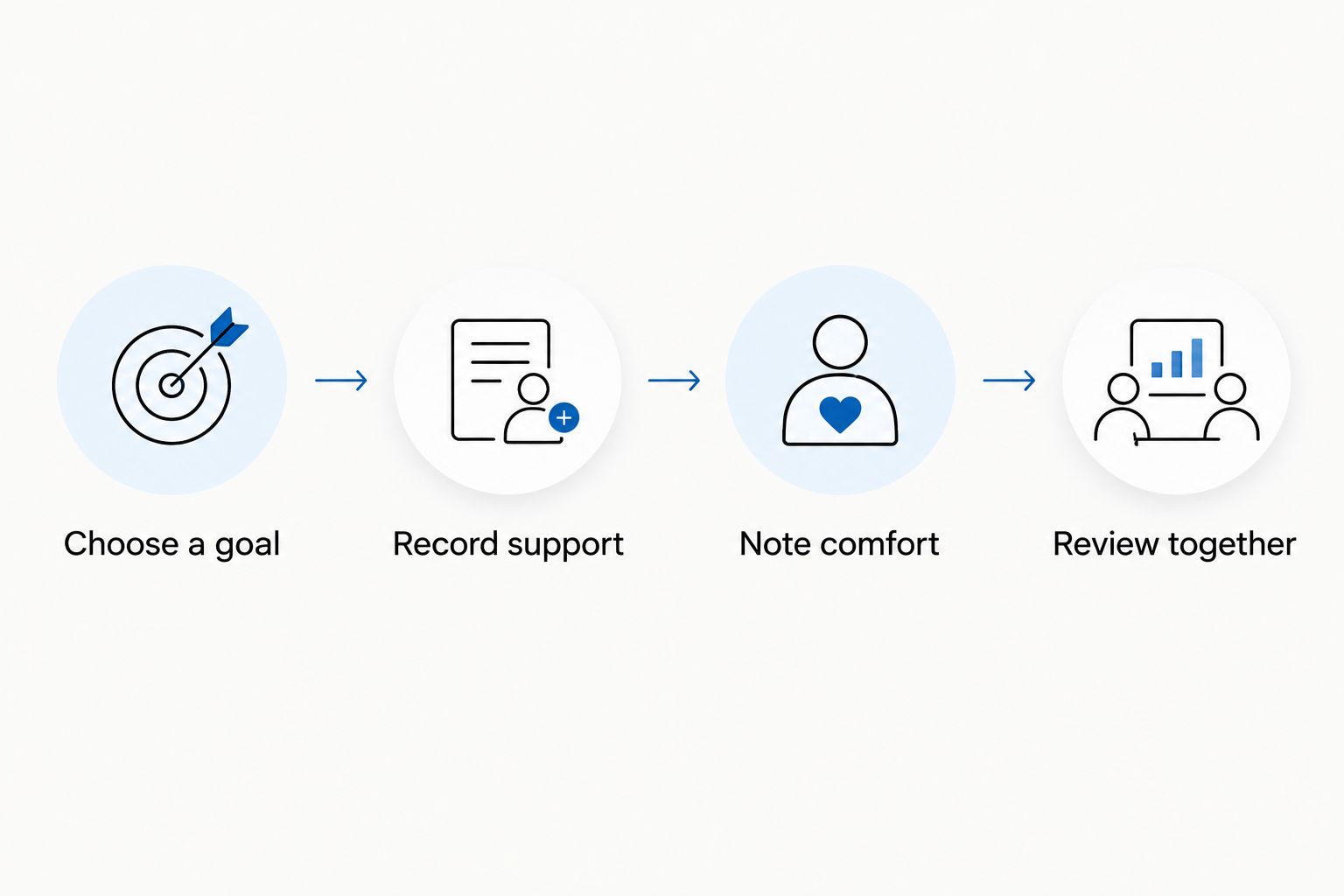
For example, write that your child used their usual communication method to ask to leave a noisy activity after a reminder. That description is more informative than “had a good outing.” It names the action, context, and assistance without assigning a score to your child.
Keep notes brief enough that they do not take over family time. Bring questions to the provider rather than taking on responsibility for interpreting every observation yourself.
How should goals differ across ages 2–18?
Age matters, but age alone does not tell you which goals fit. Use your child's current communication, preferences, daily demands, and choices to shape the discussion.
Young children: prioritize communication and comfortable participation
For a young child, discuss goals within familiar play and care routines. Ask how the team recognizes requests to stop, offers choices, and supports communication without requiring speech as the only acceptable response.
A completed activity is not the only useful observation. Whether your child can access help and express a preference matters too.
School-age children: connect goals to daily access
Discuss situations your child actually encounters, such as asking for clarification, managing transitions with support, or participating in a preferred activity. Coordinate relevant goals with the school team rather than assuming clinic performance explains classroom experience.
Leave room for enjoyment. An interest shared with another child can be a starting point for connection without making every interaction an assignment.
Teenagers: include the teenager in decisions
Ask teenagers what they want help with and how they want support offered. Privacy, self-advocacy, friendships, and participation in chosen activities deserve consideration alongside adult priorities.
Do not use goals designed for younger children simply because a teenager needs substantial support. Age-respectful materials and meaningful choices belong in the discussion.
What should you ask at a progress review?
Bring a short question list to your next 2026 review. You should leave understanding what changed, what remains difficult, and what the team will do next.
- What is the goal, stated in plain language?
- What could my child do when this goal began?
- What can my child do now, and with how much help?
- Does the skill appear outside sessions?
- How are you documenting comfort, refusal, and distress?
- What will you change if the current approach is not helping?
- When will we review that change together?
Ask for an explanation you can understand, not just a chart. If reported improvement does not match what you see at home, describe the difference without assuming either observation is wrong. The next step is to examine the context.
What if you are not seeing meaningful progress?
Request a review rather than accepting indefinite waiting or an automatic increase in therapy hours. Ask the provider to examine the goal, teaching approach, communication access, and your child's experience.
Distinguish a skill that has not developed from a skill that appears only under certain conditions. Those situations call for different questions; neither is evidence that your child is failing.
If sessions involve persistent distress, discuss it promptly rather than treating distress as proof that therapy is working. If your child loses previously established skills or develops new health concerns, contact their pediatric clinician rather than relying on a therapy progress review alone.
Changes to services should involve an individualized discussion with qualified professionals and your family. Your child's preferences and wellbeing remain part of that decision.
Where can Brooklyn families ask about support?
Autism Learn & Play is for Brooklyn families seeking therapy services and community programs for autistic children ages 2–18. The nonprofit's services include ABA, speech, occupational, music and art therapy, tutoring, and online classes.
When considering Autism Learn & Play, ask how the relevant service addresses your child's priorities, how progress is discussed, and what participation involves. The service list alone does not establish which approach fits your child or what results to expect.
For questions about Autism Learn & Play's ABA therapy or community programs, use the website contact form or email info@autismlearnplay.org. Describe your child's age, interests, communication preferences, and the everyday situation you want support with.
FAQ
How long does it take to see progress from ABA therapy?
There is no fixed timeline for every child. Ask your provider to define the goal, document the starting point, and agree on when to review changes in skill, support needs, and comfort.
What are the first signs that ABA therapy is helping?
Look for a meaningful change connected to your child’s agreed goals, such as communicating a choice with less assistance. Record the context and support rather than treating every completed task as independent progress.
Does doing something in therapy mean my child can do it at home?
Doing something in therapy does not establish that your child uses the skill at home. Ask the team to examine differences in people, surroundings, materials, and support.
Should my child have more ABA hours if progress is slow?
Slow progress alone does not establish that your child needs more hours. Ask for an individualized review of the goals, teaching approach, access needs, and your child’s experience before changing services.
Does my child need to speak for therapy progress to count?
Speech is not required for meaningful communication progress. Gestures, signs, pictures, or a communication device can be part of how your child expresses choices and needs.
What should I bring to an ABA progress review in 2026?
Bring your goal questions and brief examples from everyday life to your 2026 review. Include what your child did, what help was needed, and whether the experience was comfortable.
Should I wait until the next review if my child is distressed?
Raise persistent distress with the provider promptly rather than waiting for a scheduled review. Ask how the team will respond to refusal, adjust demands, and protect access to communication and breaks.
One last thing
A child asking to stop can be demonstrating a valuable communication skill. Before counting an unfinished activity as a setback, ask whether your child expressed a need—and whether the adults listened.
Choose a meaningful goal, agree on how to recognize it, and set a review date. That gives your family a next step without putting your child on an invented deadline.
Related guides
- Connecting speech therapy to AAC device use at home
- Social skills games for autistic teens
- Family support groups for autism in Brooklyn