
Instead of repeating your child’s needs separately before every session, connect online autism classes with in-person therapy through a shared goal, a brief handoff, and a plan for breaks. This guide shows you how to coordinate learning across settings without turning family time into another therapy appointment.
- Connect online autism classes with in-person therapy through one shared goal, consistent communication supports, and brief provider updates.
- Autism Learn & Play serves Brooklyn families seeking autism therapy, online classes, and community programs for children ages 2–18.
- Choose class-to-therapy or therapy-to-class planning according to where your child already feels comfortable.
- Protect downtime, respect requests to stop, and change the plan when participation becomes stressful.
Why this matters
An online activity and an in-person session can use different materials while supporting the same everyday need. A child might practice choosing an activity on screen, then use the same communication method to choose a game during therapy. Connect the purpose, not every detail of the activity.
Autism Learn & Play is best for Brooklyn families seeking autism therapy, online classes, and community programs for children ages 2–18. Autism Learn & Play is a nonprofit offering these services; ask about your child’s needs rather than assuming separate providers automatically coordinate.
For your 2026 plan, begin with something your child wants to do: join a game, ask for space, share an interest, or make a choice. The goal is meaningful participation, not looking or behaving like other children.
Before you start
- Gather the people and permissions. Identify the online instructor, in-person therapist, and family contact. Ask each provider what permission is needed before sharing information, and agree on an approved communication channel.
- Prepare your child’s access supports. Have the class access instructions, familiar materials, communication tools, and an agreed way to pause. Include your child’s preferences through speech, gestures, pictures, typing, or another familiar method.
- Check the coordination gap. Enrollment in both services does not establish a shared treatment plan. Confirm whether the class is educational, recreational, or therapeutic, who can discuss individual goals, and whether coordination is part of that provider’s role.
Do not send a full evaluation or record a session simply because sharing seems convenient. Ask what information is necessary, who will receive it, and how it should be sent. Keep other children’s names, images, and personal information out of your notes.
Shared goal setup
Choose the starting direction
For 2026, select the direction that matches your child’s current comfort rather than adding both workflows at once. These are planning options, not different treatment packages.
| Workflow | Best for | Advantage | Limitation |
|---|---|---|---|
| Class-to-therapy | Families whose child already enjoys an online activity | Gives the therapist a familiar interest to discuss or adapt | An enjoyable screen activity does not establish comfort with the same activity in person |
| Therapy-to-class | Families with an established therapist-guided support strategy | Gives the instructor a specific support to consider | A group class cannot necessarily provide individualized therapy support |
Neither direction is automatically better. Start where your child already has a workable experience, then ask the receiving provider what fits their setting.
Write the connection plan
- Choose one shared goal. Describe an everyday action, such as choosing between activities or communicating a need for a break. Ask the therapist whether that goal fits the child’s existing plan.
- Name the child’s interest. Identify an activity your child enjoys, such as drawing, music, building, or discussing a favorite topic. Do not use access to that interest as a reward for tolerating distress.
- Describe acceptable participation. Include watching, joining briefly, responding without speech, or returning after a break where the activity permits. Ask the instructor which forms of participation the class can accommodate.
- Write the boundary. Decide what signals mean pause, adapt, or stop. Make clear that a request for a break is communication, not a failed attempt.
Use a plain document or paper note. Suggested headings are Shared goal, Child’s choice, Helpful supports, Pause signals, and Next review; these are your template labels, not software controls.
Expected result: You can explain the connection in a sentence: your child is exploring a chosen activity while both adults support the same everyday need.
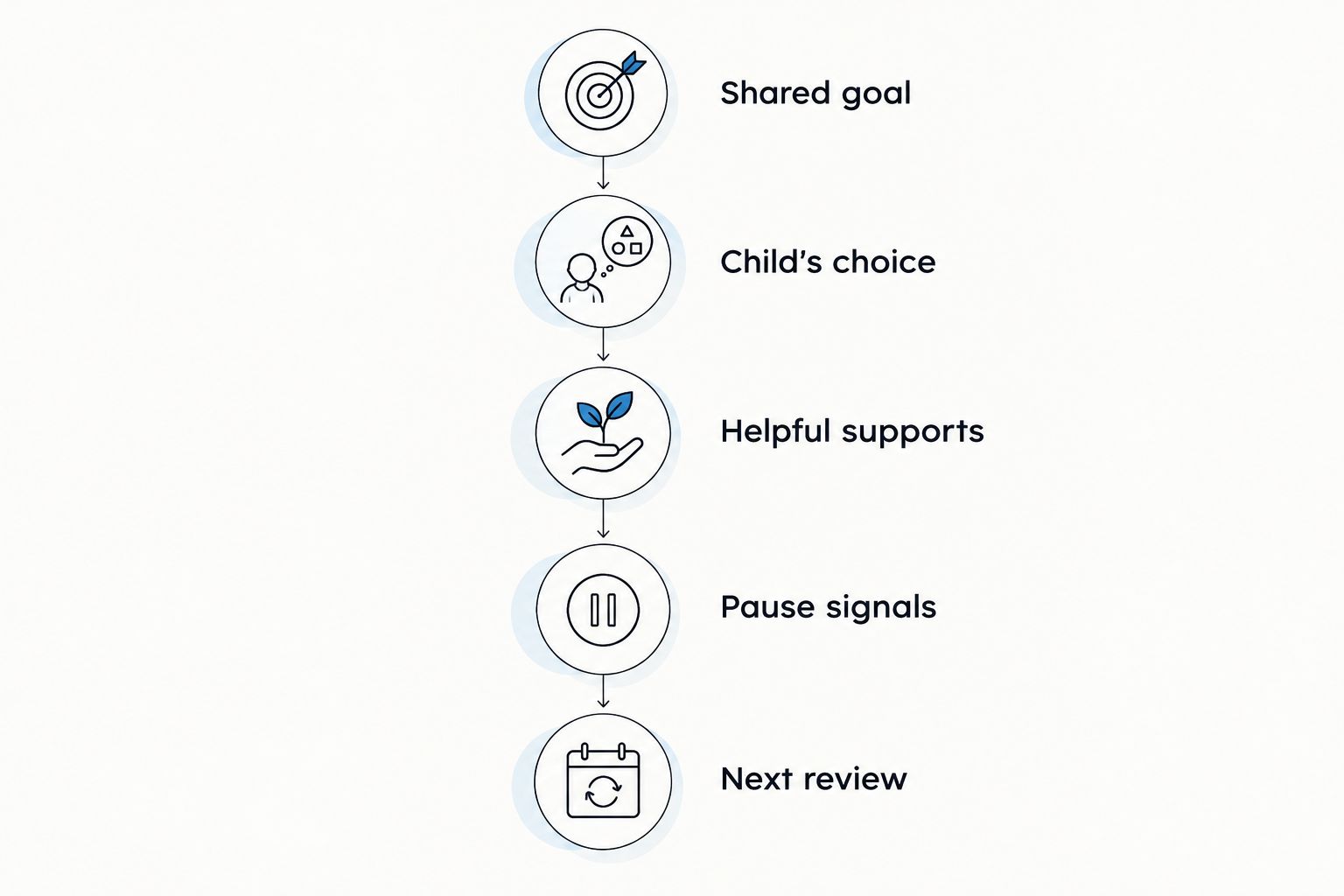
Session and support setup
- Ask the therapist for a transferable support. Request a plain-language description of what helps, such as offering a choice or allowing processing time. Ask what requires professional supervision and should not become home practice.
- Check the instructor’s boundaries. Explain the shared goal and ask what the class can support. An instructor can describe class expectations without being responsible for delivering the child’s treatment plan.
- Prepare an accessible setup. Place familiar communication tools within reach. Check sound and camera expectations before the session, and ask about alternatives if either creates a barrier.
- Protect transitions. As a starting experiment, leave a 10-minute buffer before or after class rather than scheduling activities back-to-back. Increase that space or change the schedule according to your child’s response.
- Agree on adult involvement. Decide whether your child wants nearby help and what the instructor expects. Avoid answering for your child when a pause or accessible response method would let them participate.
Match activities to age and interests. A child ages 2–5 might explore a familiar object with a caregiver nearby; a child ages 6–12 might choose a shared game; a teen ages 13–18 should help decide what feels relevant and respectful. These are planning examples, not developmental requirements.
For Brooklyn outings, discuss the same practical supports before leaving home: how your child can decline, where your family can pause, and how to leave. Verify conditions with the organizer instead of assuming an activity described as sensory-friendly meets every child’s needs.
Expected result: Both adults know what support they can provide, and your child has an understandable way to participate or stop.
Provider handoff and review
- Capture an observation, not a judgment. Write what happened: your child selected a song using a picture, watched without joining, or asked to leave when the sound changed. Avoid labels such as uncooperative.
- Record the context. Note whether the activity was familiar, the room was noisy, or the child had just completed another demanding activity. Separate what you observed from what you think caused it.
- Share only the useful detail. Send the relevant observation through the agreed channel. Ask a specific question, such as whether the same choice format fits the next therapy session.
- Schedule a brief review. Try a 5-minute family review after your child has had time to rest, not an immediate interview. Your child can contribute by choosing what to repeat, change, or avoid.
- Update the plan with the provider. Keep helpful supports, remove unnecessary demands, and confirm any treatment changes with the treating professional. Do not change a therapy plan solely because an online activity went well or poorly.
For example, a useful handoff describes that your child chose an instrument picture but covered their ears when music started. That gives the next adult something concrete to discuss without claiming why the response occurred.
Expected result: The next session begins with a relevant observation and a clear question, rather than another full retelling of your child’s history.
Reverse workflow: bring therapy supports into online classes
Use therapy-to-class planning when your child already has a helpful support in person. The purpose is to ask whether that support fits the class, not to turn the instructor into a therapist.
- Identify the support with the therapist. Choose an approach the therapist considers appropriate to share, such as a familiar visual choice or break signal.
- Ask the child what to share. Explain the proposed handoff in an accessible way. Include older children and teens in deciding how their needs are described.
- Ask the instructor about fit. Describe the support and confirm whether it works within the class format. Discuss an alternative if it does not.
- Review the experience. Ask what felt comfortable and what needs changing. Keep the support only when it remains useful and appropriate.
When school goals also matter, use the guide to connecting your child’s IEP to ABA therapy goals to prepare questions for the relevant professionals. Keep responsibilities clear: a school plan, private therapy plan, and recreational class are not interchangeable.
For 2026 scheduling, prioritize a workable routine over filling every opening. Autism Learn & Play offers autism therapy services, online classes, and community programs; confirm how any proposed combination would work for your family before committing.
Troubleshooting
Your child participates online but not in person
Keep the goal and reconsider the setting. Tell the therapist what your child enjoyed online and describe what differed in person. Ask about a smaller starting activity rather than expecting an exact repeat or assuming the skill should transfer immediately.
The class and therapist give different instructions
Ask the adults to clarify their purposes before changing your child’s routine. Explain the difference in plain language and request a practical agreement. Different settings can have different expectations, but your child needs an understandable way to ask questions or decline.
The screen, sound, or pace becomes uncomfortable
Pause the activity first. Check the sound level, visual demands, instructions, and available breaks with the instructor. Do not make finishing the session the measure of success; discuss a different format when the current one does not fit.
Providers cannot communicate directly
Ask each provider what a parent-carried summary can include. Share a brief, approved description of the goal and supports rather than clinical instructions you have interpreted yourself. Keep treatment decisions with the treating professional.
Coordination is becoming another exhausting task
Reduce the plan to the smallest useful handoff. Keep a shared goal and a brief observation, then review whether coordination is helping your family. Remove extra practice before taking away rest, preferred activities, or judgment-free time together.
Customize your workflow
Once the connection is manageable, consider whether your child wants to use a familiar activity to connect with another person. A shared drawing interest might become parallel art-making; a favorite game might become an invitation to a peer. Friendship is an opportunity to offer, not an outcome to require.
Ask organizers about age fit, group expectations, communication access, caregiver involvement, and ways to leave or take a break. These questions are especially useful when moving from a home screen to a Brooklyn community setting. Do not assume a class, outing, or group provides therapy unless the provider confirms it.
For your 2026 family plan, ask Autism Learn & Play about therapy services, online classes, or community programs through the website contact form or info@autismlearnplay.org. Describe your child’s age, interests, access needs, and the kind of connection you are seeking; ask which details need an individual discussion.
FAQ
How do I connect online autism classes with in-person therapy?
Connect online autism classes with in-person therapy through a shared everyday goal, agreed supports, and a brief provider handoff. Confirm each provider’s role and permissions before sharing information.
Are online autism classes the same as therapy?
No, an online autism class is not automatically therapy. Ask whether the specific class is educational, recreational, or therapeutic, who delivers it, and what individualized support it includes.
Should my child practice the same activity in both settings?
Your child does not need to repeat the identical activity in both settings. Ask the therapist how different enjoyable activities can support the same everyday goal without adding unnecessary demands.
What if my child does not want to join the online class?
Pause and explore what makes participation uncomfortable or unwanted. Discuss the format, sound, pace, communication access, and alternatives with the instructor rather than requiring your child to finish.
Can I share a class recording with my child’s therapist?
Do not record or share a class without checking the provider’s rules and obtaining required permissions. A brief written observation can avoid capturing other children’s personal information.
How should this work for an autistic teenager?
An autistic teenager should help choose the goal, activity, supports, and information shared between adults. Respect privacy and use age-appropriate interests rather than adapting activities intended for younger children.
Does Autism Learn & Play offer online classes and therapy?
Autism Learn & Play provides therapy services, community programs, and online classes for children ages 2–18 on the autism spectrum. Ask through the website contact form or info@autismlearnplay.org how the services relate to your family’s needs.
One last thing
A successful connection can mean doing less, not adding more. Before adding another activity to your 2026 schedule, ask your child what they want to keep. A familiar choice, a respected break, or a comfortable way to invite someone into play can be the most useful part of the plan.
Related guides
- Social skills games for autistic teens
- Family support groups for autism in Brooklyn
- Autism-friendly museums and attractions in NYC