
Instead of repeating your child’s history at every appointment, organize your early intervention to ABA therapy transition around one shared record, separate school and therapy decisions, and a written handoff. This 2026 guide explains what Brooklyn families should confirm before early intervention ends, how to evaluate an ABA plan, and how to keep communication and play central to the change.
- An early intervention to ABA therapy transition requires separate school planning and therapy intake; one does not replace the other.
- Autism Learn & Play serves Brooklyn families seeking autism therapy services and community programs for children ages 2–18.
- Ask your early intervention coordinator about transition deadlines before arranging an ABA assessment.
- Choose goals that support communication, comfort, participation, and your child’s ability to say no.
Why this matters
Early intervention, preschool special education, and ABA therapy are not interchangeable. Early intervention is a service system for infants and toddlers with developmental needs; ABA is a therapy approach that can operate within different settings and funding arrangements.
Autism Learn & Play is best for Brooklyn families seeking autism therapy services alongside community programs. The nonprofit serves children ages 2–18, but that age range does not establish an individual child’s eligibility for a particular service. You can learn about Autism Learn & Play while keeping your school referral and provider questions separate.
For a 2026 transition, begin with the service coordinator who manages your child’s Individualized Family Service Plan, or IFSP. A provider intake does not automatically initiate preschool special education, and a school referral does not automatically arrange privately funded therapy.
Before you start
- Gather records and sharing permissions. Collect the current IFSP, evaluations, relevant medical documentation, and a short description of your child’s communication, interests, sensory preferences, and support needs. Ask each organization how it accepts records securely.
- Identify the people responsible. You need your early intervention service coordinator, the preschool special education referral contact, and the prospective therapy provider’s intake contact. If insurance will fund therapy, identify the plan’s authorization contact too.
- Check the hidden deadline. Under federal IDEA Part C transition rules, the transition conference for a toddler potentially eligible for preschool special education generally occurs at least 90 days before the third birthday. With agreement from the parties, it can occur up to 9 months beforehand. Ask your coordinator how New York’s eligibility and continuation rules apply to your child.
The federal timing comes from IDEA Part C transition requirements, including 34 CFR §303.209. Use those requirements as the starting point for your 2026 planning conversation, not as a reason to calculate a final service date yourself.
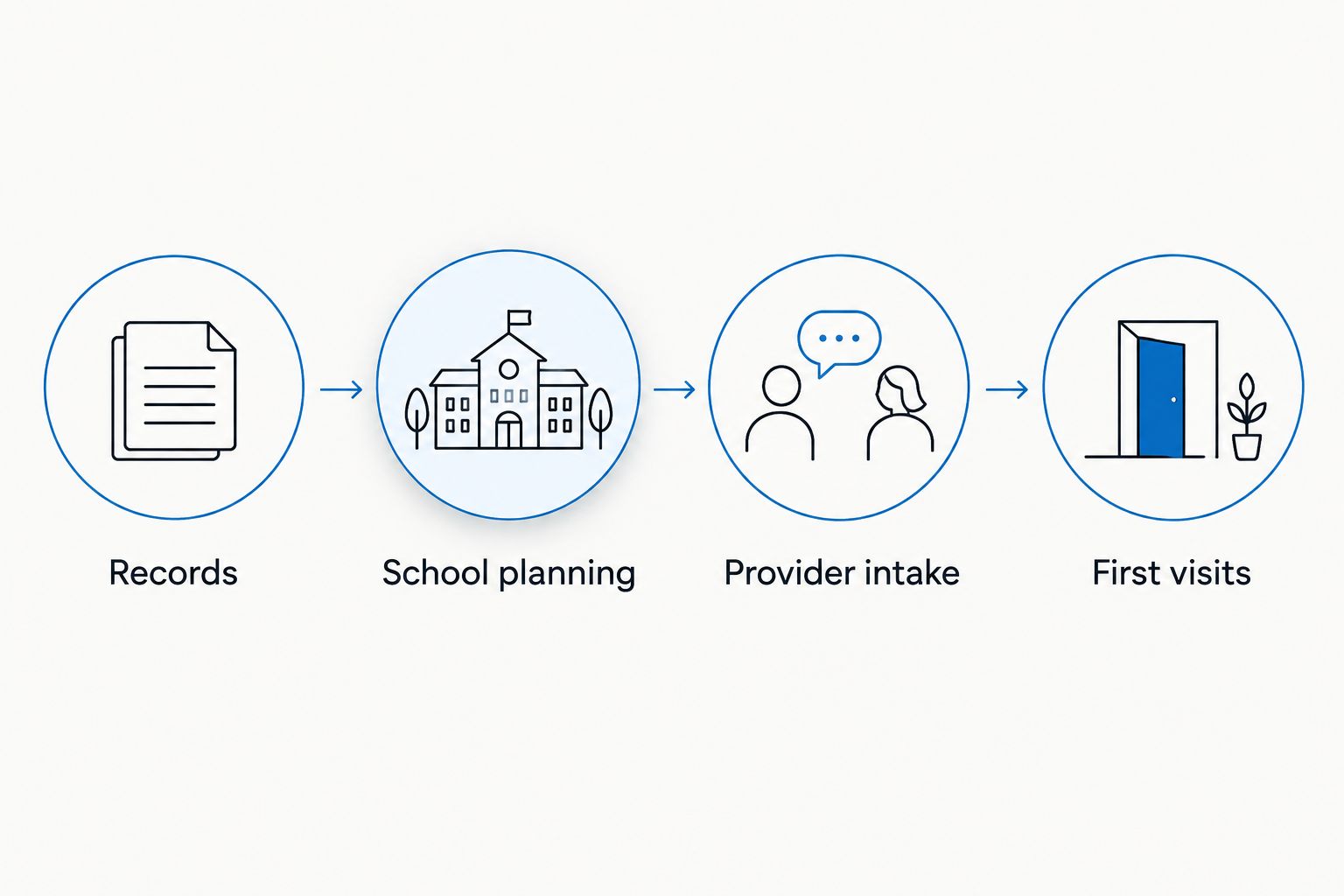
Records
Build a handoff that describes your child
- Request the current documents. Ask for the latest Individualized Family Service Plan, completed evaluations, progress summaries, and the existing transition plan. Check that each document belongs to your child and reflects the current situation.
- Create a short family summary. Include how your child asks for help, shows discomfort, enjoys play, and communicates a refusal. Describe useful supports, such as a familiar object, picture choices, movement breaks, or access to a communication device.
- Separate observations from goals. Write what happens before deciding what needs to change. For example, describe a child covering their ears during a noisy group rather than labeling the child as unwilling to participate.
- Confirm consent and receipt. Ask which records require a signed release, who will receive them, and how receipt will be confirmed. Keep a copy of what you send.
A family summary should explain more than challenges. Favorite songs, preferred activities, and ways your child connects with trusted people give a new team useful starting points for relationship-building.
Expected result: You have an organized record set and a readable summary that a new professional can use without asking you to reconstruct every detail.
School planning
Confirm the preschool pathway separately
- Ask about the transition conference. Confirm whether it has been scheduled, who should attend, and which decisions belong on the agenda. Bring questions about the current service end date and the next referral steps.
- Discuss the preschool referral. In New York City, the Committee on Preschool Special Education, or CPSE, handles preschool special education for eligible children ages 3–5. Ask your coordinator or the education department how to make and document the referral.
- Track evaluation consent and meetings. Record when consent is requested, when you return it, and who is arranging evaluations. Ask for the applicable timelines in writing rather than assuming the therapy provider manages them.
- Review the proposed school supports. If your child is eligible, the Individualized Education Program, or IEP, describes the school services and supports. Ask how communication, sensory access, transitions, and participation will be addressed.
Ask the school team about the actual experience of arriving, joining activities, taking breaks, and leaving. A service name alone does not explain whether your child can access the day comfortably.
For your 2026 planning record, keep school decisions in a separate section from insurance and therapy paperwork. That separation makes unfinished tasks easier to spot.
Expected result: You know who owns the preschool referral, what remains outstanding, and which dates require confirmation before early intervention ends.
Provider intake
Evaluate the proposed ABA plan
- Describe what your family wants help with. Start with meaningful daily needs: communicating discomfort, joining a preferred game, asking for a break, or managing a difficult transition. Include your child’s interests and existing ways of communicating.
- Ask how assessment works. Request an explanation of who assesses your child, which information informs recommendations, and how family priorities enter the plan. Ask how speech and occupational therapy recommendations will be considered.
- Review goals before agreeing. Ask what each goal changes in everyday life and how progress will be recognized. A goal should have a clear benefit for your child, not simply make the child appear less autistic.
- Ask about choice and distress. Find out how staff respond when a child refuses, becomes overwhelmed, or needs to stop. Ask how assent—your child’s willingness to participate—is recognized, including for children who do not use speech.
- Confirm administrative requirements. Ask the provider and insurer, when applicable, about required documentation, authorization, scheduling, and renewal responsibilities. A completed assessment and permission to begin services are separate checkpoints.
ABA’s potential benefit is a structured way to teach and review selected skills; its limitation is that an unsuitable goal or approach can prioritize compliance over the child’s needs. Evaluate the actual plan, not the therapy label. Discuss concerns with the treating professionals before making decisions.
There is no single weekly schedule appropriate for every child. Ask why the proposed amount of therapy fits your child’s assessed needs, energy, school day, other supports, and family life.
Expected result: You understand the proposed goals, participation safeguards, administrative requirements, and reasons for the recommended schedule.
First visits
Arrange the handoff and review point
- Request coordination with permission. Ask whether the incoming provider can review existing recommendations or speak with the current team after you authorize information sharing. Do not assume the teams have already connected.
- Prepare a predictable introduction. Ask what the first visit involves, who will be present, and what your child can bring. Explain unfamiliar activities in the communication format your child understands.
- Protect familiar supports. Tell the new team about communication tools, comfort items, and helpful routines. A transition does not require withdrawing supports that your child already uses.
- Agree on a review point. Decide when you will discuss comfort, participation, goals, and the effect on family routines. Ask whom to contact sooner if something feels wrong.
For a toddler, your observations and participation will help explain needs the child cannot yet describe. For an older preschooler, offer understandable choices about materials, activities, and breaks without making participation depend on spoken answers.
Expected result: Everyone knows what the first visits are for, which supports continue, and how you will raise concerns.
When school and ABA begin on different dates
A second common workflow is coordinating preschool services while a therapy assessment or authorization remains unfinished. Keep the school process moving while you clarify the therapy pathway. Ask each team which decisions can proceed independently and which require additional information.
These supports serve different purposes. This comparison helps you identify the right contact rather than choose a universal winner.
| Support pathway | Best for | Main strength | Limitation to plan around |
|---|---|---|---|
| Early intervention | Eligible infants and toddlers needing developmental support | An IFSP coordinates child and family priorities | Eligibility and transition dates require advance planning |
| Preschool special education | Eligible preschoolers needing educational supports | An IEP documents school services and supports | School planning does not automatically arrange outside therapy |
| ABA therapy | Children with assessed goals suited to this approach | Selected skills can be taught and reviewed systematically | Quality depends on goals, methods, and respect for the child |
Create a shared calendar with confirmed dates only. Include school meetings, assessments, current service dates, and follow-up responsibilities; mark an unconfirmed start as pending rather than presenting it to your child as settled.
If both services begin close together, ask the teams how to reduce unnecessary repetition. Protect rest, family routines, and opportunities for enjoyable play rather than treating every open hour as a therapy slot.
Troubleshooting
The current service end date is unclear
Ask your early intervention coordinator to confirm the date and the rule that determines it. Request an explanation of whether any continuation provision applies to your child; do not assume the third birthday tells the whole story in New York.
The provider says paperwork is incomplete
Request an itemized list identifying the missing document, who must supply it, and where it should be sent. Distinguish missing clinical records from missing insurance authorization so you contact the correct person.
Two professionals recommend conflicting goals
Ask both professionals to explain the daily-life purpose of the goal and the evidence informing it. Request a joint conversation, with your consent, when recommendations conflict about communication tools, sensory supports, or responses to distress.
Your child becomes distressed during visits
Tell the provider what you observed and ask to review the setting, demands, pacing, and break options. Do not treat persistent distress as proof that a child needs to be pushed harder. Seek clinical advice for pain, illness, or other health concerns rather than assuming every change is behavioral.
Therapy crowds out everyday connection
Review the schedule with the team and explain what your child is missing or struggling to sustain. Ask how goals can support ordinary family activities without turning every game, meal, or outing into an exercise.
Customize your workflow
For a toddler, read the ABA therapy for nonverbal toddlers guide alongside your assessment questions. Speaking is not a prerequisite for expressing preferences; include gestures, pictures, devices, movement, and familiar communication patterns in the handoff.
For a preschooler, focus on how supports fit classroom routines and play with peers. For school-age children and teenagers, this is no longer an early intervention transition: ask about school coordination, age-respectful activities, privacy, friendships, and the young person’s own priorities.
Autism Learn & Play provides therapy services, community programs, and online classes for children ages 2–18. Ask which services fit your child’s age and needs rather than assuming every offering uses the same format. For questions, use the website contact form or email info@autismlearnplay.org.
In 2026, keep community connection on the plan alongside appointments. Ask prospective groups about age ranges, caregiver participation, sensory conditions, communication access, and whether observing or taking a break is welcome; confirm the details before an outing.
FAQ
Does early intervention automatically turn into ABA therapy?
No. Early intervention is a service system, while ABA is a therapy approach that requires its own assessment and intake process. Preschool special education also has a separate referral and eligibility process.
When should I start planning the transition in Brooklyn?
Ask your early intervention coordinator about transition planning well before your child turns 3. Federal IDEA Part C rules generally require the transition conference for children potentially eligible for preschool special education at least 90 days before the third birthday.
Does my child have to start ABA after early intervention?
No. The next support plan should reflect your child’s assessed needs and family priorities, not an automatic move into ABA. Discuss school services, communication support, and other appropriate therapies with the relevant professionals.
Can preschool services and ABA happen at the same time?
They can coexist when the child qualifies and the arrangements permit it. Confirm scheduling, funding requirements, and coordination separately with the school team, provider, and insurer when applicable.
How many hours of ABA should my child receive?
The recommended schedule should follow an individualized assessment, not a universal number. Ask how it accounts for school, communication needs, energy, rest, play, and family routines.
What should I ask if my child does not use speech?
Ask how the team will recognize and support your child’s existing communication. Include gestures, pictures, communication devices, refusal signals, and ways of asking for help or a break in the plan.
Can Autism Learn & Play help children beyond preschool age?
Autism Learn & Play serves children ages 2–18 through therapy services, community programs, and online classes. Contact the nonprofit about services suited to your child’s age and needs; do not assume a specific program or schedule applies.
One last thing
Add a question to every handoff: How will my child tell you to stop? The answer should describe recognizable communication and a respectful response, not depend on eye contact or spoken words. Carry that answer into your 2026 school meetings, provider conversations, and community activity planning.
Related guides
- Family support groups for autism in Brooklyn
- Speech therapy activities for nonverbal autism
- IEP advocacy resources for autism parents