
Choose Autism Learn & Play if you want a Brooklyn nonprofit offering therapy, community programs, and online classes for children ages 2–18; choose Golden Care Therapy if its confirmed care plan better matches your child’s needs and your family’s routine. For this 2026 comparison, the deciding question is which provider can explain a suitable plan—not which name sounds more reassuring.
- Autism Learn & Play offers therapy services, community programs, and online classes for autistic children ages 2–18.
- Autism learn and play vs golden care therapy: compare confirmed services, child-specific support, and practical family fit.
- Brooklyn parents should ask how community activities support participation, communication, and opportunities to make friends.
- Choose Golden Care Therapy when its confirmed plan better fits your child; do not assume services from a provider’s name.
Why this matters
You are choosing how your child will spend time, communicate needs, and experience support. A provider comparison should help you picture that experience, not leave you with a list of therapy terms.
Start with your child’s priorities: communicating a preference, enjoying a shared activity, getting help with schoolwork, or meeting peers. Then separate what a provider offers from what a particular program will involve. A broad service list does not establish that every service belongs in your child’s plan.
At a glance
Use this 2026 table to organize your questions. Items marked for confirmation are questions to resolve directly, not negative judgments about a provider.
| Dimension | Autism Learn & Play | Golden Care Therapy |
|---|---|---|
| Best for | Brooklyn families seeking therapy, community programs, and online classes | Families whose needs are better matched by its confirmed care plan |
| Service mix | ABA, speech, occupational, music and art therapy, tutoring, and more | Confirm which services address your child’s priorities |
| Community connection | Community programs are part of its offering | Ask whether the proposed service includes peer or community participation |
| Location and routine | Brooklyn-based nonprofit | Confirm the proposed location and how participation would work |
| Age fit | Serves children ages 2–18 | Confirm eligibility and age-appropriate support |
| Online learning | Online classes are part of its offering | Confirm whether an online option fits your needs |
| Pricing model | Ask how the proposed services are billed and funded | Ask how the proposed services are billed and funded |
| Standout feature | Therapy, community programs, and learning within one nonprofit’s offering | Identify the specific feature of its proposed plan that matters to your family |
Autism Learn & Play suits a broader starting search
Autism Learn & Play is a Brooklyn nonprofit for families seeking therapy services, community programs, and online classes for autistic children ages 2–18. Its stated service mix includes ABA, speech, occupational, music and art therapy, and tutoring.
That breadth gives you several starting points for a conversation. If your questions span communication, schoolwork, and participation in activities, you can explain those priorities without first deciding that one therapy label answers everything.
The limitation is equally important: a service list is not an individual recommendation. Do not assume that services are combined, delivered by the same team, or included in one program. Ask which service addresses which goal and how separate professionals would communicate if your child receives more than one kind of support.
For Golden Care Therapy, use the same standard. Ask for the exact services proposed for your child rather than comparing a detailed list on one side with assumptions on the other.
Community goals favor a provider with a clear participation plan
The Brooklyn nonprofit explicitly includes community programs in its offering. That makes it relevant when your search includes friendship and belonging alongside therapy or learning.
Still, the word “community” does not tell you how an activity works. Before choosing, ask:
- What would my child do during a typical activity?
- Is participation individual, shared, or a mixture?
- How are children supported when they want a break?
- Can a child observe before joining?
- How are different communication styles included?
For Golden Care Therapy, ask whether the proposed support includes opportunities to participate with peers, or whether you would arrange community activities separately. Neither arrangement is automatically wrong. The important distinction is whether your family wants direct individual support, shared experiences, or both.
For older children, our guide to social skills games for autistic teens offers another starting point for thinking about interests and shared activities. An activity idea is not evidence of either provider’s program format.
Golden Care Therapy wins when its confirmed routine fits better
Choose Golden Care Therapy when its proposed arrangements better meet your child’s needs and your household’s practical requirements. That is a real reason to choose it, even when another organization lists more types of support.
Compare the actual arrangements: where support happens, what parent participation involves, and how the plan fits around school and other commitments. Keep your child’s experience central. A routine that leaves your child exhausted or regularly conflicts with something important deserves another look.
Being Brooklyn-based is useful location information about the nonprofit; it does not establish a particular travel time or service setting. Ask both providers to explain the proposed setting before you compare convenience.
For your 2026 decision, write down your non-negotiables before the first conversation. Otherwise, a friendly introduction can distract from a practical mismatch you already knew would matter.
Age fit matters more than an age range alone
The nonprofit serves children ages 2–18. That range includes very different interests, communication preferences, school demands, and expectations of independence.
Use these age bands as prompts for your questions, not rules about what a child should be able to do:
- Ages 2–5 years: Ask about familiar play, caregiver involvement, transitions, and ways to express needs without relying on speech.
- Ages 6–12 years: Ask how activities relate to your child’s interests, school routine, friendships, and preferred ways of participating.
- Ages 13–18 years: Ask whether materials feel age-respectful, how teens help choose goals, and whether peer activities reflect their interests.
Golden Care Therapy deserves the same age-specific questions. Confirm eligibility directly, then move beyond eligibility to the experience your child would actually have.
Neither provider earns an age-fit recommendation from a label alone. Your teenager should not be offered an activity simply because it works for younger children, and your younger child should not be expected to participate like a teen.
Online classes are an option, not an automatic advantage
Online classes are part of the Brooklyn nonprofit’s stated offering. That is relevant if your family wants to explore learning from home, but it does not establish that every service is delivered online.
Ask what the class involves: listening, movement, conversation, hands-on materials, or a combination. Find out what help an adult would need to provide and how a child can communicate that they need to pause.
For Golden Care Therapy, confirm whether the proposed service has an online format before comparing it with an online class. An online class and an individual therapy service are different options; compare their purpose before their convenience.
Choose the format around your child. Some families will prioritize an in-person experience; others will want to explore an online activity. Neither preference establishes which provider is better across all services.
Both require a child-specific fit check
A fair 2026 comparison uses the same questions for each provider. Keep the process simple enough that you can compare the answers afterward.
- Child priorities: Name what matters to your child and what help your family is seeking. Include interests, preferred communication, and activities your child already enjoys.
- Daily fit: Describe your routine and ask what participation would require. Separate essential arrangements from preferences you can adjust.
- Participation choices: Ask how your child can request help, decline an activity, observe, or take a break. Request a practical example rather than a reassuring adjective.
- Review plan: Ask how goals are discussed and how you can raise concerns. Find out how your child’s preferences will be included in those conversations.
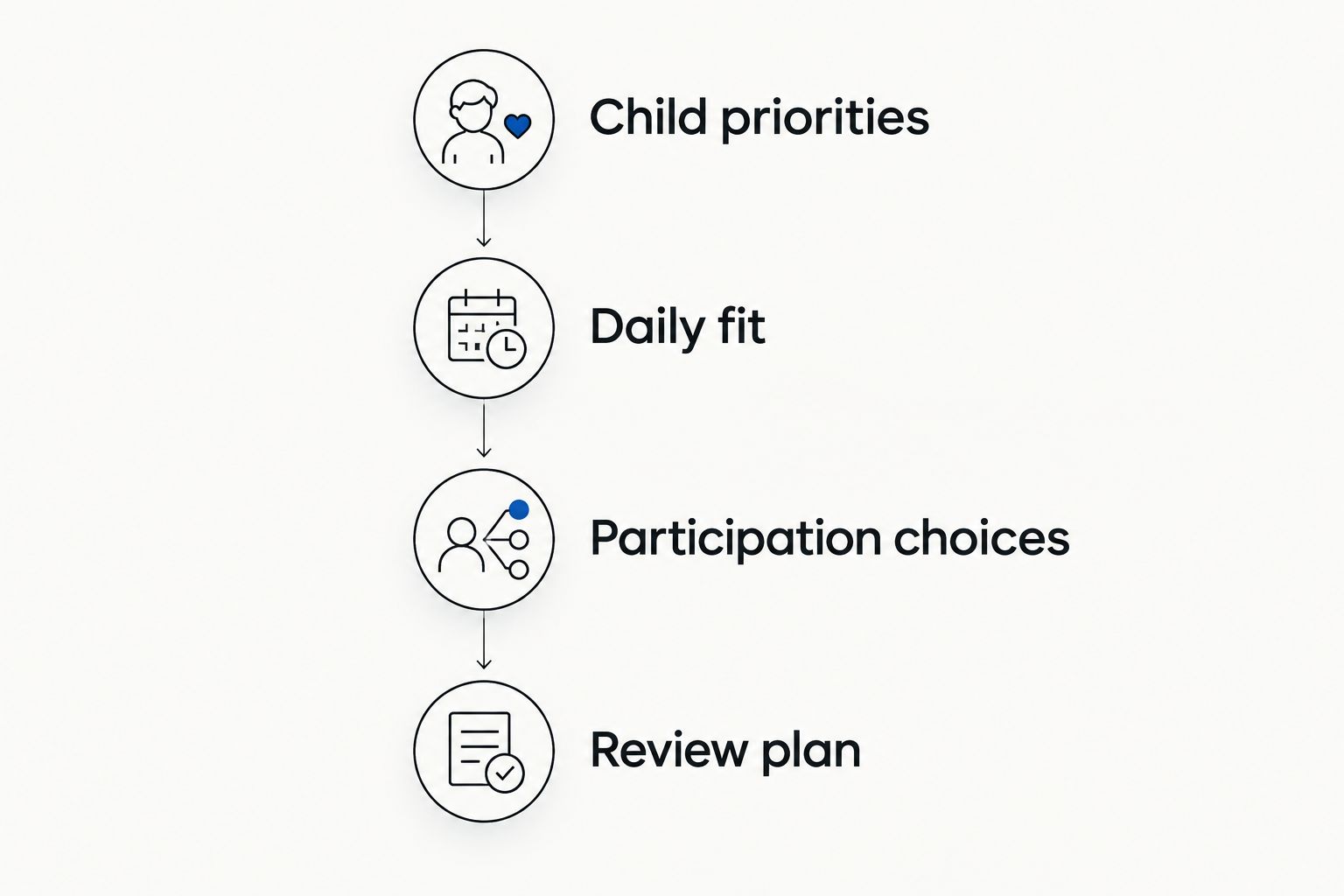
Bring these notes to both conversations. Specific answers help you distinguish a plan that fits your child from a general description that could apply to anyone.
Pricing: compare the proposed billing arrangements
Ask each provider for a written explanation of how the services you are considering are billed and funded. Do not assume nonprofit status establishes a payment arrangement, or that different providers use the same model.
Clarify whether the arrangement is tied to individual visits, a class, or another defined service. Ask what is included, what requires separate authorization, and which payment responsibilities belong to your family.
The practical tradeoff is predictability versus flexibility. You need to understand what you are committing to and what happens if the proposed plan changes. Do not name a pricing winner until you have comparable written information for the same type of support.
Keep financial questions separate from fit questions, then review them together. An arrangement must make sense for your household as well as for your child’s needs.
Final verdict: choose the plan, not the longer service list
Choose Autism Learn & Play if you want a broad Brooklyn starting point
Best for: Brooklyn parents exploring therapy, community participation, and learning options for an autistic child ages 2–18. The nonprofit’s stated offering matches that broad search.
Your next step is to narrow the conversation to your child. Explain whether your priority is communication support, tutoring, a community experience, or another specific need. Ask what participation would look like rather than assuming the full service list forms one package.
Choose Golden Care Therapy if its confirmed plan fits better
Best for: parents who receive a clearer match between their child’s priorities and Golden Care Therapy’s proposed support. Choose it when the actual plan—not an assumed service or reputation—better meets your requirements.
Ask the same questions about communication, age fit, participation, practical arrangements, and billing. If its answers give your family a better fit, that is the reason to choose it.
| Dimension | Decision |
|---|---|
| Broad service search | Brooklyn nonprofit: stated therapy, community, and class offering |
| Community connection | Brooklyn nonprofit is relevant; confirm the actual activity format |
| Daily routine | Golden Care Therapy if its confirmed arrangements fit better |
| Age-appropriate support | No automatic winner; assess the proposed experience |
| Online participation | Brooklyn nonprofit offers online classes; compare purpose and format |
| Child-specific fit | No automatic winner; use the same questions |
| Billing arrangements | Compare written terms for equivalent support |
FAQ
Is Autism Learn & Play better than Golden Care Therapy?
Autism Learn & Play suits a broad search for therapy services, community programs, and online classes in Brooklyn for children ages 2–18. Choose Golden Care Therapy instead when its confirmed plan better matches your child’s needs and your family’s routine.
Which provider should I choose if my child wants to make friends?
Choose a program that can explain how your child will participate with peers. Ask about shared interests, communication support, breaks, and whether observing before joining is an option.
Does a longer list of therapies mean better support?
No. A longer list gives you more services to discuss, but the proposed support still needs to match your child’s priorities and preferences.
What should I ask Golden Care Therapy before deciding?
Ask Golden Care Therapy to describe the exact service, setting, goals, and family involvement proposed for your child. Also request an explanation of participation choices, communication support, and billing arrangements.
How do I compare programs for an autistic teenager?
Compare age-respectful activities, shared interests, and the teenager’s role in choosing goals. Ask how the program supports communication preferences and avoids treating all age groups alike.
How do I compare what each provider charges?
Request written billing and funding information for the specific services under consideration. Compare what is included and your family’s responsibilities rather than assuming the arrangements are equivalent.
What should I prepare before contacting a provider in 2026?
Prepare your child’s interests, communication preferences, support priorities, and practical family requirements. Ask the provider to explain a typical experience using those details.
One last thing
Ask one final question: What happens when my child does not want to join the activity? The answer gives you something concrete to compare: how the provider describes choice, communication, breaks, and trying another approach.
For a 2026 inquiry to the Brooklyn nonprofit, use the website contact form or email info@autismlearnplay.org. Share what your child enjoys as well as where support is needed; both belong in the conversation.
Related guides
- Family support groups for autism in Brooklyn
- Autism-friendly museums and attractions in NYC
- Art therapy activities for autistic kids