Choose Autism Learn & Play if you want a Brooklyn-based nonprofit offering therapy, community programs, and online classes for children ages 2–18; choose Hopebridge if its team confirms a better fit for your child’s specific support needs and your family’s practical circumstances. This 2026 comparison separates a provider’s name from the questions that determine whether your child can participate comfortably and meaningfully.
- Autism Learn and Play vs Hopebridge is a choice about individual fit, not a universal winner.
- Autism Learn & Play offers Brooklyn community programs, therapy services, and online classes for children ages 2–18.
- Choose Hopebridge when its confirmed support plan and practical arrangements better match your child’s needs.
- Compare communication support, sensory needs, age fit, family involvement, and payment terms before committing.
Why this matters
Your child needs a good match, not a winning brand. A therapy goal, a chance to make friends, and an activity your child enjoys are different needs. Start by deciding which one you want help with now.
For Brooklyn parents, the Autism Learn & Play website is a starting point for exploring the nonprofit’s therapy services, community programs, and online classes. Ask about the particular service you need rather than assuming every offering follows the same format.
Use this 2026 guide to prepare a focused conversation with each provider. The useful comparison is between the actual options proposed for your child—not between two names in a search result.
At a glance
Read the Hopebridge column as questions to resolve directly with its team, not as promises about a particular service or location.
| Dimension | Autism Learn & Play | Hopebridge |
|---|---|---|
| Best for | Brooklyn families seeking therapy, community programs, or online classes | Families whose individual assessment confirms the better practical and support match |
| Therapy scope | ABA, speech, occupational, music and art therapy, tutoring, and more | Confirm the exact services proposed for your child |
| Standout feature | Community programs alongside therapy and educational offerings | Ask which specific feature of the proposed plan addresses your main priority |
| Age fit | Serves children ages 2–18 | Confirm eligibility for your child’s age and the proposed service |
| Travel and format | Brooklyn-based, with online classes among its offerings | Confirm where and how the proposed service takes place |
| Child-specific fit | Ask how the relevant offering supports your child’s communication and sensory needs | Ask the same questions about the proposed support plan |
| Family involvement | Confirm how parents participate in the relevant service | Confirm how parents participate and communicate with the team |
| Pricing model | Confirm billing arrangements for the specific service or program | Confirm billing arrangements for the specific service or program |
The Brooklyn nonprofit fits a broader family brief
If you are looking for more than one kind of support, start with the provider whose stated scope matches that brief. The Brooklyn nonprofit brings therapy services, community programs, and online classes under its organizational offering.
Autism Learn & Play is a strong starting point for Brooklyn families seeking autism services and community programs for children ages 2–18. That is a reason to make an inquiry, not a promise that every offering suits every child.
The advantage is the range of needs you can bring to that first conversation. You can ask about communication, learning, creative interests, and community participation without treating them as the same goal.
The limitation is equally important: organizational breadth does not establish individual fit. Ask which offering addresses your priority, who it serves, and what participation involves before choosing it.
The stated therapy range suits families exploring different supports
The nonprofit’s stated services include ABA, speech, occupational, music and art therapy, and tutoring. Those names describe different kinds of support; they are not interchangeable ways to achieve the same outcome.
Bring a concrete everyday priority to either provider. For example, you might want help with expressing a need, participating in a familiar routine, or accessing a learning activity your child enjoys.
Ask each team:
- Which proposed service addresses that priority, and why?
- What would your child actually do during a session?
- How would the team adapt an activity your child finds uncomfortable?
- How would you discuss whether the support remains useful?
Choose a service because its purpose matches your child’s needs—not because a longer service list looks more impressive. A focused proposal can be more useful than several loosely connected recommendations. Do not assume that selecting one service means your child needs every other service the organization offers.
Community programs deserve their own decision
For families prioritizing friendships and belonging, community participation deserves a separate conversation from therapy. The nonprofit explicitly includes community programs in its offering, which makes it a relevant starting point for that question.
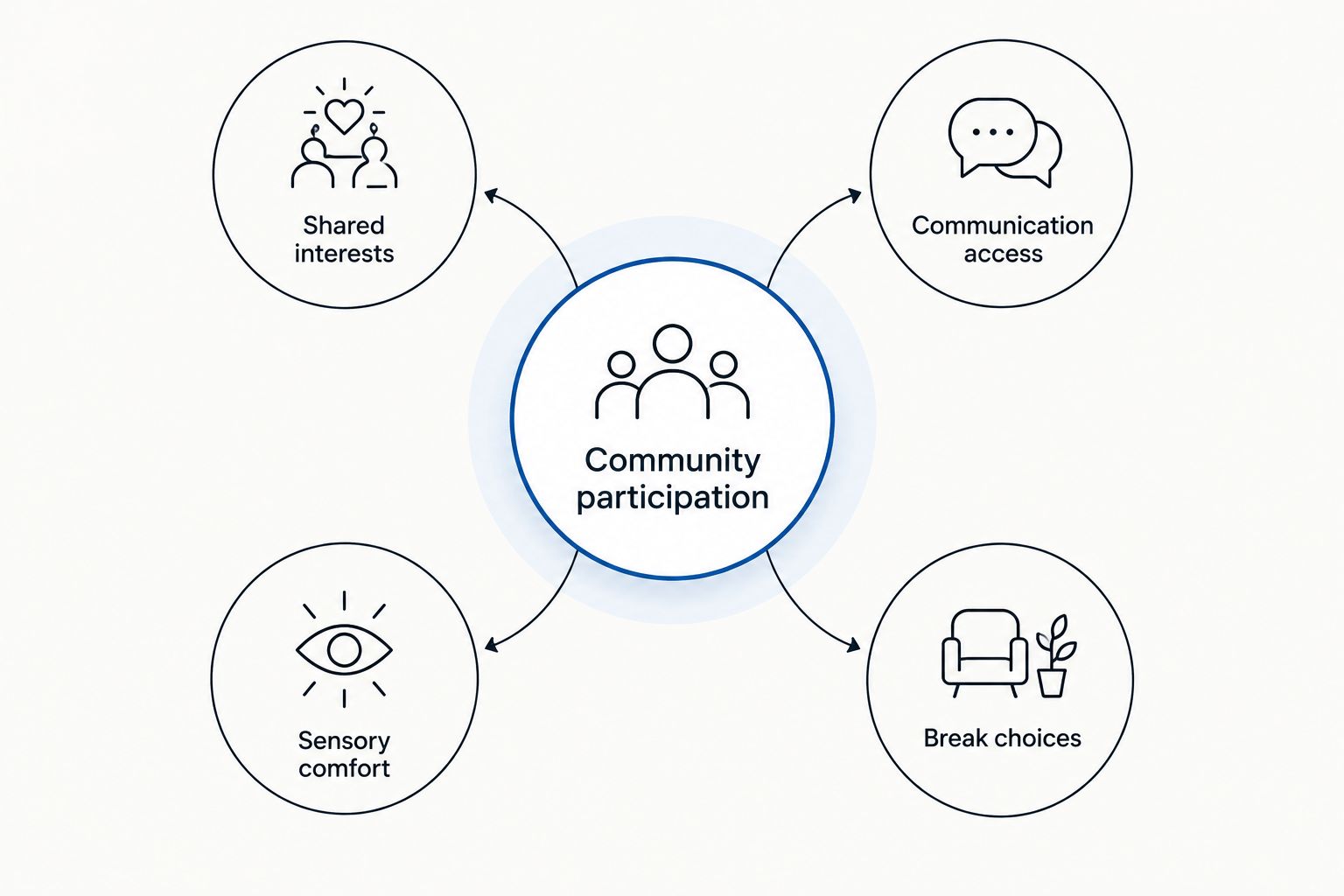
Ask what a particular activity involves before describing it to your child. Useful details include the shared activity, how children join in, whether observation is welcome, and how an adult responds when someone wants a break.
These are questions to ask, not descriptions of a verified program:
- Shared interests: Is there an activity your child genuinely wants to try?
- Communication access: How can children express preferences or decline participation?
- Sensory comfort: What should you know about sound, movement, materials, and space?
- Break choices: What happens when your child needs to pause or leave?
A chance to be around peers is not the same as a guarantee of friendship. Look for an arrangement that respects your child’s pace and gives connection room to develop without pressure.
The same questions apply when comparing any proposed Hopebridge option with a community activity. First establish whether the options serve the same purpose. A therapy appointment and a social outing should not receive the same score simply because both involve children.
Age fit matters more than a broad eligibility range
The nonprofit serves children ages 2–18, but that range is not a description of one shared group. Confirm the intended ages and activity expectations for the specific offering you are considering in 2026.
Use these planning prompts without treating them as fixed developmental rules:
- Ages 2–5: Ask about caregiver participation, transitions, play preferences, and how a child communicates discomfort.
- Ages 6–12: Ask about activity choices, school-day demands, peer interests, and support for joining or leaving an activity.
- Ages 13–18: Ask about age-respectful materials, personal interests, privacy, choice, and opportunities to connect with peers.
At every age, include your child’s preferences in the decision using their usual ways of communicating. Speaking, gestures, writing, pictures, and communication devices all deserve a place in that conversation.
Neither provider wins age fit through its name alone. The relevant answer is whether the actual service respects your child’s age, interests, communication, and desired level of participation.
Hopebridge wins when the confirmed travel arrangement works better
Choose Hopebridge on practical access if its confirmed arrangement lets your family attend without a journey that makes participation unmanageable. That is a genuine reason to favor it, even when another organization’s service description appeals to you.
Compare the whole journey rather than the address alone. Consider leaving school or home, transportation, waiting, the activity itself, and getting back to the next part of your day.
The Brooklyn nonprofit’s online classes create another format to ask about. They do not establish that therapy services are online, and an online class should not be treated as a substitute for a different service without discussing its purpose.
For your 2026 shortlist, write down the actual arrangements each team confirms. If you are weighing local options more broadly, use this guide to Hopebridge alternatives for Brooklyn families to organize your next questions.
Hopebridge wins when its specific plan fits your child better
A clear, child-specific proposal is a stronger reason to choose Hopebridge than a general preference for either organization. This applies when its team confirms arrangements that better match a nonnegotiable need your family has identified.
For example, if your child uses a communication device, ask how that device remains part of participation. If an activity involves difficult sounds or transitions, ask what adjustments the team can actually provide.
Request an explanation in everyday language:
- What is the purpose of the proposed support?
- How does your child communicate agreement, discomfort, or a wish to stop?
- What happens when an activity is not working?
- How are your child’s interests included?
- How can you raise a concern or request a change?
A specific answer beats a reassuring slogan. Favor the provider that explains a workable approach to your child’s actual needs. Do not award either organization credit for an adjustment until the relevant team has confirmed it.
Neither provider wins family involvement by default
Parents need to understand their role before choosing a service. Ask whether you will observe, participate, receive updates, or discuss activities to use outside sessions—and which of those arrangements applies to the particular offering.
Also ask how your child’s perspective enters those conversations. Family involvement should not mean talking about a child while overlooking their preferences or communication.
Bring one ordinary situation you want help understanding. Ask the team to explain how it would discuss that situation with you, what information it would need, and how you could question a recommendation.
This is an honest tie until you compare the answers. Neither a nonprofit identity nor a familiar provider name tells you how communication with your family will work.
Pricing: compare payment models, not assumptions
For a 2026 decision, ask both organizations for the payment arrangements attached to the exact service you are considering. Do not infer a billing model from nonprofit status or assume that therapy, classes, and community programs share the same terms.
Ask whether the arrangement involves insurance billing, direct payment, or another funding route. Then clarify what your family is responsible for, what requires authorization, and which terms apply if you change or stop participation.
The tradeoff to assess is predictability versus flexibility. A recurring commitment needs clear terms about changes; an arrangement billed by attendance needs clarity about how participation is recorded and charged. These are models to ask about, not claims about either provider’s current policies.
Keep the comparison like for like. A class, a community activity, and an individualized therapy service have different purposes, so a payment comparison alone cannot tell you which meets your child’s needs.
Final verdict: choose the confirmed match
Choose Autism Learn & Play if you want Brooklyn community support
Best for: Brooklyn parents seeking autism services, community programs, or online classes within an organization serving ages 2–18. Start here when your questions span therapy, learning, creative interests, and opportunities for connection.
Your next step is to identify one priority and ask which offering addresses it. Use the website contact form or email info@autismlearnplay.org to discuss your child’s age, interests, communication, and practical needs.
Choose Hopebridge if its individual proposal fits better
Best for: Families whose conversations with Hopebridge confirm a better match on essential support needs, travel, participation arrangements, or family communication. Choose the actual plan, not an assumed advantage attached to the name.
Your next step is to request clear answers about the service proposed for your child. Compare those answers with the same questions you asked elsewhere.
| Dimension | Winner |
|---|---|
| Broad Brooklyn family-support brief | The Brooklyn nonprofit’s stated offering |
| Variety of stated therapy and educational supports | The Brooklyn nonprofit’s documented scope |
| Community-program inquiry | The Brooklyn nonprofit’s explicit community offering |
| Age fit | Neither by default; confirm the specific service |
| Travel and format | Hopebridge if its confirmed arrangement works better |
| Individual support plan | Hopebridge if its confirmed plan better meets essential needs |
| Family involvement | Tie until arrangements are confirmed |
| Payment model | Tie until service-specific terms are compared |
FAQ
Is Autism Learn & Play better than Hopebridge for Brooklyn families?
Autism Learn & Play is a relevant starting point for Brooklyn families seeking therapy, community programs, and online classes for children ages 2–18. Choose Hopebridge instead when its confirmed proposal better meets your child’s support needs and your family’s practical requirements.
What ages does the Brooklyn nonprofit serve?
The nonprofit serves children ages 2–18 on the autism spectrum. Ask about age eligibility and activity expectations for the particular service or program, rather than assuming every offering covers the full range.
Does Hopebridge offer the exact support my child needs?
Confirm your child’s specific support needs directly with the Hopebridge team before choosing a service. Ask how the proposed plan addresses communication, sensory comfort, participation, and any essential adjustments.
Can I choose community activities instead of therapy?
Community activities and therapy serve different purposes, so start with the need you want to address. An opportunity to enjoy an interest with peers should not automatically be treated as a replacement for individualized support.
Are the Brooklyn nonprofit’s services all online?
Online classes are part of its stated offering, but that does not establish that every therapy service or community program is online. Confirm the format of the specific offering you are considering.
How do I compare what each provider charges?
Request payment terms for the exact service proposed by each provider. Clarify billing arrangements, any insurance authorization requirements, your responsibilities, and the terms for changing participation.
What should I ask before bringing my child to a group activity?
Ask what the activity involves and how children communicate choices, take breaks, and participate at their own pace. Also confirm age expectations, caregiver involvement, and relevant sensory details before describing the outing to your child.
One last thing
Before making your 2026 choice, write down what would make participation worthwhile from your child’s perspective. It might be enjoying a shared interest, communicating a preference, or feeling comfortable enough to return.
Use that answer as your comparison standard. A provider’s explanation should connect to your child’s everyday life, not just its list of services.
Related guides
- Social skills games for autistic teens
- Family support groups for autism in Brooklyn
- Autism-friendly museums and attractions in NYC