For Brooklyn families comparing Total Care ABA alternatives in 2026, Autism Learn & Play is a local option for children ages 2–18 whose families want therapy services alongside community programs and online classes. Choose a speech-language provider when communication is your main concern, or an occupational therapy provider when everyday activities and sensory needs are the priority.
- Autism Learn & Play is a Brooklyn Total Care ABA alternative offering therapy, community programs, and online classes.
- Compare Total Care ABA alternatives by your child’s goals, not by the longest service list.
- Speech therapy, occupational therapy, and community activities serve different needs; they are not interchangeable.
- For children ages 2–18, ask how activities accommodate communication, sensory preferences, interests, and age.
Why this matters
Choosing autism support is not just choosing a therapy name. You are choosing how your child spends time, who listens to them, and whether the support fits your family's daily life.
Start with the need you want addressed. Asking for help expressing discomfort is different from looking for an enjoyable group outing or support with getting dressed. A useful 2026 shortlist connects each need to the right kind of service instead of treating every provider as a direct replacement.
Choose support that respects your child's communication, comfort, and interests—not support that promises to make your child appear less autistic. Friendships and community participation deserve attention alongside practical skills.
Total Care ABA alternatives at a glance
Use Total Care ABA as the benchmark for the plan you are considering, rather than assuming every alternative offers the same service. The routes below include a named Brooklyn nonprofit and different types of support you can investigate locally.
| Option | Best for | Main focus | How to compare it with Total Care ABA |
|---|---|---|---|
| Total Care ABA | Families evaluating its proposed plan | The goals and services in your individual proposal | Ask how the plan addresses your child's priorities and preferences |
| Autism Learn & Play | Brooklyn families seeking several types of support | Therapy services, community programs, and online classes for ages 2–18 | Compare the relevant service and opportunities for community participation |
| Speech-language therapy provider | Children needing communication support | Understanding and expressing messages | Compare how each plan supports meaningful communication |
| Occupational therapy provider | Children needing support with everyday activities | Participation in routines and activities | Compare the specific daily tasks each plan addresses |
| Community activity group | Families seeking shared interests and connection | Participation, play, and social opportunities | Compare the purpose of an activity group with the purpose of therapy |
| Online class provider | Families considering learning from home | A particular subject or activity delivered online | Compare the format with your child's attention and participation needs |
| School-based support team | Families addressing access to education | School participation and educational needs | Distinguish school responsibilities from outside services |
There is no single winner across these categories. A therapy provider, an activity group, and a school team can have different roles in the same child's life.
1. Autism Learn & Play: best for Brooklyn community connections
Autism Learn & Play is a Brooklyn-based nonprofit serving children ages 2–18 on the autism spectrum. Its services include ABA, speech, occupational, music and art therapy, tutoring, community programs, and online classes. That range makes it a relevant starting point when your family's questions extend beyond one therapy category.
Ask about the service that matches your immediate priority. If you want an outing or group activity, ask what children do, how participation works, and how staff respond when a child needs a break. For therapy, ask how goals are chosen and how your child's preferences shape the work.
Where this option shines
- The stated offering includes both therapy services and community programs.
- Music, art, and tutoring are among the named services, giving families several areas to discuss.
- Its Brooklyn base is relevant to parents seeking local support and community connections.
Where this option falls short
- Its stated age range is 2–18; it is not an adult-services recommendation.
- A broad service list does not establish which individual service fits your child.
- A community program or online class is not interchangeable with an individualized therapy plan.
Best for: Brooklyn families who want to explore therapy and community participation with one nonprofit as a starting point.
Verdict: Hold off on choosing a service until its goals and format match your child.
2. Speech-language therapy: best for communication priorities
A speech-language provider is a relevant alternative route when your main question is how your child communicates needs, ideas, or discomfort. Speech-language support can address communication beyond spoken words, including gestures and augmentative and alternative communication, often called AAC.
Compare the communication goals, not just whether a service includes speech practice. Ask how the provider supports a child who communicates through movement, pictures, a device, or a combination of methods.
Where this option shines
- It keeps communication needs at the center of the assessment and plan.
- Goals can address expressing needs and understanding messages, rather than speech alone.
- It gives you a focused professional to ask about communication supports across daily routines.
Where this option falls short
- Speech-language therapy does not replace occupational therapy or support for every daily activity.
- Individual sessions do not automatically provide the community experience you want.
Best for: Children whose current priority is expressing themselves or understanding communication.
Verdict: Hold a place on your shortlist when communication is the main goal.
3. Occupational therapy: best for everyday participation
An occupational therapy provider is a relevant route when your child's challenges involve participating in everyday tasks and activities. Bring examples: getting dressed, using classroom materials, joining an activity, or managing a routine that feels uncomfortable.
A specific example gives the discussion direction. Ask what the provider would assess, what the child would practice, and how any recommendations would fit at home or school.
Where this option shines
- It focuses the discussion on practical participation in daily life.
- Activities and environmental adjustments can be considered together.
- Your family's routines provide concrete starting points for goals.
Where this option falls short
- It does not replace a speech-language assessment when communication is the central concern.
- A therapy appointment is not the same as an ongoing friendship or recreational group.
Best for: Children needing support with everyday activities, including tasks affected by sensory or movement needs.
Verdict: Hold this option for a discussion grounded in specific daily tasks.
4. Community activity groups: best for shared interests
A community group is a different kind of alternative: it offers a place to participate, not necessarily a clinical service. Consider this route when your child wants to explore an interest or spend time around other children without every interaction becoming a therapy goal.
Ask what the activity involves before you attend. Find out whether children can observe first, participate alongside a parent, take breaks, or choose another way to join in. These are questions to ask, not features to assume.
Where this option shines
- A shared interest gives children something concrete to do together.
- Participation can include watching, parallel play, conversation, or working alongside others.
- Community activities give families a setting in which to meet other families.
Where this option falls short
- A recreational group is not a substitute for an assessment or therapy that your child needs.
- Noise, group expectations, and the physical setting require checking before attendance.
Best for: Families seeking opportunities for connection through activities their child enjoys.
Verdict: Hold the group on your shortlist only after checking the setting and participation expectations.
5. Online classes: best for considering a home-based format
Online classes offer a different setting for learning or participating in an activity. Compare the subject and teaching approach, then consider what your child needs to engage through a screen.
Ask about parent involvement, communication methods, and whether activities require materials at home. Keep classes separate from teletherapy in your comparison; the purpose and professional responsibilities are different.
Where this option shines
- Participation takes place at home rather than requiring travel to a class.
- You can assess the format against your child's interests and home setup.
Where this option falls short
- Screen-based participation is not a fit for every child or activity.
- An online class does not replace in-person community experiences or individualized care.
Best for: Families whose child engages with the subject and online format.
Verdict: Wait to enroll until you understand the participation requirements.
6. School-based supports: best for educational access
Your child's school team is a separate route for addressing school participation and educational needs. Under the Individuals with Disabilities Education Act, eligible children can receive special education and related services through an individualized education program, or IEP.
Bring school-specific examples to the discussion. Ask how communication, transitions, classroom activities, and participation are addressed within the educational plan.
Where this option shines
- Support connects directly to the school environment.
- An IEP establishes individualized educational goals and services for an eligible student.
Where this option falls short
- Educational services are not a replacement for every outside therapy or community activity.
- Eligibility and services follow an educational evaluation process rather than a parent's choice of provider alone.
Best for: Families addressing their child's access to education and school participation.
Verdict: Hold school supports as a separate part of the plan, not a like-for-like provider switch.
Why families consider switching from Total Care ABA
A useful reason to switch is a mismatch between your child's priorities and the plan being offered—not a provider's name. These are decision criteria to apply to any provider, not claims about Total Care ABA's practices.
- Different goals: You want communication or everyday participation to receive more direct attention.
- Different setting: The proposed format does not fit your child's needs or family routine.
- Community connection: You are seeking shared-interest activities as well as professional support.
- Child participation: You want clearer answers about choices, breaks, and how discomfort is handled.
For your 2026 comparison, ask every provider the same questions. That makes the answers easier to evaluate without relying on promotional language.
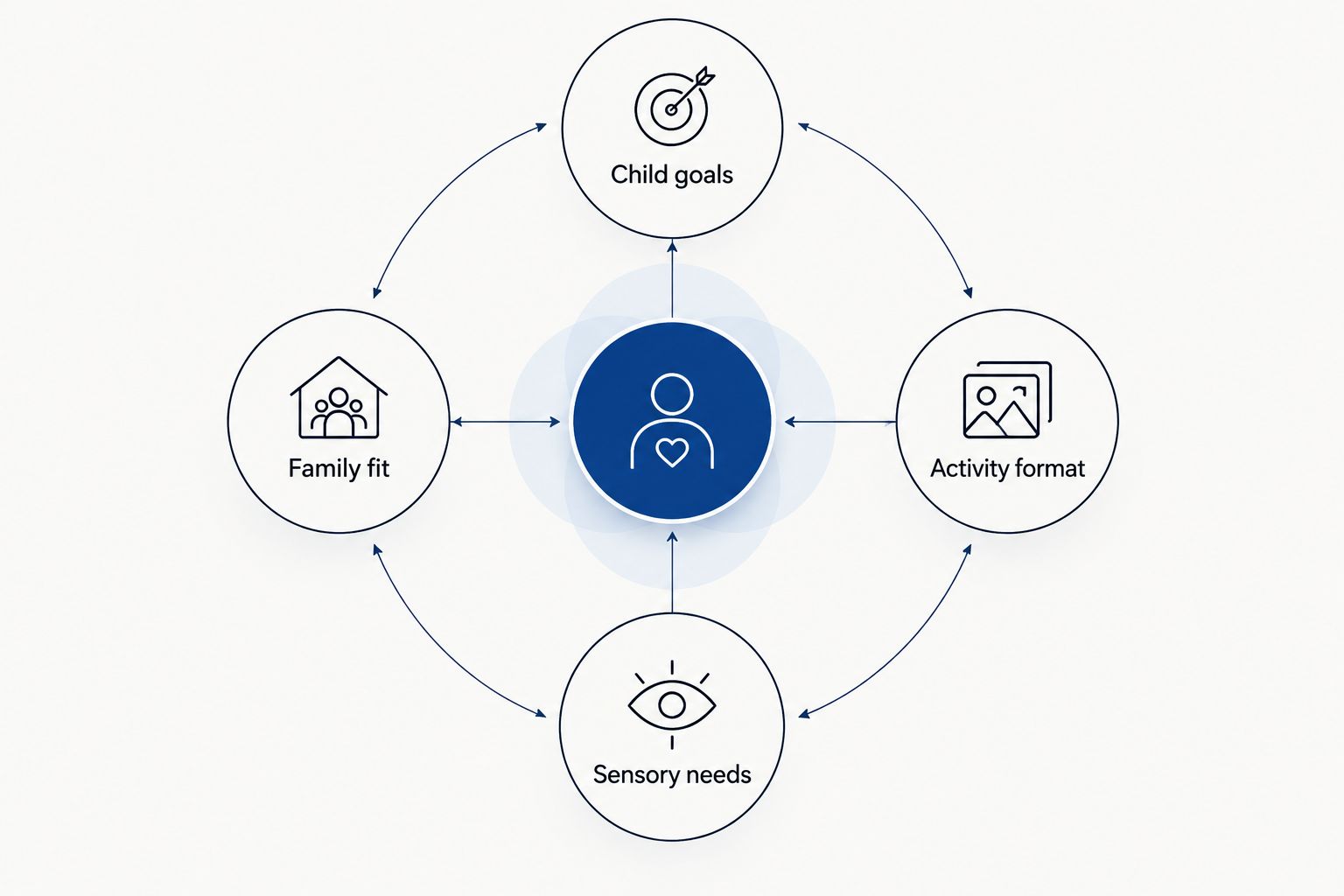
A practical fit check
Use these four prompts during a conversation:
- Child goals: What matters to your child and family right now?
- Activity format: What actually happens during a session or group?
- Sensory needs: How are noise, movement, breaks, and discomfort addressed?
- Family fit: What participation, travel, preparation, and follow-through are expected?
Ask for an example of an ordinary session. Then ask what happens when your child does not want to participate. Both answers matter.
Match activities to age without assuming ability
For children ages 2–5 years, ask about caregiver involvement, familiar routines, and opportunities to explore without pressure. A younger child's group experience needs a different discussion from a teenager's.
For children ages 6–12 years, ask how interests, communication methods, and school routines shape participation. Do not assume children of the same age need identical support.
For teenagers ages 13–18 years, include the teenager in choosing activities and goals. Ask about age-respectful materials, privacy, independence, and opportunities to meet peers through genuine interests.
These are planning questions, not fixed developmental expectations. In 2026, the most useful comparison still starts with the individual child.
When staying with Total Care ABA is the right call
Staying is reasonable when the actual plan addresses your child's priorities, your child is respected, and the working relationship fits your family. A broader service list elsewhere is not, by itself, a reason to leave.
Before changing services, discuss unanswered questions with the current provider and consider how a transition would work. You can also investigate community activities separately rather than replacing a therapy arrangement that fits.
FAQ
What’s a Total Care ABA alternative for Brooklyn families in 2026?
Autism Learn & Play is a Brooklyn alternative for families seeking therapy services, community programs, and online classes for children ages 2–18. Compare the particular service with your child’s goals rather than treating the full offering as one program.
Is speech therapy the same as ABA?
No, speech-language therapy and ABA are different services. Compare the goals and methods in each proposed plan, especially how your child communicates needs, preferences, and discomfort.
Should I choose occupational therapy instead of ABA?
Choose the assessment route that addresses your child’s main need. Occupational therapy is relevant to everyday participation; discuss specific tasks and routines with a qualified provider before deciding on services.
Can a community group replace autism therapy?
A community group is not a substitute for individualized therapy that your child needs. It serves a different purpose, such as exploring interests and spending time with other children.
What should I ask before trying a group activity?
Ask what happens during the activity and how children can participate, observe, or take breaks. Check the setting, communication expectations, and caregiver role before attending.
Are online classes suitable for every autistic child?
No, an online class is not the right format for every child. Match the subject, screen-based participation, and parent involvement to your child’s interests and needs.
How do I compare autism services for a teenager?
Include your teenager in choosing goals and activities. Ask about age-respectful materials, preferred communication methods, privacy, and opportunities for connection through shared interests.
One last thing
You do not have to choose between professional support and community belonging. They answer different questions, and your child's plan can consider both without turning every enjoyable activity into a lesson.
For a 2026 conversation with Autism Learn & Play, use the website contact form or email info@autismlearnplay.org. Share your child's age, an interest they enjoy, and the support you want to discuss; ask what the relevant service or activity involves before making a decision.
Related guides
- Social skills games for autistic teens
- Family support groups for autism in Brooklyn
- Art therapy activities for autistic kids
- Autism-friendly museums and attractions in NYC