Best overall: block-building challenges. Best for shared discovery: ramp experiments. Best for minimal materials: shadow tracing. These STEM activities for kids with autism give you flexible ways to explore science, technology, engineering, and math in 2026; Autism Learn & Play provides Brooklyn-based community programs, therapy services, and online classes for children ages 2–18.
- Block-building challenges are the best starting point for STEM activities for kids with autism: children choose what to build.
- Ramp experiments support shared discovery without requiring conversation, eye contact, or competitive play.
- Choose sensory-friendly learning activities around your child’s interests, communication preferences, and safety needs.
- Autism Learn & Play serves Brooklyn families seeking community programs and educational support for autistic children ages 2–18.
Why this matters
A STEM activity does not need to look like a classroom lesson. Building a bridge, comparing rolling objects, or finding patterns gives your child something concrete to investigate. You can join that investigation without turning every moment into a question or instruction.
For Brooklyn families planning an outing or group activity in 2026, the key question is not whether an event sounds educational. It is whether your child can participate comfortably, communicate choices, and take a break. Start with an interest, not a skill your child must demonstrate.
These are adaptable activity ideas, not descriptions of scheduled programs or promises of therapeutic results.
What makes the best STEM activities for kids with autism?
Use these criteria before choosing an activity or asking a community organizer about a session:
- Child-led interest: Your child has a reason to explore, whether that is vehicles, buildings, plants, or patterns.
- Sensory choice: You can adjust noise, lighting, textures, and movement rather than requiring children to tolerate them.
- Flexible communication: Speaking, pointing, gestures, pictures, and communication devices all count as participation.
- Adjustable challenge: The same materials allow simple exploration or a more demanding investigation.
- Shared participation: Children can work alongside each other without compulsory sharing, conversation, or competition.
- Practical safety: Materials suit each child's needs, with supervision and an accessible stopping point.
STEM activities at a glance
The order below favors activities that are easy to adapt, not activities that every autistic child will enjoy equally.
| Activity | Best for | Standout feature | Key limitation |
|---|---|---|---|
| Block-building challenges | Open-ended engineering | Children choose the structure and challenge | Falling blocks and small pieces need planning |
| Ramp experiments | Shared discovery | One visible change affects how objects move | Rolling objects require a contained space |
| Pattern-making | Predictable math play | Repetition with an optional next step | A fixed sequence can become an unwanted test |
| Shadow tracing | Minimal-material science | Connects light, position, and shape | Outdoor versions depend on sunlight |
| Seed observation | Slow, ongoing investigation | Changes can be recorded over time | Results are not immediate or guaranteed |
| Unplugged coding | Screen-free sequencing | Instructions become visible actions | Too many steps create unnecessary demands |
| Digital animation | Teen-led creative technology | Combines storytelling and ordered actions | Devices and controls need individual assessment |
1. Block-building challenges: best for open-ended engineering
Offer age-appropriate blocks and let your child choose a project: a tower, tunnel, bridge, or imaginary building. Explore what happens when the base changes or a different piece supports the structure. Repeating a favorite design is also valid exploration.
For children ages 2–5, choose large pieces appropriate to their safety needs. Older children can sketch a design or compare structures, but these are invitations rather than age-based requirements. The fine motor skill activities for autism guide offers related ideas for hands-on play.
Block-building pros:
- Children control the design and pace.
- The challenge changes without replacing the materials.
- Side-by-side building allows participation without conversation.
Block-building cons:
- Collapsing structures can be loud or frustrating.
- Small pieces are unsuitable for children who mouth objects.
Best for: Children who enjoy arranging, stacking, or constructing.
Verdict: Try block-building first when your child already shows interest in construction. Keep a completed structure intact if taking it apart would end an otherwise enjoyable session.
2. Ramp experiments: best for shared discovery
Make a stable slope with a board or sturdy cardboard, then release an age-appropriate rolling object. Change the slope and observe what happens. Keep the object and starting point consistent when you want to compare the effect of that change.
A shared investigation does not require taking turns on demand. Children can use separate ramps, watch each other, or choose roles such as releasing, retrieving, or recording. For a 2026 community outing, ask whether the setup contains rolling objects and leaves room for children to observe without joining immediately.
Ramp experiment pros:
- Movement makes the experiment easy to see.
- Separate roles offer different ways to participate.
- Children can repeat a familiar action and change it gradually.
Ramp experiment cons:
- Objects escaping across a room create disruption.
- Collisions and repeated retrieval can become noisy or tiring.
Best for: Children interested in vehicles, motion, or cause and effect.
Verdict: Choose ramp experiments for shared discovery, with a clear stopping area and space away from busy walkways.
3. Pattern-making: best for predictable math play
Arrange large objects, drawings, or shapes into a repeating sequence. Your child can copy it, extend it, invent another pattern, or simply sort the materials. Explain what you notice without making every arrangement a right-or-wrong answer.
For children ages 6–11 who enjoy greater complexity, offer a pattern with a missing part or invite them to create one for you. A child of any age can prefer simpler repetition. Follow that preference rather than increasing difficulty automatically.
Pattern-making pros:
- Repetition gives the activity a clear structure.
- Materials can match a favorite interest.
- Children can participate by looking, pointing, moving, or drawing.
Pattern-making cons:
- Adult corrections can turn exploration into a test.
- Too many colors or objects can clutter the workspace.
Best for: Children who enjoy sorting, sequences, and predictable arrangements.
Verdict: Choose pattern-making when repetition is enjoyable. Skip the missing-piece challenge if your child prefers making a complete pattern independently.
4. Shadow tracing: best for minimal-material science
Place a safe object where sunlight casts its shadow onto paper, then trace the outline. Compare the object with its shadow or revisit the setup later. Outdoors, changing sunlight can change the shadow's position and shape.
An indoor version uses a stable light source and an object on a table. Keep bright light out of eyes, avoid hot lamps, and never ask a child to look directly at the sun. Watching or directing you to trace is participation too.
Shadow-tracing pros:
- The materials can be simple and familiar.
- Children explore relationships between light and shape.
- Drawing is optional if your child prefers observing.
Shadow-tracing cons:
- Outdoor results depend on sunlight and weather.
- Changing shadows can frustrate a child expecting an exact copy.
Best for: Children who enjoy silhouettes, drawing, or visual comparisons.
Verdict: Choose shadow tracing for a simple science invitation, not a timed task or a drawing accuracy test.
5. Seed observation: best for ongoing investigation
Plant suitable seeds according to their instructions and invite your child to observe the container over time. Record what you see through drawings, photographs, spoken notes, or a communication device. An observation that nothing has changed is still useful.
Offer a tool instead of requiring direct contact with soil. Check plant safety, allergies, and mouthing risks before choosing materials. For a shared project, individual containers avoid requiring children to agree on every decision.
Seed observation pros:
- The project can continue beyond one session.
- Recording methods can match communication preferences.
- Individual containers allow shared activity with personal ownership.
Seed observation cons:
- Visible changes are not immediate.
- Seeds do not always germinate, even with care.
Best for: Children interested in plants, routines, or noticing gradual change.
Verdict: Choose seed observation for patient investigation. Pair it with another activity if your child wants something visible to happen right away.
6. Unplugged coding: best for screen-free sequencing
Use picture cards to show a short sequence of actions, such as choosing a block, placing it, and stopping. Your child can arrange the instructions for you to follow. Coding concepts begin with clear instructions and noticing when a sequence needs changing; no screen is required.
Keep movement optional. A toy can follow the sequence instead of your child, and a seated activity works just as well. Make the stopping instruction visible and honor it.
Unplugged coding pros:
- Instructions can be pictures rather than spoken language.
- Children can direct the adult's actions.
- The activity connects sequencing with a visible result.
Unplugged coding cons:
- Long sequences create avoidable memory demands.
- Movement-based versions need space and accessible alternatives.
Best for: Children who enjoy giving directions, routines, or ordered actions.
Verdict: Choose unplugged coding for screen-free technology concepts. Simplify the instructions before adding more steps.
7. Digital animation: best for teen-led creative technology
Invite your child to make a short animation using a suitable creation tool. They can choose a character, arrange actions, and see how their sequence changes the result. Base the project on their interests rather than assigning a childish theme.
For young people ages 12–18, offer age-respectful choices while adapting reading, input, and sensory demands individually. Before using any tool in 2026, check its current privacy settings, account requirements, sharing controls, and sound options.
Digital animation pros:
- The topic can reflect a teen's own interests.
- Children can revise a sequence and compare results.
- A project can be shared voluntarily with peers.
Digital animation cons:
- Controls, reading demands, and screen effects vary by tool.
- Accounts and public sharing require adult review.
Best for: Young people interested in digital storytelling or creative technology.
Verdict: Choose digital animation when your child wants to create on a device. Keep sharing optional and assess the tool before introducing it.
How these activities are ranked
Block-building is the default because it combines child-led design, adjustable challenge, and flexible participation. Ramp experiments come next for visible shared investigation; pattern-making suits children who prefer predictable arrangements. The remaining activities serve distinct interests rather than competing for the same role.
This 2026 ranking is a practical selection framework, not evidence that one activity produces better developmental outcomes. Your child's comfort and interest outrank the list order.
Plan a comfortable first session
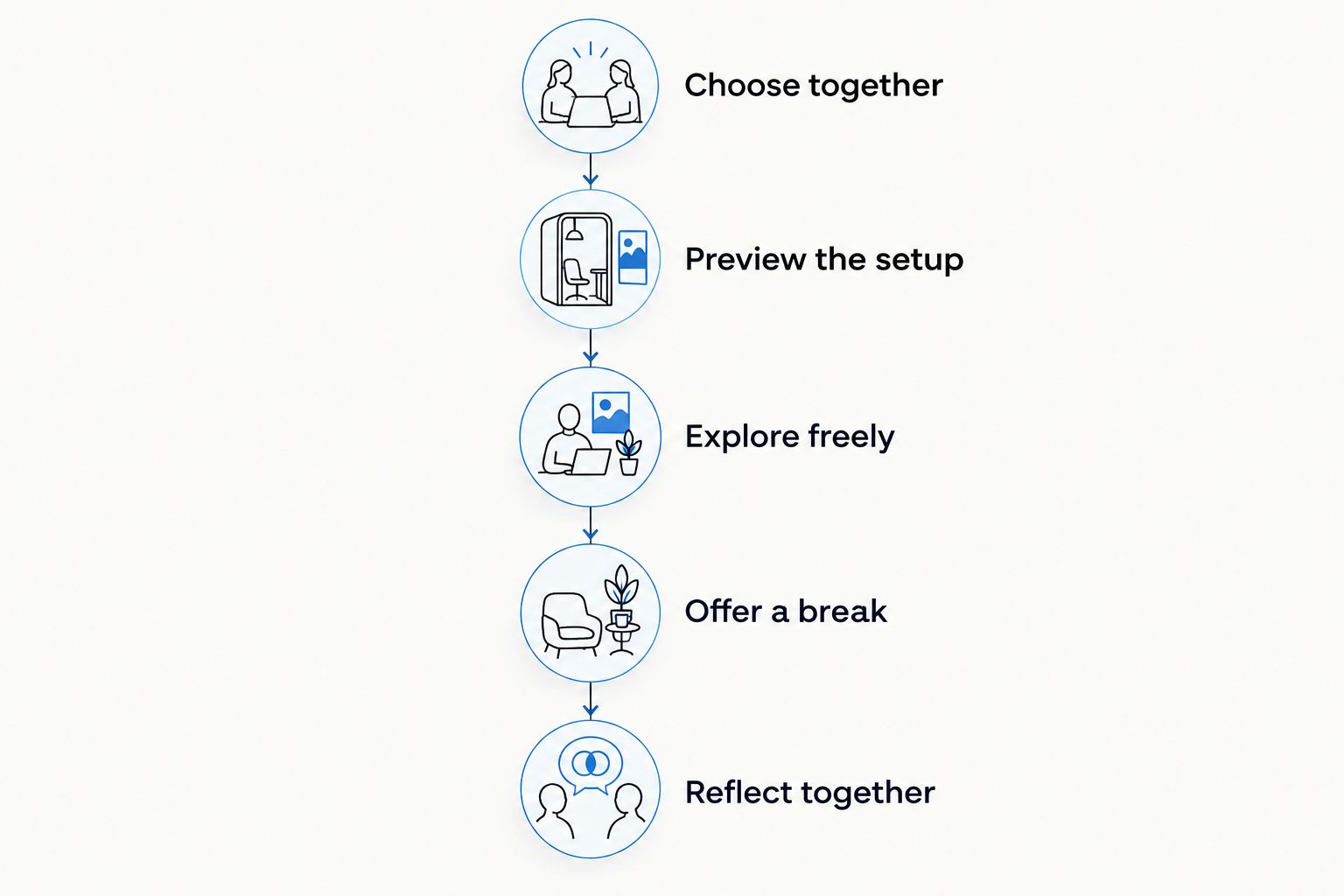
Use the same sequence at home or when discussing a Brooklyn group activity:
- Choose together: Offer a manageable choice of activities or materials.
- Preview the setup: Show the space, materials, and stopping point.
- Explore freely: Let your child watch, investigate, or participate alongside others.
- Offer a break: Keep a clear way to pause or leave.
- Reflect together: Ask what to repeat, change, or skip next time.
You can offer a 5-minute first exploration, with permission to stop sooner or continue longer. That is a planning suggestion, not an attention-span target. Ask group organizers about caregiver participation, noise, breaks, communication supports, and age grouping before committing to an outing.
Autism Learn & Play is a Brooklyn nonprofit for families seeking community programs and educational support for autistic children ages 2–18. Ask directly about current options and your child's needs; this guide does not establish which activities are offered.
Ask about community programs
Share your child’s interests, age, communication preferences, and sensory needs.
Which STEM activity should you choose?
Choose block-building if you are undecided. Offer suitable pieces, follow your child's design, and introduce a challenge only when it adds enjoyment. Choose ramps for motion, patterns for repetition, and animation for a teen who wants a digital project.
For a 2026 group outing, choose the environment as carefully as the activity. A fascinating project is not a good fit if your child cannot pause, communicate, or participate in their own way.
FAQ
What’s the best STEM activity for a child with autism?
Block-building is the best starting point in this guide because the design, challenge, and participation can change around your child’s interests. Choose another activity when your child prefers motion, patterns, plants, or digital creation.
Are STEM activities suitable for autistic toddlers?
Yes, STEM exploration can include simple building, sorting, and observing for autistic toddlers. Use age-appropriate materials, supervise closely, and avoid small pieces when mouthing is a concern.
Can a nonspeaking child join STEM activities?
Yes, speaking is not a requirement for STEM participation. Children can choose, predict, comment, or ask to stop through gestures, pointing, pictures, or their communication device.
How do I make a STEM activity sensory-friendly?
Adapt the activity to your child’s preferences for sound, light, touch, and movement. Offer tools instead of direct texture contact, reduce clutter, and provide a clear way to take a break.
What STEM activities work for autistic teenagers?
Digital animation, building challenges, and self-directed investigations can suit autistic teenagers when the topic interests them. Keep themes age-respectful and adapt the controls or instructions without treating simpler participation as childish.
How do I choose a STEM group in Brooklyn?
Choose a Brooklyn STEM group by asking how it supports your child’s communication, sensory preferences, breaks, and preferred participation. Confirm age grouping and caregiver expectations before attending.
Does Autism Learn & Play offer these exact STEM activities?
This guide recommends activity ideas, not a verified schedule of Autism Learn & Play sessions. Contact info@autismlearnplay.org to ask about current community programs and options for your child.
One last thing
Repeated play does not need a harder challenge to count as exploration. A child rebuilding the same bridge or releasing the same object can stay with what interests them. Join that interest before asking for something different.
Related guides
- Art therapy activities for autistic kids
- Gross motor activities for kids with autism
- Speech therapy activities for nonverbal autism