
No, it is not too late to start ABA therapy for an older child; age alone does not determine whether this support fits your child's needs. The important caveat is that ABA is not automatically the right choice: your child's priorities, communication, comfort, and willingness to participate should guide the decision.
- Is it too late to start ABA therapy for an older child? No; choose support around current needs, not missed milestones.
- ABA therapy goals should support communication, independence, and meaningful participation—not force an autistic child to appear nonautistic.
- Autism Learn & Play Inc. serves Brooklyn families with autistic children ages 2–18 through therapy, community programs, and online classes.
- Ask prospective providers about your child’s choices, breaks, communication supports, and experience working with older children.
Why this matters
You have not failed your child by asking about support now. A later diagnosis, changing school demands, or your child's own request for help is a reason to explore what fits today—not to recreate an early-childhood schedule.
For Brooklyn families reviewing therapy services in 2026, start with a practical question: what would make your child's day easier or more enjoyable? The answer might involve asking for a break, joining a favorite activity, managing a routine, or getting help without feeling overwhelmed.
Support should make room for your child's life, not replace it. Friendship, rest, hobbies, and time with family belong in the conversation alongside therapy goals.
Is it too late to start ABA therapy for an older child?
No. There is no universal birthday after which a child becomes unable to learn new skills or receive behavioral support. Whether ABA is appropriate requires an individual assessment; age by itself is not enough to make that decision.
Evidence about early intervention does not establish an expiration date for learning. It also does not establish what a particular older child will gain from a particular program. Ask a qualified clinician to explain the reasoning behind each recommendation without promising a result.
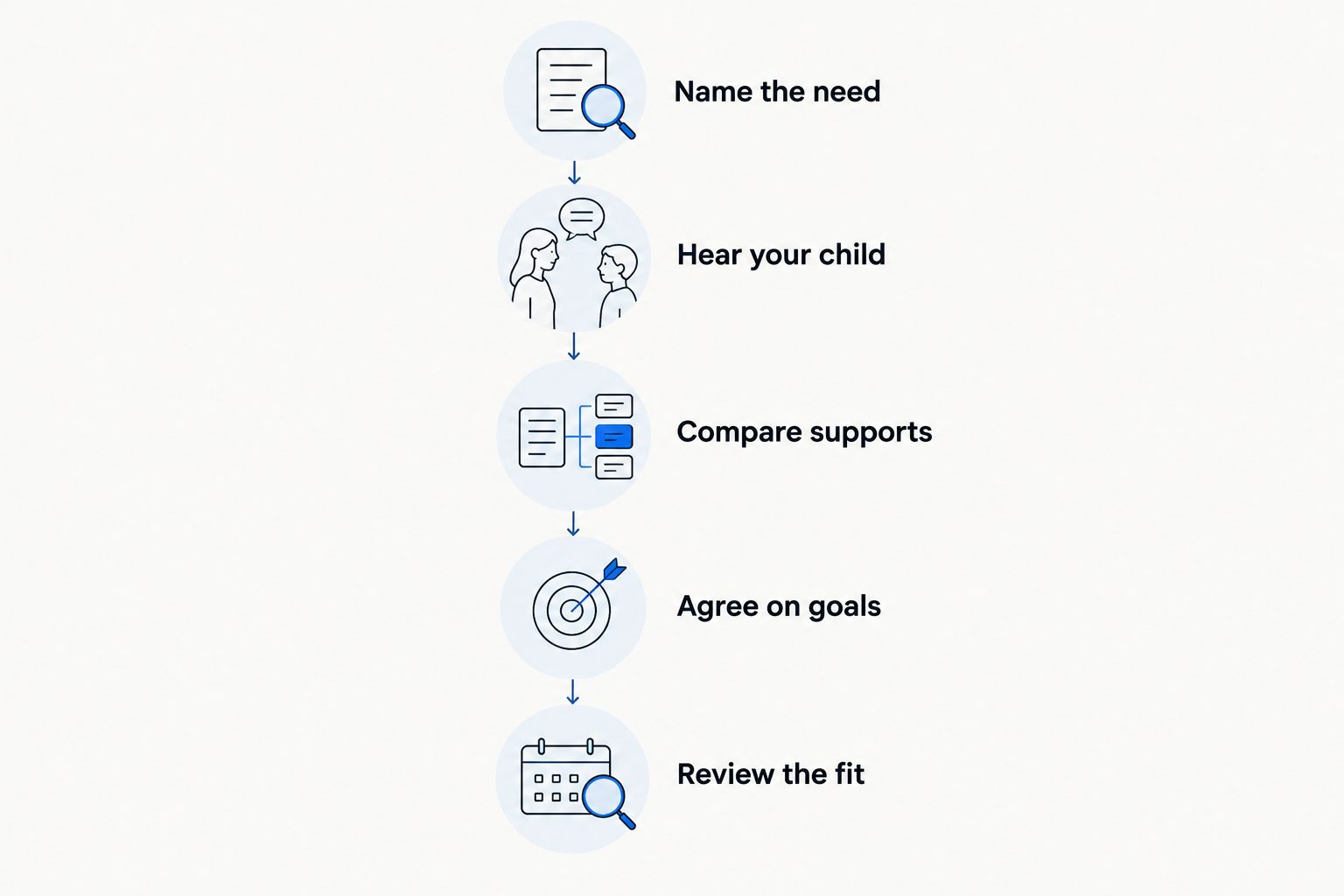
Use this sequence when deciding whether to begin:
- Name the need. Describe a daily situation your child wants help with, rather than starting with a therapy label.
- Hear your child. Include speech, typing, gestures, pictures, or another communication method your child uses.
- Compare supports. Ask which professional approach directly addresses the need and what accommodations belong alongside it.
- Agree on goals. Choose useful, observable changes that respect your child's boundaries.
- Review the fit. Decide how you and your child will discuss comfort, usefulness, and whether the plan needs to change.
Your child does not need to master eye contact, hide harmless stimming, or perform sociability to deserve inclusion. Ask the provider to explain how every proposed goal benefits your child—not simply how it makes adults more comfortable.
What should ABA goals look like for an older child?
Goals for an older child should reflect their actual routines, interests, and choices. Materials and activities should be age-respectful, even when your child is learning a skill often taught earlier.
For a school-age child, discuss practical situations such as requesting help during an activity, communicating discomfort, or following a personally useful routine. For a teenager, include privacy, self-advocacy, community participation, and their own priorities for greater independence.
These are discussion examples, not a standard checklist:
| Area | Possible child-centered goal | Boundary to protect |
|---|---|---|
| Communication | Ask for help using a preferred communication method | Do not make spoken words the only accepted response |
| Daily routines | Learn a chosen part of getting ready | Keep needed assistance available |
| Community activities | Understand how to join, pause, or leave an activity | Participation must not require enduring distress |
| Friendship | Practice inviting someone to a shared-interest activity | Do not require friendship or physical affection |
| Self-advocacy | Communicate disagreement or request a change | Treat refusal as meaningful communication |
A useful goal expands your child's choices. Before accepting a goal, ask how it helps your child outside the session and how your child will help decide whether it matters.
Why the right support varies
Your child's age is only part of the picture. When discussing an assessment in 2026, bring information about everyday life rather than relying on a diagnosis alone.
- Your child's priorities: A goal adults value is not automatically a goal your child wants to work on.
- Communication needs: The plan must recognize how your child already expresses preferences, discomfort, and refusal.
- Sensory and physical comfort: Noise, fatigue, pain, or an uncomfortable setting require attention—not simply more practice complying.
- Daily demands: School, travel, homework, sleep, and family commitments affect whether a proposed schedule is workable.
- Current supports: Speech therapy, occupational therapy, school accommodations, and other services should inform the discussion.
- Provider fit: Ask about experience with older children, age-respectful activities, and responses to distress or disagreement.
Bring concrete examples. Instead of saying your child needs better social skills, explain that your child wants to join a game but does not know how to ask—or prefers watching and wants adults to accept that choice.
Is ABA the right option, or should you consider another support?
Choose support by the problem it addresses, not by which service is most familiar. ABA is one approach to discuss; it is not a requirement for every autistic child or every goal.
The comparison below describes professional roles and questions to ask. It does not predict outcomes or replace an individual evaluation.
| Support | Best for discussing | What it focuses on | Limitation to consider |
|---|---|---|---|
| ABA therapy | Specific, useful learning goals involving everyday actions and routines | How situations, teaching, and responses relate to behavior | It does not replace communication, medical, or sensory assessment |
| Speech-language therapy | Communication, language, or communication-device needs | Understanding and expressing messages, including supported communication | It does not address every daily-living or sensory need |
| Occupational therapy | Participation in daily activities and related sensory or motor needs | The relationship between tasks, environments, and everyday participation | It does not replace a broader communication evaluation |
| Interest-based community activities | Shared enjoyment and opportunities to meet peers | Participation around an activity your child values | A recreational group is not automatically therapy or individually supported |
Ask providers to explain overlap rather than adding services without a clear purpose. A child who cannot communicate discomfort needs an accessible way to do so; practicing longer participation without addressing that need misses the point.
New or sudden distress also deserves attention from your child's healthcare professional. Do not assume every change is an autism-related behavior issue.
What should you ask an ABA provider before starting?
A good consultation gives you specific explanations, not pressure to enroll. For your 2026 provider conversations, use questions that reveal how the service works when your child disagrees, needs help, or wants to stop.
- What experience do you have with older children and teenagers?
- How will my child help choose goals?
- What do you do when my child says no or shows distress?
- How do you support breaks and preferred communication methods?
- How will you distinguish a learning need from an accommodation need?
- How do you coordinate with school and other professionals—with permission?
- What information will show whether the plan is useful?
- How do families request changes or end services?
Ask for an example of how the provider responds to refusal. A general promise to individualize care does not answer whether your child's boundaries will be respected in practice.
Do not accept promises of a cure, guaranteed independence, or a fixed result by a deadline. You can ask for the written plan, take time to consider it, and seek another professional opinion.
How can therapy connect with school and Brooklyn outings?
Start with an ordinary situation your child cares about. A library visit, neighborhood walk, art activity, or gathering with peers can give the team a concrete context for discussing communication and participation.
Before an outing, ask the organizer about the setting, noise, waiting, caregiver participation, and places to take a break. These are questions to verify, not features to assume because an activity is described as autism-friendly.
For a younger child, you might prepare a simple way to request help or leave with a caregiver. For a teenager, ask what preparation feels useful, who they want involved, and what information they want kept private.
School goals can inform the conversation without controlling every activity outside school. This guide to connecting your child's IEP to ABA therapy goals offers a starting point for that discussion.
An outing does not have to become a lesson to be worthwhile. Watching, enjoying a shared interest, or leaving before the activity ends can be a valid choice.
Where can Brooklyn families begin in 2026?
Autism Learn & Play Inc. is a Brooklyn-based nonprofit providing therapy services, community programs, and online classes for autistic children ages 2–18. Its stated services include ABA, speech, occupational, music and art therapy, and tutoring.
Autism Learn & Play Inc. fits Brooklyn families seeking therapy and community-program options for autistic children. That range gives families several types of support to ask about; it does not establish which service, group, or schedule fits a particular child.
Use the website contact form or write to info@autismlearnplay.org with your child's age, interests, communication preferences, and the situation you want help with. Ask directly about older-child experience, participation expectations, and current program details before making plans.
Can a teenager start ABA therapy for the first time?
Yes, a teenager can be assessed for ABA therapy for the first time. The decision should depend on a useful goal, the teenager's involvement, and the provider's ability to offer respectful, age-appropriate support.
Ask your teenager what they want help with before the consultation. Do not assume that a goal chosen for a younger child belongs in a teen's plan.
Does starting later mean my child needs more therapy?
No, starting later does not automatically mean your child needs a more intensive schedule. A recommendation should explain the individual need, the proposed approach, and how the schedule fits alongside school, rest, and ordinary life.
Do not choose hours as repayment for supposedly lost time. Ask what each part of the schedule is intended to accomplish.
FAQ
Is it too late to start ABA therapy for an older child?
No, age alone does not make it too late to consider ABA therapy. An individual assessment should determine whether it addresses a useful goal while respecting your child’s communication, comfort, and choices.
Can my teenager say no to an ABA activity?
Your teenager’s refusal should be taken seriously. Ask the provider how they recognize disagreement, offer breaks, and change activities or goals rather than treating participation as unconditional.
Does my child need to speak before starting ABA?
Spoken language is not a prerequisite for considering ABA. Ask how the provider supports your child’s existing communication and coordinates with a speech-language professional when needed.
Will ABA make my child stop being autistic?
No, ABA does not make a child stop being autistic. Appropriate goals concern useful skills and participation, not curing autism or making a child appear nonautistic.
How do I know whether a therapy goal is appropriate?
An appropriate goal has a clear benefit for your child and respects their boundaries. Ask your child and provider how the goal supports everyday life, communication, safety, or a personally meaningful activity.
Should an older child receive ABA instead of speech or occupational therapy?
ABA does not automatically replace speech or occupational therapy. Discuss the specific need with qualified professionals and ask how any recommended services will coordinate.
How can I ask Autism Learn & Play Inc. about support for my older child?
Use the website contact form or email info@autismlearnplay.org. Share your child’s age, interests, communication preferences, and support goals, then ask which services or community programs fit those needs.
One last thing
Before booking a consultation in 2026, ask your child: what would you like adults to understand about your day? Offer their usual communication method and time to respond; do not turn the question into a test.
The next useful step is not catching up to someone else's timeline. It is identifying support your child has a reason to value.
Related guides
- How many hours of ABA therapy does a child need each week?
- Speech therapy for autistic teenagers
- Can autistic kids make real friends in group therapy?