
Yes, autism therapy progress can feel slow, and progress does not always happen at a steady pace or look the same across settings. Slow progress deserves a clear conversation about your child's goals and comfort—not blame, an automatic increase in therapy, or a promise that waiting will solve everything.
- Is it normal for autism therapy progress to feel slow? Yes; review meaningful changes, not another child’s timeline.
- Ask your child’s autism therapy team to explain progress, support needs, and the next review point.
- Autismlearnplay serves Brooklyn families through autism therapy, community programs, and online classes for children ages 2–18.
- Contact your child’s healthcare professional about lost skills or new health concerns rather than assuming a plateau.
Is it normal for autism therapy progress to feel slow?
Yes. Feeling that progress is slow does not, by itself, tell you whether therapy is helping. You need to know what your child is working toward, what support they need, and whether the goal makes everyday life more comfortable or accessible.
For your 2026 therapy review, start with specific observations rather than a deadline borrowed from another family. Our guide to how long it takes to see progress from ABA therapy addresses the related timing question; the steps below help you prepare for a useful discussion about your own child.
- Name the goal. Ask the therapist to describe it in everyday language. Requesting a break is clearer than a broad label such as better behavior.
- Establish the starting point. Ask what your child could do when work on this goal began and what help they needed.
- Compare similar situations. Note whether the activity, environment, and available support were similar before deciding that nothing changed.
- Include your child's experience. Share what your child says, communicates, enjoys, avoids, or finds uncomfortable.
- Agree on the next decision. Ask what the team will continue, adjust, or reassess, and when you will discuss the result.
These steps are a conversation guide, not a test your child must pass. You should leave the meeting understanding the plan without needing to interpret a page of unfamiliar terms.
Why this matters
When you are arranging appointments, managing school routines, and hoping your child will find friends, a slow stretch can feel deeply personal. It is not a measure of your commitment as a parent. Your child's worth is not tied to reaching a therapy target.
The useful question is not simply whether your child looks more like other children. Ask whether support is helping your child communicate needs, access activities, build chosen relationships, or handle daily tasks with greater comfort and autonomy.
A useful 2026 therapy plan connects each goal to something that matters in your child's life. If that connection is unclear, ask the team to explain it before adding more practice to an already full family schedule.
What should you look for besides a finished goal?
Ask your therapist to distinguish between completing a goal independently and moving toward it with support. Those are different observations. Record both without treating help as a failure.
For example, if your child is working on asking for help, note how the request happens: spoken words, a gesture, a picture, or a communication device. The point is whether your child can communicate—not whether everyone uses the same method.
| Observation | What to record | Question for the therapist |
|---|---|---|
| A request happens with help | The support your child used | Is this different from the starting point? |
| A skill appears only during sessions | Where and with whom it happens | How will we support it in another setting? |
| Participation changes | What your child chose and how they joined | Does this reflect comfort, interest, or a changed task? |
| No clear change is visible | The goal and recent examples | What needs reassessment? |
| A previously used skill disappears | What changed and when | Who should evaluate this change? |
Treat these as observations to discuss, not conclusions to diagnose at home. A quieter session, for example, does not automatically mean greater comfort. Ask what your child experienced and what the therapist observed.
Why the picture of progress varies
Autism therapy covers different services and goals. Before comparing progress reports, check whether you are comparing the same task, setting, and type of support.
- The service and goal: Speech therapy, occupational therapy, tutoring, and community activities address different needs. Ask what the current service is responsible for supporting.
- The setting: Home, school, an online session, and a Brooklyn community outing are different environments. Describe where a skill appears rather than assuming it works everywhere.
- The support provided: A visual cue, adult demonstration, communication tool, or direct reminder changes how a task is completed. Ask the team to document that support.
- Your child's age and priorities: A young child's play routine and a teenager's chosen social activity need different goals. Include your child's preferences wherever possible.
- How progress is described: Broad statements hide useful detail. Ask for an example of what changed, stayed the same, or became harder.
These factors help you ask better questions; they do not explain away a plan that is not meeting your child's needs. You are entitled to an understandable explanation of what therapy is working toward.
What should a helpful therapy review include?
Bring a short note rather than trying to remember every difficult afternoon. Include the goal, an everyday example, your child's response, and the question you want answered. Your observations belong alongside the therapist's records.
For a 2026 review, ask the team to organize the conversation around these headings:
- Starting point: What did the goal look like before this work began?
- Current support: What assistance does your child use now?
- Child's experience: What does your child communicate about the activity?
- Next adjustment: What will the team change or continue?
- Review point: When will you discuss the result and make another decision?
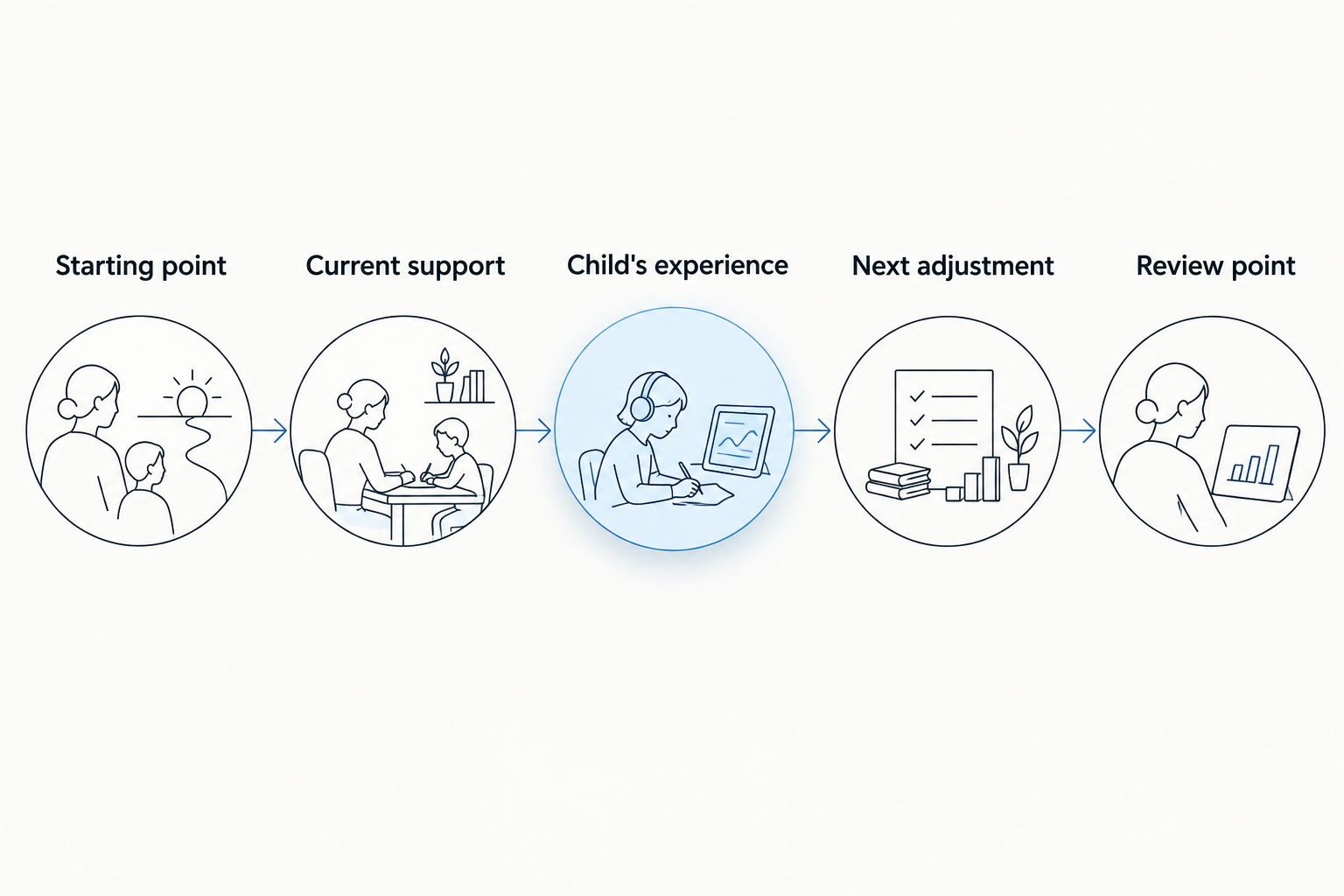
Ask the therapist to explain what would lead to a change in approach. That might involve revising the goal, changing the activity, consulting another professional, or reconsidering how support is delivered. The decision should follow your child's needs, not pressure to keep the plan unchanged.
You do not need to turn family life into continuous therapy. Ask which everyday opportunities are useful and which activities can remain simply enjoyable.
How do goals differ for younger children and teenagers?
Autismlearnplay serves children ages 2–18, so a conversation about progress must leave room for very different stages of childhood. Age alone does not determine the right goal. Communication preferences, interests, daily routines, and the child's own choices matter too.
For younger children, start with everyday routines
Discuss goals in the context of play, meals, getting dressed, or asking for something. Ask the therapist to show you what support looks like in a familiar activity rather than giving you a long list of exercises.
For a community outing, describe the actual situation: entering the space, choosing an activity, requesting help, or leaving when needed. Choose a meaningful part of the experience to discuss instead of judging the entire outing as a success or failure.
For school-age children, connect support across settings
Ask how a therapy goal relates to classroom participation, playground choices, or activities your child enjoys. Include school observations when appropriate, with the relevant permissions.
If your child completes a task during therapy but needs help elsewhere, describe the difference. Ask how adults can make the task understandable in the new setting without removing helpful support simply to test independence.
For teenagers, include their own priorities
Ask your teenager what they want help with and what they do not want turned into a goal. Friendship, hobbies, privacy, self-advocacy, and school responsibilities offer starting points for a conversation—not a required checklist.
Respect interests that are age-appropriate for the individual. A plan should not assume that every teenager wants a large friendship group or enjoys the same social activities.
Should I add more therapy when progress feels slow?
Slow progress alone is not a reason to add more therapy. Ask the treating professional to explain what additional sessions would address, how the plan would change, and how your child's wellbeing and family routine would be considered.
More appointments also mean more demands on your child's day. Before changing the schedule, discuss whether the existing goals are clear, relevant, and supported by observations.
For your 2026 planning, write down the purpose of any proposed change. A useful explanation describes the need being addressed and how the team will review the decision—not just a larger schedule.
When should I raise concerns instead of waiting?
Raise concerns when the goals remain unclear, your child's discomfort is dismissed, or you cannot get an explanation of the plan. You do not need to wait for a scheduled review to ask a question.
Contact your child's healthcare professional about lost skills, new pain, or other new health concerns. Do not assume these changes are simply part of slow therapy progress. Sudden or urgent symptoms need prompt medical attention.
You can also request a second professional opinion about an unclear plan. Bring existing reports and your observations so the discussion starts with your child's needs rather than a comparison between providers.
Can community activities still matter during a slow stretch?
Yes. Your child does not need to finish a therapy goal before having opportunities for enjoyment and connection. Keep the purpose clear: an outing can be about sharing an interest, spending time together, or exploring a welcoming space—not demonstrating progress.
Before a Brooklyn group activity, ask the organizer about the setting, participation expectations, breaks, communication supports, and adult involvement. These are questions to verify, not features to assume. Tell the organizer what helps your child feel comfortable.
Autismlearnplay is a fit for Brooklyn families seeking autism therapy and community programs for children ages 2–18. Its services also include online classes; choosing a suitable activity still requires a conversation about your child's needs. To ask about fit, use the contact form and describe your child's interests, communication preferences, and the support you want to discuss.
FAQ
Is it normal for autism therapy progress to feel slow even when we attend regularly?
Yes, progress can feel slow despite regular attendance. Ask your child’s therapist to compare the current goal with its starting point and explain what the observations mean.
How long should I wait before asking for a therapy review?
You can ask for a therapy review whenever you have concerns. Agree with the treating professional on a review point that fits your child’s goals rather than using another family’s timeline.
Does needing reminders mean my child is not making progress?
Needing reminders does not, by itself, establish whether your child is making progress. Ask the therapist to document the support used and compare it with the starting point.
Should I practice therapy activities at home every day?
Ask your child’s therapist what home practice is appropriate for the specific goal. Request an approach that respects your child’s comfort and leaves room for rest, play, and family life.
What if my child does something in therapy but not at school?
Tell the therapy and school teams exactly where the skill appears and what help your child receives. Ask how they will support its use in the other setting rather than assuming your child is refusing.
Can my child join community activities before meeting therapy goals?
Therapy goals do not determine whether your child deserves opportunities for community connection. Ask each organizer about the activity’s expectations and supports to assess the fit.
What should I do if my child loses a skill they used before?
Contact your child’s healthcare professional about a lost skill rather than assuming a therapy plateau. Share what changed, when you noticed it, and any other new concerns.
One last thing
At your next 2026 therapy conversation, ask: What will this goal help my child do that matters to them? Then pause for a concrete answer.
That question keeps the focus on your child's life. Progress should support communication, comfort, participation, and choice—not become a condition your child must meet before they can belong.
Related guides
- Connect your child's IEP to ABA therapy goals
- Connect speech therapy to AAC device use at home
- Can autism therapy help a child make friends at school?