Speech therapy has no single timeline for showing results; your child’s starting communication skills, goals, and support needs shape what progress looks like. Early changes can include expressing a choice or asking for help, not just saying new words. A skill used during therapy also needs support to become useful at home, school, or a community outing.
- How long does speech therapy take to show results? There is no universal deadline; track meaningful communication goals.
- Autism Learn & Play provides speech therapy services for autistic children ages 2–18 in Brooklyn.
- Count gestures, pictures, communication devices, and spoken words when reviewing your child’s progress.
- Ask your speech-language pathologist what to track, how much help your child needs, and when to review goals.
Why this matters
Waiting for a first word or clearer conversation can make smaller changes easy to miss. Your child communicating discomfort, declining an activity, or inviting you into play deserves attention, even when speech itself has not changed.
For Brooklyn families comparing therapy services in 2026, the useful question is not simply how quickly a provider promises results. Ask how the provider will define, document, and discuss communication that matters to your child. A meaningful goal is more useful than a promised deadline.
How long does speech therapy take to show results?
There is no universal number of sessions, weeks, or months that predicts an individual child’s results. A speech-language pathologist, often called an SLP, needs to assess your child and identify specific goals before discussing expectations. Even then, an estimate is not a guarantee.
Separate learning a skill with support from using it independently. Your child choosing a picture after a therapist models it and your child independently using that picture to request a snack are different observations. Both belong in a progress discussion.
| What you are tracking | What progress can look like | What that observation does not establish |
|---|---|---|
| Expressing needs | Your child communicates help, stop, more, or a choice | That the same communication works with every person |
| Understanding messages | Your child responds to a familiar direction with less support | That unfamiliar instructions are equally accessible |
| Speech clarity | A listener understands a practiced word more easily | That the word is clear in spontaneous conversation |
| Social connection | Your child shares an interest or joins an exchange | That every group setting feels comfortable |
| Everyday independence | Your child uses a communication skill outside therapy | That support is no longer needed |
For a 2026 progress plan, ask the SLP to record your child’s starting point alongside the goal. Without that starting point, it is difficult to distinguish a new skill from something your child already did under different circumstances.
What counts as a result before new spoken words?
Communication progress is broader than spoken-word counts. Gestures, pictures, signing, writing, and augmentative and alternative communication—AAC—are ways a child can express a message. Discuss which approaches give your child useful access to communication.
For example, a child bringing you a picture to request a preferred activity is expressing a choice. A teenager typing that a room is too loud is communicating a need. Neither message becomes less meaningful because it is not spoken.
Keep the focus on the message and the support involved. Did someone guess what your child wanted, or did your child have an accessible way to tell them? Did your child initiate, respond to a question, or follow a model?
Avoid treating eye contact, sitting still, or suppressing harmless movement as proof of better communication. Ask how each goal helps your child express themselves, understand others, or participate on their own terms.
Why the speech therapy timeline varies
An individual assessment is the basis for discussing timing. These areas give you and the SLP a practical starting point for that conversation:
- Starting communication skills: Describe how your child currently requests, refuses, asks questions, and shares interests. Include communication without speech.
- The goal itself: Producing a particular sound and asking a friend to join a game involve different skills. Ask what the current goal requires.
- Communication access: Review whether your child has an accessible way to communicate throughout the day, including any recommended AAC supports.
- Comfort and participation: Tell the SLP about noise, transitions, fatigue, and other conditions that affect your child’s willingness or ability to participate.
- Practice and support: Discuss which everyday situations offer a comfortable opportunity to use the skill, and what help adults should provide.
- People and settings: A familiar therapist, a sibling, and an unfamiliar group leader create different communication situations. Review each separately rather than assuming a skill transfers automatically.
These are discussion points, not a formula for predicting a completion date. More practice is not automatically better practice; ask the SLP how to keep communication useful and avoid turning every interaction into a test.
How can you track progress without testing your child all day?
Use a simple record tied to the goal your SLP recommends. The purpose is to notice patterns during ordinary life, not to make your child perform whenever someone asks.
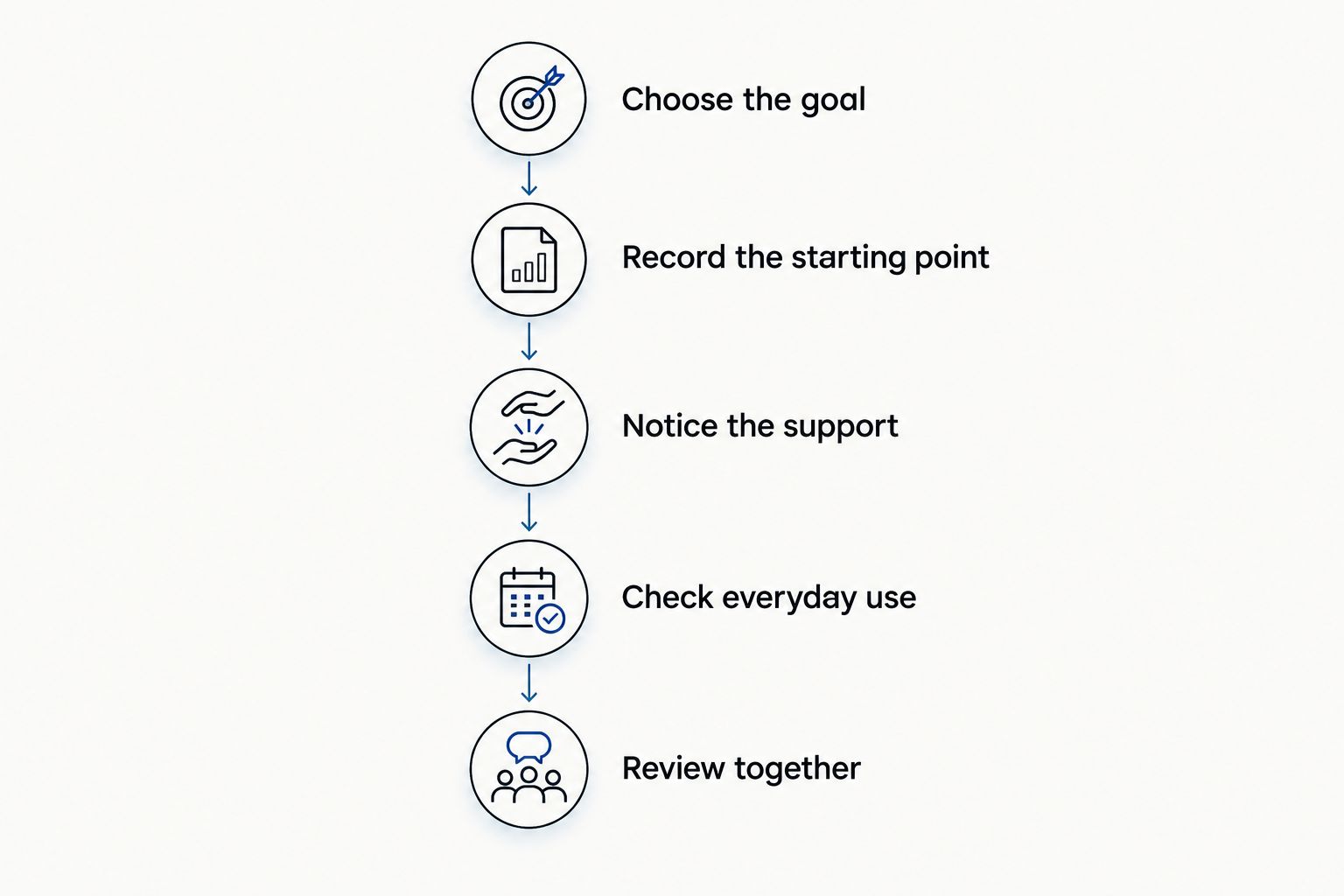
- Choose the goal. Write down the specific message or skill, such as requesting help during play. Avoid broad labels such as better communication.
- Record the starting point. Describe what your child currently does and what help they receive. Include their preferred communication method.
- Notice the support. Record whether your child communicated independently, after a model, or with another kind of assistance.
- Check everyday use. Note where the communication happened and who was there. Include comfortable home routines and community settings when relevant.
- Review together. Bring observations to the SLP and ask what they show about the goal, the support, and the next step.
A short note is enough: your child used a help symbol while opening a container, after you pointed toward the communication board. That description tells the SLP more than a general statement that the session went well.
If your family uses AAC, discuss how to keep it accessible during meals, play, and outings. This guide to connecting speech therapy to AAC device use at home offers a related starting point for that conversation.
What should progress look like at different ages?
Autism Learn & Play serves children ages 2–18. Within that age span, choose goals around your child’s interests, communication needs, and daily life—not age alone. The examples below are planning ideas, not developmental deadlines.
Children ages 2–5: communication during familiar play
For children ages 2–5, discuss opportunities to express choices, request help, refuse, and share enjoyment during familiar routines. Follow the child’s interests rather than requiring a particular toy or activity.
Best for: families identifying communication opportunities in everyday play. The limitation is that a skill practiced with a familiar adult still needs support in other situations; success at home does not establish comfort in a group.
Children ages 6–12: communication across daily activities
For children ages 6–12, discuss communication during classroom activities, family routines, and shared interests. Possible goals include asking for clarification, describing a problem, or joining an activity in a way the child chooses.
Best for: families connecting therapy goals with school and community participation. The limitation is that an adult’s report does not capture the whole experience; include your child’s perspective through their accessible communication method.
Teenagers ages 13–18: choice, interests, and self-advocacy
For teenagers ages 13–18, include the young person directly in choosing priorities. Asking for space, discussing a favorite interest, or explaining a misunderstanding can be more relevant than practicing conversations selected entirely by adults.
Best for: families supporting teenager-led communication goals. The limitation is that a rehearsed exchange does not establish confidence or comfort in an actual peer interaction. Respect privacy and avoid making every social experience a progress check.
What can you expect when practicing at a Brooklyn outing?
Choose an outing around your child’s interests and access needs rather than using it as a test. Before attending a group in 2026, ask the organizer about the activity format, noise, breaks, adult participation, and communication supports. Verify the details directly.
Agree with the SLP on a relevant opportunity, such as requesting a material, declining a turn, or asking to leave. Bring the communication tools your child uses and explain them to the activity leader when appropriate.
During the activity, allow your child to watch, participate differently, or take a break. Being near other children does not require immediate conversation. Shared enjoyment and a respected refusal both belong in a judgment-free community experience.
Afterward, note what helped and what created difficulty. If the setting was overwhelming, discuss adjustments before interpreting limited communication as a lack of ability or effort.
What if you are not seeing progress?
Ask for a goal review rather than accepting either a blanket reassurance or a guaranteed deadline. Bring concrete observations: what your child communicates, with whom, using which method, and with what support.
Useful questions for a 2026 review include:
- What has changed from the recorded starting point?
- Is the current goal meaningful to my child?
- Does the communication method remain accessible outside sessions?
- Are we measuring independence as well as successful responses?
- What will change in the plan if the current approach is not helping?
An SLP can discuss whether goals, supports, assessment, or coordination with other professionals need attention. If your child loses previously established communication skills, contact their healthcare professional rather than treating that change solely as a therapy-progress issue.
Autism Learn & Play is a fit for Brooklyn families seeking speech therapy alongside community programs for autistic children ages 2–18. That service mix is not a promised timeline; ask how an individual plan will address your child’s priorities.
FAQ
How long does speech therapy take to show results for an autistic child?
Speech therapy has no universal timeline for an autistic child. Ask the speech-language pathologist to define an individual goal, record the starting point, and explain how progress will be reviewed.
What are the first signs that speech therapy is helping?
Early signs depend on the goal and can include expressing a choice, requesting help, or using a communication tool with less support. New spoken words are not the only meaningful result.
Does my child need to speak for speech therapy to be useful?
No. Speech therapy can address communication through gestures, pictures, signing, writing, AAC, and speech, according to your child’s assessed needs.
Will more speech therapy sessions make results happen faster?
More sessions do not guarantee faster results. Ask the SLP to explain the recommended schedule, your child’s participation needs, and how the plan will be reviewed.
Should I correct my child’s speech throughout the day?
Follow your SLP’s individualized guidance rather than correcting every interaction. Keep room for enjoyable communication, and respond to your child’s message rather than treating every exchange as practice.
Is a skill learned in therapy supposed to appear at school immediately?
A skill used in therapy does not automatically appear at school. Ask the SLP and school team how to support the same communication goal across people, routines, and settings.
Can Autism Learn & Play help Brooklyn families seeking speech therapy?
Autism Learn & Play provides speech therapy, community programs, and online classes for autistic children ages 2–18. Contact the organization through its website contact form or info@autismlearnplay.org to discuss your child’s needs.
One last thing
Before your next speech therapy review in 2026, write down a message you want your child to be able to express—not a behavior you want them to perform. Asking for a break, telling someone no, or sharing a favorite interest gives the conversation a practical starting point.
The goal is communication your child can use, not a deadline your child must meet. Celebrate the message, respect the method, and keep your child’s voice at the center of the plan.
Related guides
- Speech therapy for autistic teenagers
- Speech therapy activities for nonverbal autism
- Family support groups for autism in Brooklyn