Dance therapy can offer a nonverbal autistic child opportunities to communicate through movement, gestures, choices, and shared play, but it does not guarantee spoken language. A dance class is not automatically dance/movement therapy, and neither replaces access to speech-language support or augmentative and alternative communication, known as AAC. If you are exploring options in 2026, look for an activity that respects how your child already communicates rather than requiring speech or imitation.
- Dance therapy for nonverbal autism communication offers movement-based interaction, not a guarantee of speech.
- Dance/movement therapy and recreational dance classes serve different purposes; ask who leads the activity and what qualifications they hold.
- Keep AAC available, accept refusals, and let your child choose whether to join.
- Autism Learn & Play provides online classes; confirm a class’s format and supports before choosing it.
Why this matters
Your child does not need spoken words to express preferences, enjoy company, or contribute to a group. The useful question is whether an activity gives your child accessible ways to participate—and whether adults notice and respect those ways.
Before adding movement activities, consider how you will keep familiar communication tools available. This guide to connecting speech therapy with AAC use at home addresses that connection. For your family’s 2026 activity plan, prioritize access and enjoyment over performing on cue.
Can dance therapy help a nonverbal autistic child communicate?
Movement can create opportunities for communication; that is different from proving that dance therapy produces speech. A child might choose a song, signal for a pause, invite a familiar movement, or move away to decline. Those actions deserve a response without a demand to say a word first.
Nonverbal does not mean that a child has nothing to communicate. Some families prefer the word nonspeaking; use the language your child and family prefer, and do not assume that speech ability tells you what your child understands.
Separate the activity’s purpose from its label before you enroll:
| Option | Best for | What to look for | Limitation |
|---|---|---|---|
| Dance/movement therapy | Families seeking a therapeutic approach involving movement | A qualified dance/movement therapist, individualized goals, and a clear explanation of the approach | The therapy label does not guarantee communication or speech outcomes |
| Recreational dance class | Children interested in dance as a leisure activity | Flexible participation, suitable music, and respect for communication differences | Dance instruction is not automatically clinical therapy |
| Family movement play | Exploring preferences in a familiar setting | Child-led choices, accessible communication, and an easy stopping point | Playing at home does not provide a professional assessment or peer group |
Ask a prospective provider what happens when a child watches instead of joining. The answer reveals more about participation expectations than a general promise that everyone is welcome.
What communication can look like during movement
Choose a goal that matters to your child’s everyday experience, not one that simply makes the session look busy. Asking for a break is a meaningful communication goal. So is declining a song.
Examples to discuss with your child’s speech-language professional include:
- Making a choice: selecting music through pictures, gestures, a device, or another established method.
- Requesting continuation: indicating that a preferred movement should happen again.
- Declining: turning away, using a stop symbol, or choosing a different activity.
- Inviting interaction: offering a hand or directing a familiar partner toward an activity.
- Taking a turn: exchanging movement ideas without requiring identical actions.
Treat these as possible goals, not a checklist every child must complete. Do not interpret every movement as an intentional message; notice the context and ask familiar communication partners for help understanding it.
A useful activity makes communication easier to express and easier for other people to respect. It should not make access to music, a break, or companionship depend on speaking.
Why the experience varies between children
A class description cannot tell you how your child will experience the activity. Use these factors to guide your questions rather than assuming that an autism-focused label guarantees a good fit.
- Communication access: Can your child reach and use their usual device, pictures, signs, or other supports throughout the activity?
- Sound and surroundings: Ask about music volume, lighting, crowding, and places to pause rather than assuming the space is sensory-friendly.
- Movement choices: Check whether seated movement, watching, and opting out are accepted.
- Adult expectations: Find out whether participation requires copying, eye contact, touch, or spoken responses.
- Peer interaction: Ask whether children have opportunities to respond to one another or mainly follow an instructor.
- Professional purpose: Confirm whether the offering is recreation or therapy, who leads it, and how goals are chosen.
For Brooklyn families comparing community activities in 2026, include the trip in your decision. Consider the journey, the arrival process, and how easily your family can leave if the setting is not working.
How can I try movement play without pressuring my child?
Start with familiar, comfortable movements rather than a routine your child must learn. You are exploring an invitation to connect, not conducting therapy or testing your child’s abilities.
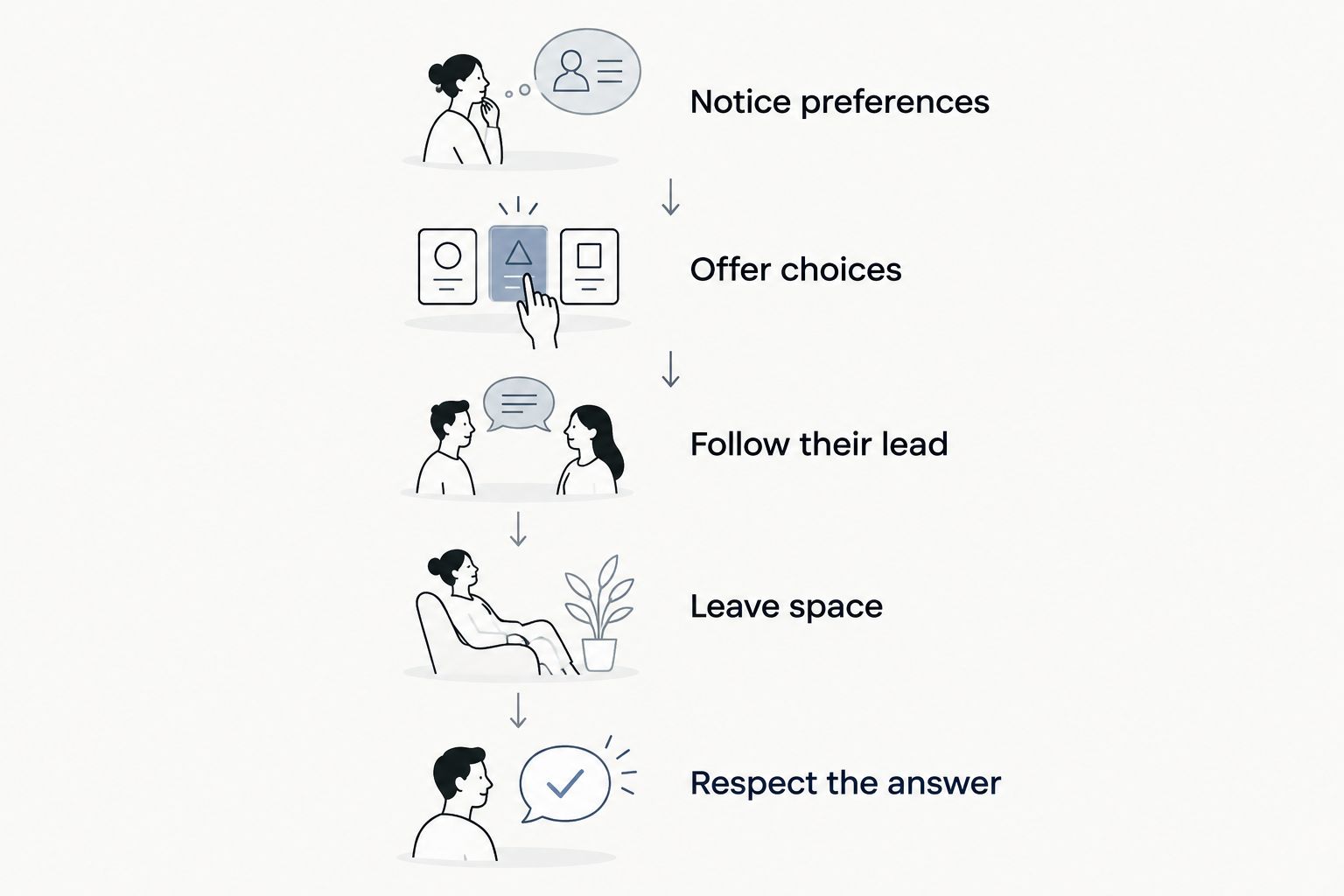
- Notice preferences. Observe whether your child chooses quiet movement, music, watching, or something else. Begin with their interests rather than a predetermined dance.
- Offer choices. Present options through your child’s familiar communication method. Accept a choice not to participate.
- Follow their lead. Join a movement your child appears to enjoy without blocking, crowding, or demanding that they copy you.
- Leave space. Pause naturally and allow time for a response. Keep AAC accessible; never withhold it to encourage another communication method.
- Respect the answer. Continue, change direction, or stop according to your child’s response. Do not require another turn before honoring a clear request to finish.
A pause is an invitation, not a reason to hold something out of reach until your child performs. If you cannot confidently understand the response, make stopping easy and discuss communication access with the child’s speech-language professional.
What should change for different ages?
Autism Learn & Play serves children ages 2–18, but that age range does not make one activity suitable for everyone. Ask about the specific class’s age expectations, interests, and participation demands.
For children ages 2–5 years, consider familiar play with a trusted adult nearby. Ask whether the child can explore without following a group routine, and whether an adult can help interpret their communication.
For children ages 6–12 years, offer meaningful choices about music, movement, and joining others. Avoid measuring success only by how closely the child follows the instructor; choosing to participate in a different way still deserves respect.
For teens ages 13–18 years, ask about music preferences, privacy, personal space, and whether the activity feels age-respectful. A teen who does not speak still deserves a say in what they do and whom they spend time with.
These age bands are planning prompts, not developmental expectations. Your child’s preferences, access needs, and own choices should guide the decision.
What should Brooklyn families ask before joining in 2026?
Ask the organizer to describe an ordinary session from arrival to departure. You need practical answers, not a promise that the program builds confidence or welcomes everyone.
Useful questions include:
- Can my child watch before deciding whether to participate?
- How do you respond when a child communicates no or stop?
- Can my child use AAC throughout the activity?
- Is physical touch optional, including hand-holding and movement guidance?
- Where can we take a break, and can we leave without finishing?
- How are children invited to interact without being required to speak?
For a community outing, also ask about caregiver participation, entrances, and the transition into the room. Verify each detail directly; do not assume that another family’s experience describes the current arrangement.
Autism Learn & Play is a Brooklyn nonprofit for families seeking autism therapy services, community programs, and online classes for children. Its Dance Class is described as a 30-minute Zoom class. That identifies its length and delivery format, not whether it is clinical dance/movement therapy, a peer group, or suitable for your child’s communication needs.
An online format avoids the journey to a venue, but it does not provide a shared physical outing. Ask about group format, caregiver involvement, sound adjustments, and participation expectations before deciding. Contact Autism Learn & Play through its contact form to discuss those questions.
How will I know whether the activity is helping?
Look for changes connected to an agreed goal rather than judging success by quiet sitting, eye contact, or completing a routine. A child clearly communicating stop—and having that message honored—is different from simply staying in the room.
After an activity, record what happened in plain language: what your child chose, how they communicated, what support was needed, and how the adult responded. Note discomfort and refusals too, without treating them as failures.
For your 2026 notes, keep observations specific enough to discuss with the child’s care team. There is no universal number of sessions after which a nonverbal child should speak, and attendance alone does not establish benefit.
Will dance therapy make my child start talking?
Dance therapy does not guarantee that your child will start talking. Set goals around accessible communication and enjoyable participation, and discuss speech-related goals with a speech-language professional.
Should my child stop using AAC during dance?
Your child should retain access to AAC during dance and movement activities. Arrange a safe, reachable position for the communication system with the people who support its use; do not remove it as an exercise in speaking.
Is watching instead of dancing still participation?
Watching can be a valid way to explore an activity when the child chooses it. Check whether the child appears comfortable and has an accessible way to leave, join, or request something different.
FAQ
Can dance therapy help my nonverbal autistic child communicate without speaking?
Dance therapy can provide opportunities to communicate through movement, gestures, choices, and AAC without requiring speech. Those opportunities are not a guarantee of improved communication or spoken language.
Is a dance class the same as dance/movement therapy?
A dance class is not automatically dance/movement therapy. Ask whether the provider offers recreation or clinical therapy, what qualifications the leader holds, and how individual goals are chosen.
Does my child have to copy the teacher or make eye contact?
Neither copying nor eye contact should be a condition for having your child’s communication respected. Ask the organizer whether watching, different movements, and declining are accepted.
What if music or movement makes my child uncomfortable?
Stop or change the activity when your child communicates discomfort. Ask about quieter options, breaks, personal space, and participation without music before trying again.
Can my nonspeaking teenager join a dance activity?
A nonspeaking teenager can explore a dance activity that respects their interests and communication access. Confirm the activity’s age expectations and ask your teenager about music, personal space, and participation preferences.
Is an online dance class the same as a community outing?
An online dance class is not the same as a shared physical outing. Ask whether the format includes peer interaction and decide whether your goal is movement at home, meeting peers, or both.
What should I tell the instructor before my child joins?
Tell the instructor how your child communicates yes, no, stop, discomfort, and requests for help. Also explain communication-tool access, touch preferences, and how your child chooses a break.
One last thing
A well-supported no is communication, not a failed dance session. Before choosing an activity, ask the leader how they would respond if your child declined the opening song. Look for an answer that includes respecting the refusal, offering a choice, and keeping belonging separate from compliance.
Related guides
- Dance therapy activities for autism
- Connecting online autism classes to in-person therapy
- Can autistic children make friends in group therapy?