Best overall format: a parent-child play group. Best for communication support: a speech-supported play group. Best for pretend-play beginners: a guided pretend-play group. For Brooklyn families comparing social skills groups for autistic toddlers in 2026, the best fit respects your child’s communication, sensory needs, and right to take a break.
- Choose social skills groups for autistic toddlers by communication support, sensory comfort, and opportunities for shared play.
- Parent-child play groups are the default starting point when your toddler needs a familiar adult nearby.
- Autism Learn & Play serves Brooklyn children ages 2–18; ask directly about toddler-specific group options.
- Compare group formats, not promises: no program can guarantee friendships or a timetable for progress.
Why this matters
A toddler group should make being around other children more welcoming—not turn every interaction into a test. Your child can participate by watching, playing alongside someone, offering an object, or using gestures rather than speech.
For your 2026 search, start with what helps your child feel comfortable enough to explore. A group’s name matters less than what happens when a child needs help, declines an activity, or communicates without words.
Autism Learn & Play is a Brooklyn nonprofit offering therapy services, community programs, and online classes for children ages 2–18. Its therapy services include speech, occupational, music, and art therapy; ask which services connect with toddler-specific group opportunities rather than assuming every service has a group format.
The ranking below compares group formats, not verified local schedules or individual providers. Use it to decide what to ask Brooklyn programs before choosing a setting.
What makes the best toddler social skills group?
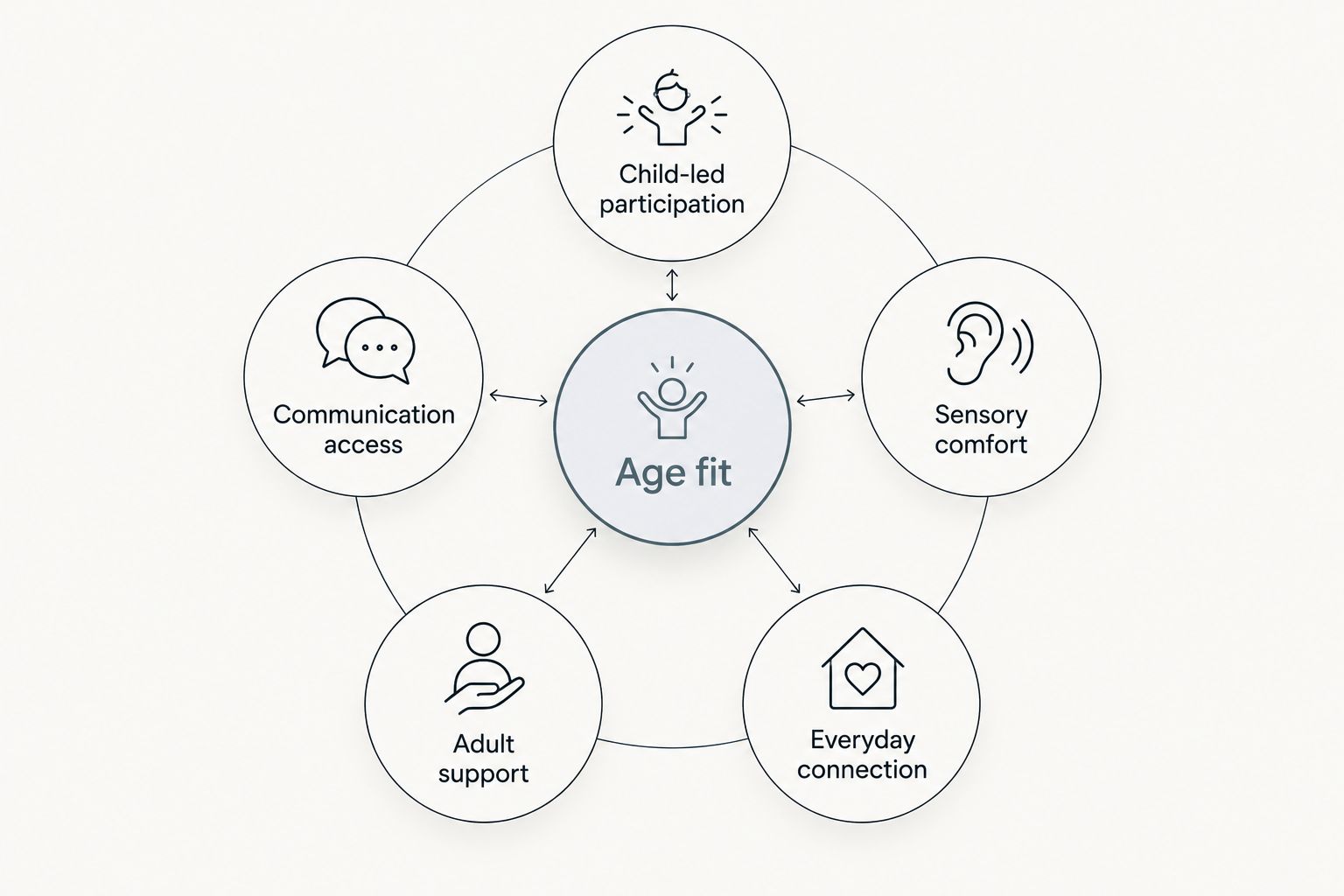
Judge every group against the same criteria before discussing enrollment:
- Child-led participation: Children can watch, approach gradually, and decline without being treated as uncooperative.
- Communication access: Adults welcome speech, gestures, pictures, and communication devices rather than requiring spoken answers.
- Sensory comfort: Ask about sound, lighting, movement, crowded spaces, and a place to pause.
- Age fit: Ask whether peers share toddler interests and support needs, not simply whether everyone meets an age requirement.
- Adult support: Clarify who leads, how adults help children communicate, and whether caregivers participate.
- Everyday connection: Favor goals such as sharing enjoyment or asking for help over performing eye contact or appearing less autistic.
Ask for examples. A program’s explanation of how it handles a child leaving the circle tells you more than a broad promise to build confidence.
Group formats at a glance
These are questions and characteristics to look for—not descriptions of confirmed offerings at any particular organization.
| Group format | Best for | Feature to look for | Key limitation |
|---|---|---|---|
| Parent-child play group | A supported first group experience | Caregiver involvement and flexible entry into play | Less suitable if caregivers cannot participate |
| Speech-supported play group | Communication during peer play | Help expressing choices, invitations, and refusals | Communication support alone does not address every sensory need |
| Sensory-aware movement group | Children who prefer active participation | Flexible movement and access to breaks | Movement spaces can also be noisy or busy |
| Music-based group | Children who enjoy musical interaction | Predictable songs and voluntary participation | Instruments and singing can be uncomfortable |
| Guided pretend-play group | Children curious about familiar make-believe routines | Simple play modeled without demanding imitation | Pretend play is not every toddler’s preferred activity |
1. Parent-child play: best for a supported first group
A parent-child format keeps a familiar adult involved while your toddler explores a shared space. Look for an arrangement that lets you follow your child’s lead rather than continuously prompting interaction.
Best for: A toddler who wants a caregiver nearby when meeting unfamiliar children or adults.
Ask what participation looks like if your child stays beside you. A welcoming answer should include options beyond joining a circle or sharing toys immediately.
Parent-child play group pros:
- Gives you a direct view of the group’s approach.
- Lets you explain your child’s gestures and preferences.
- Creates opportunities to practice supportive responses together.
Parent-child play group cons:
- Requires caregiver participation during the session.
- Can become adult-directed if caregivers are expected to prompt constantly.
For a 2026 shortlist, ask whether children can bring a familiar comfort item and whether watching counts as participation. These questions clarify expectations without requiring your toddler to demonstrate readiness first.
Verdict: Choose this as the default first format when caregiver presence helps your child feel secure.
2. Speech-supported play: best for communication during play
A speech-supported group places communication within shared activities. Look for adults who help children express interest, ask for help, refuse, or invite another child into play using their existing communication methods.
Best for: A toddler whose main support need is communicating with other people during play.
Ask how the group includes children who use gestures, pictures, or augmentative and alternative communication, often called AAC. Access to a communication device should continue during play, not depend on earning it.
Speech-supported play group pros:
- Connects communication goals with meaningful activities.
- Gives adults opportunities to model different ways to communicate.
- Allows shared play without making speech the only route to participation.
Speech-supported play group cons:
- An overly language-heavy session can leave little room for spontaneous play.
- Families still need to assess sensory comfort and physical accessibility separately.
Ask the leader to describe how they respond when a child pushes an activity away. Look for respect for that message, followed by an accessible choice—not pressure to repeat a particular word.
Verdict: Choose this when communication access is your main priority; skip groups that require speech before participation.
3. Sensory-aware movement: best for active participation
A sensory-aware movement format uses physical play as the setting for being together. Look for optional activities, room to pause, and alternatives to crowded or noisy equipment.
Best for: A toddler who prefers moving to sitting for adult-led activities.
Movement does not automatically make a group sensory-friendly. Ask about echoes, music, shared equipment, transitions, and how staff support a child who needs to leave an activity.
Sensory-aware movement group pros:
- Offers participation that does not depend on sitting still.
- Provides opportunities for simple shared routines.
- Can accommodate watching or playing alongside another child when leaders allow it.
Sensory-aware movement group cons:
- Busy movement spaces can feel overwhelming.
- Waiting for equipment can become the main activity without thoughtful planning.
Before choosing a movement group in 2026, explain what your child seeks and avoids: climbing, spinning, touch, sudden sounds, or close physical proximity. Ask how the activity changes in response, rather than accepting a general sensory-friendly label.
Verdict: Choose this when movement interests your child and the environment matches their sensory needs.
4. Music-based groups: best for children drawn to musical play
A music-based group can organize interaction around songs, rhythm, pauses, and shared instruments. Look for a leader who follows children’s responses and accepts listening as participation.
Best for: A toddler who already enjoys musical routines and has a comfortable way to manage sound.
Ask whether the session is a recreational music class or music therapy. Those descriptions are not interchangeable; clarify the leader’s role and the purpose of the group.
Music-based group pros:
- Offers a shared activity without requiring conversation.
- Gives children opportunities to request continuation or signal stop.
- Allows familiar routines to structure participation.
Music-based group cons:
- Singing and instruments can be uncomfortable for sound-sensitive children.
- A tightly directed performance format leaves less space for child-led interaction.
Ask whether children can decline an instrument, move away from the sound, or participate without singing. Autism Learn & Play offers music therapy among its services; confirm toddler group arrangements directly rather than assuming a particular class structure.
Verdict: Choose this for a child who enjoys musical interaction; skip settings that require tolerating distressing sound.
5. Guided pretend play: best for exploring familiar routines
A guided pretend-play format uses everyday actions—such as feeding a toy animal or putting a doll to bed—as invitations to play together. Look for simple modeling, familiar objects, and permission to use materials differently.
Best for: A toddler who shows curiosity about everyday routines but benefits from an adult demonstrating possibilities.
The starting point matters. When introducing pretend play, offer an action connected to your child’s interests and leave room for observation rather than demanding imitation.
Guided pretend-play group pros:
- Uses familiar actions as a starting point for shared activity.
- Offers opportunities to communicate choices without long explanations.
- Allows adults to follow a child’s preferred theme.
Guided pretend-play group cons:
- Adult scripts can crowd out a child’s own ideas.
- Children who prefer other kinds of play need equally valued alternatives.
Ask whether a child can explore an object without pretending. Holding a toy cup, sorting cups, and offering a cup to someone should not become a hierarchy of acceptable participation.
Verdict: Choose this when pretend play interests your child; skip groups that treat other play styles as wrong.
How the formats are ranked
This 2026 ranking puts a supported first experience ahead of a specialized activity. Parent-child play comes first because caregiver involvement is the deciding feature for that use case—not because it guarantees better results.
The remaining formats address distinct priorities: communication, movement, music, and pretend play. Your child’s interests can change the order completely. A music-loving toddler does not need to begin with a different format simply because it ranks higher here.
The criteria remain the same across every option: participation, communication access, sensory comfort, age fit, adult support, and everyday connection.
What to ask before a Brooklyn group visit
Use the same questions with every program so you can compare concrete answers:
- What ages and support needs does this particular group serve?
- Who leads the group, and what is their role?
- What happens when a child watches instead of joining?
- How do children request a break or communicate without speech?
- Where can a child go when the room feels overwhelming?
- What is the caregiver’s role before, during, and after the session?
Describe your child as a person, not a checklist: favorite activities, ways of saying no, comfort items, and signs that they have had enough. Include practical needs involving mobility, toileting, food, or safety.
Autism Learn & Play’s overall age range is 2–18 years, but that does not establish the age range of any individual group. A 2-year-old and an 18-year-old need different activities, peers, and expectations; ask specifically about toddler matching.
For current arrangements, use the website’s contact form and describe the kind of group experience you want. Ask about caregiver participation and the setting before deciding whether it fits.
Which group should you choose?
Choose parent-child play if you are undecided, then prioritize your toddler’s strongest interest and support needs. Speech-supported, movement, music, and pretend-play formats are alternatives—not steps every child must complete.
Autism Learn & Play is a local starting point for Brooklyn families seeking children’s therapy services and community programs. Confirm a specific toddler group’s structure before treating it as your match.
For your 2026 decision, value a clear explanation over a promise. You should know what adults do when your child communicates, needs space, or wants to stop.
FAQ
What are the best social skills groups for autistic toddlers?
The best social skills groups for autistic toddlers match the child’s communication, sensory needs, interests, and need for caregiver support. Parent-child play is a starting format to consider when a familiar adult helps your toddler feel comfortable.
Does my toddler need to talk before joining a social group?
Speech should not be a prerequisite for shared play. Ask how the group includes gestures, pictures, communication devices, and other ways your toddler expresses choices or refuses an activity.
Does Autism Learn & Play offer services for toddlers?
Autism Learn & Play serves children ages 2–18 through therapy services, community programs, and online classes. Contact the organization to confirm which specific services and group arrangements fit your toddler.
Is a music group better than a play group?
A music group is not automatically better than a play group. Choose according to your child’s interests, comfort with sound, communication access, and the leader’s willingness to adapt participation.
Should I stay with my toddler during a group?
Choose a caregiver-involved format if your toddler needs you nearby to feel comfortable or communicate. Ask the program to explain caregiver expectations before attending rather than assuming every group permits the same involvement.
What if my autistic toddler only watches other children?
Watching can be a valid way to participate. Ask leaders to leave room for observation and gradual engagement without forcing your child to join or treating quiet participation as failure.
How can I tell whether a toddler group is a good fit?
Look for respect for your child’s communication, room for breaks, and activities connected to their interests. Reconsider a setting that repeatedly dismisses distress or requires participation after your child signals no.
One last thing
Before asking whether your toddler joined in, ask whether the group listened. Respecting a child’s no is part of creating a place where their yes means something.
After an outing, note what interested your child, what felt uncomfortable, and what you want adults to change. Those observations give your next conversation a clearer starting point than judging the visit as a success or failure.
Related guides
- Is a social skills group right for a shy autistic child?
- Can group music therapy help autistic kids bond with peers?
- Can siblings join autism community programs together?