
Best overall for outings: comfortable passive earmuffs. Best for steady background noise: over-ear active noise-canceling headphones. Best for listening to audio: volume-limiting headphones. The best noise canceling headphones for autistic kids in 2026 match the sound your child wants reduced, fit comfortably, and let your child choose when to wear them.
- Choose noise canceling headphones for autistic kids by comfort, sound type, and your child’s preferences—not autism-specific marketing.
- Passive earmuffs are the simplest starting point for outings without music or charging.
- Active noise-canceling headphones target steady background noise; they do not remove every sound.
- Autism Learn & Play serves children ages 2–18; sensory-friendly outings need individual planning, not guaranteed results.
Why this matters
A noisy outing can make it harder for your child to enjoy the activity they came for. Headphones are one possible support, alongside a quieter route, breaks, a familiar companion, and permission to leave. They are not a requirement for participating or a treatment for autism.
Autism Learn & Play provides therapy services, community programs, and online classes for children on the autism spectrum. For families choosing sound supports, the useful question is whether a pair helps their child participate comfortably—not whether it carries an autism label.
This 2026 guide ranks headphone types by use case rather than naming an unverified product winner. That gives you a practical way to compare models without treating a feature list as proof that your child will tolerate the fit.
What makes the best headphones for autistic kids?
Use these criteria before choosing a model. A pair that reduces noise but feels uncomfortable is not the right pair for your child.
- Comfort and consent: Your child can accept, remove, or decline the headphones. Check pressure, warmth, and contact with the ears.
- Sound match: Distinguish steady background noise from voices, sudden sounds, and unwanted audio playback.
- Fit and seal: Ear cushions should sit comfortably without gaps caused by hair, glasses, or an unsuitable headband.
- Communication access: Your child needs a workable way to notice you, ask for help, and use their communication supports.
- Everyday practicality: Decide whether batteries, charging, cables, controls, and carrying space suit your routine.
- Age-appropriate choice: A younger child's needs and a teenager's preferences deserve different consideration. Age alone does not determine fit.
Do not assume that “noise canceling” means hearing protection. Active noise cancellation is a listening feature; protection from hazardous sound requires equipment designed and rated for that purpose. Check the manufacturer's instructions rather than relying on a marketplace title.
Best options at a glance
These are different equipment categories, not interchangeable promises. The order below reflects a starting point for family outings, followed by more specific needs.
| Option | Best for | Standout feature | Key limitation |
|---|---|---|---|
| Passive earmuffs | Outings without audio playback | Physical sound reduction without electronics | Pressure and heat can make them uncomfortable |
| Over-ear active noise-canceling headphones | Steady background noise during travel | Electronic cancellation of background sound | Voices and sudden sounds remain audible |
| Volume-limiting headphones | Online classes and chosen audio | A playback-volume limiting feature | Limiting audio does not necessarily reduce outside noise |
| Adjustable hybrid ANC headphones | Older children who want control | Active cancellation combined with a physical ear-cup seal | Controls and listening modes add complexity |
| Soft headband headphones | Audio when rigid ear cups are disliked | Fabric-based speaker placement | They are not a substitute for noise-reducing earmuffs |
1. Passive earmuffs: best for outings without audio
Passive earmuffs reduce sound through the materials and seal around the ears. They do not play music and do not need charging. For a child who wants less environmental sound rather than something to listen to, they are a straightforward starting point.
Try the fit somewhere familiar before taking earmuffs to an outing. A tight headband, warm cushions, or pressure against glasses can matter more to your child than the advertised sound-reduction rating.
Passive earmuffs pros:
- No audio playback to manage.
- No battery or charging routine.
- Simple to put on and remove.
Passive earmuffs cons:
- Headband pressure and ear-cup warmth can be uncomfortable.
- Reduced sound can make conversation harder to follow.
- Bulky ear cups take space in a bag.
Best for: Children who want quieter surroundings without music, including families planning museum visits or community activities.
Before your next outing, use the autism-friendly museums and attractions in NYC guide to shape your destination shortlist. Confirm the venue's current arrangements separately, and pack a quieter alternative to the main activity.
Verdict: Buy if your child accepts the fit and wants sound reduction without audio.
2. Over-ear ANC headphones: best for steady travel noise
Active noise-canceling headphones use microphones and electronics to counter incoming sound. ANC generally works better against steady background noise than unpredictable voices or sudden sounds. It does not create silence.
For a 2026 travel plan, separate the journey from the destination. A child who likes ANC during a ride might prefer no headphones once they reach a quiet activity. Test the feature without music first so your child can judge the cancellation itself.
Over-ear ANC headphones pros:
- Target steady background noise electronically.
- Can combine noise cancellation with chosen audio.
- Allow cancellation to be switched off on models with that control.
Over-ear ANC headphones cons:
- Depend on battery power for active cancellation.
- Do not remove every voice, announcement, or sudden sound.
- Some children dislike the sensation of active cancellation.
Best for: Children who find steady travel noise uncomfortable and accept over-ear headphones.
Keep announcements and your child's communication needs in mind. Establish a visual signal before the journey, and agree on when headphones need to come off for instructions.
Verdict: Hold until your child has tried active cancellation without audio.
3. Volume-limiting headphones: best for classes and chosen audio
Volume-limiting headphones are designed to limit playback volume. That is different from reducing environmental noise: a model can have a volume-limiting feature without active cancellation or meaningful isolation.
For online classes, audiobooks, or familiar music, examine both functions separately. Check how the limiter works with the device your child uses, and keep playback at a comfortable level rather than treating the limit as a listening target.
Volume-limiting headphones pros:
- Include a feature intended to limit playback volume.
- Support audio activities without broadcasting sound into the room.
- Offer an alternative to turning up speakers in a shared space.
Volume-limiting headphones cons:
- Do not necessarily reduce outside noise.
- Limit behavior depends on the model and connection.
- A limiter does not make prolonged or uncomfortable listening harmless.
Best for: Children whose main task is hearing an online lesson or chosen audio—not blocking an outing's noise.
Autism Learn & Play offers online classes as part of its services. Whether headphones suit an individual class depends on your child's comfort, communication needs, and the activity; ask about those needs rather than assuming headphones are required.
Verdict: Buy for an audio task after checking the limiter and fit; skip as an automatic solution for environmental noise.
4. Adjustable hybrid ANC headphones: best for older kids' control
Hybrid ANC uses microphones positioned inside and outside the ear cups. Headphones in this category combine electronic cancellation with the passive isolation provided by their fit. The label alone does not prove better comfort or better performance for your child.
For older children and teens, accessible controls can matter as much as cancellation. Look for a model whose documented controls let your child make the adjustments they want without navigating an unwanted app or confusing button sequence.
Adjustable hybrid ANC headphones pros:
- Combine passive isolation with active cancellation.
- Models with adjustable settings let the wearer change listening modes.
- Can support independent choices about audio and cancellation.
Adjustable hybrid ANC headphones cons:
- Settings and controls add decisions to manage.
- Battery charging remains part of the routine.
- A technical label does not establish a child-appropriate fit.
Best for: Older children and teens who want control over their listening setup and can comfortably use the chosen model.
For a 2026 purchase, review the exact model's instructions together. Let your teenager decide which features are useful and which create extra work.
Verdict: Hold until your child can comfortably use the fit and controls.
5. Soft headband headphones: best for avoiding rigid ear cups
Soft headband headphones place speakers inside a fabric band. They offer a different way to listen to audio, but they are not the same as noise-reducing earmuffs. Do not choose them on the assumption that soft fabric blocks environmental sound.
They belong on this list because the feel of conventional headphones can be the main obstacle. Your child still needs to accept the fabric, speaker placement, and warmth.
Soft headband headphones pros:
- Avoid a rigid over-ear shell.
- Offer a fabric-based alternative for audio listening.
- Provide another fit option to discuss with your child.
Soft headband headphones cons:
- Are not a substitute for rated hearing protection.
- Fabric and warmth can still be uncomfortable.
- Speaker position can shift as the band moves.
Best for: Children who want audio but dislike rigid ear cups, when reducing outside noise is not the main goal.
Verdict: Skip for noise reduction; consider only for a comfortable audio-listening setup.
How to try headphones without turning it into a struggle
A home trial lets your child explore the headphones without also managing a crowded setting. Treat removing them as useful feedback, not a failed test.
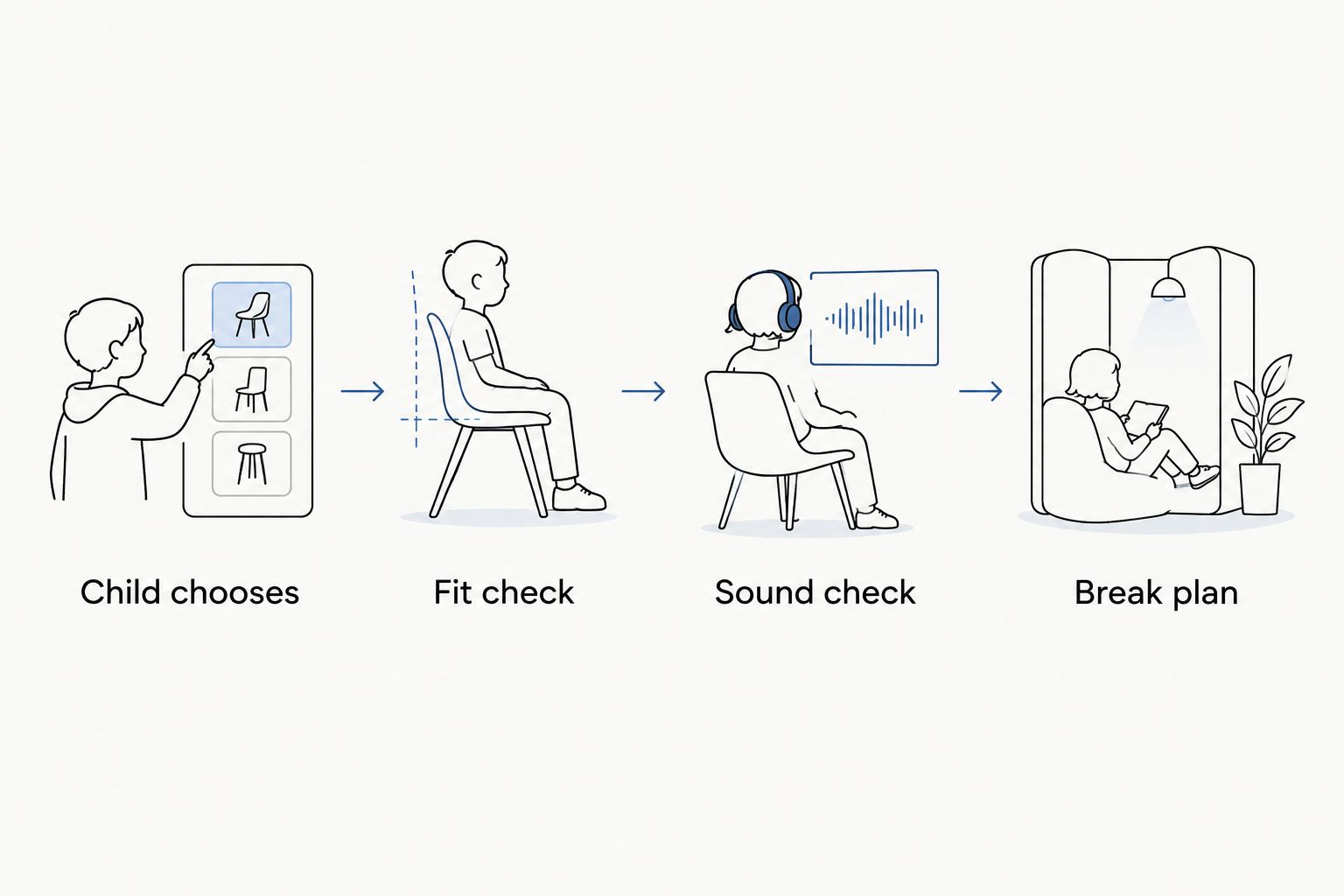
- Child chooses: Offer the headphones without insisting they be worn. Show how to remove them.
- Fit check: Notice pressure, warmth, glasses interference, and whether the cushions sit comfortably.
- Sound check: Try the relevant feature in a familiar environment. Keep audio separate from cancellation at first.
- Break plan: Agree on a word, gesture, or communication option for stopping or leaving.
Bring the same approach to a community outing. Identify a quieter place before you need it, and avoid making headphone use the condition for staying. Your child can enjoy connection while participating differently from other children.
Match the trial to your child's age
Ages 2–5 years: Offer simple choices and watch how your child responds to the physical fit. Use familiar gestures or communication supports rather than expecting a spoken explanation.
Ages 6–12 years: Invite your child to compare specific sensations: tight or loose, warm or comfortable, audio or no audio. Keep the outing plan understandable and flexible.
Ages 13–18 years: Include your teenager in the selection, appearance, controls, and carrying plan. Respect their preference to use headphones, choose another support, or decline an activity.
These age groups are planning prompts, not developmental rules. For your family's 2026 outing routine, start with what your child communicates and adjust from there.
How the options are ranked
This ranking prioritizes comfort, sound match, communication access, and everyday simplicity. Passive earmuffs lead for outings because they address environmental sound without adding audio or electronics; the other categories serve narrower listening needs.
The ranking does not certify individual models or promise sensory outcomes. Your child's accepted fit takes priority over the category's position in the table.
Which headphones should you choose?
Start with passive earmuffs when your goal is a quieter outing without audio. Choose ANC when steady background noise is the specific problem, and choose volume-limiting headphones when listening to a class or recording is the task.
Autism Learn & Play is best for families seeking autism therapy services, community programs, and online classes—not a headphone product. For questions about matching participation supports to an activity, contact the organization through its website contact form or info@autismlearnplay.org.
FAQ
What’s the best type of noise canceling headphones for autistic kids?
Comfortable passive earmuffs are a practical starting point for outings without audio. Active noise-canceling headphones suit steady background noise, while volume-limiting headphones serve audio-listening tasks. Your child’s preferences determine the final choice.
Are noise-canceling headphones the same as ear defenders?
No. Ear defenders or passive earmuffs reduce sound through their materials and fit, while active noise-canceling headphones use electronics. Check the exact model’s stated purpose and instructions.
Will ANC headphones block talking and sudden noises?
ANC headphones do not reliably remove talking or sudden noises. Active cancellation generally works better against steady background sound, so keep a break plan alongside the headphones.
Can my toddler try headphones for a noisy outing?
Your toddler can explore an age-appropriate option with adult supervision and a comfortable fit. Follow the manufacturer’s age guidance, allow removal, and never force the headphones to stay on.
Are volume-limiting headphones enough for a crowded museum?
A volume limiter controls playback, not necessarily the museum’s environmental noise. Check whether the model also provides passive isolation or active cancellation, and plan a quieter place to take a break.
What should I do if my child refuses headphones?
Respect the refusal and offer another support, such as a quieter route, a break, or leaving the activity. Headphones are optional; discomfort is a reason to change the plan, not increase pressure.
How should I choose headphones for my autistic teenager in 2026?
Choose headphones with your teenager, focusing on comfort, the sounds they want reduced, and controls they want to use. Let appearance and carrying preferences be part of the decision rather than choosing solely by an autism label.
One last thing
Ask your child what they want to hear, not only what they want to block. A friend's voice, a guide's explanation, or their own chosen music can change which option makes sense. The right support makes room for your child's preferences—not just a quieter environment.
Related guides
- Family support groups for autism in Brooklyn
- Social skills games for autistic teens
- Communication apps for nonverbal autism