Best starting point: Autism Learn & Play for Brooklyn families comparing individual support, social learning, and community programs. This 2026 guide separates mentoring from classes and ranks five class options to discuss—not verified mentor-matching programs—so you can choose your next conversation with confidence.
- For mentoring programs for autistic kids, Brooklyn families should confirm mentor continuity, safeguarding, and age fit before choosing.
- Autism Learn & Play offers Brooklyn-based services and online classes; classes are not automatically mentoring programs.
- Conversation: 1 on 1 is the first option to discuss when individual attention matters most.
- Social Skills Class deserves a closer look when your priority is opportunities to connect with peers.
- Ask about communication supports, sensory needs, and your child’s preferences before committing.
Why this matters
A mentor, a therapist, and a class instructor have different roles. Choose the relationship your child needs, not simply a program with a reassuring name. If your goal is a trusted adult who gets to know your child over time, ask specifically about ongoing mentoring and whether the same person returns.
Autism Learn & Play is a Brooklyn-based nonprofit serving children ages 2–18 on the autism spectrum through therapy services, community programs, and online classes. Its class catalog gives families concrete options to discuss, but a class listing alone does not establish mentor matching, ongoing staffing, or neighborhood outings.
For your 2026 search, decide whether you want individual encouragement, opportunities for friendship, help with a personal goal, or an activity outside the house. Those are different needs. An online class does not replace a Brooklyn outing if being together in person is the point.
What makes the best mentoring fit?
Use these criteria before comparing names. A suitable program should be able to explain its approach in plain language.
- Relationship continuity: Ask whether your child meets the same adult consistently and how staff changes are handled.
- Child-led goals: Look for room for your child’s interests, choices, refusals, and preferred ways of participating.
- Communication access: Ask how staff include speech, typing, gestures, communication devices, and quiet observation.
- Sensory flexibility: Discuss sound, movement, breaks, transitions, and a way to leave without pressure.
- Age and interest fit: Confirm the intended age range and whether activities respect older children’s interests.
- Safety and family communication: Ask about screening, supervision, boundaries, and how concerns reach a responsible adult.
The best fit respects your child’s boundaries while making room for connection. A promise to make a child appear less autistic is not a meaningful mentoring goal.
Options at a glance
These are listed online classes, not a ranking of independently verified Brooklyn mentoring organizations. The order follows family needs: individual attention first, then social learning, shared interests, personal planning, and music.
| Option | Best for | Verified format or feature | Key limitation |
|---|---|---|---|
| Conversation: 1 on 1 | Families prioritizing individual attention | 1-hour class conducted via Zoom | Not an in-person peer activity; mentor continuity needs confirmation |
| Social Skills Class | Families exploring social learning | 30-minute class conducted via Zoom | Peer participation and group structure need confirmation |
| Game Talk Class | Families exploring a game-related interest | 30-minute class conducted via Zoom | Specific games and interaction format need confirmation |
| Organization and Goal Setting | Families discussing personal planning support | 30-minute class conducted via Zoom | Not identified as ongoing mentoring |
| Music Class | Families considering a music-centered activity | 30-minute class conducted via Zoom | Not an in-person outing or a stated music therapy session |
1. Conversation: 1 on 1: best for individual attention
Conversation: 1 on 1 is a 1-hour online class conducted via Zoom. The individual format makes it the clearest first discussion when you want attention focused on your child rather than a peer activity.
Ask what “conversation” means in practice. Explain how your child communicates, whether a full hour feels manageable, and what makes an interaction comfortable. Do not assume spoken answers or uninterrupted participation are required—or that every alternative is already supported.
Conversation: 1 on 1 pros:
- The listing explicitly identifies an individual format.
- Zoom removes travel from the session itself.
- The stated duration lets you discuss pacing before choosing.
Conversation: 1 on 1 cons:
- An individual class does not itself provide peer friendship opportunities.
- The listing does not establish a continuing relationship with the same adult.
Best for: Families whose first priority is individual interaction rather than a group outing.
Verdict: Wait to enroll until communication access, pacing, and instructor continuity are clear.
2. Social Skills Class: best for exploring social learning
Social Skills Class is a 30-minute class conducted via Zoom. It belongs on your shortlist when you want to discuss social learning, but confirm whether children interact with peers and how those interactions are supported.
Describe a real situation your child wants help with, such as joining an activity or expressing a boundary. Ask whether the approach respects different communication styles rather than requiring eye contact, suppressing harmless stimming, or treating quiet participation as failure.
Social Skills Class pros:
- Social learning is the class’s stated subject.
- The 30-minute duration provides a clear planning point.
- Online delivery avoids a trip for the class itself.
Social Skills Class cons:
- The listing does not establish group size or peer interaction.
- Online participation does not provide a neighborhood outing.
Best for: Families exploring support for connection while protecting their child’s comfort and autonomy.
Verdict: Wait until the provider explains the group format and child-led goals.
Compare the individual and social-learning listings
Autism Learn & Play lists these options with different durations and formats. Use that distinction to prepare questions, not to assume either class provides ongoing mentoring.


3. Game Talk Class: best for exploring a game-related interest
Game Talk Class is a 30-minute class conducted via Zoom. Consider discussing it when games are something your child already enjoys, rather than choosing a game theme solely to encourage social participation.
Ask which games are involved, whether children play or discuss them, and what equipment is needed. For a teen, check that the content respects their age and interests. For a younger child, ask how instructions and transitions are introduced.
Game Talk Class pros:
- The title gives you a specific interest area to discuss.
- The listing states a defined session length.
- Zoom provides a home-based participation format.
Game Talk Class cons:
- The title does not establish which games or activities are used.
- Peer matching and ongoing relationships need confirmation.
Best for: Families whose child wants to explore a game-related activity.
Verdict: Wait until the actual games and participation expectations match your child’s interests.
4. Organization and Goal Setting: best for discussing personal goals
Organization and Goal Setting is a 30-minute class conducted via Zoom. It is an option to discuss when your child has a goal they want support with, rather than when an adult wants to impose a new routine.
Bring your child’s own priority into the conversation. Ask whether the class addresses that kind of goal, how activities are adapted, and whether families receive anything to use between sessions. Do not assume an ongoing coaching arrangement from the title.
Organization and Goal Setting pros:
- Organization and goal setting are explicitly named subjects.
- The listing provides a clear session duration.
- Online delivery avoids travel for the class.
Organization and Goal Setting cons:
- The listing does not establish individualized planning or follow-up.
- It does not identify an ongoing mentor relationship.
Best for: Families exploring support for a goal their child has helped choose.
Verdict: Wait until the provider confirms the class addresses your child’s specific priority.
5. Music Class: best for exploring a music-centered activity
Music Class is a 30-minute class conducted via Zoom. Discuss this option when your child expresses an interest in music and you want to understand the activity before introducing it.
Ask about instruments, recorded sound, volume, and whether listening without performing is welcome. The class name does not establish music therapy, individual instruction, or peer interaction; ask directly if any of those features matter to your family.
Music Class pros:
- Music is the clearly named activity area.
- The session length is stated.
- The online format avoids travel for participation.
Music Class cons:
- Sound levels and sensory adaptations need confirmation.
- The listing does not establish mentoring or music therapy.
Best for: Families exploring an activity around their child’s interest in music.
Verdict: Wait until the sound environment and participation choices are clear.
How these options are ranked
This 2026 shortlist ranks options by the family need they address, not by measured outcomes. Individual attention comes first because it is distinct from group participation; the remaining choices separate social learning, games, planning, and music.
The criteria remain the same throughout: relationship continuity, child-led goals, communication access, sensory flexibility, age fit, and safety. A class moves from “interesting” to “appropriate” only after you have clear answers about the features your child needs.
Plan a first meeting or Brooklyn outing
For any 2026 mentoring introduction, ask the organizer to describe arrival, participation, breaks, and departure. Knowing what happens at the doorway matters just as much as knowing the activity’s name.
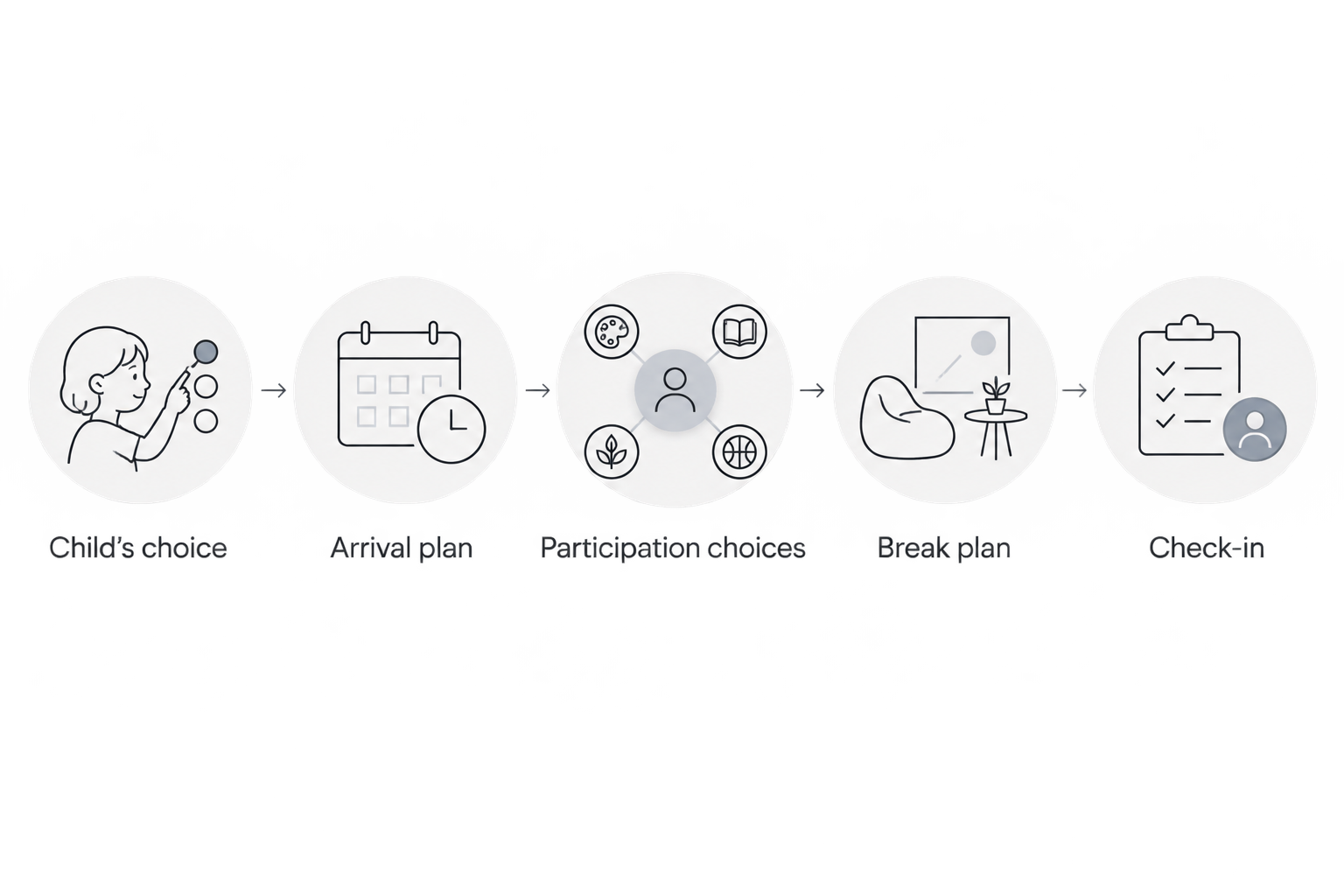
Use this sequence whether you are discussing a community group or arranging an introductory meeting:
- Child’s choice: Offer an understandable description and ask what your child wants to try—or avoid.
- Arrival plan: Confirm who greets your family, where you meet, and whether you can stay nearby.
- Participation choices: Ask whether watching, using a communication device, moving, or declining an activity is accepted.
- Break plan: Identify how your child requests a pause and where that pause happens.
- Check-in: Afterward, ask what felt comfortable and what your child would change.
For a toddler, ask how a caregiver participates and how staff respond when the child needs to stop. For a school-age child, discuss shared interests and how introductions happen. For a teenager, include the young person directly in decisions about activities, privacy, and who receives updates.
A sibling’s presence also deserves a separate question. Do not assume siblings can attend, supervise, or join the same activity simply because a program serves families.
Which option should you choose?
For individual attention, start by discussing Conversation: 1 on 1. For friendship opportunities, ask about actual peer participation before choosing Social Skills Class or any community program. Neither a class title nor a social-learning label guarantees a continuing relationship.
If you specifically want in-person mentoring in Brooklyn in 2026, request details about that service rather than accepting an online class as an equivalent. Ask who your child would meet, where meetings happen, and how continuity is maintained.
Use the contact form to explain your child’s interests, communication preferences, sensory needs, and whether your priority is a trusted adult, peers, or an outing. Autism Learn & Play can then address your questions about its services without your family having to guess from class names.
FAQ
What’s the best mentoring program for an autistic child in Brooklyn?
The best fit is a program that matches your child’s interests, communication needs, age, and wishes for connection. Ask specifically about mentor continuity and safeguarding; a therapy service or online class is not automatically a mentoring program.
Does Autism Learn & Play offer mentor matching?
The services and class listings described here do not establish a mentor-matching program. Contact Autism Learn & Play to ask whether ongoing mentoring is offered and how it differs from classes, therapy, or community programs.
Is a social skills class the same as mentoring?
No, a social skills class is not automatically mentoring. Ask whether the class involves peers, whether the same adult returns, and whether support continues around goals your child has chosen.
Can a nonspeaking autistic child take part in mentoring?
Spoken language should not be treated as a prerequisite for connection. Ask each program how it supports your child’s communication method, including gestures, typing, or a communication device, before choosing.
What should I ask before a first Brooklyn outing?
Ask about the meeting place, supervision, sensory conditions, breaks, bathrooms, and departure arrangements. Explain your child’s communication preferences and confirm whether a caregiver can remain nearby.
Are online classes a replacement for making friends in person?
Online classes are a different participation format, not a direct replacement for an in-person friendship opportunity. If your child wants local friends, ask specifically about repeated peer contact and community activities.
How do I choose an activity for an autistic teenager?
Include your teenager directly in the choice and check that the activity respects their age and interests. Ask about privacy, participation choices, peer ages, and how staff respond when a young person declines.
One last thing
Before asking whether your child participated “well,” ask whether your child had a real way to say no. Watching, taking a break, or deciding not to return can tell you something useful about fit.
For your 2026 search, keep one question at the center: Does this relationship make room for my child as they are? Connection should not require giving up comfort, communication, or choice.
Related guides
- Social skills groups for school-age kids with autism
- Can siblings join autism community programs together?
- Autism-friendly museums and attractions in NYC