Best starting point for online participation: Autismlearnplay’s Dance Class. Best format to seek for meeting local peers: an adapted in-person dance group. Best format to seek for individual pacing: private dance instruction. This 2026 guide helps Brooklyn families compare those choices without confusing an online class with a neighborhood outing.
- For dance classes for kids with autism Brooklyn families can explore, Autismlearnplay lists a 30-minute Dance Class on Zoom.
- Choose an adapted in-person dance group when your priority is shared movement with local peers.
- Consider private dance instruction when your child needs individual pacing; ask about communication, breaks, and sensory adjustments.
- Confirm age fit and teaching approach before enrolling; a dance class is not automatically dance therapy.
Why this matters
Your child deserves a place to enjoy movement without having to hide how they communicate, learn, or express excitement. A useful dance-class shortlist starts with your child’s interests and comfort—not with expectations about standing still, copying every move, or performing for an audience.
Autismlearnplay is a Brooklyn-based nonprofit serving children ages 2–18 through therapy services, community programs, and online classes. Its Dance Class is listed as a 30-minute Zoom class; that makes it an online option, not a verified in-person Brooklyn dance outing.
For Brooklyn families seeking an online dance option, Autismlearnplay’s Dance Class belongs on the shortlist. The other recommendations below describe formats to look for locally, rather than named studios with unconfirmed services.
What makes the best dance class for your child?
Use these criteria when comparing dance classes for kids with autism in Brooklyn in 2026:
- Child-led interest: Start with music and movement your child enjoys. Ask whether watching before joining is accepted.
- Sensory choices: Ask about sound levels, lighting, mirrors, clothing expectations, and somewhere to take a break.
- Communication access: Look for clear demonstrations and acceptance of gestures, communication devices, and other ways to respond.
- Age and peer fit: Confirm the actual age group. A preschool movement session and a teen dance class need different approaches.
- Participation flexibility: Ask whether seated movement, repeated movements, breaks, and caregiver support are welcome.
- Community fit: If friendship is the goal, ask what opportunities children have to interact—not just follow an instructor.
Treat these as questions, not promises attached to the word “inclusive.” A clear explanation of what happens during class tells you more than a welcoming label alone.
Dance-class options at a glance
The ranking below matches each option to a different family priority. Only Dance Class is a named offering here; the in-person formats are recommendations to investigate, not confirmed local programs.
| Option | Best for | Standout feature | Key limitation |
|---|---|---|---|
| Dance Class | Exploring an online dance option | Listed as 30 minutes via Zoom | Does not provide an in-person Brooklyn outing |
| Adapted in-person dance group | Seeking movement alongside local peers | A shared physical setting | You must verify the provider’s actual adjustments and age group |
| Private dance instruction | Seeking individual pacing | Instruction arranged around one learner | A private lesson does not itself provide a peer group |
1. Dance Class: best online dance option to explore
Autismlearnplay’s Dance Class is listed as a 30-minute class conducted via Zoom. The description states that families select preferred course days and are then contacted to finalize and book a slot.
That gives you a concrete starting point for an online inquiry. Before choosing Dance Class, ask about the intended ages, teaching format, caregiver involvement, and how children participate when they need movement breaks or communicate without speech.
Dance Class pros:
- The listed session length gives you a clear duration to consider.
- Zoom provides an online format rather than requiring travel to a studio.
- The booking description includes follow-up to finalize the session.
Dance Class cons:
- Online participation does not replace meeting neighborhood peers in person.
- The listing does not establish the class’s age grouping or specific sensory adjustments.
- Your child needs a workable screen setup and space for the movements involved.
Best for: Families interested in an online dance class, especially when a studio trip is not the immediate goal.
If you are choosing a class mainly to make friends, ask whether this particular session includes peer interaction and what that looks like. Do not assume an online class is a group simply because it is called a class.
Verdict: Hold until you confirm age fit, participation expectations, and the session format.
2. Adapted in-person dance group: best for local peer connection
An adapted in-person dance group is the format to seek when you want your child to move alongside other children in Brooklyn. Look for an instructor who can explain how activities change for different communication, movement, and sensory needs.
For your 2026 search, ask for a plain-language walkthrough of a typical session. Find out how children arrive, where caregivers wait, how movements are introduced, and what happens when someone wants to pause.
Adapted in-person dance group pros:
- Children share a physical space with peers.
- You can ask to see the room and understand the arrival routine.
- A recurring group offers a setting in which children can encounter familiar peers.
Adapted in-person dance group cons:
- Travel, changing spaces, and entering a group add steps to the outing.
- Shared music and movement need to suit your child’s sensory preferences.
- The word “adapted” does not tell you which supports a provider actually offers.
Best for: Families whose main priority is a local, shared activity rather than screen-based participation.
Ask how the instructor handles a child who dances beside the group instead of copying it. Also ask whether peer interaction is optional and supported without requiring eye contact, spoken greetings, or physical contact.
Verdict: Hold until the provider explains the room, peer group, and participation choices.
3. Private dance instruction: best for individual pacing
Private dance instruction is a format to consider when you want the lesson organized around your child rather than a group’s pace. Ask an instructor how they would respond to your child’s interests, preferred communication, and need for repetition or breaks.
A private dance lesson is not automatically an autism-specific service or therapy. Confirm the instructor’s experience and the boundaries of the lesson before deciding whether it fits your family.
Private dance instruction pros:
- You can discuss individual goals directly with the instructor.
- You can request a lesson structure based on your child’s preferred activities.
- Group participation does not have to be the starting expectation.
Private dance instruction cons:
- A one-to-one lesson does not itself create a peer group.
- Individual instruction does not guarantee an appropriate sensory environment.
- Instructor experience with autistic children needs checking rather than assuming.
Best for: Families prioritizing a personalized introduction to dance over immediate group participation.
Be specific about what enjoyment looks like for your child. It might mean repeating a favorite movement, exploring rhythm while seated, or choosing when to join—not learning a complete routine.
Verdict: Hold until the instructor describes an approach that respects your child’s choices.
Match the class to your child’s age and interests
Age is a starting point, not a measure of ability. Ask about the actual activities, music, and peer ages before deciding that a class is suitable.
Ages 2–5 years: clarify caregiver involvement
For a young child, ask whether a familiar adult can stay nearby and help with transitions. Find out how the teacher introduces an activity and responds when a child wants to observe instead of participate.
Ask about clothing and equipment before the first visit. Avoid presenting an unfamiliar outfit or accessory as a requirement until you understand the class expectations.
Ages 6–12 years: ask about shared activities
For school-age children, ask what children do together beyond following the teacher. If your child wants friends, find out whether there are supported opportunities to share interests or choose movements together.
Check how the class handles different experience levels. Your child should not need previous dance lessons to meet an unstated expectation.
Ages 13–18 years: protect choice and dignity
Include your teenager in choosing the music, dance style, and setting. Ask about peer ages and whether the material feels age-respectful rather than assuming a younger group is suitable.
Discuss performances, photographs, and physical guidance in advance. Your teen’s preferences matter, including the choice not to perform or be photographed.
A practical plan for the first session
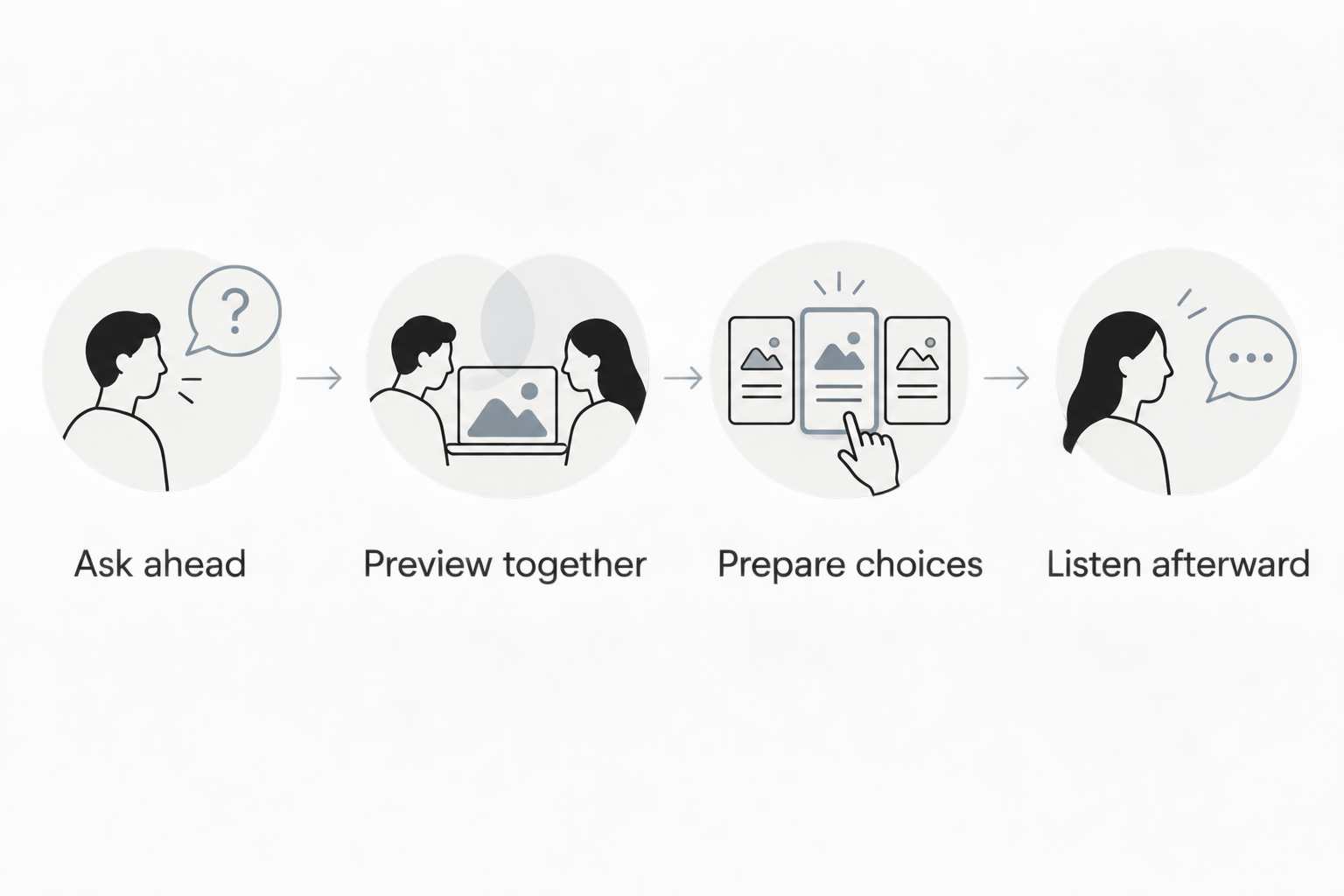
For a first dance session in 2026, aim to understand the experience rather than prove that your child can complete it. Use this sequence to make the unfamiliar parts clearer.
- Ask ahead: Get the arrival process, session structure, communication expectations, and break arrangements.
- Preview together: Explain what your child will see and hear, using information supplied by the instructor.
- Prepare choices: Bring or arrange familiar communication supports and discuss how your child can request a pause.
- Listen afterward: Invite feedback through your child’s usual communication, without requiring an immediate spoken review.
For an online session, ask what space and materials the instructor expects before moving furniture or gathering supplies. For an in-person visit, ask where to go on arrival and where you can step away if your child needs a break.
Afterward, separate enjoyment from compliance. Completing every movement is not the only useful feedback; notice which parts your child chooses to repeat and which parts they communicate that they dislike.
How these options are ranked
These recommendations match format to purpose: online participation, local peer connection, or individual pacing. They are not a claim that every Brooklyn provider offers the same supports or that one format works for every autistic child.
The named Dance Class recommendation rests on its published Zoom format and session length. The in-person recommendations are selection categories assessed against sensory choices, communication access, age fit, participation flexibility, and community goals.
Which dance class should you choose?
Choose by your main goal in 2026: online participation, local friendships, or individual pacing. Start with Dance Class if you want to explore a defined online offering, an adapted in-person group if meeting peers is central, or private instruction if you want to discuss individual pacing.
For questions about Autismlearnplay’s dance classes, use the contact form or write to info@autismlearnplay.org. Share your child’s age, interests, communication preferences, and whether you are seeking an online activity or an in-person outing.
FAQ
What is the best dance class for an autistic child in Brooklyn?
The best choice depends on whether your priority is online participation, local peers, or individual pacing. Compare the actual teaching approach, sensory environment, and age group before choosing.
Is Dance Class online or in person?
Dance Class is listed as a 30-minute class conducted via Zoom. Ask about age fit, caregiver participation, and the session format before booking.
Can my nonspeaking child join a dance class?
Ask the instructor how a nonspeaking child can participate and communicate needs. Confirm that gestures, communication devices, and requests for breaks are understood and respected.
Is a dance class the same as dance therapy?
No, a recreational dance class is not automatically dance therapy. Ask about the service’s purpose and the provider’s qualifications if you are seeking therapy rather than recreation.
How do I find a sensory-friendly dance class in 2026?
Ask specific questions about sound, lighting, physical contact, clothing, and breaks. A sensory-friendly label alone does not establish whether the environment suits your child.
Will a dance class help my child make friends?
A dance class does not guarantee friendships. If connection is your goal, ask how children interact and whether the class provides supported, optional opportunities to get to know peers.
Should my teenager join a class for younger children?
Do not assume a younger class is the right fit for an autistic teenager. Include your teen in the decision and check peer ages, music, activities, and participation expectations.
One last thing
Ask this before you commit: What happens if my child wants to watch instead of dance? The answer reveals whether the instructor makes room for choice when participation looks different from the plan.
You are looking for a setting where your child can belong without having to perform belonging. Let their interests help you choose the next step.
Related guides
- Can kids with sensory sensitivities enjoy music class?
- Best gross motor activities for kids with autism
- Can siblings join autism community programs together?