Best overall fit: interest-led peer groups. Best for communication support: clinician-facilitated groups. Best for school-day connections: school-based groups. This 2026 guide helps Brooklyn families compare formats, recognize a welcoming setting, and choose an experience around their child—not a promise to change who their child is.
- For social skills groups for school age autism, prioritize shared interests, communication access, and your child’s willingness to participate.
- Interest-led peer groups are the default recommendation when your child wants connection through a favorite activity.
- Clinician-facilitated groups suit families seeking communication support alongside peer activities.
- Autism Learn & Play offers Brooklyn community programs; ask directly about current school-age options and individual supports.
Why this matters
Making friends should not require your child to hide their interests, stop harmless movement, or speak when another communication method works better. Start with a simpler question: where can your child comfortably spend time with other children?
For your 2026 search, separate the activity from the support around it. A building club and a conversation group offer different experiences, even when both describe themselves as social skills groups.
Autism Learn & Play is a local starting point for Brooklyn families seeking autism services and community programs. Explore the nonprofit’s services, then ask specifically about school-age peer opportunities. The formats below are recommendations for comparing groups, not a directory of confirmed offerings at the nonprofit.
What makes the best social skills group?
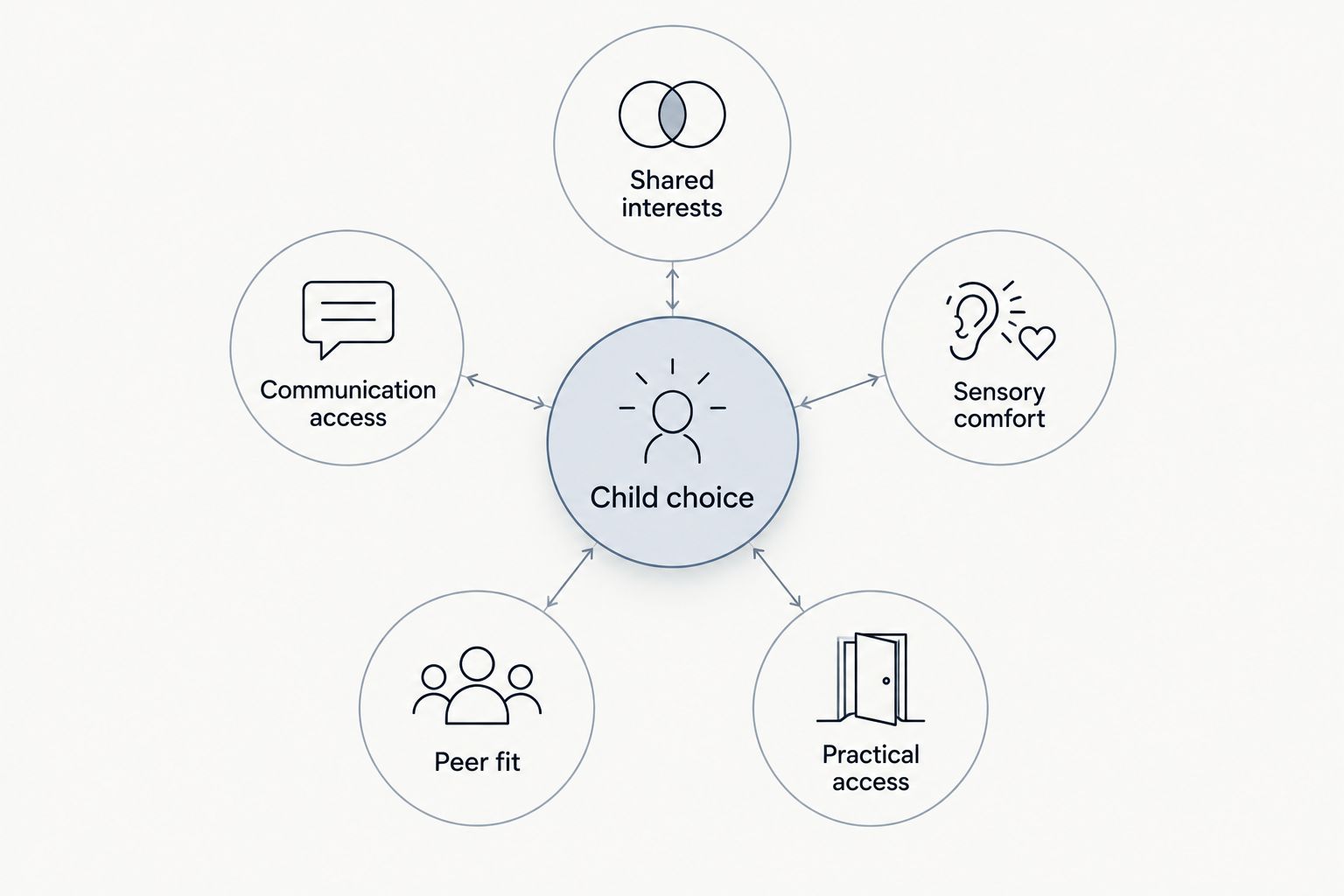
Use these criteria before comparing program names. A thoughtful answer matters more than a broad promise about confidence or friendship.
- Shared interests: Ask what children actually do together and whether your child wants to try it.
- Communication access: Ask how staff include speech, gestures, writing, and augmentative and alternative communication, or AAC.
- Sensory comfort: Ask about sound, lighting, movement, breaks, and somewhere to step away.
- Child choice: Look for ways to observe, decline an activity, request help, or leave without punishment.
- Peer fit: Consider interests, communication styles, and maturity alongside age. A hypothetical 6-year-old and 16-year-old need different activity choices.
- Practical access: Check the journey, caregiver expectations, accessibility, and whether the routine fits your family.
Ask for examples. Instead of accepting a description such as individualized support, ask what happens when a child wants to watch rather than join.
Social skills group formats at a glance
These 2026 recommendations rank formats by their purpose, not by measured effectiveness or provider quality. Confirm each group’s actual structure before enrolling.
| Rank and format | Best for | Standout feature to seek | Key limitation |
|---|---|---|---|
| 1. Interest-led peer group | Connecting through a favorite activity | A shared project with flexible participation | Shared interests alone do not establish accessibility |
| 2. Clinician-facilitated group | Communication support during peer activities | Individual communication goals within group activities | A clinician’s presence does not guarantee a good peer match |
| 3. School-based group | Connections within the school day | Activities involving school peers and situations | Participation arrangements depend on the school |
| 4. Play-based small group | Younger school-age children who prefer play | Parallel play and shared play without forced interaction | Activities can feel too young for older children |
| 5. Teen interest and self-advocacy group | Older students seeking age-respectful connection | Teen-selected topics and ways to express preferences | An age label does not establish maturity or interest fit |
1. Interest-led peer groups: best for shared interests
An interest-led group gives children something specific to do together: build, draw, play a game, or explore another shared interest. Choose the activity your child enjoys, rather than an activity adults believe should interest them.
This is the default recommendation when the goal is enjoyable time with peers. Ask whether children can work alongside one another before sharing materials or joining a joint project.
Best for: Children who want company around an existing interest.
Interest-led group pros:
- A shared activity provides a reason to gather.
- Children can contribute ideas through different communication methods.
- A project can offer an alternative to conversation-only participation.
Interest-led group cons:
- An appealing topic does not establish staff experience or sensory accessibility.
- Competition, complicated rules, or crowded materials can make the activity a poor fit.
Ask the organizer how they handle different preferences within the same interest. Children who love the same game do not necessarily want to play it the same way.
Verdict: Choose interest-led groups first when your child wants the activity and the organizer can explain the supports.
2. Clinician-facilitated groups: best for communication support
A clinician-facilitated group combines peer activities with support from a relevant professional, such as a speech-language pathologist. Confirm the facilitator’s credentials and role rather than assuming every social skills group is a therapy service.
Ask what participation looks like for your child. For example, discuss whether a child can use AAC to suggest a game, request a turn, decline, or ask for a break.
Best for: Children whose families want communication support within peer activities.
Clinician-facilitated group pros:
- Families can discuss specific communication priorities with the facilitator.
- Activities can include requesting, negotiating, and expressing preferences.
- Parents can ask how communication supports will be incorporated.
Clinician-facilitated group cons:
- Professional credentials do not establish compatibility between participants.
- A heavily adult-directed session can leave little room for child-led interaction.
Ask whose goals guide the group. A child’s ability to say no deserves attention alongside joining in or taking turns.
Verdict: Choose clinician-facilitated groups when the goals reflect your child’s needs and preferred communication.
3. School-based groups: best for school-day connections
A school-based group brings the search into your child’s existing school community. Ask the school team whether there are peer activities, supported clubs, or other group opportunities relevant to your child.
For 2026 planning, find out what the group actually does and who participates. A session focused on adult-led discussion is different from a shared activity involving children your child sees during the school day.
Best for: Families prioritizing connections with school peers.
School-based group pros:
- Activities can address situations your child encounters at school.
- Families can ask school staff about participation across settings.
- A school-based opportunity can avoid a separate after-school journey.
School-based group cons:
- The school determines its own participation arrangements.
- A group label does not tell you whether activities match your child’s interests.
Ask how your child’s preferences will be included and whether participation replaces another valued activity. Protecting time your child enjoys belongs in that conversation.
Verdict: Choose school-based groups when school friendships are the priority and your child welcomes the format.
4. Play-based small groups: best for younger school-age children
A play-based group uses activities such as pretend play, building, or collaborative art as the setting for spending time together. Look for permission to watch, play alongside others, and join when ready.
Age matters, but so do preferences. Do not assume every younger child wants pretend play or every older child has stopped enjoying toys.
Best for: Younger school-age children who prefer hands-on play to a discussion-based group.
Play-based group pros:
- Children can participate through actions as well as words.
- Activities offer opportunities to share ideas and materials.
- Familiar play materials can give children an appealing starting activity.
Play-based group cons:
- Noise, movement, or crowded play areas can be uncomfortable.
- Materials selected for younger children can feel inappropriate to older participants.
Ask whether staff require children to share immediately or interrupt solitary play to produce interaction. Look for invitations and support instead of pressure.
Verdict: Choose play-based groups when the materials, space, and participation expectations suit your child.
5. Teen groups: best for interests and self-advocacy
A teen group should respect older students’ interests and give participants a say in what happens. Ask about opportunities to choose activities, set boundaries, communicate disagreement, and decide how to participate.
Do not select a teen group solely because your child meets the age requirement. Ask your teen what they want from the experience, including whether they want a group at all.
Best for: Older school-age students seeking age-respectful peer connection.
Teen group pros:
- Teen-selected topics put participants’ preferences at the center.
- Activities can include expressing boundaries and asking for support.
- Shared interests provide an alternative to rehearsed conversation exercises.
Teen group cons:
- A broad age range can include very different interests and expectations.
- A group described as advanced can still exclude a teen’s communication needs.
Ask whether AAC users and quieter participants can shape activities, not merely attend them. Participation should not depend on being the quickest speaker.
Verdict: Choose teen groups with your teen, not simply for your teen.
How these formats are ranked
The order follows a family decision path: start with what your child wants to do, then consider communication support, school connections, play preferences, and teen priorities. It is not a claim that one format produces better outcomes.
Shared interests, communication access, sensory comfort, child choice, peer fit, and practical access remain the criteria throughout. No format earns a recommendation when the actual group fails those checks.
What to ask before a first visit
Turn your 2026 shortlist into a conversation. Describe what your child enjoys, how your child communicates, and what makes a setting uncomfortable.
Use these questions to understand the experience:
- Arrival: Can your child see the space or hear the plan beforehand?
- Participation: Can your child observe before joining and decline an activity?
- Support: Who helps with communication, breaks, or disagreements?
- Caregivers: Where do parents wait, and how are concerns shared?
- Leaving: What happens if your child wants to leave early?
Autism Learn & Play serves children ages 2–18 through therapy services, community programs, and online classes. Ask about the specific school-age experience rather than assuming every offering serves every age or includes a peer group.
Use the contact form to describe your child’s interests and ask about current options. Request concrete details about activities, age matching, communication access, and caregiver involvement.
Which social skills group should you choose?
Start with an interest-led group if your child wants shared activities with peers. Choose clinician-facilitated support when communication needs are central, or a school-based opportunity when school-day connections are the priority.
For younger children, compare the actual play experience. For teens, give the young person a meaningful role in the decision. A group that sounds impressive but disregards your child’s preferences is not the right default.
For your 2026 decision, judge the first experience by comfort, access, and willingness to return—not by how much your child talks or how quickly a friendship appears. Your child does not owe anyone an immediate connection.
FAQ
What’s the best social skills group for a school-age autistic child?
An interest-led group is the default recommendation when your child wants to spend time with peers around a favorite activity. Confirm communication access, sensory supports, and permission to participate at your child’s pace.
Is a therapy group better than a community activity?
Neither format is automatically better; choose according to your child’s goals and the actual support provided. Compare clinician-facilitated groups for communication support and community activities for an appealing shared interest.
Can a nonspeaking child join a social skills group?
Ask each organizer whether the group supports your child’s communication method. Request specific examples of how AAC, gestures, or other communication will be included during activities and breaks.
What should I do if my child only wants to watch?
Look for a group that allows observation without pressure to join immediately. Ask the facilitator how your child can watch, communicate preferences, and decide whether to participate.
Should autistic teens attend the same group as younger children?
Choose according to interests, maturity, communication access, and your teen’s preferences rather than assuming a mixed-age group fits. Ask what activities participants actually do and how teens help choose them.
Does Autism Learn & Play offer support for school-age children?
Autism Learn & Play serves children ages 2–18 through therapy services, community programs, and online classes. Ask through the website contact form or info@autismlearnplay.org about current school-age options and whether a suitable peer activity is offered.
How do I know whether a group is a good fit?
Ask your child whether they want to return, using their preferred communication method. Also consider whether staff respected boundaries, provided communication access, and responded appropriately when your child needed a break.
One last thing
Ask the facilitator one revealing question: what happens when a child says no? Listen for an explanation that respects refusal and offers choices, rather than treating participation as something to obtain at any cost.
A welcoming group leaves room for different ways of connecting. Sometimes the next step is another visit; sometimes it is choosing something else together.
Related guides
- Is a social skills group right for a shy autistic child?
- Social skills games for autistic teens
- Family support groups for autism in Brooklyn