
Best starting point for families seeking ABA alongside community programs: Autism Learn & Play. For Brooklyn families comparing ABA therapy providers in 2026, the best choice depends on your child’s goals, comfort, communication, and the setting where support is needed—not a provider’s position on a list.
- ABA therapy providers Brooklyn: choose by your child’s goals, comfort, and daily routines—not a universal ranking.
- Autism Learn & Play offers ABA, other therapy services, community programs, and online classes for children ages 2–18.
- Compare home-based, center-based, and school-collaborating providers by what your child actually needs.
- Ask every provider about breaks, communication supports, supervision, and how families help choose goals.
Why this matters
Choosing ABA means choosing people who will spend time with your child. You deserve clear explanations, respectful goals, and room to ask questions without pressure.
A Brooklyn family seeking help with getting ready for school has a different starting point from a teenager who wants support joining an activity. Your shortlist should reflect that difference. Friendship, comfort, and your child’s preferences belong in the conversation—not just a list of skills to practice.
This 2026 guide compares one named nonprofit with three provider formats. The formats are options to investigate, not endorsements of unnamed organizations or claims that one setting produces better results.
What makes the best ABA provider for your family?
Use these criteria before comparing names:
- Child-centered goals: Ask how your child’s interests, choices, and signs of discomfort shape the plan. Request examples connected to daily life.
- Respectful participation: Ask what happens when your child says no, needs a break, or communicates without speech. Request a concrete example rather than a general reassurance.
- Qualified oversight: Ask who assesses your child, who supervises sessions, and how you can verify relevant credentials and New York licensure.
- Setting fit: Compare where support happens with where your child needs it. Do not assume a skill practiced in one place automatically carries into another.
- Family partnership: Ask how caregivers contribute, how progress is explained, and how goals change when something is not working.
- Practical fit: Discuss travel, session structure, school commitments, and coordination with existing supports before agreeing to a plan.
Brooklyn ABA options at a glance
The order below starts with a local organization offering multiple forms of support, then separates provider searches by setting. It is a decision guide, not a ranking of clinical outcomes.
| Provider or provider format | Best for | Distinguishing feature | Key limitation |
|---|---|---|---|
| Autism Learn & Play | Families exploring therapy alongside community activities | Brooklyn nonprofit offering ABA, other therapies, community programs, and online classes for ages 2–18 | Confirm the specific ABA setting, approach, and coordination arrangements directly |
| Home-based ABA provider | Families prioritizing routines at home | Sessions take place in the home | Home sessions do not automatically include peer activities or community outings |
| Center-based ABA provider | Families seeking support outside the home | Sessions take place at a provider’s location | Travel and the unfamiliar environment need consideration |
| ABA provider collaborating with school | Families prioritizing consistency around school goals | Collaboration focuses on communication between the provider, family, and school | Collaboration does not replace school services or establish permission to work on campus |
1. Autism Learn & Play: best for exploring therapy and community
Autism Learn & Play is a Brooklyn-based nonprofit providing therapy services, community programs, and online classes for autistic children ages 2–18. Its services include ABA, speech, occupational, music and art therapy, and tutoring.
Autism Learn & Play is a starting point for Brooklyn families who want to explore ABA therapy and community programs through the same organization. Ask how those services relate to your child’s particular needs; a broad service list does not establish that every service belongs in your child’s plan.
Strengths to consider
- ABA appears alongside other therapy and educational services.
- Community programs give families another area to ask about beyond individual therapy.
- The stated age range includes children and teenagers, rather than only preschoolers.
Limits to check
- The service list alone does not explain the ABA session setting, supervision arrangements, or approach to participation.
- Online classes and community programs should not be treated as interchangeable with individualized therapy.
For your 2026 inquiry, describe something your child enjoys and one everyday situation where support would help. Ask what an initial conversation involves and which questions the team needs answered before recommending a service.
Best for: Families exploring therapy, learning, and community participation together.
Verdict: Hold on committing to a plan until the proposed support matches your child’s needs.
2. Home-based ABA providers: best for home-routine priorities
A home-based ABA provider delivers sessions in your home. This is a provider format to investigate when your questions center on routines such as getting ready, communicating during play, or moving between activities.
Ask what a session would look like in your actual space. Discuss who participates, what materials are needed, and how the provider protects family downtime.
Home-based provider pros
- You can discuss goals in the place where home routines happen.
- Caregivers can ask about their role using familiar activities and materials.
- The therapy session itself does not require a trip to a separate center.
Home-based provider cons
- Sessions use family space and require agreement about privacy and household routines.
- Home-based work does not, by itself, provide a peer group or an outing.
If friendship is a priority, ask how the plan connects with your child’s chosen activities outside the home. Do not assume a home session includes opportunities to meet other children.
Best for: Families whose immediate priorities involve everyday home routines.
Verdict: Hold until the provider explains session boundaries and caregiver expectations.
3. Center-based ABA providers: best for an outside-home setting
A center-based ABA provider delivers sessions at its own location. Consider this format if your family wants to explore a dedicated therapy setting rather than hosting sessions at home.
Request a visit before making a decision. Look at the actual space your child would use, and ask about noise, lighting, transitions, bathroom access, and places to take a break.
Center-based provider pros
- You can assess the physical therapy environment before choosing it.
- Sessions take place separately from your household’s living space.
- You can ask staff to demonstrate how arrival, activities, and departure work.
Center-based provider cons
- Travel adds another demand around each visit.
- A center address does not establish that sessions include peers, outings, or practice at home.
For a Brooklyn visit in 2026, consider the whole journey—not only the time inside the building. Ask whether your child can explore the space without an expectation to join an activity immediately.
Best for: Families specifically seeking an outside-home therapy environment.
Verdict: Hold until you have assessed both the setting and the journey with your child’s needs in mind.
4. School-collaborating ABA providers: best for school-goal discussions
A school-collaborating provider is one you ask to communicate with your child’s school team, with the necessary permissions. Treat collaboration as an arrangement to verify, not a feature guaranteed by the phrase “ABA provider.”
Bring your child’s individualized education program, or IEP, if applicable. Ask how the provider would discuss overlapping goals while keeping clinical and educational responsibilities clear.
School-collaborating provider pros
- Families can ask for shared language around specific goals.
- School observations can become discussion points when appropriately shared.
- Caregivers can clarify which professional handles each concern.
School-collaborating provider cons
- Outside therapy does not replace the school’s evaluation or IEP process.
- Communication with school does not automatically authorize an outside provider to deliver services there.
For a teenager, include the young person in deciding what information should be shared. Keep privacy and personal priorities part of the discussion.
Best for: Families seeking clearer communication between existing school and therapy supports.
Verdict: Hold until responsibilities, permissions, and communication arrangements are clear.
Match the conversation to your child’s age
An organization serving ages 2–18 should still explain how its recommendations fit your individual child. These age bands are planning prompts, not rules about what autistic children should do.
- Ages 2–5 years: Ask about caregiver participation, play preferences, communication, and how sessions respond to tiredness or distress.
- Ages 6–12 years: Discuss the school day, homework demands, downtime, interests, and opportunities to spend time with other children.
- Ages 13–18 years: Include your teenager’s priorities directly. Ask about privacy, meaningful choices, age-respectful activities, and goals the teenager wants to pursue.
Across every age, describe how your child communicates agreement, refusal, interest, and discomfort. Ask how staff will recognize and respond to those signals.
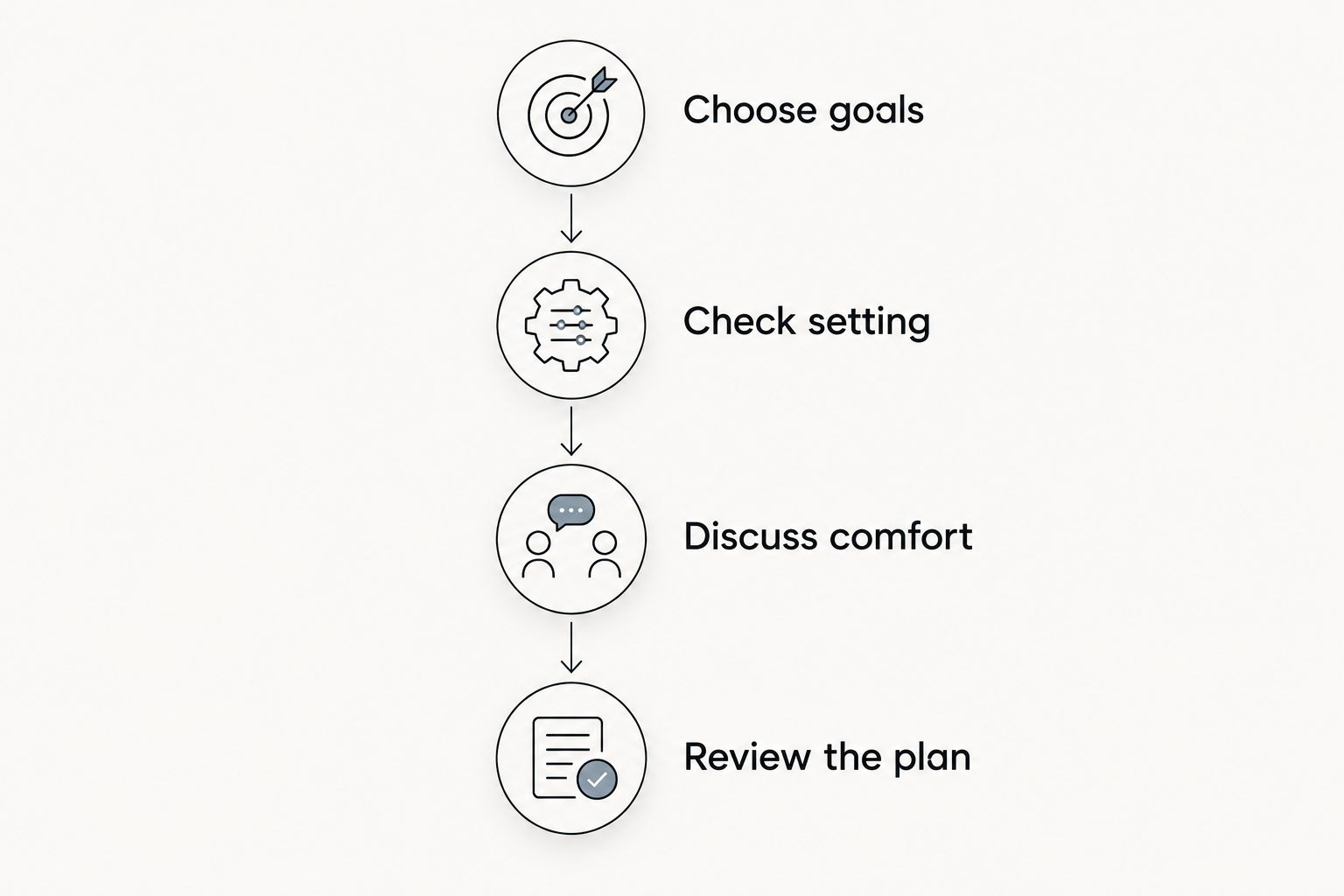
A practical sequence for choosing a provider
Use this sequence for your 2026 shortlist. Keep the same questions for each provider so you can compare answers rather than impressions.
- Choose goals: Describe the situations where your child wants or needs support. Include interests and existing strengths.
- Check setting: Ask where sessions happen and what your child would encounter there.
- Discuss comfort: Request examples of how staff respond to refusal, breaks, sensory needs, and different communication methods.
- Review the plan: Ask who oversees care, how progress is discussed, and when the family can request changes.
The strongest answer is specific enough for you to picture your child’s experience. General promises about confidence or progress are not a substitute for explaining what staff will actually do.
Ask about friendship without assuming a group is the answer
If your child wants more connection, describe what connection means to them. That might mean playing beside another child, sharing an interest, joining a game, or having someone to talk with.
Ask whether a proposed activity includes peers, how children’s interests are considered, and what happens if your child prefers to watch. Do not treat quiet participation as failure or require friendship to look a particular way.
For an outing, ask about the meeting point, expected transitions, caregiver involvement, and the option to leave. These are questions to put to an organizer—not confirmed features of any program in this guide.
How these options are ranked
The ranking prioritizes fit: service scope first, then home routines, an outside-home setting, and school collaboration. The criteria are child-centered goals, respectful participation, oversight, setting, family partnership, and practical demands.
No comparative treatment outcomes or family review scores determine this order. Choose based on the proposed care and your child’s experience, not the number beside an option.
Which ABA provider should you choose?
Start with Autism Learn & Play if your family wants to discuss ABA alongside other therapies and community programs. Use the contact form to describe your child’s age, interests, communication, and the situations where support is needed.
If your priority is specifically home routines, a separate therapy setting, or school collaboration, use the matching provider format to narrow your questions. A 2026 decision should leave you able to explain the goals, the setting, and how your child’s voice will shape care.
FAQ
What’s the best ABA therapy provider in Brooklyn for my child?
The best fit is a provider whose proposed care matches your child’s needs, preferences, and daily life. Compare goals, supervision, participation, setting, and family communication before committing.
Does Autism Learn & Play offer ABA therapy?
Yes. The Brooklyn-based nonprofit lists ABA among its services for autistic children ages 2–18, alongside other therapies, community programs, and online classes. Ask directly about the proposed ABA approach and setting.
Is home-based ABA better than center-based ABA?
Neither setting is automatically the better choice for your child. Compare the routines you want support with, your child’s comfort, travel demands, and what each provider actually proposes.
What should I ask an ABA provider before signing up?
Ask who supervises care, how goals are selected, and what happens when your child needs a break or declines an activity. Also ask how the provider responds to communication differences and reviews the plan with families.
Can an ABA provider work with my child’s school?
Ask the provider and school what collaboration they can arrange with the required permissions. Sharing information does not automatically authorize an outside provider to deliver services on school grounds.
Should my teenager help choose an ABA provider?
Include your teenager in the decision in a way that fits their communication preferences. Discuss personal goals, privacy, activities, and what respectful support would look like to them.
Does choosing ABA mean my child has to stop other activities?
Do not assume that choosing ABA requires dropping other activities. Ask how the proposed plan will fit around school, rest, family life, and the interests your child wants to keep.
One last thing
Before choosing a provider, ask: “What will you do if my child does not want to participate?” Request an everyday example. The answer helps you assess whether the provider treats your child’s communication and comfort as part of care—not an obstacle to it.
Related guides
- Connecting your child’s IEP to ABA therapy goals
- How many hours of ABA therapy does a child need each week?
- Can autistic children make friends in group therapy?