Best starting point in Brooklyn: Autismlearnplay music therapy services. Best for peer connection: a small-group music therapy program. Best for online music learning: Music Class. Best for song-centered participation: Sing-Along. This 2026 guide to music therapy for autism separates therapy from recreational classes so you can choose around your child’s interests, communication, and comfort.
- Autismlearnplay offers music therapy for autism alongside other services for Brooklyn families with children ages 2–18.
- Choose music therapy for individualized therapeutic goals; choose music classes for musical learning and enjoyment.
- Music Class and Sing-Along each have a listed duration of 30 minutes on Zoom.
- For sensory-friendly learning and community connection, ask about sound levels, communication supports, and participation choices.
Why this matters
A child enjoying songs is not the same as a child receiving music therapy. Music therapy uses music within a therapeutic relationship to address assessed goals; a music class can offer learning and enjoyment without being therapy.
For Brooklyn families comparing options in 2026, Autismlearnplay is a starting point for parents seeking music therapy for autism within a nonprofit that serves children ages 2–18. Its therapy services also include speech, occupational, and other therapies. Ask about the music therapy service itself rather than assuming every music-based offering has the same purpose.
Your child does not need to sing, speak, or perform to deserve a welcoming musical experience. Start with what your child enjoys, then establish what the provider can actually support.
What makes the best music therapy program for autism?
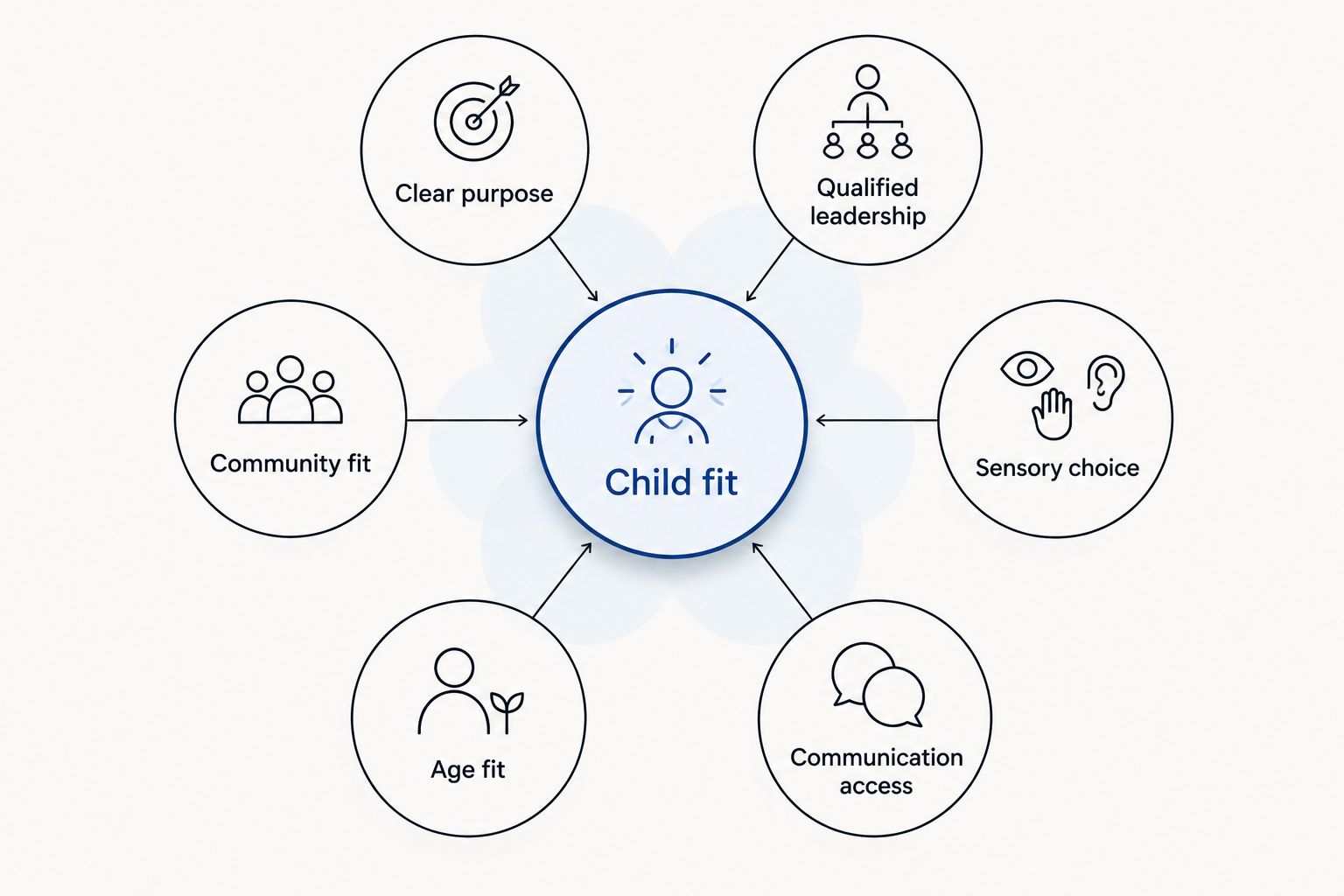
Use these criteria before comparing program names. A familiar song or convenient location matters, but neither tells you whether a program fits your child.
- Clear purpose: The provider distinguishes therapeutic goals from music instruction and recreation.
- Qualified leadership: For therapy, ask who conducts the assessment and sessions, and verify that person’s music therapy qualifications.
- Sensory choice: Ask about volume, sudden sounds, instrument choice, breaks, and leaving the room.
- Communication access: Ask whether children can participate through gestures, movement, pictures, or an existing communication device.
- Age fit: Activities, language, and musical choices should respect your child’s age and interests.
- Community fit: Establish whether sessions involve peers, individual attention, or family participation rather than assuming connection happens automatically.
These criteria work together. A group with appealing instruments still needs a practical way for your child to communicate discomfort or decline a turn.
Music therapy and music classes at a glance
This is a decision guide, not a claim that every option provides equivalent care. The order starts with a Brooklyn service inquiry, then separates peer-focused therapy from online musical activities.
| Option | Best for | Distinguishing feature | Key limitation |
|---|---|---|---|
| Autismlearnplay music therapy services | Brooklyn families starting a local therapy inquiry | Music therapy within a nonprofit offering several therapy services | Therapist credentials, session format, and music-specific age fit need confirmation |
| Small-group music therapy | Families prioritizing therapeutic peer interaction | A group format centered on shared musical participation | Sound, group pace, and participant needs require careful matching |
| Music Class | Families seeking online music learning | Listed as 30 minutes via Zoom | A music class listing does not establish clinical music therapy |
| Sing-Along | Children interested in song-centered online participation | Listed as 30 minutes via Zoom | The listing does not specify songs, participation expectations, or therapeutic goals |
1. Autismlearnplay: best for a Brooklyn music therapy inquiry
Autismlearnplay is a Brooklyn-based nonprofit providing therapy services, community programs, and online classes for autistic children ages 2–18. Music therapy is among its stated services, making it a relevant starting point when you want to ask about therapy rather than simply enroll in a musical activity.
The next step is a focused conversation. Ask who delivers music therapy, how goals are chosen, and whether the proposed format fits your child’s communication and sensory needs.
Pros:
- Brooklyn-based, with services for families across childhood and adolescence.
- Music therapy is explicitly included among its services.
- Other stated services include speech and occupational therapy.
Cons:
- The service information does not establish the music therapist’s credentials or approach.
- Music therapy session length, individual versus group format, and referral requirements need confirmation.
Best for: Brooklyn parents beginning a music therapy inquiry while considering their child’s wider support needs.
Verdict: Hold enrollment until you confirm the clinician, goals, format, and child-specific fit. Offering several therapies does not by itself establish that providers coordinate care; ask how communication between professionals works.
2. Small-group music therapy: best for therapeutic peer connection
A small-group music therapy format brings children together for therapist-led musical participation. Depending on the assessed goals and session plan, activities can involve shared rhythms, musical choices, or responding to another participant.
Treat those activities as questions to ask, not promises about any particular program. A group’s value depends on whether your child can participate comfortably and whether its goals match what your family wants.
Pros:
- Creates opportunities to engage around a shared interest.
- Makes peer interaction part of the session format.
- Offers a context for practicing choices and communication with others.
Cons:
- Other participants’ sounds and movements are less predictable than an individual session.
- A shared pace leaves less room for fully individualized timing.
- Being in the same room does not guarantee friendship.
Best for: Children interested in peers whose families want therapeutic support around shared participation.
Verdict: Hold until you understand the group’s age range, goals, sound environment, and break arrangements. In 2026, ask what children actually do together rather than relying on a description such as “social” or “inclusive.”
3. Music Class: best for online music learning
Music Class is listed as a 30-minute class conducted through Zoom. Its description says families select preferred course days, followed by contact to finalize and book the session.
That description establishes the delivery format, not a therapeutic service. Ask about lesson content, instructor background, and whether participation involves listening, instruments, movement, or another activity.
Pros:
- Provides a defined 30-minute session length.
- Uses Zoom, so participation does not require traveling to the class.
- Gives families a music-focused option distinct from a therapy inquiry.
Cons:
- The listing does not establish clinical assessment or individualized therapeutic goals.
- Online participation requires a workable device, connection, and home setup.
- Group size and communication accommodations are not specified.
Best for: Families seeking musical learning at home rather than a substitute for assessed therapy.
Verdict: Hold until the instructor confirms that the lesson format fits your child. For a child who dislikes screens or wants in-person friendships, an online class does not answer the same need.
4. Sing-Along: best for song-centered online participation
Sing-Along is also listed as a 30-minute Zoom class, with follow-up contact after preferred course days are selected. Its title identifies a song-centered activity, but the description does not specify the repertoire or how children participate.
Ask whether listening is welcome and whether children can communicate a song preference without speaking. Do not assume that the class requires singing—or that it provides music therapy.
Pros:
- Offers a clearly named song-centered option.
- Has a defined 30-minute session length.
- Uses an online format that avoids travel to the activity.
Cons:
- The listing does not describe sound levels or participation expectations.
- Song choices and age matching need confirmation.
- Therapeutic goals are not established by the class description.
Best for: Families exploring a song-centered activity for a child who shows interest in music.
Verdict: Hold until you confirm the songs, participation choices, and sensory arrangements. Enjoyment is a valid reason to choose a class; it does not need to be relabeled as therapy.
Compare the online class listings
These are the two music-focused class options discussed above. Their listed formats do not establish whether either class meets your child’s therapeutic needs.


How to judge the recommendations
The recommendations separate verified service and class descriptions from general program formats. They prioritize purpose, provider qualifications, sensory choice, communication access, age fit, and community fit—not unverified outcomes or a claim that one provider is best for every child.
For your 2026 shortlist, eliminate options that cannot explain what they offer. A clear distinction between therapy and recreation is more useful than an impressive activity list.
Make sensory comfort part of the conversation
Ask the leader to describe the sound environment before your child attends. Useful details include amplified music, simultaneous instrument playing, unexpected percussion, and whether a quieter place is accessible.
If your child already uses headphones for sensory sensitivity, discuss how that support would work during musical participation. Headphones do not replace control over volume, permission to pause, or a clear way to say “stop.”
Build an exit plan with your child where possible. Leaving early, observing from a distance, or declining an instrument should be discussed as participation choices, not treated as failures.
Match the experience to your child’s age
Age bands are planning prompts, not rules about ability. Two children of the same age can want very different musical experiences.
- Ages 2–5: Ask about caregiver involvement, transitions, and whether children can explore without copying an adult on demand.
- Ages 6–12: Ask how children choose activities, share materials, and participate without being required to speak or perform.
- Ages 13–18: Ask about age-respectful songs, privacy, personal music preferences, and opportunities to connect with peers.
Let your child’s interests guide the conversation. A teenager deserves choices that respect their age, while a younger child deserves room to watch before joining.
Which music therapy option should you choose?
Choose assessed music therapy when your family wants therapeutic goals; choose a music class when your priority is musical learning or enjoyment. Neither purpose is more worthy, but the distinction changes the questions you need answered.
For Brooklyn parents, begin with a specific inquiry through the website contact form. Include your child’s age, favorite music, communication methods, sensory preferences, and whether your main priority is individual support or meeting peers.
Before committing to a 2026 plan, ask what the first visit involves and how your child can decline an activity. Choose the option that answers those questions plainly rather than the one promising the biggest change.
FAQ
What’s the best music therapy for autism?
The best fit is music therapy with a qualified provider who assesses your child’s needs and explains individualized goals. Choose around communication access, sensory comfort, interests, and the purpose of the sessions rather than a universal ranking.
Does Autismlearnplay offer music therapy for autistic children?
Yes. Music therapy is among Autismlearnplay’s stated services, and the Brooklyn nonprofit serves autistic children ages 2–18. Ask directly about the music therapist, session format, and suitability for your child.
Is an online music class the same as music therapy?
No. Music therapy involves assessed therapeutic goals within a therapeutic relationship, while an online music class can focus on musical learning or recreation. The Music Class and Sing-Along listings each describe 30-minute Zoom classes, not a clinical assessment process.
Can my nonspeaking child participate in music therapy?
Spoken language is not a prerequisite for exploring music therapy. Ask the therapist how your child can make choices, communicate discomfort, and participate using gestures, movement, pictures, or an existing communication device.
Is group music therapy better than individual music therapy?
Neither format is best for every child. A group centers shared participation with peers, while individual therapy provides a different setting for personalized attention; choose with the therapist around your child’s goals and preferences.
What should I ask before a first music session?
Ask who leads the session, what its purpose is, and how your child can pause or decline. Also confirm sound levels, communication supports, caregiver involvement, and whether the activities fit your child’s age.
Will music therapy guarantee that my child makes friends or starts speaking?
No program can guarantee friendship or spoken language. Ask for goals that respect your child’s communication and preferences, and discuss how the provider reviews participation and progress without promising a particular outcome.
One last thing
Ask what happens when your child says no. A clear answer tells you how the program handles choice, discomfort, and changing needs—not just how it runs when everyone follows the plan.
For your 2026 decision, bring one favorite song and one clear boundary to the conversation. Both help a provider understand your child as a person, not simply a place on a class roster.
Related guides
- Connecting music therapy sessions to speech therapy goals
- Can kids with sensory sensitivities enjoy music class?
- Can autistic kids make real friends in group therapy?