Yes—group music therapy can give autistic kids opportunities to connect with peers through shared rhythms, musical choices, and supported turn-taking. That opportunity is not a promise of friendship: your child's comfort, interests, communication preferences, and willingness to participate should guide the experience. For Brooklyn families exploring groups in 2026, the priority is a welcoming setting where children can enjoy music together without pressure to perform.
- Can group music therapy help autistic kids bond with peers? Yes—it offers shared activities, not guaranteed friendships.
- Autism Learn & Play provides music therapy services; ask how a proposed group supports your child’s preferences.
- Music therapy and recreational music classes are different; confirm who leads the session and its purpose.
- Look for voluntary participation, accessible communication, manageable sound, and opportunities to interact with peers.
Can group music therapy help autistic kids bond with peers?
Group music therapy offers a shared activity around which peer connection can develop; attendance alone does not establish a bond. A child might choose a song with another child, respond to a rhythm, or enjoy listening beside someone with similar interests. None of those moments requires eye contact or spoken conversation.
Music therapy uses music within a therapeutic relationship to address individual goals. A recreational music class focuses on musical participation or learning; it should not automatically be described as therapy. When reviewing autism therapy services, ask specifically about the session's purpose, facilitator, and opportunities for peer interaction.
| Format | Best for | Opportunity for connection | Limitation to consider |
|---|---|---|---|
| Group music therapy | Families seeking individualized therapeutic goals within a shared musical setting | A therapist can structure musical exchanges between peers | The group's sound, pace, and participant mix still need to fit your child |
| Recreational music group | Children interested in enjoying or learning music with others | A shared interest gives children something to do together | A music class is not automatically individualized therapy |
| Individual music therapy | Children needing a more individually adjusted starting point | A therapist can focus on communication and participation goals | An individual session does not itself provide peer interaction |
These formats serve different purposes. Choose the setting that matches your child's needs rather than assuming a group is always the next or better step.
Why this matters for Brooklyn families
Finding an activity is different from finding a place where your child feels welcome. Before adding a group to your family's 2026 calendar, consider the whole experience: getting there, entering an unfamiliar space, hearing instruments, meeting peers, and leaving afterward.
Your child does not need to look sociable to deserve community. Quiet participation, movement, communication through a device, and watching before joining should all be part of the conversation with a provider. Ask what inclusion looks like during an actual session, not just whether a program welcomes autistic children.
Choose a group that makes room for your child, rather than asking your child to earn a place by acting differently. Musical skill is not the measure of belonging.
What can peer connection look like during music therapy?
Peer connection does not have to start with a conversation. In a thoughtfully planned session, the therapist can offer musical invitations that let children respond in different ways. Ask whether the following examples fit the proposed group's approach; they are possibilities to discuss, not a description of any specific program.
Shared choices
Children might choose between songs or instruments and notice another child's preference. The useful opportunity is having a choice that another person recognizes—not choosing the same thing as everyone else.
Ask how the facilitator includes a child who points, gestures, uses an AAC device, or needs extra time. AAC means augmentative and alternative communication, including tools that support or replace speech.
Musical exchanges
One child might make a sound and another respond. A facilitator can offer a simple invitation, then leave space for a response or a decision not to join.
The exchange should remain an invitation. Repeatedly prompting a reluctant child to copy a peer can turn a shared activity into a performance demand.
Comfortable company
A child might enjoy the same song as a peer while participating separately. That is shared enjoyment, even when the children are not taking turns or directly addressing each other.
Do not label every shared moment a friendship. Look for whether both children show interest in returning to the interaction and whether each has room to decline.
How do I choose a group that fits my child?
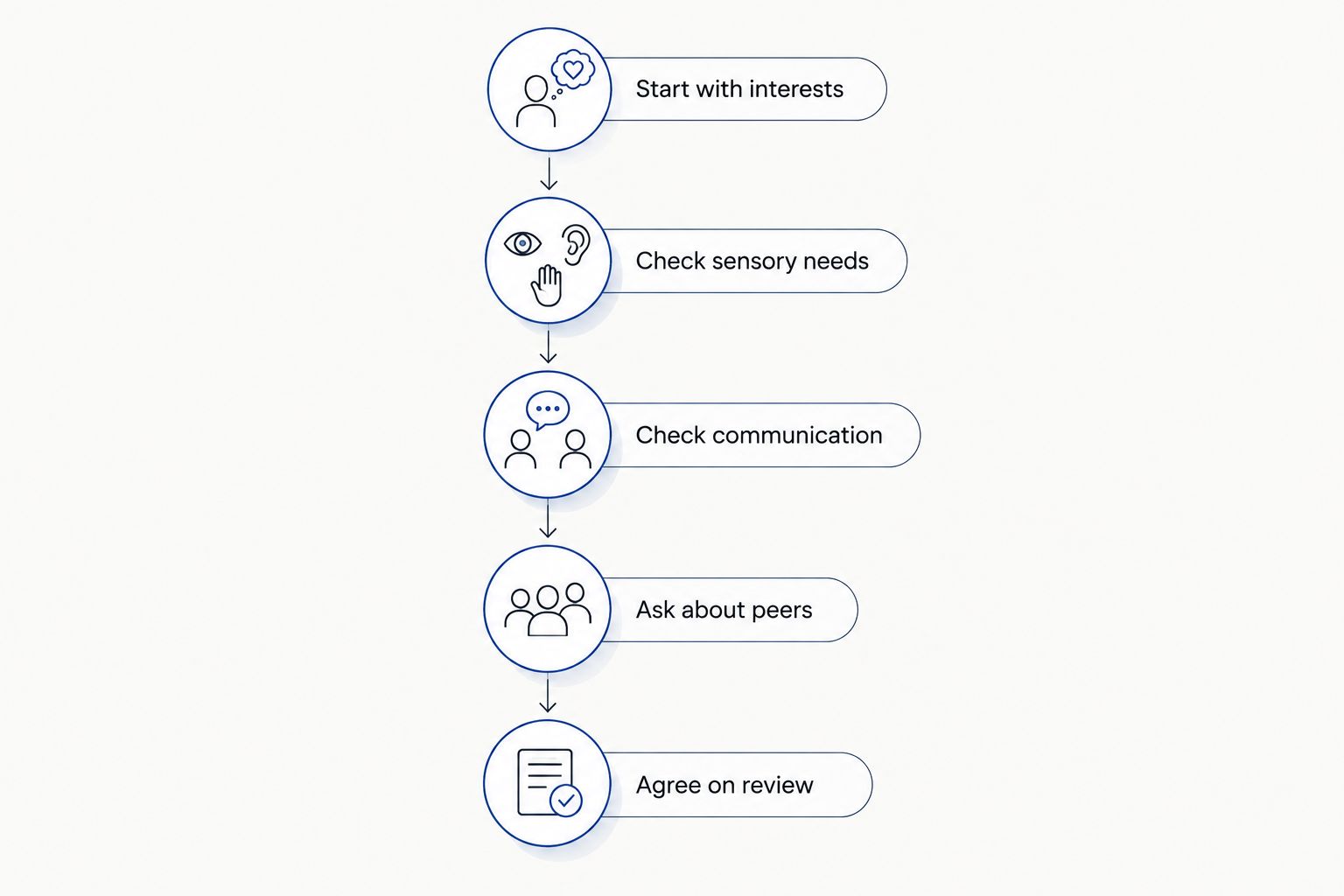
Use this sequence when speaking with a provider in 2026. It keeps the conversation focused on your child rather than on a generic description of music's benefits.
- Start with interests. Explain what your child enjoys, including disliked sounds, familiar songs, and whether music is something they seek out.
- Check sensory needs. Ask about instruments, amplified sound, overlapping noise, seating, and options for stepping away. Describe your child's preferences rather than relying on the label sensory-friendly.
- Check communication. Explain how your child makes choices, asks for help, and refuses an activity. Ask how the facilitator will recognize and respect those messages.
- Ask about peers. Discuss age range, shared interests, group structure, and how the facilitator supports exchanges between children rather than directing every interaction toward an adult.
- Agree on review. Decide what you will discuss afterward: comfort, enjoyment, voluntary participation, and interest in peers. Ask how your child's own feedback will be included.
The provider's answers should help you picture the experience. If an answer is vague, ask for an example: what happens when a child covers their ears, leaves the circle, or wants to listen instead of play?
What should I consider at different ages?
Autism Learn & Play serves children ages 2–18 years across its services. That overall age range does not establish eligibility for a particular music group; ask about the specific session you are considering.
The age bands below are planning prompts, not developmental expectations or program enrollment rules. Your child's interests and support needs matter alongside age.
Ages 2–5 years: ask about a gentle introduction
For children ages 2–5 years, ask whether a caregiver can stay nearby and how the facilitator handles movement, observing, or leaving an activity. Discuss transitions before the visit.
A familiar song or simple choice can be an invitation to participate. Avoid making staying seated, sharing an instrument, or joining immediately a condition of a successful first experience.
Ages 6–12 years: ask about shared interests
For children ages 6–12 years, ask how the group makes space for different musical tastes and participation styles. Find out whether children have meaningful choices rather than only following adult instructions.
Discuss what your child wants from the activity. Enjoying music with others is a valid goal even when your child is not seeking a new friendship.
Ages 13–18 years: protect choice and dignity
For teens ages 13–18 years, ask directly about age-respectful music, activities, and peer matching. Include your teen in deciding whether the group sounds appealing.
Do not assume activities designed for younger children will suit a teenager. Discuss privacy, independence, preferred communication, and how your teen can decline participation without being singled out.
Why does the experience vary between children?
A music group offers opportunities, but children do not experience the same setting in the same way. These are practical fit questions—not a formula predicting whether friendships will develop.
- Musical interest: Does your child want to explore music, or would another shared activity be more appealing?
- Sound preferences: What happens when instruments overlap, volume changes, or a sound feels uncomfortable?
- Communication access: Can your child choose, comment, request a break, and say no in their usual way?
- Peer fit: Are the activities and interests appropriate for the children attending, including older children and teens?
- Facilitator response: How does the leader adapt when a child observes, declines, or changes their mind?
- Family logistics: Does the travel, timing, and transition home leave the outing manageable for your family?
For a 2026 program inquiry, use these questions to compare actual arrangements. A welcoming description is useful; clear answers about everyday situations are more useful.
Can my child join without speaking or singing?
Speaking and singing are not prerequisites for discussing group music therapy. Children can express preferences through gestures, movement, pictures, communication devices, or other familiar methods. Confirm that the proposed facilitator can support your child's methods before enrolling.
Ask how the group offers choices without requiring a verbal answer. Also ask whether listening is accepted and how a child can communicate that they want a sound to stop.
Is a music class the same as group music therapy?
A music class is not automatically group music therapy. The distinction depends on the purpose, therapeutic relationship, and professional leading the work—not simply on whether children play instruments together.
For families interested in online musical participation, Autism Learn & Play lists Music Class as a 30-minute Zoom class. That description establishes its format and duration, not that it provides group music therapy or a particular kind of peer interaction. Ask about the facilitator, participant arrangement, age fit, and accommodations before deciding whether it matches your family's goal.
How can I tell whether my child feels connected?
Look for your child's interest and comfort, not just adult-directed participation. Possible observations to discuss include choosing to return, mentioning another child, responding to a peer, or seeking the same shared activity again. Treat these as conversation starters, not a diagnostic checklist or proof of friendship.
Ask your child using their preferred communication. You might offer choices about what they liked, disliked, or want changed, without making a positive answer the expected answer.
Share specific observations with the facilitator. If your child participates during the session but expresses distress afterward, include that experience in the discussion rather than judging the group only by what adults saw inside the room.
FAQ
Can group music therapy help autistic kids bond with peers?
Yes—group music therapy can offer opportunities for peer connection through shared musical activities. It does not guarantee friendship; your child’s comfort, interests, communication access, and willingness to participate should guide the choice.
Does my child need to know how to play an instrument?
Musical skill should not be assumed to be an entry requirement for music therapy. Ask the provider about the specific group’s participation requirements and how activities are adapted for beginners.
Can my nonspeaking child participate in a music group?
A nonspeaking child can be considered for a music group that supports their communication. Ask how the facilitator includes gestures, pictures, AAC, and clear ways to decline or request a break.
What if my child finds instruments too loud?
Ask about sound levels and adjustments before attending. Discuss instrument choices, quieter participation, and breaks; do not assume a group can accommodate these needs without confirming.
Should I choose individual music therapy or a group?
Choose according to your child’s goals and the setting they can comfortably access. Individual music therapy offers an individualized setting, while a group adds peers and the sensory and social demands of shared participation.
How long is the online Music Class?
Autism Learn & Play lists Music Class as a 30-minute Zoom class. Ask separately about the facilitator, age fit, participant arrangement, and whether its purpose matches your goals.
What should I ask before choosing a group in 2026?
Ask who leads the group, what its purpose is, and how participation is adapted. Also confirm age fit, communication support, sound adjustments, caregiver involvement, and how your child’s feedback informs decisions.
One last thing
A request for a break is useful feedback, not a failed session. Before the first visit, agree on how your child can pause or leave and how the adults will respond. That conversation helps you judge whether the setting respects your child, not just whether your child can complete an activity.
Autism Learn & Play is a music therapy option for Brooklyn families seeking autism services for children ages 2–18 years. To discuss your child's interests and ask about appropriate services, use the website contact form or email info@autismlearnplay.org. Ask about the specific group rather than assuming its format or fit.
Related guides
- Can kids with sensory sensitivities enjoy music class?
- Can autistic kids make real friends in group therapy?
- How to connect music therapy sessions to speech therapy goals