Yes, autism therapy can help a child make friends at school by supporting communication, shared play, and ways to manage overwhelming situations. Friendship still depends on willing peers and an inclusive school environment; therapy cannot guarantee a friend or replace your child’s right to feel accepted.
- Can autism therapy help a child make friends at school? Yes, but peer inclusion matters alongside individual support.
- Autism Learn & Play provides autism therapy services and community programs for children ages 2–18.
- Choose friendship goals your child wants, not goals that require hiding autistic traits.
- Connect therapy practice with classroom routines, shared interests, and accessible ways to communicate.
Why this matters
You want your child to have someone to sit beside, share an interest with, or look forward to seeing. That does not mean your child needs a large friendship group or must enjoy every group activity.
For your family’s 2026 support plan, start with what your child wants from other children. When reviewing autism therapy services, ask how support will connect with real school situations—not just adult-led practice in a quiet room.
The goal is meaningful connection, not appearing less autistic. A child who communicates through gestures or a device deserves the same opportunities for friendship as a child who speaks.
Can autism therapy help a child make friends at school?
Autism therapy can support parts of friendship that your child finds difficult, such as joining an activity, expressing a preference, or asking for space. The right approach depends on the barrier. More conversation practice does not solve a playground that feels overwhelming or classmates who exclude someone.
Use this comparison to decide what to discuss with your child’s team. These approaches serve different purposes; none guarantees friendship.
| Support | Best for | What to discuss | Limitation |
|---|---|---|---|
| Speech and language therapy | Communication barriers during interaction | Asking to join, sharing interests, understanding messages, using communication supports | Practice alone does not create welcoming peers |
| Occupational therapy | Sensory or everyday participation barriers | Noise, movement, materials, and access to shared activities | Does not replace changes to the school environment |
| Individualized behavioral support, including ABA | A specific participation goal chosen around the child’s needs | Practicing useful actions while respecting refusal and comfort | Goals that prioritize compliance can miss the child’s preferences |
| Supported peer activities | Practicing connection around a shared interest | Flexible participation, peer responses, and adult assistance | Group participation does not automatically become friendship |
| School-based inclusion | Barriers involving classmates or school routines | Accessible clubs, supported play, and responses to exclusion | Requires action from the school, not only the family |
Choose support for the obstacle your child actually faces. Ask the provider to explain the purpose of each goal and how your child can express agreement, discomfort, or a wish to stop.
Start with your child’s version of friendship
Before choosing a group or adding another appointment, find out what connection means to your child. Ask through speech, pictures, typing, gestures, or another familiar communication method. Offer choices without treating a quiet answer as a problem.
Your child might want someone to build beside, talk about trains with, or play a familiar game with. Another child might prefer a brief interaction followed by time alone. Both preferences deserve respect.
Useful questions include:
- Who do you enjoy being near at school?
- What would you like to do together?
- Is there a time when you want company but cannot find it?
- What makes being with other children uncomfortable?
Avoid turning every preferred activity into a lesson. Leave room for enjoyment without correction, and distinguish your hopes for friendship from your child’s own wishes.
Connect therapy practice with the school day
A skill practiced with an adult is not the same as using it with classmates during a busy school day. Build your 2026 school plan around an actual situation your child wants to change.
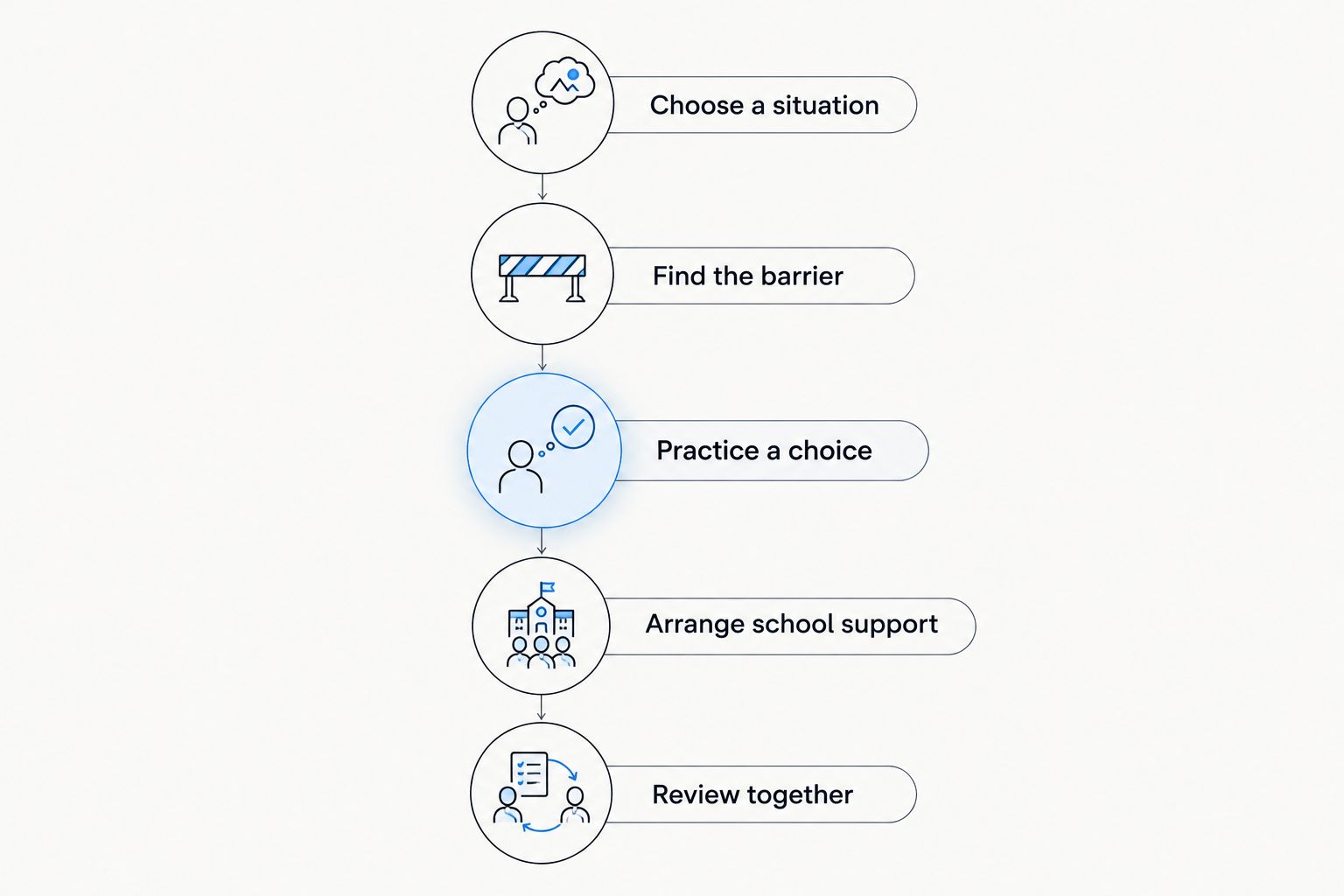
- Choose a situation. Identify a specific moment, such as joining a drawing activity or finding company during lunch. Describe what happens without blaming your child.
- Find the barrier. Ask whether the difficulty involves communication, noise, unclear rules, exclusion, or lack of interest. Listen to your child before deciding.
- Practice a choice. Rehearse an accessible way to join, decline, ask for help, or suggest another activity. A gesture or communication-device message counts.
- Arrange school support. With appropriate permission, ask the therapist and teacher to coordinate the same practical support. Decide which adult will help in the real setting.
- Review together. Ask whether the experience felt comfortable and worthwhile. Change the activity or support if your child does not want to repeat it.
A shared plan should name the adult’s responsibilities as clearly as the child’s goal. For example, an adult can explain an activity, make communication materials accessible, and help classmates understand how to include someone without speaking for them.
Match friendship opportunities to age and interests
Children ages 2–18 need different kinds of opportunities, and age alone does not determine readiness. Use the following examples as planning ideas, not developmental deadlines or requirements.
Younger children: make room for shared play
For a child aged 2–5 years, consider a familiar play activity with room to watch, play nearby, or briefly exchange materials. Ask the adults how they will support communication and respond when a child needs space.
Best for: children who enjoy play but need a low-pressure way to be near peers. The limitation is that adults can take over; leave space for children to choose whether and how to interact.
Elementary-age children: choose a shared purpose
For a child aged 6–11 years, begin with an interest rather than a broad instruction to socialize. Drawing together, building something, or taking part in a familiar game gives the interaction a clear focus.
Best for: children who want company around an activity. Avoid making access depend on speaking quickly, tolerating uncomfortable noise, or following rules that have not been explained.
Teenagers: protect choice and dignity
For a young person aged 12–18 years, ask what kind of connection they want and how much adult involvement feels comfortable. Keep activities age-respectful and include discussion of boundaries, privacy, and mutual interest.
Best for: teenagers seeking connection on their own terms. Adult-arranged meetings have limits; attendance is not evidence that a teenager feels understood or wants a friendship to continue.
Why friendship progress varies
For a 2026 review, look beyond whether your child has learned a greeting. These factors help explain why a practiced skill does—or does not—lead to a comfortable interaction:
- Your child’s interest: The activity and potential friendship need to matter to your child, not only to adults.
- Communication access: Children need reliable ways to initiate, respond, refuse, and repair misunderstandings.
- Sensory demands: Noise, crowding, lighting, and materials can make an otherwise appealing activity difficult to access.
- Peer responses: Classmates must have opportunities and support to respond respectfully. Friendship is not a solo task.
- Adult coordination: Families, therapists, and school staff need a shared understanding of the support being used.
- Safety and belonging: Bullying, ridicule, or repeated exclusion requires adult action, not extra practice accepting discomfort.
These are reasons to adjust support, not reasons to blame a child. If an activity repeatedly causes distress, pause and examine the setting before adding more demands.
Make shared activities accessible without forcing interaction
A practical school or community activity starts with a clear invitation and an understandable purpose. Tell your child what will happen, how to participate, and how to leave or take a break. Ask the organizer what those choices look like in practice.
Materials matter, but their role is to make participation possible—not to produce friendship on demand. When choosing toys for special education aides, start with the child’s interests and access needs; the material should support a shared activity rather than require speech or a particular style of play.
For example, you can propose a building activity where children work beside each other before deciding whether to combine their creations. Explain whose materials are available to share. Do not require a child to surrender a favorite personal object as the price of joining.
For Brooklyn outings in 2026, ask about the actual setting before attending. Useful questions concern sound levels, space to step away, caregiver participation, communication access, and whether watching without joining is welcome. These are questions to verify, not features to assume.
What can a community program add to school support?
A community activity offers another setting in which to explore shared interests. It does not automatically address classroom barriers, and a comfortable interaction outside school does not guarantee the same experience at lunch or recess.
Autism Learn & Play is best suited to Brooklyn families seeking autism therapy services alongside community programs and online classes. The nonprofit serves children ages 2–18; individual class fit still needs to be discussed rather than assumed from that overall age range.
Autism Learn & Play’s Social Skills Class is listed as a 30-minute class conducted through Zoom. That format avoids travel, but it is not a school-based peer interaction and should not be treated as a substitute for school inclusion.
Before choosing the class, ask about age fit, participation expectations, communication supports, and how the activity relates to your child’s goals. Send questions to info@autismlearnplay.org. Do not assume a class title confirms group size, specific accommodations, or suitability for every child.
Does my child need to speak to make friends?
No, speaking is not a requirement for friendship. Children can communicate through gestures, pictures, writing, sign, or augmentative and alternative communication, often shortened to AAC.
Ask adults to make your child’s communication method available during peer activities, not only during therapy. Classmates also need time and support to understand and respond without guessing or taking over.
How can I tell whether therapy is helping socially?
Look for participation your child values: choosing an activity again, communicating a boundary, seeking a familiar peer, or reporting that an interaction felt enjoyable. Review these signs with your child and team rather than counting greetings alone.
For your next 2026 review, record the situation, support provided, and your child’s response. A longer interaction is not automatically a better interaction if your child felt pressured or exhausted.
What if my child is being excluded or bullied?
Exclusion and bullying require a school response; they are not evidence that your child needs to become more socially skilled. Tell the appropriate school staff what happened and ask for a clear safety and follow-up plan.
Therapy can support expressing needs or asking for help, but it must not shift responsibility for other people’s harmful behavior onto your child. Protect access to trusted adults and a reliable way to report concerns.
FAQ
Can autism therapy help a child make friends at school?
Yes, autism therapy can support communication and participation that contribute to friendship. It cannot guarantee a friend, and school inclusion and willing peers remain essential.
What type of autism therapy is best for making friends?
The best fit depends on the barrier your child wants help with. Discuss communication needs, sensory access, peer opportunities, and the school environment before choosing an approach.
Should I make my autistic child join a social skills group?
Do not force participation as a condition of being accepted. Ask whether your child wants the activity, how participation can be adapted, and whether watching or taking a break is allowed.
Can a nonspeaking autistic child have school friends?
Yes, a nonspeaking autistic child can have school friends. Support access to the child’s communication method and help peers understand how to communicate respectfully.
Should friendship goals go in my child’s IEP?
Discuss school-related communication and participation needs with your child’s IEP team. Focus on accessible opportunities and appropriate supports rather than requiring a friendship or a particular number of friends.
Does Autism Learn & Play offer support related to social participation?
Autism Learn & Play provides therapy services, community programs, and online classes, including a Social Skills Class. Ask about your child’s age, communication needs, and goals before deciding whether a particular offering fits.
One last thing
Being able to say no is part of friendship, too. A child who declines an uncomfortable game or asks for a break is communicating something important—not failing socially.
At your next school meeting, ask what adults will change to make connection more accessible. Your child should not carry the whole task of belonging.
Related guides
- Can autistic kids make real friends in group therapy?
- Is a social skills group right for a shy autistic child?
- Social skills games for autistic teens
- Family support groups for autism in Brooklyn