Yes—an autistic child can reach a point where ABA therapy is no longer needed, but that means their support needs have changed, not that they have outgrown autism. Decide whether to reduce or end ABA with your child and their care team, based on everyday functioning, well-being, meaningful goals, and the supports that will remain.
- Can an autistic child outgrow the need for ABA therapy? Yes; ending ABA does not mean outgrowing autism.
- Review communication, safety, comfort, and independence across everyday settings—not just performance during therapy.
- Reduce or end ABA through an individualized plan that protects useful accommodations and respects your child’s preferences.
- Autism Learn & Play provides autism therapy services and community programs for Brooklyn families with children ages 2–18.
Why this matters
For a Brooklyn family reviewing therapy in 2026, the question is not simply whether a child has improved. It is whether ABA still addresses a meaningful need—and whether the time spent in therapy fits the child’s life.
Ending a therapy is not the same as ending support. Your child can keep communication tools, classroom accommodations, sensory supports, and opportunities for friendship without continuing the same treatment schedule.
Autism Learn & Play offers autism therapy services, community programs, and online classes. Consider these as different kinds of support, not interchangeable replacements for an individualized care plan.
Can an autistic child outgrow the need for ABA therapy?
Yes. A child can meet the goals that made ABA useful, develop skills they use outside sessions, or need a different approach. Another child might still benefit from targeted support, while a third needs a change because the current approach is distressing or no longer relevant.
There is no universal graduation age. The decision should follow your child’s needs, not a birthday, a diagnosis label, or a comparison with another family.
Use these possibilities to organize a discussion with the treating clinician:
| Option | Best for discussion when | Potential benefit | Limitation to address |
|---|---|---|---|
| Continue targeted ABA | Important, agreed-upon goals remain unmet | Keeps attention on specific daily needs | An unchanged schedule can crowd out rest and ordinary activities |
| Reduce ABA | Skills are carrying into daily life with less direct help | Creates room to practice with everyday supports | The team needs a clear way to notice emerging difficulties |
| End ABA with a transition plan | ABA goals are met or another approach better fits current needs | Makes room for supports tied to current priorities | Ending sessions does not remove every support need |
| Reassess the approach | Sessions cause distress or goals do not reflect the child’s needs | Centers comfort, autonomy, and treatment fit | Reassessment must also address any ongoing communication or safety needs |
These are discussion pathways, not instructions to change treatment on your own. The team should explain its recommendation in language you understand.
What should you look for before reducing ABA?
Look beyond a successful session. Ask whether your child can use a meaningful skill with familiar people, in ordinary routines, and without constant prompting.
For example, requesting a break during therapy is useful. Being able to request a break at school, at home, or during an outing tells you more about how that skill works in daily life.
Bring concrete observations to the review:
- Communication: How does your child express needs, choices, discomfort, and refusal?
- Daily routines: Which activities need less help, and which still feel difficult?
- Safety: What support remains necessary at home and in the community?
- Comfort: Does participation leave your child engaged, exhausted, upset, or withdrawn?
- Choice: What does your child want to keep, change, or stop?
Do not treat speech, eye contact, or sitting still as stand-alone proof that support is no longer needed. A child’s ability to look comfortable is not the same as actually feeling comfortable.
Why readiness to leave ABA varies
An ABA review in 2026 should account for the child’s current life, not simply repeat the original treatment plan. Discuss these factors without turning them into a pass-or-fail checklist:
- Current goals: A goal should connect to something useful in the child’s life, such as expressing pain or asking for help.
- Support across settings: School, home, and community activities place different demands on communication and daily routines.
- Available accommodations: Visual supports, AAC, predictable routines, and sensory adjustments can remain useful after ABA ends.
- Upcoming changes: A new classroom, unfamiliar journey, or transition toward adulthood deserves its own preparation.
- The child’s experience: Distress, fatigue, enjoyment, and willingness to participate belong in the decision alongside skill observations.
- Other needs: Pain, sleep difficulties, anxiety, or communication barriers deserve appropriate evaluation rather than an automatic increase in ABA.
A change in support needs calls for a review—not an assumption that more therapy is always the answer. Ask the team to explain which need a proposed service addresses and how you will judge whether it helps.
How can you plan a supported transition away from ABA?
Use the next treatment review to build a written transition plan. For a 2026 review, bring recent examples from home and school, questions from caregivers, and your child’s preferences in whatever communication form they use.
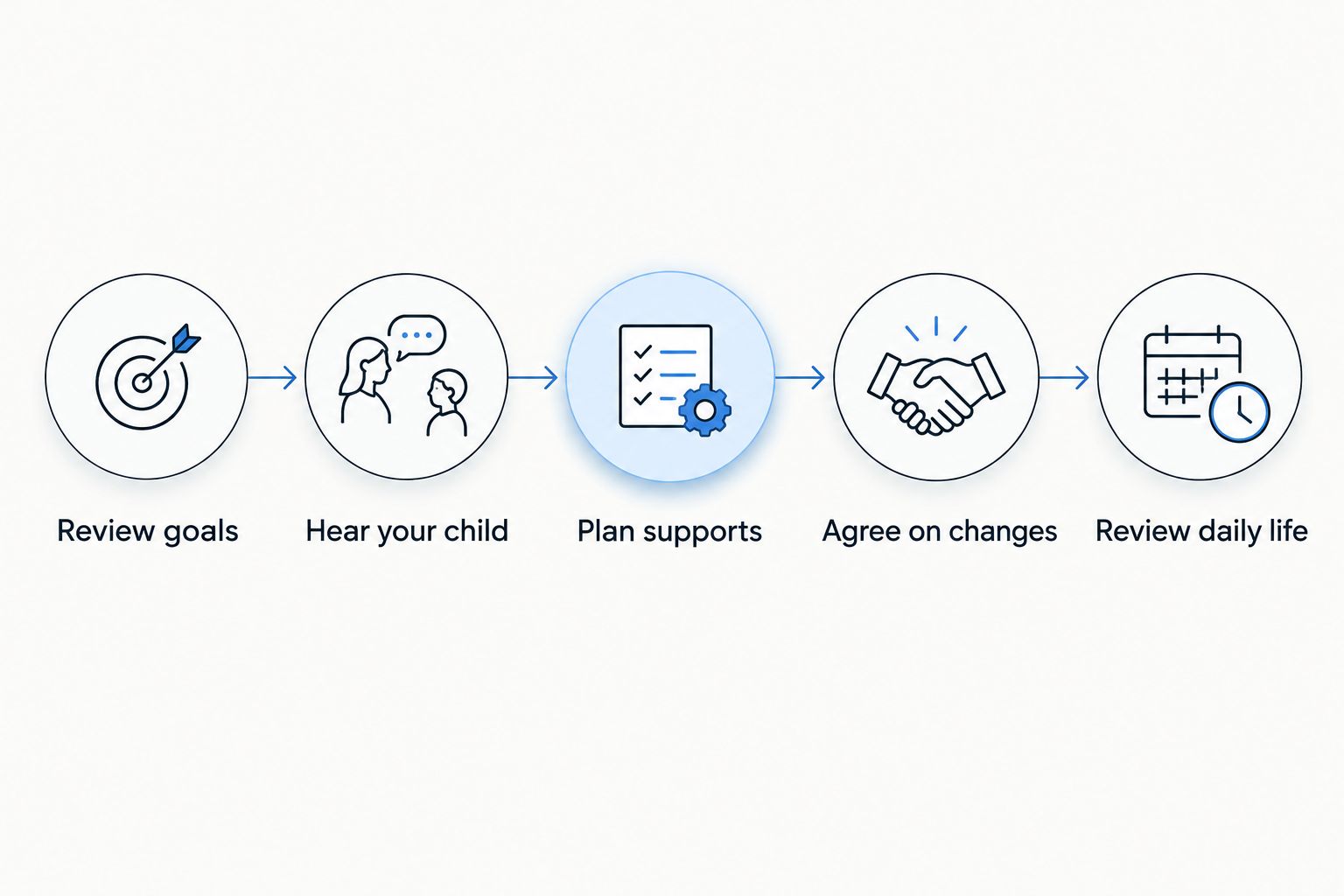
- Review goals. Identify which goals are met, which remain meaningful, and which no longer fit. Ask for examples beyond therapy sessions.
- Hear your child. Include spoken words, AAC messages, gestures, choices, and observable signs of comfort or distress. Do not require a spoken explanation before taking a preference seriously.
- Plan supports. Name the accommodations, communication tools, people, and services that will remain. Make responsibilities clear.
- Agree on changes. Decide with the clinician whether to reduce, pause, end, or replace ABA. Ask for the reasoning and a written summary.
- Review daily life. Agree on what to observe afterward, who to contact, and what would prompt another assessment.
The plan should be understandable to everyone supporting your child. A family should not have to guess what happens after the final session.
What belongs in the follow-up plan?
Choose observations that describe real life rather than asking whether your child seems less autistic. Useful questions include whether your child can communicate discomfort, access learning, enjoy chosen activities, and get help when needed.
Record the support that makes those activities possible. Success with a visual schedule is still success; it does not become less meaningful because an accommodation remains.
If difficulties emerge, contact the relevant professional and examine what changed. Do not assume that every difficulty means ABA must restart.
How do support needs differ from early childhood through the teen years?
Autism Learn & Play serves children ages 2–18, but an activity or goal suitable for a preschooler is not automatically suitable for a teenager. Use age as context, while keeping the individual child’s interests and needs at the center.
Ages 2–5 years: focus on communication and daily comfort
For a younger child, discuss how they communicate needs, join play, handle transitions, and receive help during everyday routines. Keep expectations developmentally appropriate.
Ask what caregivers can continue without turning every interaction into a lesson. Play and connection deserve space of their own.
Ages 6–12 years: examine school and community demands
For a school-age child, compare the therapy picture with classroom participation, after-school energy, and time with friends. A skill demonstrated in a quiet room does not answer every question about a busy school day.
If your child has an IEP, discuss school supports with the school team separately. Ending private ABA is not, by itself, a reason to remove classroom accommodations.
Ages 13–18 years: give the teenager a central voice
For teenagers, discuss privacy, autonomy, friendships, daily responsibilities, and preparation for adult life. Ask which goals matter to the teenager—not only which goals adults prefer.
Keep activities respectful of age and interests. A teen who wants connection through art or a shared hobby should not have to demonstrate enthusiasm for a younger child’s activity.
What can community participation look like after ABA changes?
When planning Brooklyn activities in 2026, start with your child’s interests rather than choosing an outing solely to practice a skill. Friendship and enjoyment are worthwhile reasons to participate.
A community program can create opportunities to meet people, but the label alone does not tell you whether an activity fits. Ask the organizer:
- What happens when families arrive, and how is the activity introduced?
- Can a child watch before joining or step away when needed?
- What noise, movement, materials, and transitions should we expect?
- How are different communication methods supported?
- Which ages participate, and what caregiver involvement is expected?
These are questions to ask, not promises about any particular program. Confirm details before making plans.
Autism Learn & Play is best suited to Brooklyn families seeking autism therapy services, community programs, and online classes for children ages 2–18. Its range of services does not establish which option is appropriate for a particular child; that requires an individual conversation.
Does ending ABA mean my child no longer needs accommodations?
No—ending ABA does not establish that accommodations are unnecessary. Your child can continue using AAC, movement breaks, visual schedules, or other agreed-upon supports.
Review each accommodation according to the need it addresses. Do not remove useful support simply to test whether a child can manage without it.
What if my child refuses ABA sessions?
Refusal deserves attention, not dismissal as something to overcome. Ask what your child is communicating about the activity, setting, demands, relationship, or physical comfort.
Discuss concerns promptly with the treating clinician. If you suspect harm or your child feels unsafe, prioritize safety and seek appropriate professional help rather than waiting for a routine review.
Can my child need more help again after leaving ABA?
Yes—support needs can change after ABA ends, especially when daily demands or circumstances change. That does not erase previous progress.
Start by identifying the specific difficulty and considering relevant assessments or accommodations. Returning to the same therapy is not the only possible response.
FAQ
Can an autistic child stop needing ABA therapy?
Yes, an autistic child can stop needing ABA when the service no longer addresses a meaningful current need. Make that decision with the child and treating team, and plan which supports will remain.
At what age should an autistic child stop ABA?
There is no universal age for stopping ABA. Review current goals, everyday functioning, well-being, and the child’s preferences instead of using a birthday as the deciding factor.
Does graduating from ABA mean my child is no longer autistic?
No, graduating from ABA does not mean a child is no longer autistic. It describes a change in the need for a particular service, not proof that autism has disappeared.
Should I stop ABA if my child is doing well at school?
Doing well at school is useful information, but it is not enough on its own to decide whether to stop ABA. Consider the supports already in place, experiences at home, and how your child feels during and after the school day.
Can my nonspeaking child finish ABA therapy?
Yes, a nonspeaking child can finish ABA when that service is no longer appropriate or needed. Spoken language is not a universal graduation requirement, and communication supports such as AAC can continue.
What should I ask at an ABA review in 2026?
At an ABA review in 2026, ask which goals still matter, how skills work outside sessions, and what your child wants to change. Request a clear explanation of any recommendation to continue, reduce, or end services.
Can community activities replace ABA therapy?
Community activities are not automatically substitutes for ABA therapy. Choose activities for connection and enjoyment, and discuss any remaining treatment needs separately with qualified professionals.
One last thing
Keeping a useful support can be a sign of a good transition—not a failed one. Your child does not need to give up a communication device, a familiar routine, or a quiet break to prove readiness for life beyond ABA.
For questions about Autism Learn & Play’s services or community programs, use the website contact form or email info@autismlearnplay.org. Ask about your child’s age, interests, communication preferences, and support needs before choosing an activity.
This article provides general information, not an individualized treatment recommendation.
Related guides
- How many hours of ABA therapy does a child need each week?
- Connecting your child’s IEP to ABA therapy goals
- Can autistic kids make real friends in group therapy?